


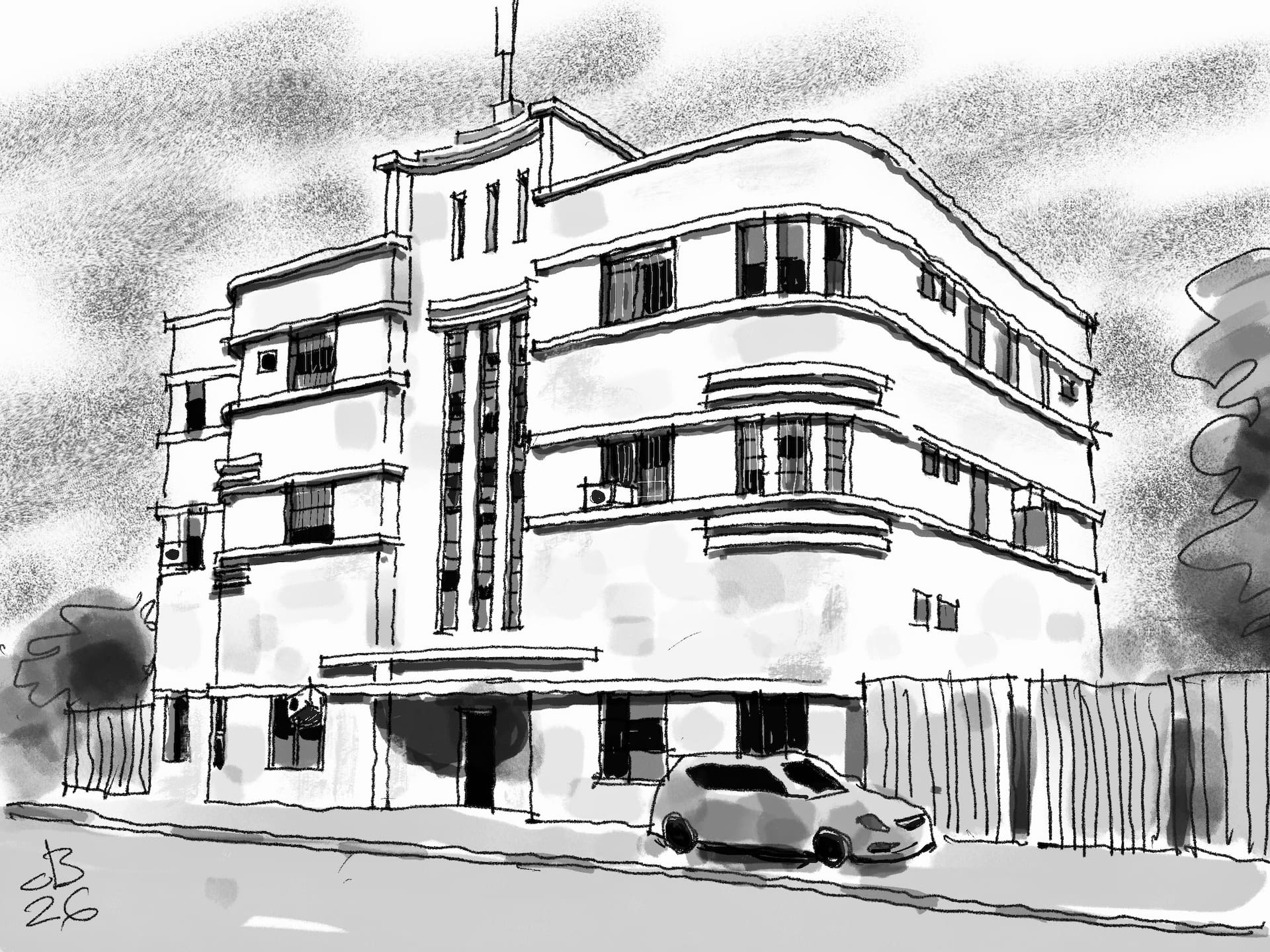
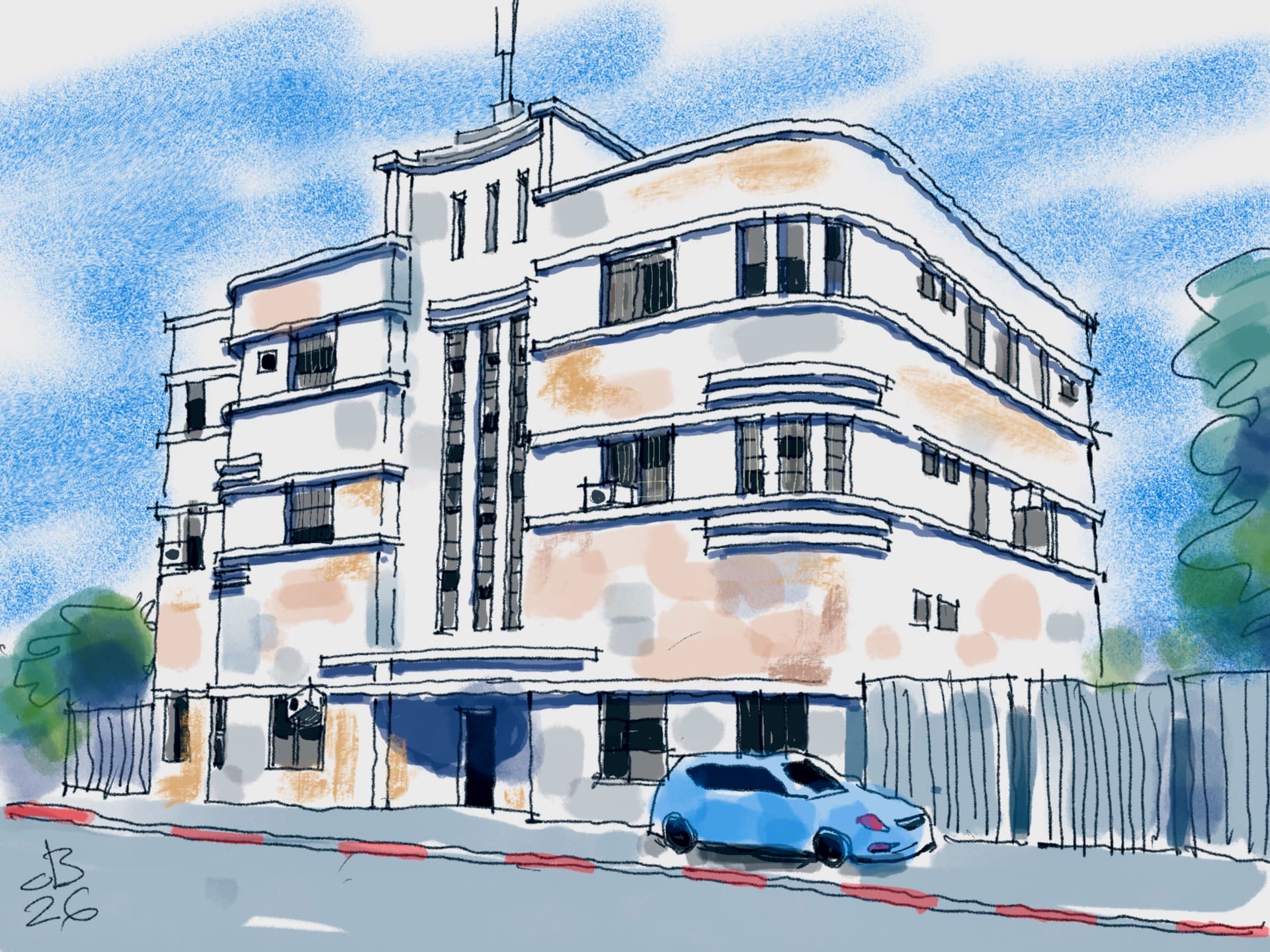
An unusual building, with a special presence, stands on the side of the road, at 21 Hativat Golani Street. Its impressive appearance is still evident today, even though it is abandoned and the ravages of time are evident. Its story begins with the initiative of a large British company, and continues with the transformations it went through during the Mandate period and after the establishment of the state.
ICI Company
The building was intended to serve as the offices of Imperial Chemical Industries — ICI, one of the largest chemical companies in Britain. The company, founded in 1926, was involved in the marketing of fertilizers, pesticides, paints, and industrial chemicals. Its activities in Israel also included consulting for farmers and distributing products used in plantations, research stations, and factories.
Among the figures identified with the founding and operation of the company was Sir Alfred Mond, aka Lord Melchett (Lord Melchett). He was one of the founders of ICI and was its head in its early years. The company's activities in the Levant region were managed by Yechiel Weizmann, the younger brother of Haim Weizmann, who later became the first president of Israel. In 1938, the company moved its center of operations from Haifa to the Jaffa and Tel Aviv area, due to the expansion of its operations in the central region.
on the building
The building was erected in the late 1920s. The building permit files list the names of N. Epstein (?) and David Wittman as the building's designers. Originally, the building had two floors and a tiled roof, but in 1933 the roof was removed and a floor was added. The facade facing Hativat Golani Street is symmetrical and its edges are rounded.
Its facade is constructed of simple wall surfaces, covered with smooth white plaster. The roof parapet and the window strip are emphasized by horizontal concrete elements, which create a contrast to the central block, which contains the stairwell, which has narrow vertical openings. The front wall of the central block is concave, and it ends in a pyramidal shape. The combination of the horizontal emphasis and the vertical central block gives the building its special character.
The building belongs mainly to the International Style, but the central block, its concave side, and its pyramidal end also link its appearance to the Art Deco style.
First incarnation: Mandate Police
After ICI left Haifa, the building was used by the British police. Some sources indicate that it served as its administration; local sources also describe it as the last headquarters of the British police in Haifa, before the end of the Mandate.
In late April 1948, during the battles for Haifa as part of Operation "Bleeding the Bitterness," British forces were also present in the city alongside the fighting forces. From the sources we have, it is not clear what the activities of the police officers who were stationed in the building itself were, and whether they intervened in the battles or watched them from the sidelines. However, it is known that during the events two British police officers were killed and one was wounded.
According to various sources, the British police assisted Arab residents who wanted to reach Acre, and from there to Arab countries. We have no information indicating that the building itself was a focal point of fighting, but it was located in a city where fighting was taking place at the time and many residents left their homes.
Second incarnation: Israel Police
After the end of the Mandate, the building was transferred to the use of the Israel Police. For years, it housed, among others, the traffic police and administrative, vehicle and maintenance units. Residents of the area called it "the old police building." Later, the police moved to a new office building, a few meters away from this building. Although the old building was abandoned, it remained a familiar landmark in the urban landscape.
About the architects
As mentioned, in the permit files N. Epstein and David Wittman appear as the building designers. We do not know who the architect was. N. EpsteinNor can we determine what his role was in the planning. It is possible that this is the real estate developer N. Epstein, for whom D. Whitman designed the building known as the "Ship House" at 35 Moriah Street, but at this stage this is only a hypothesis. We would be happy to receive information from readers who can help identify him and clarify the issue.
David Whitman (1904-1989), born in Hungary, was one of the most prominent architects working in Haifa during the Mandate period. His designs are characterized by clean lines, meticulous functionality, and the incorporation of modernist elements such as rounded balconies, horizontal sash windows, and emphasized stairwells.
Among the works attributed to him are: Epstein House ("The Ship House"), Marc Chagall Artists' House, "folk" cinema In Neve Sha'anan andThe People's House In Kiryat Haim.
A third incarnation?
The building has been declared a conservation building by the Haifa Municipality. Despite its condition and neglect, its appearance is still impressive, and its architectural details are clearly visible. Its story, from the offices of a British company, through police use to its abandonment, is part of Haifa's urban history. Its preservation will allow us to preserve not only a building of architectural value, but also tangible evidence of the changes that have occurred in the city. What will its third incarnation be?
Dear readers,
The articles in this section are based on open information published in sources such as Wikipedia and other websites and may include various historical inaccuracies arising from the aforementioned sources.
We invite our readers to suggest buildings as subjects for articles and if interesting stories are found behind them we will be happy to review them in this section.
The State of Israel's connection with ICI continued even after the establishment of the state. The coins of the Prota series were minted there, as well as part of the Agora coin series, including the famous 1 Agora coin with 8 grains. Such a coin recently sold for over 100 NIS.
Thank you for your response, very interesting information, I'll go check to see if I have any 1-euro coins!
Truly an impressive building with very impressive neighbors.
To David Shalom
The building housed the central unit of the Haifa/Coastal Region. It contained detention cells and in the courtyard were logistics offices, a gas station, and a vehicle wash station.
Today it is used as a storage site for bottle recycling.
And it doesn't look good to say the least.
Thank you for your response, I didn't know there were also detention cells there.
In my opinion, this is one of the special buildings in Haifa, I would even put it in the top 10. The neglect is especially painful in this case. I have several photographs of it between 1928 and 1941. A famous photo that appeared there and there is the Antubos of the line to Beirut in front of the entrance.
Thank you for your response, my opinion is the same as yours.
Thank you for your response, it is indeed interesting to note that the building houses the bus station for the Haifa-Beirut line.
Another building, one of many designated for preservation by the municipality, but in the process of decay, like most buildings in the area. I wouldn't be surprised if the building was designated for preservation sometime 20 years ago, windows were sealed with concrete blocks and that's it. A landmark for drug addicts and the homeless who fill the entire adjacent space.
It is sad that the city, blessed with many beautiful buildings, does not know how to preserve them and how to integrate them into urban development.
Thanks for the article
Thank you for your response, there is such a magnificent architectural heritage in Haifa, but the municipality does not know how to leverage it!
But to be precise, where does the information come from that it was built in the late 20s? The permit in the file is from 1933.
There are several sources including dated photographs.
Thank you for your response, photos date the building to 28. A floor was added to 33 and this is probably the permit in question.
Hi, it is possible that this is engineer Nahum Epstein, who was involved in other buildings in the same area in the 20s.
Thank you Karnit, if Engineer N. Epstein is the owner of the Epstein House, that probably explains his listing on the building permit.