


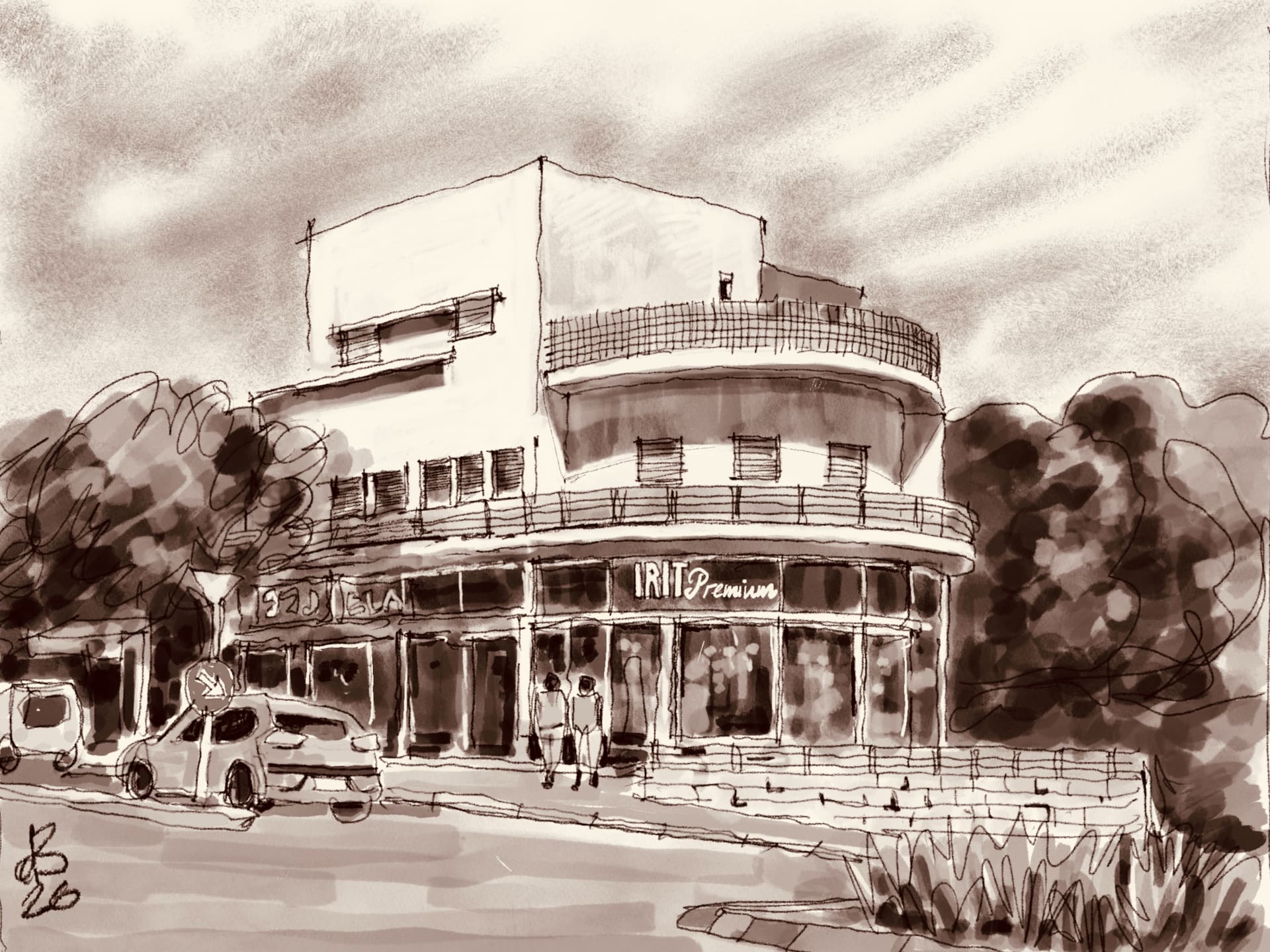
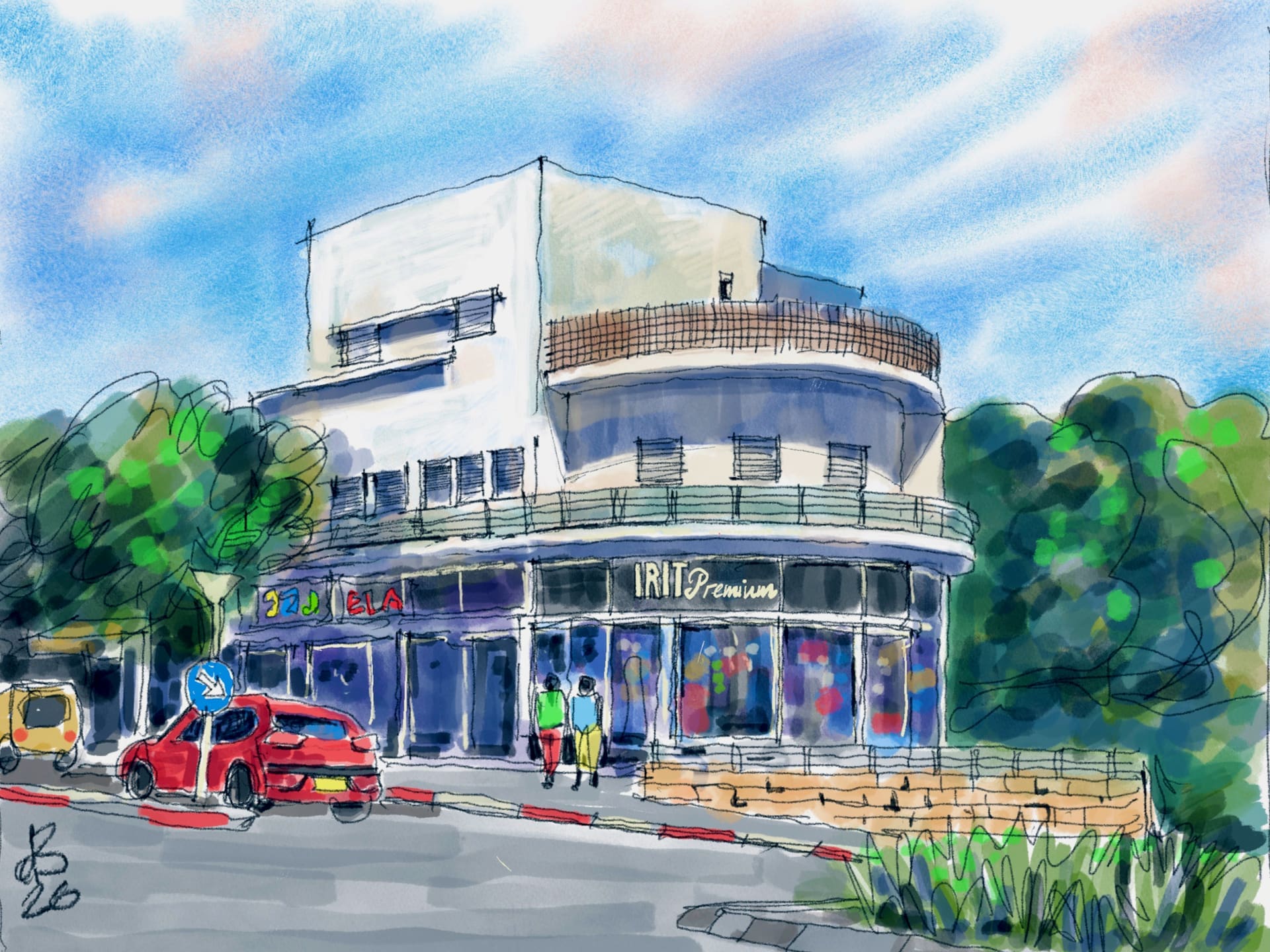
Story about a building: At the intersection of busy Moriah Boulevard and Sports Street – 35 Moriah – stands the “Epstein House” – a building with curved lines, also known as the “Ship House.” It is a commercial and residential building from the 1930s, designed in the spirit of the International Style.
Pioneering and modernism
In the 1930s and 1940s, Haifa became a central focus of the International Style (Bauhaus), thanks to fruitful collaboration between local entrepreneurs and architects who brought with them the gospel of modernism from Europe.
The building at 35 Moriah Boulevard is a clear example of this trend. It combines pioneering real estate entrepreneurship with modernist architecture. The building was built in 1936 for the couple Esther and Nahum Epstein, designed by the architect David Whitman.
Nachum Epstein – The Entrepreneur
Nachum Epstein was an entrepreneur and property owner who recognized the potential inherent in the development of the Carmel Ridge, and in combining commerce and residences along a central axis. Together with his wife Esther, he commissioned the planning of several buildings, some of which over the years have become significant assets in the built fabric of the city.
on the building – Epstein House – “The Ship House”
The building has a commercial floor and two residential floors above it. Its rounded facade, facing the intersection of streets, gives it a striking urban presence. The sequence of horizontal windows, the rounded balconies with steel railings, and the emphasis on horizontal lines create an image reminiscent of a ship — hence the nickname “Ship House.”
The wide balcony on the top floor reinforces this feeling, similar to the upper deck of a ship. At the same time, its design maintains the functional restraint characteristic of the International Style. The building was originally plastered in a light shade (probably white), in keeping with the modernist aesthetic.
About the Architect – David Whitman
David Wittman (1904–1989), born in Hungary, was one of the most prominent architects working in Haifa during the Mandate period. His designs are characterized by clean lines, meticulous functionality, and the incorporation of modernist elements such as rounded balconies, horizontal sash windows, and emphasized stairwells. (For more on the architect, see the chapter “Architects Who Designed Haifa”).
Additional collaborations
The collaboration between Epstein and Leitman produced additional buildings in the city, including:
- ICI Building (Golani Division 21), built for the Imperial Chemical Company in 1928–1933
- A residential building at 36 Sea Road, another example of the combination of private entrepreneurship and modernist architecture.
- Whitman's works in Haifa include the Chagall Artists' House, the "Ammami" cinema in Neve Sha'anan, and the "Donia Weizmann" conservatory building in Hadar Elyon.
Building preservation
The connection between Nachum Epstein and David Wittman reflects the growth of modern Haifa — a meeting between entrepreneurial vision and meticulous architectural planning, which left a clear mark on the city's image.
The building was declared a conservation building by the Haifa Municipality in 1997. Its importance stems from its being a clear example of the international style in the city, while incorporating subtle "maritime" features that give it uniqueness and local identity.
The Epstein House, with its horizontal lines and rounded balconies, continues to “sail” up the Carmel Mountain—living testimony to the moment when modernism met Haifa Bay..
Dear readers,
The articles in this section are based on publicly available information published in sources such as Wikipedia and other websites and may include various historical inaccuracies stemming from these sources.
Interesting article.
It's time to evacuate Binui. And early.
Thank you for another wonderful article.
Accurate as always.
Cherish and appreciate every piece of information you research, edit, and share.
Eyal
Thank you for your words of appreciation, it's nice to receive praise.
In the early 1950s, "Café Klein" operated there under the management of Edward Ezra Weiss [14/2/1899-2/5/1958], who moved on to manage "Café Haaz" at 127 President Boulevard, where "Mandarin" and the frozen yogurt are today.
As a former Haifa resident, I greatly enjoy the exposure of buildings from my childhood in Haifa.
Thank you for your response, Shabbat Shalom!
Hello, many, many thanks for the information about the interesting buildings in Haifa and Carmel. I lived for years on Shimshon Street. I walked thousands of times to the center of the Carmel. I knew nothing about this building until this article and about other old buildings throughout the city.
Impressive, there's nothing like Epstein.
Thank you for your response, Shabbat Shalom!
Very interesting. Good to know.
Thank you for your response, Shabbat Shalom!
And what are the contractors building today?
Ugly rectangular cubes, 6 stories high, plus a seventh floor that is supposed to be half a story and is immediately closed off by ugly pergolas.
A city without vision. Architecture without interest. Cubes upon cubes above a parking lot whose lights blind the pedestrians on the sidewalks. Walking in Carmel used to mean walking near shops or beautiful gardens and under shady pine trees.
Today, walking in Carmel means walking near parking lots or dazzling entrances at night to parking lots full of soot and dirt.
This is the legacy of our generation that is destroying Haifa with endless greed. And not even preserving what still has a little taste and investment from times when architecture was important and interesting.
Don't you ever have anything positive to say? Your comments are usually negative! Try thinking positive -
you'll be surprised by the difference it makes
True...even in Eilat this year I saw new buildings that were many times more beautiful than the ones in Haifa..
Dean Dean told you exactly what I was thinking. Shabbat Shalom!
Wow, how beautiful…
Thank you for the intriguing and interesting information 👍🏻🙏🏻🩵
Thank you for your response, Shabbat Shalom!