

In the heart of Bucharest, in the historic Jewish Quarter area near "Union Square" (Piața Unirii), stands the Templul Coral, the Choral Synagogue, one of the most important and impressive Jewish buildings in Romania.
Brief history of the establishment
The revolutions of 1848, which spread throughout Europe under the banners of freedom and civil equality, also gave new impetus to the struggle of the Jews in Romania for emancipation and the attainment of full civil rights.
Against this background, the idea of establishing a modern and magnificent synagogue in Bucharest arose in 1857, at the initiative of Itzhak Live Weinberg (Isaac Leib Weinberg). The building was intended to express the integration of Romanian Jews into modern society and to be a symbol of the community's emancipation process.
Construction began in 1864, after Jacob To be (Iacob Löbel) raised the necessary funds. In June 1866, on the eve of its inauguration, the synagogue was attacked and damaged during anti-Semitic riots. After restoration, it was inaugurated on July 6, 1867 and became one of the central institutions of Bucharest Jewry.
on the building
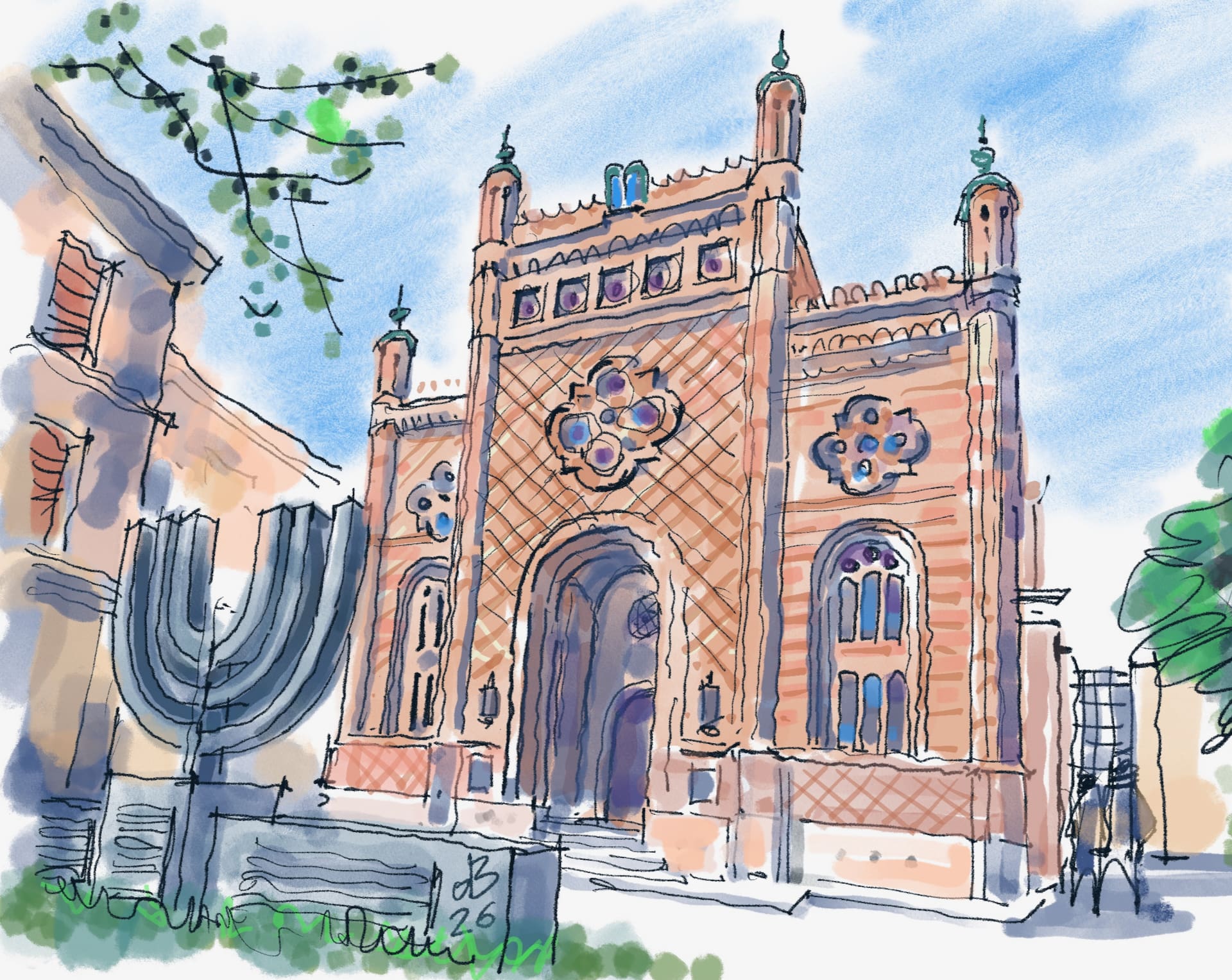
The synagogue was built in the style Neo-Mori, one of the styles that characterized magnificent synagogues in Europe (such as Paris, Florence), in the second half of the 19th century. The style drew inspiration from the Muslim architecture of Spain and North Africa, and was characterized, among other things, by horseshoe arches, geometric decorations, and rich colors. This style was adopted at that time in many synagogues in Europe, in part because it was perceived as a unique, non-Christian architectural expression.
The building's symmetrical facade is clad in two-tone brick, creating a rich horizontal pattern, with an entrance in the center highlighted by a horseshoe arch. Above it are round windows and geometric decorations, and at the top of the facade rise small turrets that give the building a distinctly oriental silhouette.
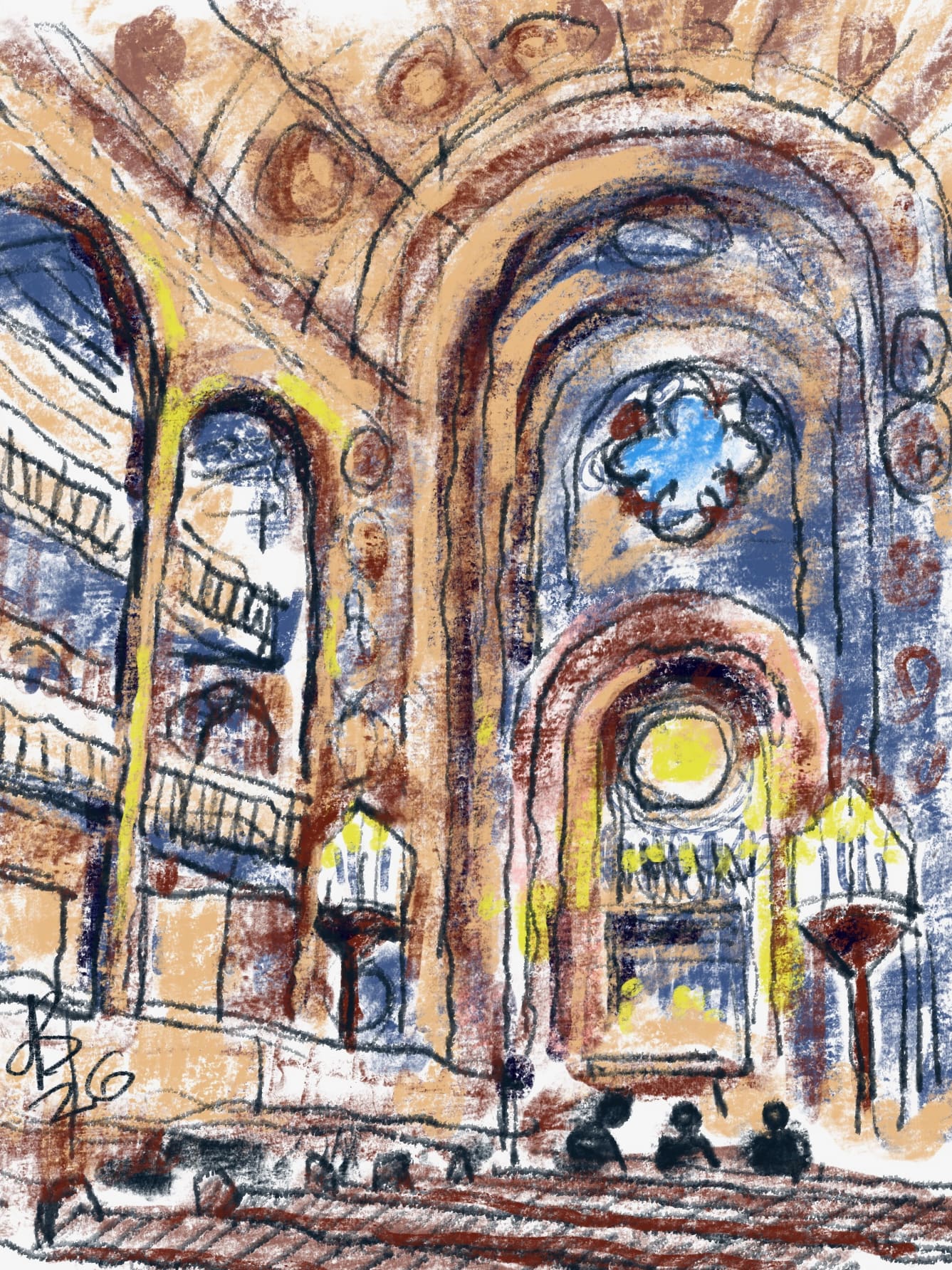
The interior is even more impressive than the facade. The prayer hall is divided into a central nave and two side aisles, and above them are galleries for women on two levels. Horseshoe arches, geometric and floral decorations, stained glass windows and large chandeliers create a rich and colorful space. At the end of the hall, the Ark of the Covenant stands within a system of decorated arches, and it is the focal point of the entire space.
As its name suggests, the prayers inCoral Temple Have been with him since the beginningChoir singing, an expression of the modernization trends that permeated Jewish religious life in Europe at that time.
About the architects
The synagogue was designed by Viennese architects. Carol Anderle (Carol Enderle) andGustav Freiwald (Gustav Freywald), who chose to design it in the Neo-Moorish style. Their design was clearly influenced by the Leopoldstädter Tempel synagogue in Vienna, designed by Ludwig Förster and inaugurated in 1858.
The choice of the Viennese model expressed the community's aspiration to belong to the modern cultural world of Central Europe. Ironically, the synagogue in Vienna was destroyed on Kristallnacht in 1938, while its counterpart in Bucharest has survived to this day.
Upheavals in the 20th century
The 20th century presented the synagogue and the Jewish community of Bucharest with a series of shocks.The November 1940 earthquake The building was damaged and needed repairs. A few months later, in January 1941, during The Legionnaires' Revolt – The Romanian Fascist and Anti-Semitic Movement andThe pogrom Among the Jews of Bucharest, members of the movement broke into the synagogue, looted it, and vandalized its contents. The building was damaged, but survived and was restored after the war.
With the rise of the communist regime, Templul Coral continued to serve as the main synagogue for the Jews of Bucharest. A key figure during this period was Chief Rabbi Moshe Rosen (Moses Rosen), who served in the position from 1948 to 1994. Rosen operated within a complex relationship with the government, while taking advantage of his position and connections outside Romania to preserve as much as possible the community's institutions, religious life, and ties with Israel and the Jewish world.
רThe Great Land Festival of 1977 It caused further damage to the building, but this time it was also restored and continued to operate.
In the last years of his reign ניקולאה צ'אושסקו (Nicolae Ceaușescu) The center of Bucharest underwent a dramatic transformation. As part of the massive construction project of the Civic Center, entire streets were demolished, including large parts of the historic Jewish Quarter. Several synagogues and community institutions were destroyed or put in danger, and this synagogue was also under threat. The activities of Moshe Rosen, along with international pressure, helped to preserve it and its continued existence as the city's main synagogue.
After the fall of the communist regime, the building underwent a long process of restoration and preservation. Extensive work began in the 2000s and included strengthening the building and restoring its architectural and artistic elements. The synagogue reopened in December 2014.
The community today
According to the 2021 census, about 900 Bucharest residents defined themselves as Jews, although the number who actually belong to the Jewish community may be larger.
Today, Templul Coral continues to serve as one of the important centers of Jewish life in Bucharest and the Jewish communities in Romania. Prayers are held there on holidays and festivals, along with memorial ceremonies and public events.
Its status goes beyond its role as a house of prayer and it also serves as a central place for state and community ceremonies.
More than one hundred and fifty years after its inauguration, and after being repeatedly damaged, restored, and brought back to life, the Choral Synagogue, like a phoenix, continues to serve once again as a center of prayer, identity, and Jewish life in the heart of Bucharest.
Dear readers,
The articles in this section are based on publicly available information published in sources such as Wikipedia and other websites and may include various historical inaccuracies stemming from the aforementioned sources. The illustrations accompanying the article were made based on photographs from various sources published online.
We invite our readers to suggest buildings as subjects for articles and if interesting stories are found behind them we will be happy to review them in this section.
A twin building to the building in Bucharest is located in the town of Drohobych, Ukraine, which has been completely renovated in recent years.
Rabbi Moshe Rosen was the "Red Rabbi" - a staunch communist. In Yiddish: Der Roite Reba!
Thank you for your response. I'm not sure he was a communist, but he knew how to talk to the communists and protect the interests of the Jewish community during a very difficult time.
Mr. Bar On, during the time of Nicolae Ceausescu and his wife Elena (whose photograph is unforgettable, lying on the road after being shot), from what I remember, there were articles about Israel transferring money to Ceausescu's regime in various transactions, and as a result, it was expected that the attitude in the Jewish Quarter would be better than described here, but the information you gathered is probably more reliable.
Thank you for your response. It is true that Israel paid money for every Jew who received an exit visa from Romania, but this has nothing to do with Ceausescu's grandiose plans for the redevelopment of central Bucharest, within the framework of which the Choral Synagogue was also supposed to be damaged.
My colleague, Dr. David Bar-On, described very beautifully and meticulously the Choral Synagogue in the State of Romania. May God bless you, sir, and conclude with a good signature.
Thank you very much for your kind words. It seems that the topic is not that interesting to my readers here. Good job!