


Carmel presents us with flowers in all seasons.
In this column, we will always present one of the Carmel flowers, in parallel with its appearance in the field, and you will be invited
Visit it in one of the places where it blooms this week.
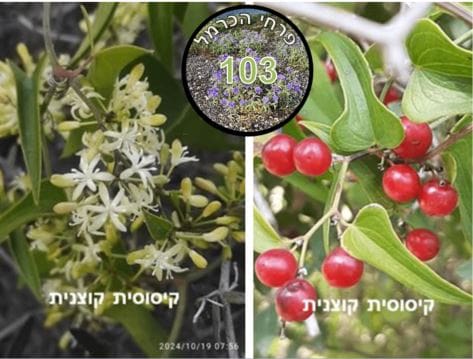
Thorny Ivy – Smilax aspera
An evergreen, perennial, thorny climber with spiny stems. It sometimes forms a network of branches or a tangle that is difficult to overcome. Ivy is the most common climber in the country. It is dioecious and the flowers are unisexual, meaning the male and female flowers are different and grow on separate plants.
Type name"Ivy" is derived from the ivy plant. Hedera – Due to the great visual similarity between them, mainly in the shape of the leaves (heart-shaped or arrow-shaped) and the fact that they are evergreen climbing plants.
Species name: "Prickly" comes from the spines and prickles that cover its stems and petioles.
Along theגWith a yoke of ankylaceous thorns.
The leaf is heart-shaped and is leathery and shiny. The leaf blade has 3 main veins, the remaining veins branch off from them like a network. From the base of the leaf petiole, 2 tendrils emerge that curl and cling to nearby trees or walls. The tendrils develop as the side leaves roll.
Ivy blooms in autumn and early winter, from September to December.
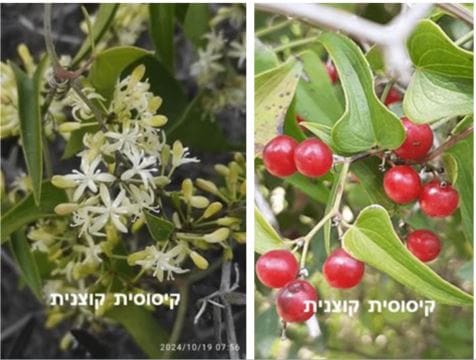
The flowers are tiny, 3-4 mm in diameter and creamy-green or white in color. They are arranged in small, multi-flowered spherical clusters that emerge from the leaf axils. The flower has 6 similar sepals (no distinction between sepals and petals). The male flowers have 6 fertile stamens, the female flowers have 6 sterile, degenerate stamens.
The fruit of the prickly ivy is a juicy spherical grape with a diameter of 5-8 mm. At the beginning of its development, the fruit is green, during ripening it turns bright red and stands out from a distance, and at the peak of its ripeness its color changes to dark red to black-purple. Each grape usually contains 1-3 hard seeds. Birds eat the grapes, digesting the juicy pulp, but the hard seeds inside them pass through their digestive system without being damaged and are excreted in their feces while flying. The fruits of the ivy are poisonous and are not suitable for human consumption.
Ivy flowers have a strong, concentrated scent, which serves as the plant's important advertising channel for attracting pollinators.
The flowers secrete nectar at the base of the bracts. The male flowers offer pollinators both nectar and pollen. The female flowers offer pollinators only nectar. The main pollinators are: bees, hoverflies, and wasps.
Ivy grows as a climber in groves, but is also found in treeless groves.
Distribution in Israel: Golan, Hermon, Galilee, coastal plain, valleys, Carmel, Samaria and Judean mountains, Sharon, Shephelah.
ID
| family: | Ivy (formerly included in the rose family). - Smilacaceae |
| root: | Perennial. |
| height: | It can reach a length of several meters depending on the height of the tree it climbs. |
| Leaves: | Leathery and shiny, heart-shaped at the base and drawn out like an arrow further on, the leaf blade has 3 main veins, from which the remaining veins branch out like a network. |
| stalk: | Along the stem are thorny branches, as well as tendrils that curl and cling to nearby trees or walls, sometimes forming a thicket that is difficult to walk through. |
| rash: | In the fall and early winter, mainly in the months of September - December. |
| flower: | The flowers are tiny, 3-4 mm in diameter and creamy white in color. They have 6 bracts. They are arranged in multi-flowered clusters. |
| The structure of the flower: | Unisexual, there are male and female flowers on separate plants. |
| fruit: | A bitter and poisonous red grape, growing in clusters, spread by birds. |
| smell: | The small ivy flowers have a strong scent. |
| nectar: | The flowers produce available nectar designed to reward pollinating insects that arrive following the strong scent. |
| uses: | In folk medicine, it is used to treat diabetes, sore throats, fever reduction, gastrointestinal infections, and diarrhea. |
| Distribution in Israel: | Common in all areas where more than 350 mm of rain falls annually, it grows as a climber in groves but also in bogs and along stream banks. |
A place to meet the plant of the week
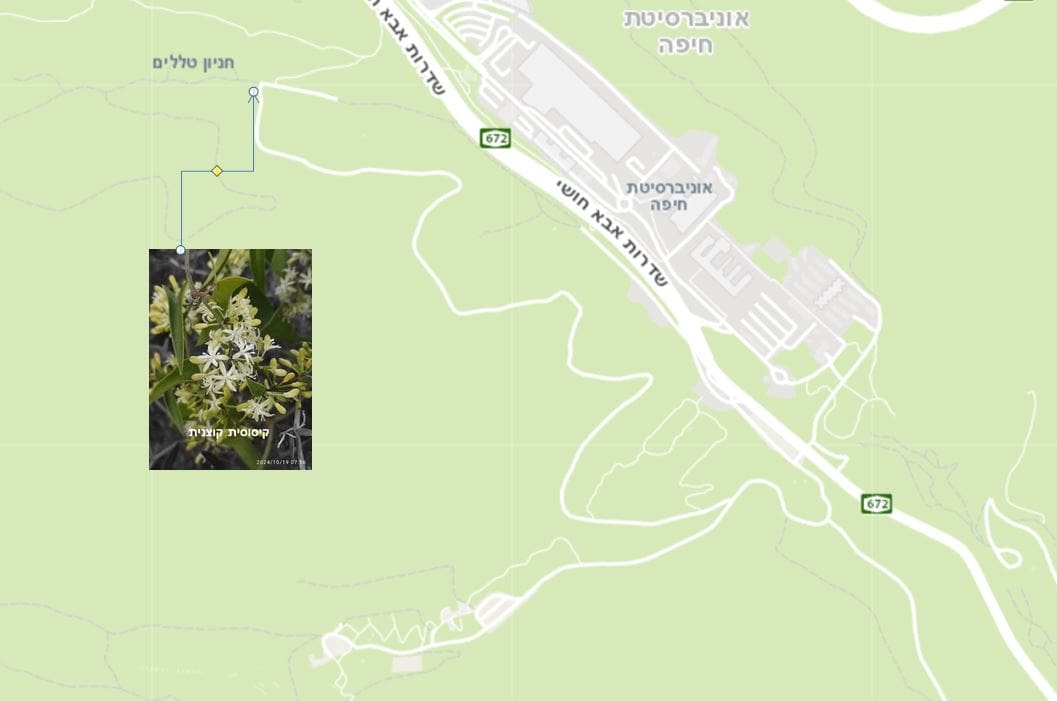
Carmel Park west of Abba Khushi Road.
- Drive from Haifa on Abba Khushi Road – Route 672 towards the university (southeast).
- Immediately after the pedestrian bridge to the university, turn right (west) towards the Tallim parking lot.
- Continue about 200 m to the parking area (located on the left of the road).
- After the parking lot, a paved road continues, go down it (on foot or by car) about 100 meters, to the place where the road turns south towards the wildlife area (from here there is no longer any vehicle access).
At the entrance, on the right (west) side of the paved footpath leading towards the wildlife area, you will see a rich bloom of prickly ivy.
If you go to visit the flower with children, you can tell them the fairy tale about prickly ivy.
The Legend of Prickly Ivy
In a small, sunlit valley lived a young, playful plant named Ivy. It was different from the other plants:
It did not have strong roots, nor a sturdy stem like its neighbors. Its body was thin and delicate.
Every day the ivy looked around with envy:
"The hairy lotus blooms with wonderful pink flowers," she said.
"The spiny boat protects itself with strong spikes," she added.
“And me? I’m just a little thread twisting in the wind….”
One day a strong wind blew through the valley.
The tall plants bent, some broke, and the little ivy was almost uprooted.
At the last moment, she wrapped herself around a thorny bush near her.
"Hey! Who are you, clinging to me like that?" the bush grumbled.
“I’m Ivy,” she replied shakily. “The storm almost blew me away. I just wanted to hold on to something strong.”
The bush sighed: “Well, if you’re already here, hold on tight. Just don’t forget to thank me later.”
And so the ivy leaned against the bush.
Day after day, she entangled herself around its branches, climbing up and wrapping herself around it tenderly and carefully.
The thorny bush, which once looked gloomy and threatening, was slowly covered with elongated heart-shaped green leaves.
The plants in the valley looked on in amazement:
“Look! The ivy has turned the thorns into a plant with lush green leaves.”
From that day on, the ivy realized something important:
Its true strength was not in its durability or thorns, but Her ability to connect with others and surround them with love.
And since then, every autumn, when the prickly ivy blooms on the wild bushes and lights up the fields in creamy white colors
Everyone remembers, even a thorn can become beautiful, if only someone would believe in it and surround it with a bright green heart.