


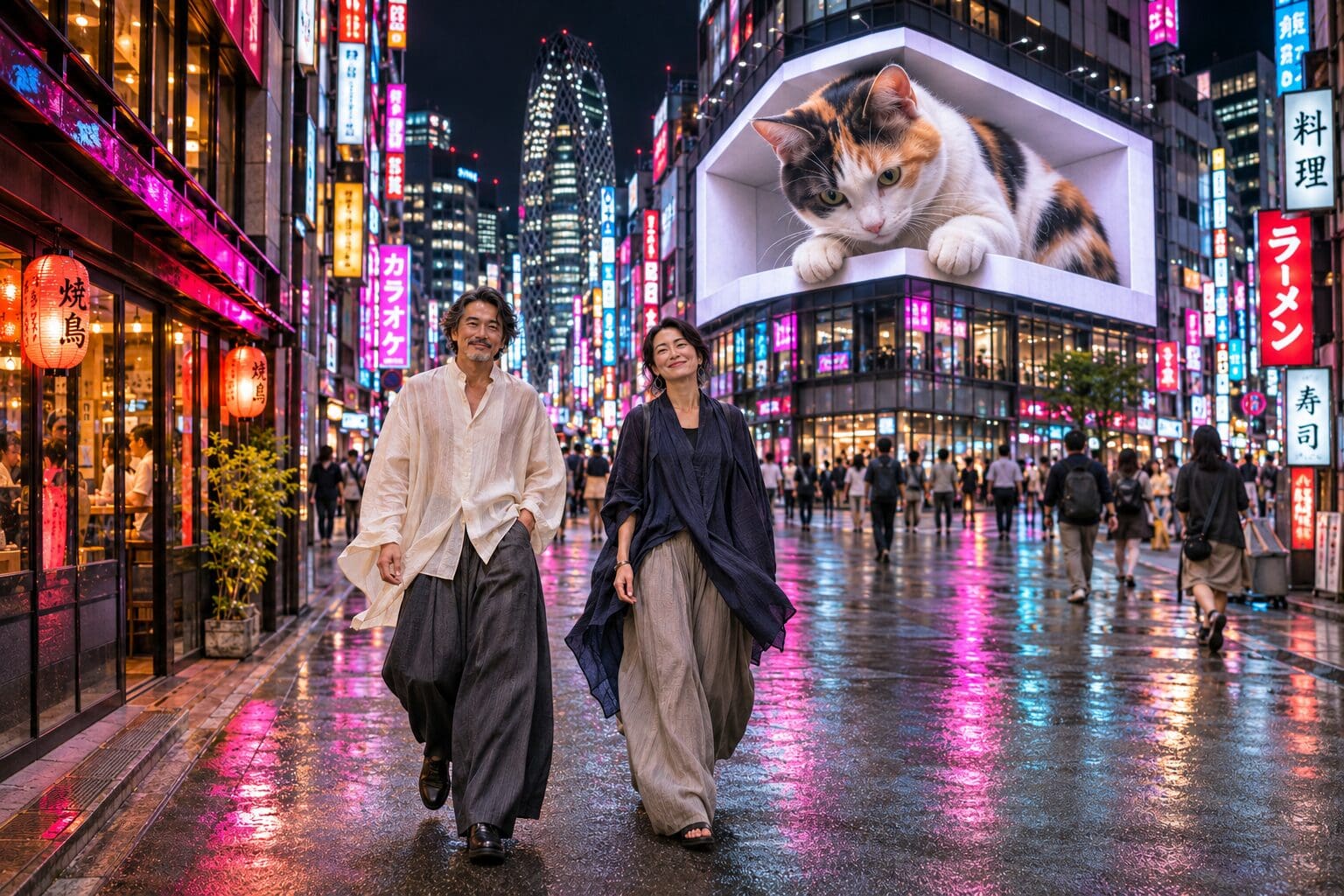
(haipo) – Many have written about Japan and dreamed of visiting it. For years, it has been imagined as an intriguing meeting point between tradition and the future. Its name has also appeared in music: in 1984, during the synth-pop era of the 1980s, the band Alphaville released Big in Japan.
The poem features, loosely translated, the images "neon on my bare skin" and "passing shadows." They invite us to imagine a street at night: light falling on the canvas, figures in motion, and clothes taking shape with every step.
Today, for many, that dream is within reach. Japan attracts millions of travelers, and the weak yen can ease some of the costs of visiting and shopping. The images on the screens can be replaced by walking down the street, in front of shop windows and among the people.
During my visit to Japan, I was particularly drawn to the loose clothing and thin, airy fabrics. As a stylist, I was intrigued by the ability to create a refined look that leaves space for the body. This observation led me to seek the connection between clothing and the culture around it: tradition, landscape, architecture, food, and everyday life.
From the kimono to the street
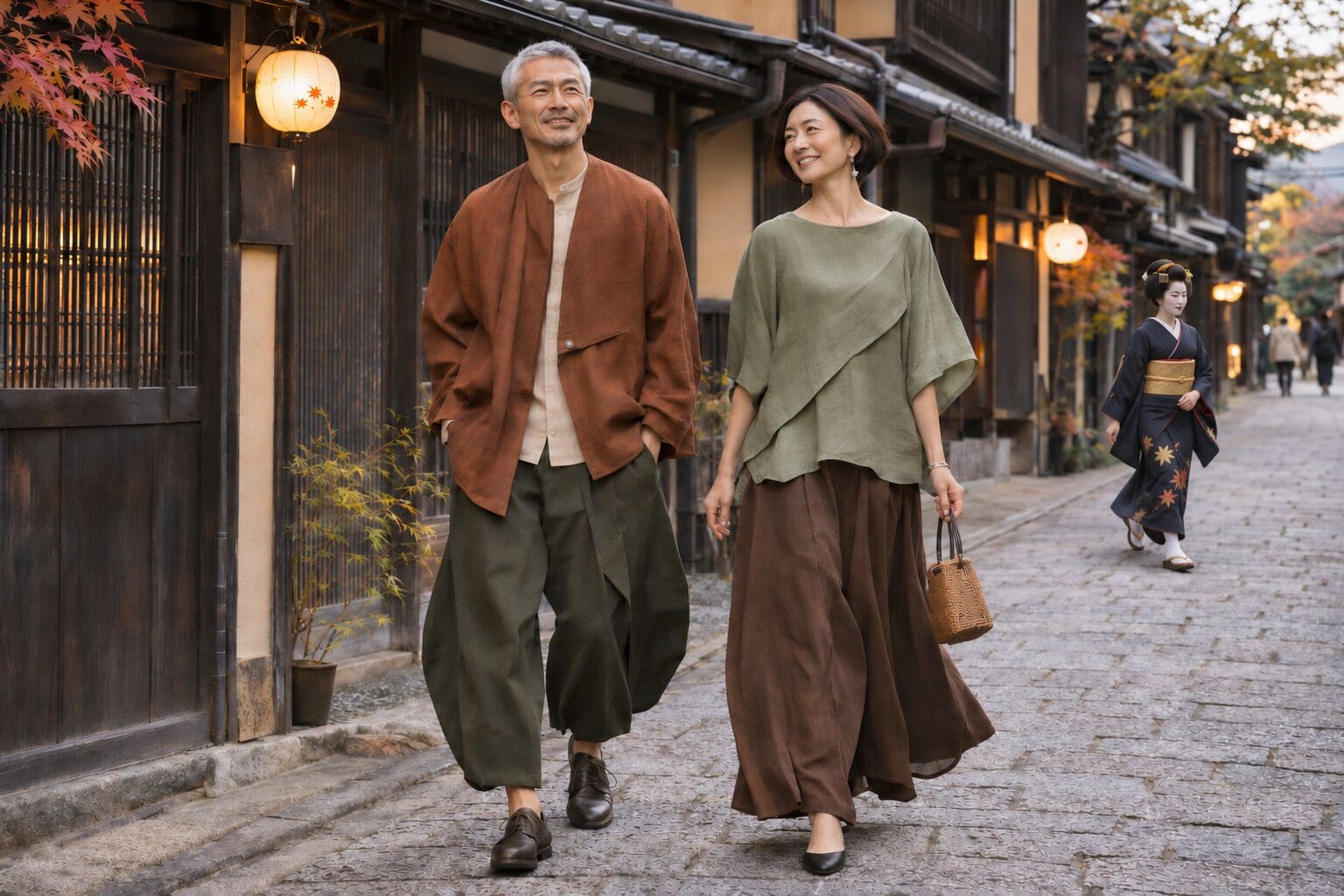
The traditional kimono, whose name means "thing worn," is made of pieces of cloth joined with straight seams and wrapped around the body with an obi belt. Its shape gives importance to the fabric, pattern, and relationship between the body and the garment.
Clothing also carried social significance. In the courts of the nobility it expressed status and taste, and in the Edo period, with the strengthening of the merchant class, the culture of consumerism in fashion expanded. The demand for new patterns and decorations encouraged the creation and dissemination of styles.
To me, there is a conceptual affinity between the traditional wrap and a loose shirt or soft jacket, which takes shape on the body. The loose fit allows women and men to give presence to movement and texture.
The landscape and climate play a role
Clothing in Japan varies with the environment: from the cold north to the subtropical south, from the cities to the mountain ranges. The hot, humid summers in large parts of the country make light fabrics and airy cuts a practical necessity; the cold winters in other areas require layering and insulation.
There is also seasonal adaptation in kimono, from unlined versions to more padded versions. The airy fabrics I remembered from the visit fit into this thought of comfort, alongside attention to fabric composition and weaving.
What: The space between the body and the garment
The space between the body and the garment reminded me of “ma”—a Japanese cultural and aesthetic concept that refers to a gap or pause in space and time. In music, it’s the silence between sounds, and in architecture, it’s the relationships between the parts of a structure and the spaces between them. The space itself has a role: it affects rhythm, balance, and the way we experience the whole.
To me, this is an interesting way to look at clothing as well. In a loose fit, the distance from the body allows the fabric to move, fold, and create a changing volume. The air between the body and the fabric becomes part of the appearance. Hence the parallel I draw between architectural space and a garment that takes shape in movement.
Attention to material and season also appears in Washoku, the Japanese dining tradition, in the choice of raw materials and serving utensils. I see this as an analogy to clothing that gives space to texture and color. In the kimono itself, flowers, leaves, and landscapes sometimes carry seasonal significance.
Harajuku, anime and freedom to dress
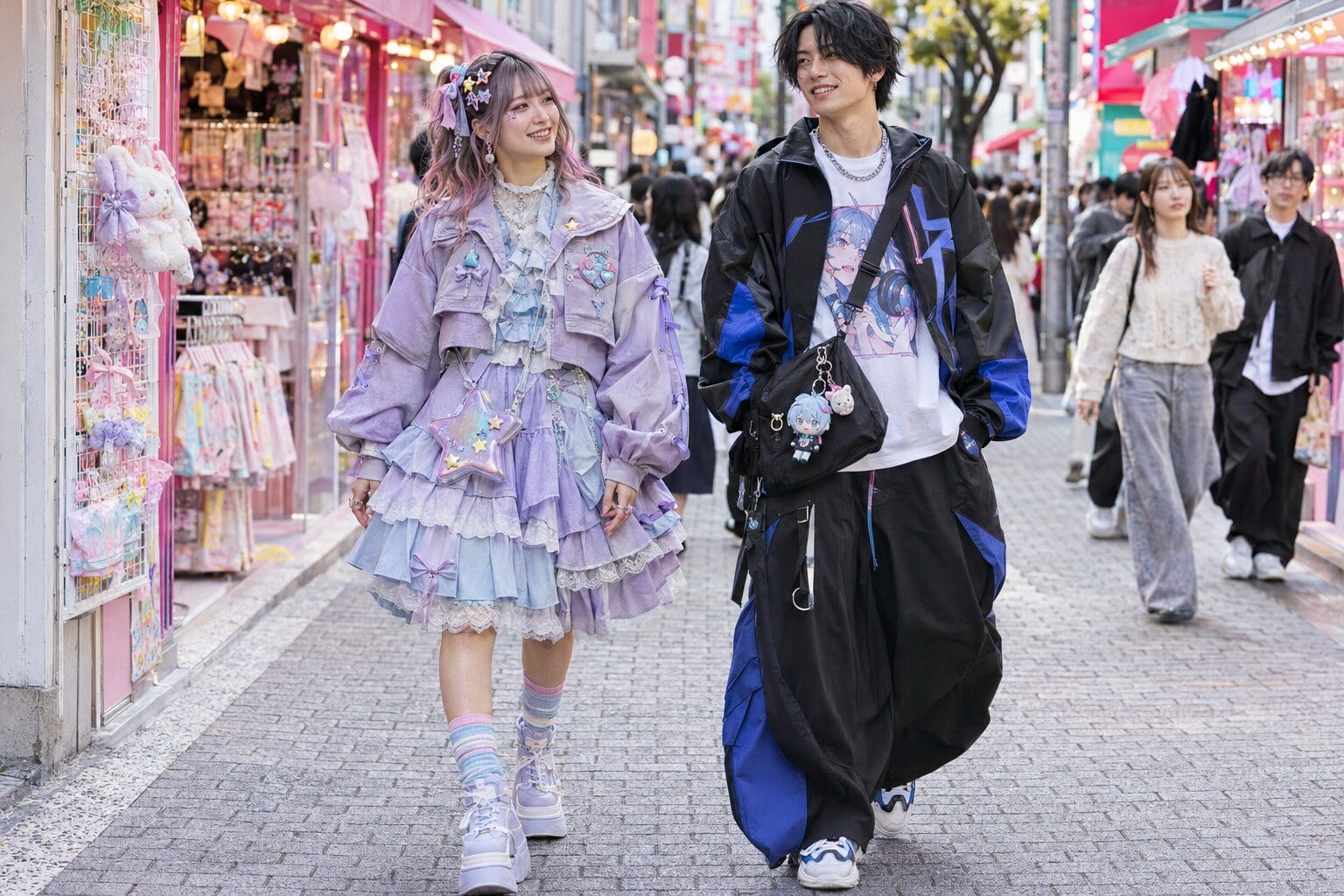
The playful side of Japanese fashion can be found in Harajuku, Tokyo. Styles associated with the area include layered clothing, puffy skirts, and Lolita-style competition, vintage items, punk clothing, and colorful hair accessories. These are different ways to use clothing for personal expression.
Alongside them, the influence of anime, Japanese animation, and manga, Japanese comics, is evident: characters and images are transferred to shirts, bags, and accessories. In cosplay, dressing up as characters, the inspiration becomes a complete look. Pop culture thus adds a world of imagination to fashion, which exists alongside tradition and craftsmanship.
The variety is also found in stores. At Uniqlo, UNIQLOThe AIRism series combines fabric technology for comfort in humid conditions. At Moji, MUJI, linen and hemp give space to the feeling of the material. Nets like BEAMS AND UNITED ARROWS Combining original lines and other brands, presenting several interpretations of clothing under one roof.
Designers continue to interpret tradition
In fashion houses, the fabric and cut receive personal expression: a house Issey Miyake Associated with folds, lightness and movement, andYuji Yamamoto With volume, black and big silhouettes.
Among the designers working today, Maiko Kuroguchi Nature and Crafts Notebook for Feminine Design; Shinichiro Ishibashi, designer KUON, gives new life to fabrics through repair traditions; Yusuke Takahashi CFCL creates flexible clothing using computerized knitting; andChitose Abe Sacai combines materials and cuts into surprising combinations. Together, they offer different ways to bring heritage together with contemporary life.
From Japan to Carmel and the personal wardrobe
The meeting can be continued in Haifa, at the Tikotin Museum of Japanese Art. The museum opened to the public in 1960, based on the collection of Felix Tikotin and an initiative he promoted with Abba Khushi. Its collections include traditional, modern and contemporary art, including paintings, prints, curtains and art objects.
For me, observing line, color, and pattern connects the piece to the garment. The curiosity that arose in Japan can continue in Carmel and from there into the wardrobe: into the way the pants fall, the fabric feels, and the shirt moves as you walk. Within these small choices, something of the journey remains.