


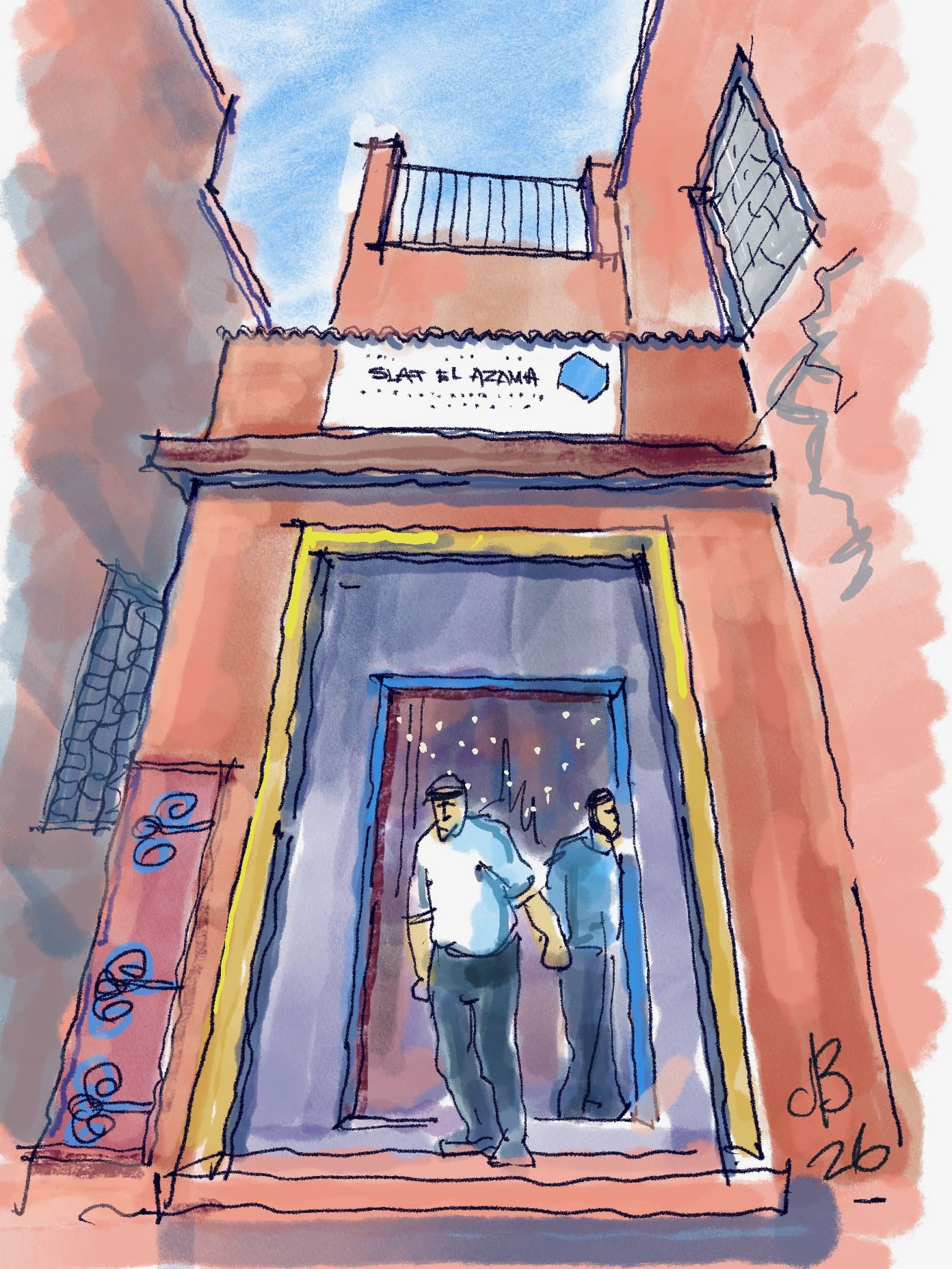
In the heart The salt – The old Jewish quarter of Marrakech, hidden behind a modest synagogue facade Tsalat Al-Azma (Slat al-Azama), one of the best known synagogues in Morocco.
A brief history of the synagogue
Following the expulsion from Spain in 1492, many Jews arrived in Morocco, known as “expelled,” as opposed to the “residents,” the Jews who had been living in Morocco even earlier. The deportees brought with them their own prayer customs, halachic traditions, and Jewish-Sephardic culture, and in various places in Morocco they established synagogues in which the text of their prayers was preserved.
According to local tradition, also Tsalat Al-Azma Sit downMarrakesh Founded by exiles from Spain, the year 1492 has become an inseparable part of the synagogue's story and identity over the generations, even though the building has undergone many changes and renovations since then.
The Mellah of Marrakech was established in the mid-16th century. Over the generations, it became the center of life for one of the most important Jewish communities in Morocco, and many synagogues operated within it. Tzlat al-Azma was one of the most prominent of them, and was used not only for prayer but also for Torah study.
the building
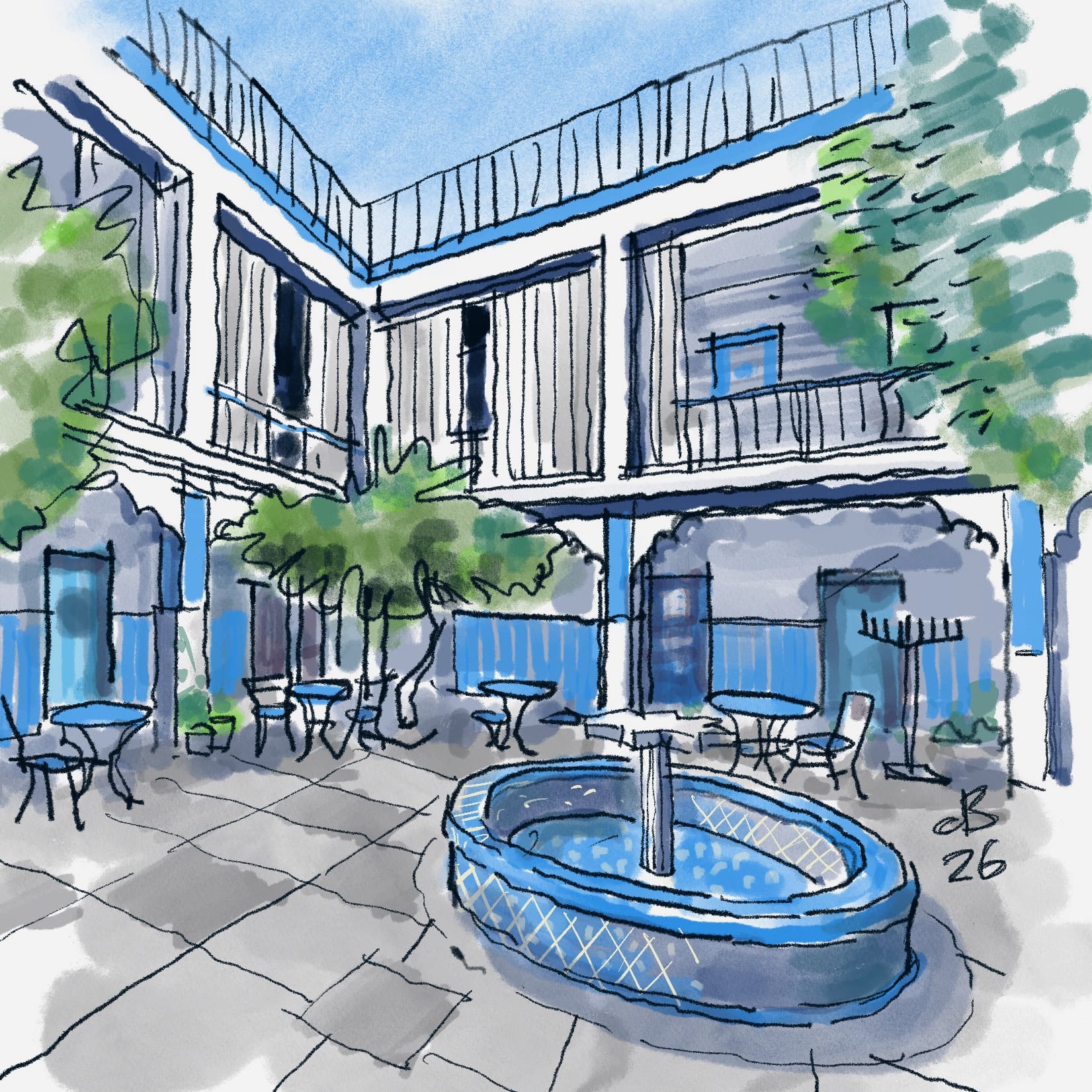
Unlike the main synagogues in Europe, such as those in Paris, Florence or Bucharest, Tzalat al-Azma does not stand out from the street; it is integrated into a complex with a domestic character, organized around a central inner courtyard – the center of life of the building, similar to theRiyadh (the traditional Moroccan house) and to some extent also toמדרסה (a traditional institution for the study of Islam), where the yard It is the heart of the building.
The courtyard is the most prominent and memorable element of the place. Its walls are partly covered with zellige – a traditional Moroccan mosaic made of glazed ceramic tiles cut into geometric shapes. In its center is a fountain, surrounded by citrus trees, inward-facing galleries and patterns in blue and white tones, which give it a distinctly Moroccan character.
The prayer hall itself is modest compared to the courtyard and is also decorated with traditional Moroccan elements. Over the years, it has undergone changes, including the replacement of the original wooden ark with a marble ark and the addition of a women's sanctuary in the eastern wing.
The synagogue as a community center
Tzlat al-Azma was not only a place of prayer. For generations, the complex was also a center of Torah study and community life. A yeshiva operated on the upper floor, and alongside it were educational settings for young people; sources describing the place also mention Torah study and charitable activities.
The rooms around the courtyard were used for study and gathering, and thus the courtyard became a common space that connected prayer, study, and the daily life of the community. Until the great immigration of Moroccan Jews in the mid-20th century, educational settings operated there, where many of the community's children studied.
The community in the 20th century and today
Until the mid-20th century, Marrakech was an important Jewish center, but from the 50s and especially in the 60s, most of the city's Jews left for Israel, France, and other countries. As a result, the community rapidly shrank, and many synagogues and community institutions in Mellah ceased to operate.
The Tzlat al-Azma, on the other hand, was preserved and continued to serve as a recognized Jewish center in the city. Today, there is a small Jewish community in Marrakech, numbering only about 150 people, and the synagogue serves both as a place of prayer and as a heritage site, where photographs and artifacts telling the story of Marrakesh Jewry are displayed.
ֿThus, Tsalat al-Azma, in the heart of Marrakech's medina, continues to carry to this day the memory and tradition of the Jews of Spain who found a new home in Morocco.
Dear readers,
The articles in this section are based on open information published in sources such as Wikipedia and other websites and may include various historical inaccuracies arising from the aforementioned sources. The illustrations accompanying the article were made based on photographs from various sources published online.
We invite our readers to suggest buildings as subjects for articles and if interesting stories are found behind them we will be happy to review them in this section.
😍Exciting!!! I visited this "synagogue" in "Morocco"!😂
* It is evident, from "Jewish history" that "Jews of Morocco", clearly and logically from the "descendants of the Spanish expulsion"... the entire "wandering journey" that was forced upon them throughout the years of the history of the "People of Israel" from the Land of Israel to "Spain" and then to "Morocco" = "strictly kosher Jews"!!!😭😭😭
In fact, the courtyard connected prayer and life itself. It is known that the state was hostile and anti-Semitic to this community for most of the years, not only in the Palestinian context, long before events and riots such as the Ugada and the Grada, and the harassment of the Jewish settlement.