

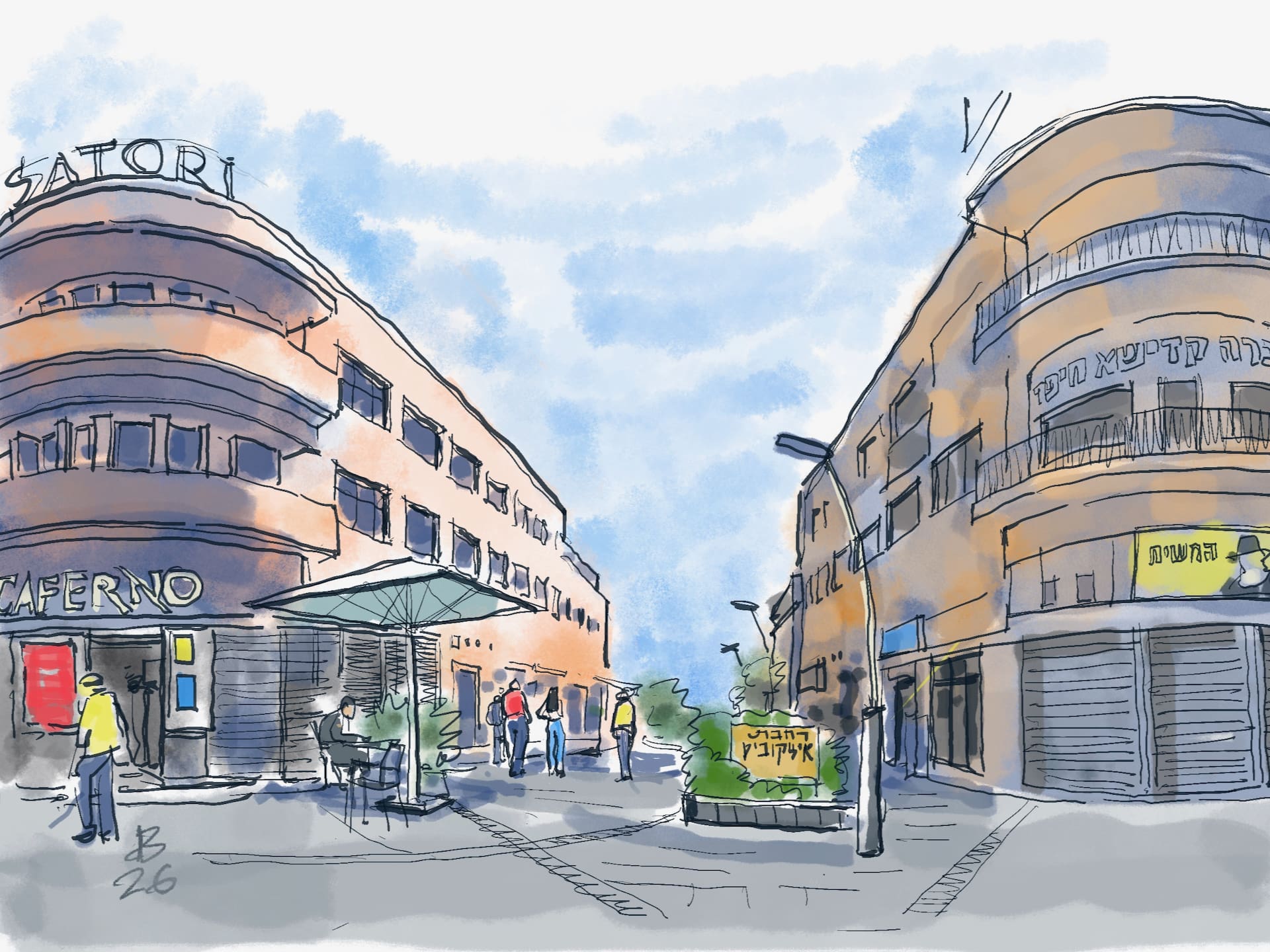
Anyone passing by Herzl Street in Hadar may see Itzkovich Square as just a convenient passage to the Talpiot Market. In fact, the square, which includes the plaza, the two built sides, and the set of stairs that descends towards Hehalutz Street, is an entire urban complex, connecting Herzl Street to the market area. Behind this complex lies a much more complex urban story, which we will try to tell later.
Shmuel Itzkovich – engineer, industrialist and public figure
Shmuel Itskovich was born in 1881 in Volkovysk, then part of the Russian Empire. He began his engineering studies at the Kharkov Institute of Technology, but was expelled from the institution due to political activity. He completed his studies at the Polytechnic in Munich, where he qualified as an engineer in 1906, and in the same year he immigrated to Israel and settled in Haifa.
In Haifa, he was one of the pioneers of local industry and was a partner in establishing a machine factory within the framework of the "Atid" company. Alongside his professional activities, he was one of the founders of The Technion and the Real SchoolY. participated in laying the cornerstone of the Technion and worked to promote teaching in Hebrew.
After World War I, he returned to Haifa and reintegrated into its public life. His house, designed by Alexander Berwald's office, was one of the first houses on Herzl Street. Itzkovich served as chairman of the Haifa Engineers' Association, was active in various public institutions, and in 1931 was elected chairman of the Hadar Carmel Committee.
Itzkovich died in 1934. His contributions to industry, education, and the development of Hadar Carmel well explain why his name is commemorated precisely in the heart of the neighborhood where he worked and lived.
Itzkovich Square – the architectural complex
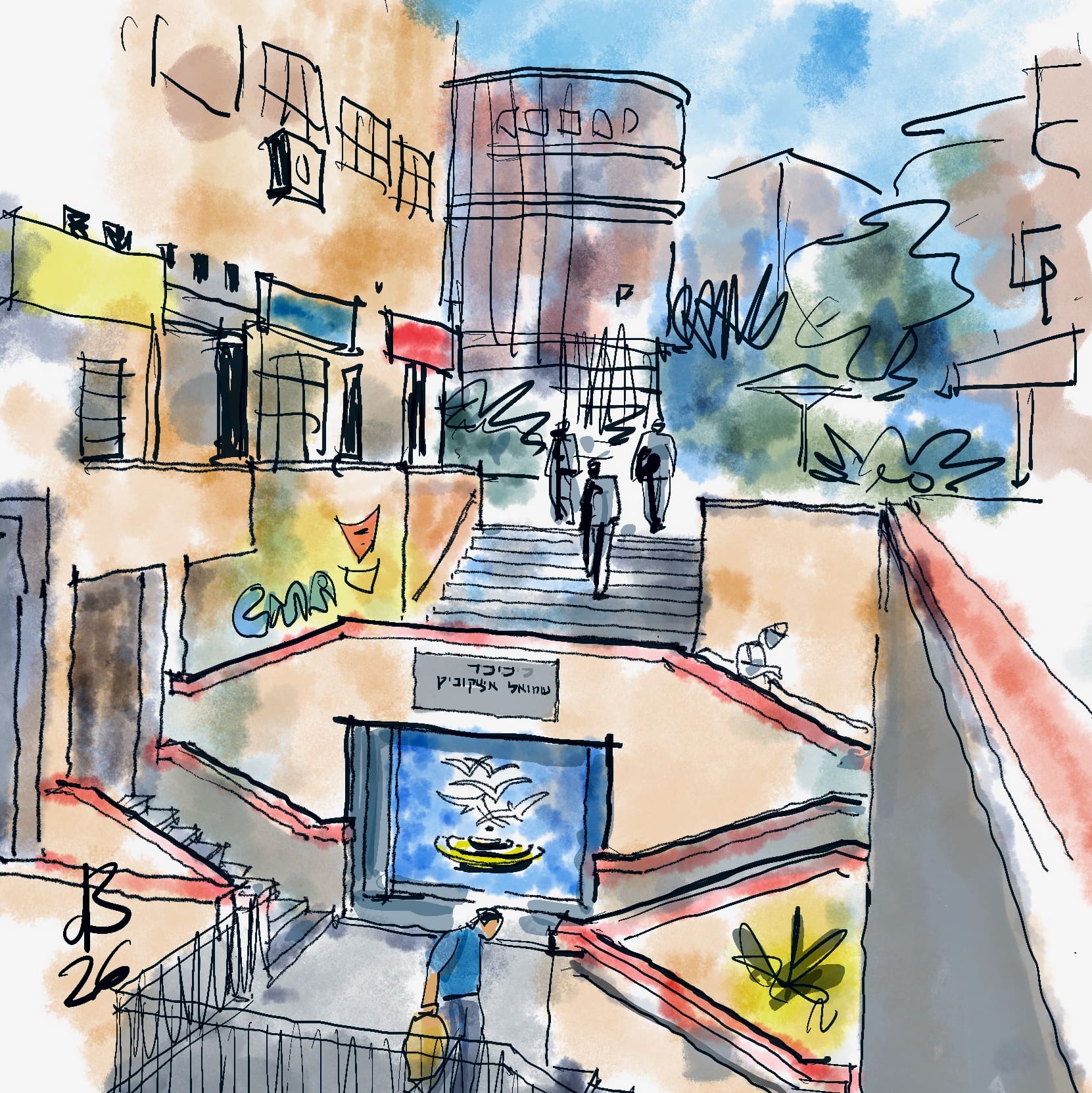
Itskovitch Square is built as a terraced urban complex, connecting Herzl Street with Hehalutz Street and further on to the Talpiot Market area. Two built walls delimit the upper plaza, and between them a wide set of stairs descends, creating a clear downward traffic axis.
The western wall, Herzl 61, is a hotel Talpiot, now a hotel Satori, designed by the architect Moshe GerstelThe building is characterized by horizontal emphasis, rounded corners, and balconies facing the plaza, as is customary in the international style.
On the other side stands the eastern wall, Herzl 63, which corresponds with the building opposite and creates a sense of an almost symmetrical composition with it. Today, this block is integrated into the base structure of the Haifa Tower and is in fact part of it, although it maintains an architectural language that is clearly distinct from the later tower block that rises behind it.
The urban planning of the complex is based on City Building Plan No. 502, designed by the architect Shmuel RozovThe staircase system descending to Hechalutz Street was designed by Moshe Gershtel. On the opposite side, Herzl 63, several planning attempts have been made over the years, including a hospital and a cinema. The research of Mendel's cornea, who specializes in Gerstel's work, indicate his involvement in the planning of the eastern side as well, and drawings related to cinema were even found in his archive. However, the extent of his role in the planning of the constructed structure is uncertain.
In the center of the staircase, a public fountain was added in 1959, above which is the artist's ceramic work "Birds in Flight." Israel RubinsteinRubinstein was an Israeli sculptor, painter, and mosaic artist who worked extensively in Haifa and created several works of art in public spaces. His works in the city include mosaics at the Technion and a monument in Neve Sha'anan.
The work in Itzkovich Square, made of turquoise ceramic tiles, features white birds in flight. It exists to this day and is included in the Haifa Municipality's list of works recommended for preservation.
About the architects
Moshe Gerstel (1886–1961), born in Galicia and a graduate of architecture and engineering studies in Vienna, immigrated to Israel in 1935 and worked mainly in Haifa. He was one of the most prominent architects of the International Style in the city, and designed, among other things, the Talpiot Market, You Coffee Israel And other buildings in Hadar. In Itzkovich Square, he designed the Talpiot Hotel at 61 Herzl Street and the staircase descending towards Hehalutz Street.
Shmuel Rozov (1900–1975) was also one of the main architects active in Haifa in the 20th century, and was involved in the design of public, commercial and hotel buildings. Among his works in the city are **Armon Cinema, Pinchas Rotenberg House, Solel Boneh House וDan Carmel HotelIn the 60s, he was a member of the team that prepared the outline plan for Haifa.
A conservation area?
The Itskovitch Square complex has distinct historical, architectural and urban values that deserve preservation. However, there has been no confirmation to date that the square, its two sides and the staircase system have been designated as an official complex for preservation. The ceramic work “Birds in Flight” by Israel Rubinstein, which is integrated into the stairs, is included in the Haifa Municipality’s list of recommended works for preservation.
Upon visiting the site, it was difficult to ignore the gap between the architectural value of the complex and its current condition: the neglect, the dirt, the broken fountain, and the use of the lower plaza for parking and storing garbage carts, harm the quality of the space and its original function as a pedestrian thoroughfare connecting Herzl Street to Talpiot Market.
Thanks
My thanks to Ms. Mendel's cornea, an expert on the life and work of architect Moshe Gershtel, for the significant information she shared with me, which greatly assisted in formulating the article.
Dear readers,
The articles in this section are based on open information published in sources such as Wikipedia and other websites and may include various historical inaccuracies arising from the aforementioned sources.
We invite our readers to suggest buildings as subjects for articles and if interesting stories are found behind them we will be happy to review them in this section.
In the "square" itself, in the sixties, before going down to the market on the left side, there was the "Talpiot" club, where rhythm bands performed every weekend, with the best hits of the period, to mention a dear friend, Uzi Avram, who was a singer in the band "Naarei HaHetzer".
The place later became a snooker club 🎱..
It was a really tough time.
It was also worth mentioning his brother Dr. Yitzhak Itzkowitz, whose house at 16 Arlozorov Street and even his tombstone were designed by architect Berwald.
Thank you for your response. I didn't know about the family connection between them, even though I wrote about Dr. Itzkowitz a long time ago. You should look for the article here.
See article here: https://haipo.co.il/item/400980
Preserving memory in scripture is more important than ever. If not, where are we? This is where the gratitude to Rabbi David Bar On comes from. He is in charge of the "Hai Peh" website for commemorating the sites of Haifa, and in doing so, also for commemorating the work of Haifa's founding fathers. Well done, David!
Dear Uri, thank you very much for your moving words that relate my work to the broader context of memory preservation.
It is worth noting. Inside the courtyard of Herzl 61 and a staircase between Herzl and the pioneer, the *Ot* printing house was one of the first mythical printing houses in Haifa. Which in the upper part of the wall between 61 was a long and wide display window the size of the wall with camera photos of a photo shop in the place and another staircase to the backyard of the *Ot* printing house
Thank you for your response, very interesting information!
I think calling the place a square is a bit of a sin for this place, which is a real complex. And that's very true, and it's a shame that they don't invest in nurturing and preserving the place.
Thank you Dr. David Brown. Thank you for the painting. Beautiful. You take us back years. I enjoyed it, I really liked hanging out there.
Thank you for your kind words.
There are only drug addicts there!! And neglect…
The article is interesting and the illustration is truly wonderful. But I share your sorrow over the immense neglect of such a lovely corner in the heart of Haifa.
Thank you for your response, I share your hope despite my doubts.
interesting…
Many times in my youth I went shopping at Talpiot Market and Itskovitz Square.
And I didn't know her past, her uniqueness, or her plans.
Thank you for the information.
Thank you for your response, I'm glad the article brought you unfamiliar information.
Streets of my childhood. What a great illustration.
Thank you for your response, it's always nice to receive a compliment.