


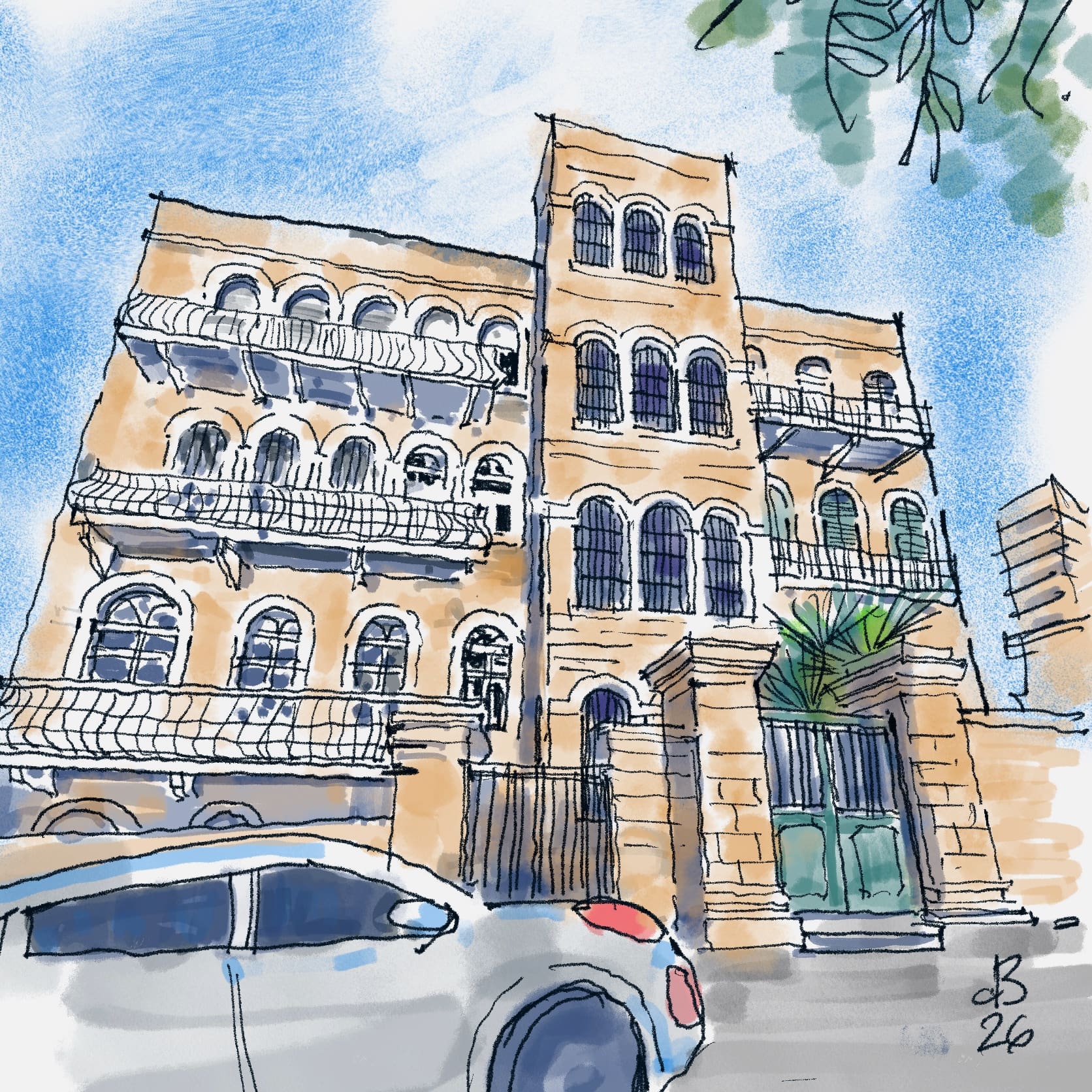
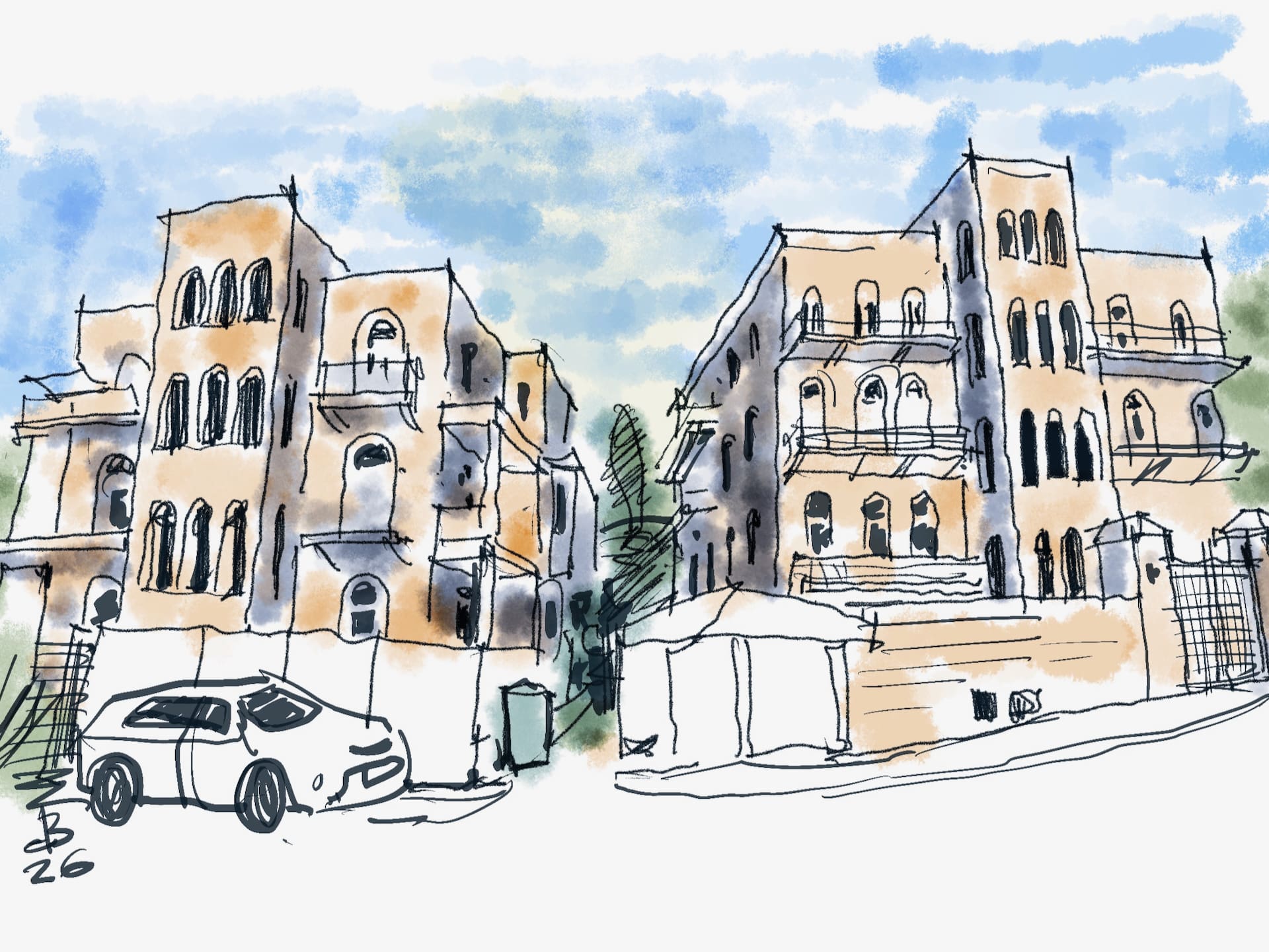
On Yechiel Street, which climbs from the lower city towards the Talpiot Market complex, stand two twin buildings, testifying to the days when the area was a hub for luxury residences for wealthy families – a reality that is difficult to guess from the appearance of the area today, some 90 years later.
Merchants from Damascus as real estate developers in Haifa
In the early 1930s, when Haifa was developing rapidly and becoming an important economic and commercial center, luxurious residences were built on Yehiel Street, which attested to the area's status as a sought-after residential area among wealthy Arab families, near the Talpiot Market complex.
In the construction files for the two buildings at 18 and 20 Yehiel Street, the names of Ibrahim Wardy and Shafik Sarakby appear, members of merchant families originating from Damascus, who operated in Haifa during the British Mandate.
Historian May Seikaly's research shows that Vardi and Sarakby were involved in commercial activities, including importing household goods from Syria and glassware from Eastern Europe. In 1935, they participated, along with another partner, in establishing a rice mill in Haifa.
Alongside their commercial activities, they also engaged in real estate investments. Sarakbi, for example, was the partner of businessman Haj Taher Karaman in the construction of an apartment building at 34 Sirkin Street, designed by architect Moshe Gershtel.
The "Twin Palaces," as the two buildings on Yechiel Street are called, therefore reflect the prosperity of a class of Arab merchants and entrepreneurs in Haifa in the 1930s, who invested their fortune, among other things, in the construction of luxurious residences.
About the buildings
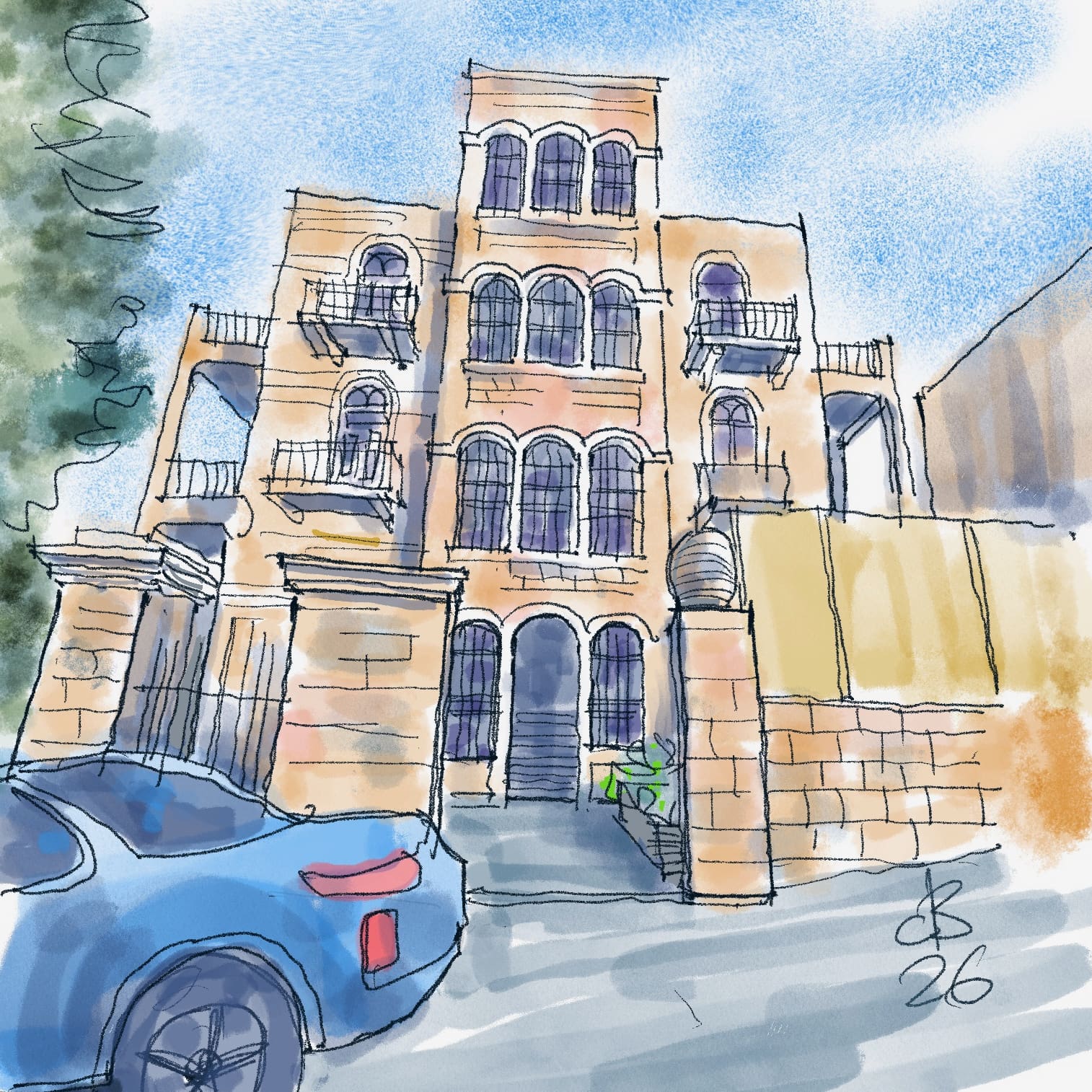
The two buildings at 18 and 20 Yechiel Street were designed by architect Haim Harry in 1932–1933. Although they are not identical, the great similarity between them is evident, expressed in a common architectural language.
The buildings were designed in the spirit of urban Arab residential architecture of the period, while incorporating modern construction methods. The impressive stone facades are characterized by arched window arrays, prominent balconies with metal railings, and central stair towers that rise above the roofline, giving the buildings a monumental appearance.
The apartments were designed to a high standard of living, with spacious spaces and high ceilings. The interior design was based on a central space around which the living rooms are arranged, similar to the local Arab building tradition. Special attention was paid to the finishing details, including decorated floors, arched wooden windows and wooden shutters. Documentation from recent years indicates that some of these details have been preserved and even restored as part of the renovation of apartments in the buildings.
Despite the changes and additions made over the years, both buildings retain much of their original character and are reminiscent of the residential splendor that once characterized the area.
About the architect Haim Hari
Haim Harry (1888–1981), born in Galicia, immigrated to Israel in 1906. He acquired his professional training through practical work in the office of architect Yosef Barsky, first in Tel Aviv and later in Haifa, where he participated in the construction of the historic Technion building. Although he did not study architecture in a formal academic setting, he was awarded an architect's certificate by the British Mandate authorities.
Harry worked in Haifa for decades, designing residential buildings for the Jewish and Arab communities. His notable works include the Aziz Kayat House, the Rafol Jabour House, and the Abu Zayd House. In his works, he combined the influences of modern European architecture with local building traditions.
The "Twin Palaces" on Yechiel Street are another example of his work for wealthy Arab families and the professional cooperation between members of the various communities in Haifa during the Mandate period.
Between conservation and renewal
Over the years, both buildings have undergone changes in ownership, population, and appearance. In the file for the building at 20 Yechiel Street, the Custodian of Absentee Property appears in 1952 as the owner of the property, a testament to the changes that occurred in the area following the events of 1948.
Today, the two "twin palaces" are included in the Haifa Municipality's list of buildings for strict preservation, and are even part of the Yechiel Highway complex, which is defined as a conservation area.
A visit to the site shows that the buildings continue to be used for residential purposes, and that renovation and renewal work is even being carried out. It appears that their residents are adapting them to the needs of modern life, and it is hoped that this is being done while preserving their unique architectural characteristics.
Thus, the "Twin Palaces" continue to live and renew themselves, almost a century after their construction, while carrying with them the memory of the people and the period that gave them their special character.
Thanks
My thanks to Mr. Yigal Segal who raised the issue on Facebook and to Ms. A blunt statement, from the Haifa History Association, for the fascinating historical information she shared with me, which contributed greatly to the formulation of the article.
Dear readers,
The articles in this section are based on open information published in sources such as Wikipedia and other websites and may include various historical inaccuracies arising from the aforementioned sources.
We invite our readers to suggest buildings as subjects for articles and if interesting stories are found behind them we will be happy to review them in this section.
Many thanks to Dar Bar On for uploading historical treasures in Haifa from the archive. I'll go visit, place.
Half of the "natives" here who claim to have been here for 10 generations in total are Bedouins and merchants from Lebanon and Damascus who settled in Haifa before and even after the first immigrants, so their rights here do not exceed ours.. Remember well when they blabber on about "Ottoman Haifa". They were actually from Damascus, Jordan and Beirut and not from Haifa or from Balestina, which at the time was even called the Tulkarm district.