


The child who was born from the breakup and built a life of light
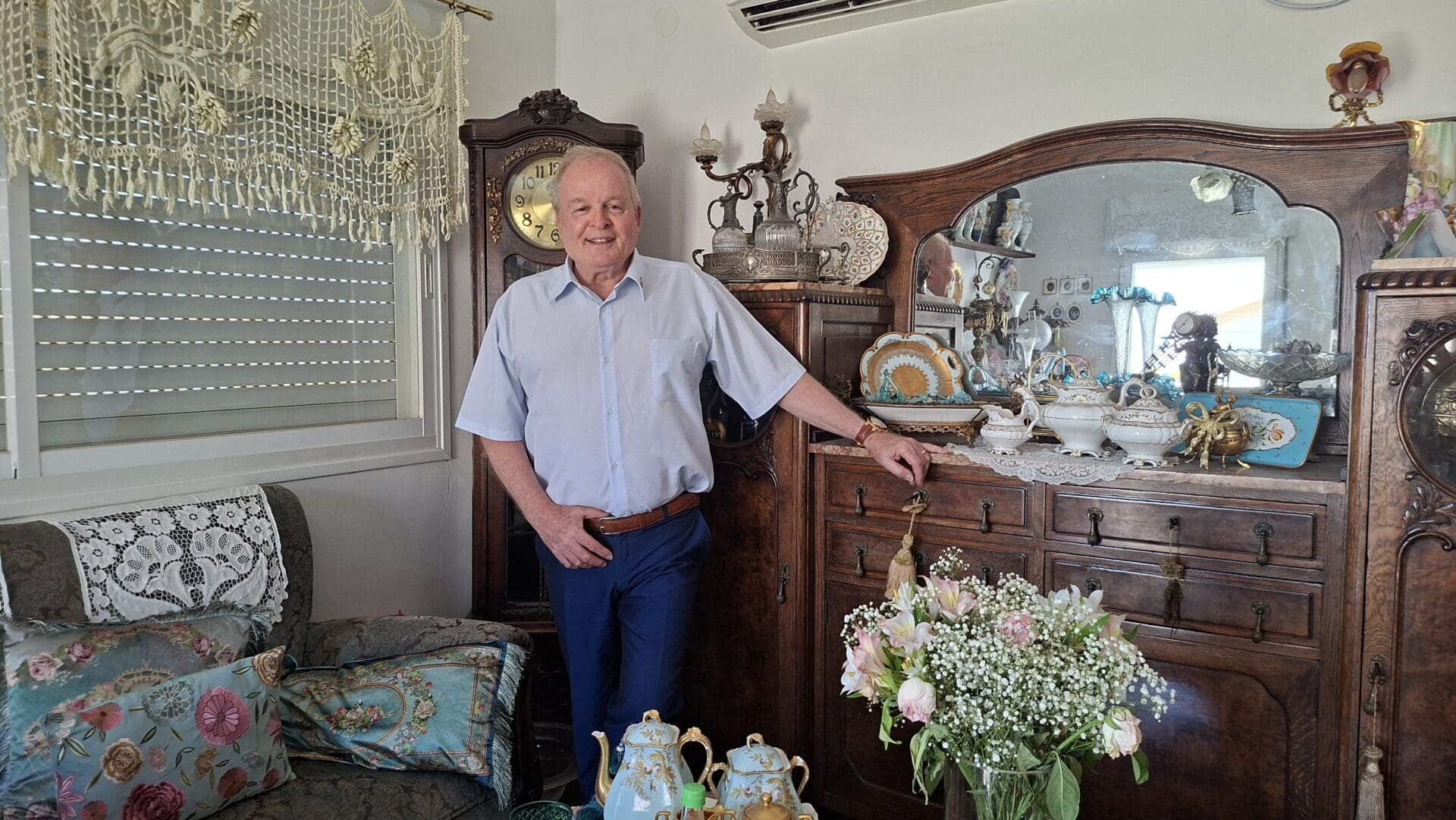
In a house full of antique chandeliers that he restores and brings back to life, Yona Mazor is surrounded by objects that carry with them centuries of memories.
Perhaps that is why they are so close to his heart: his own life is also a story of preservation, repair and rebuilding. Today, as a businessman, a public figure and a leader at the top of "Rotary Israel", he acts from the inner peace of a person who knows that a person's significance is not measured only by what he has achieved, but by what he gives to others.
Behind this impressive path stands a child born in 1952 in Haifa to Holocaust survivor parents, who arrived in Israel without families, without property, and without a past that could be reclaimed.
In a modest two-room apartment in the Kiryat Eliezer neighborhood, between the stories of his parents' loss and the Israeli dream of a new beginning, Yona Mazor learned the lesson that would follow him throughout his life: Even from a brokenness, light can be built.
"I live here too"
Here, the section that seeks to open doors, not only of houses, but of souls. This is a section that brings you fascinating Haifa characters, straight to their living spaces, with the belief that true acquaintance is forged through stories, life lessons, and unique and personal perspectives.
Thus, the rich human mosaic of our city, Haifa, a city of voices, memories, and living, breathing identities, gradually unfolds. A section about women and people who live here, as the section's name suggests: "I live here too."
This is where we meet these characters inside their homes, but not as a purely physical space, one measured in square meters, real estate valuations, or design aesthetics. The home is described here as a space filled with meaning: a treasure trove of memories, evidence of life stories, and a space charged with emotion. Through the home, we get to know its inhabitants, not from the outside, but from the inside: through an intimate, one-time lens that reveals their world as it is experienced from the inside.
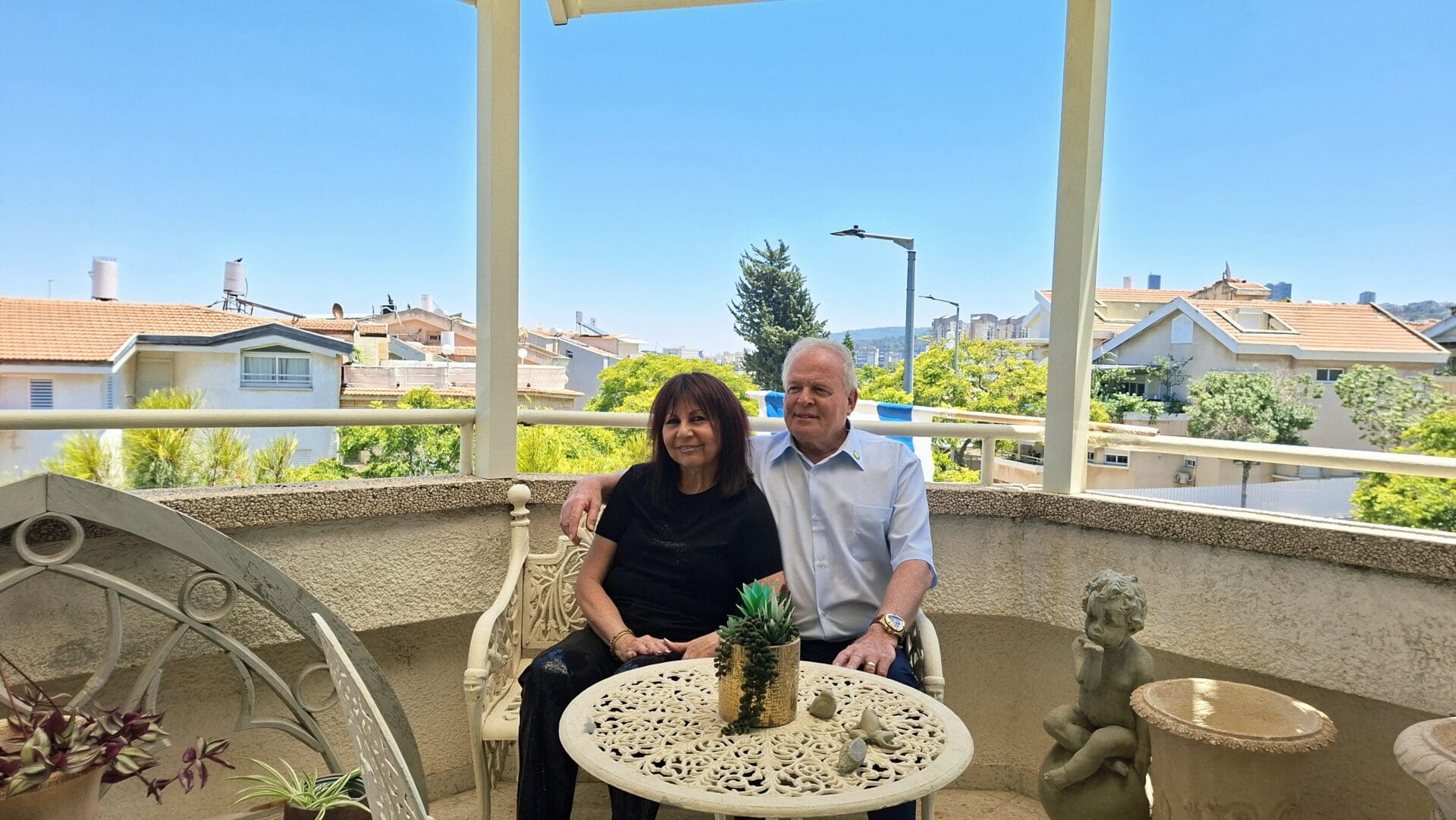
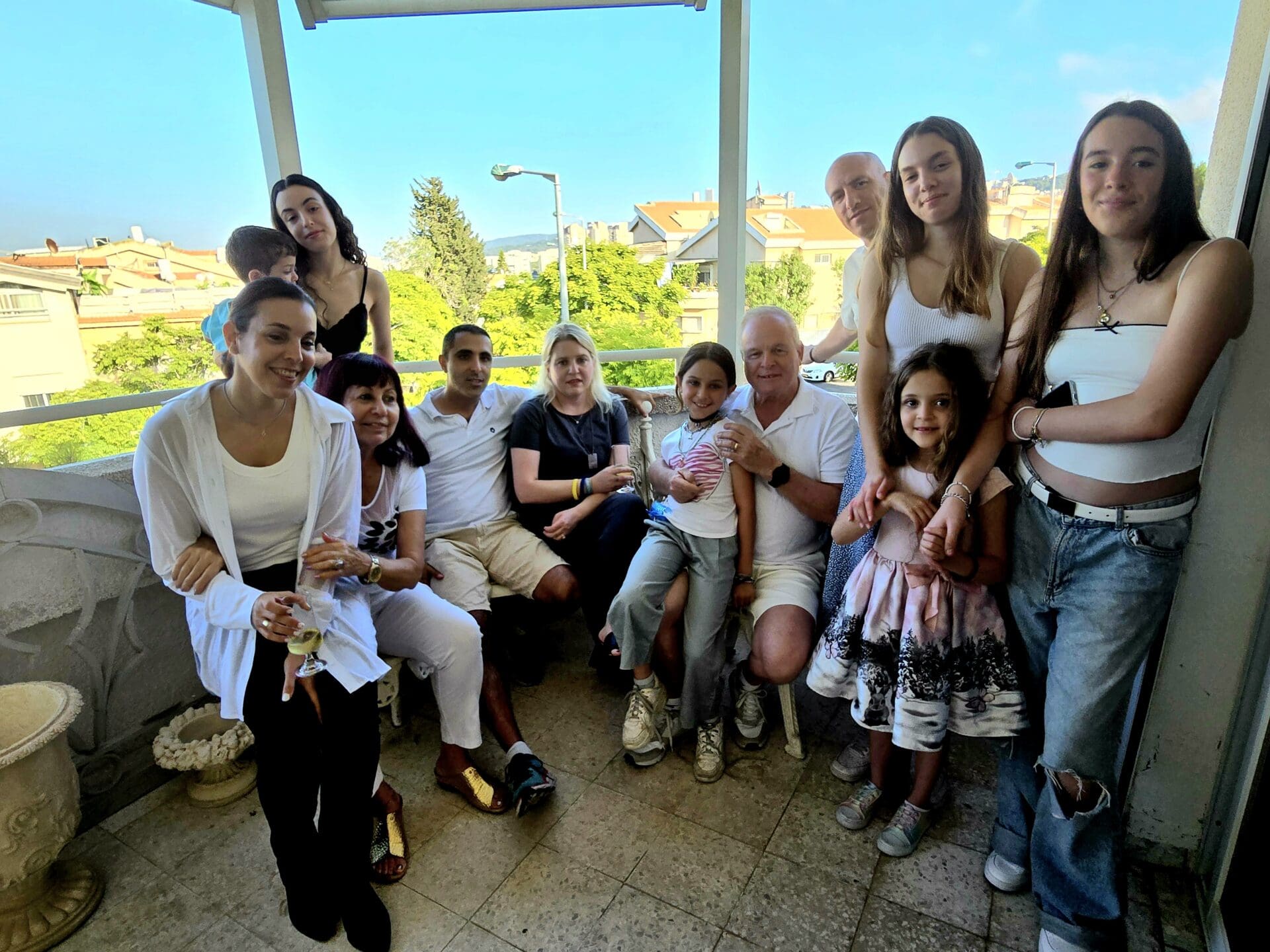
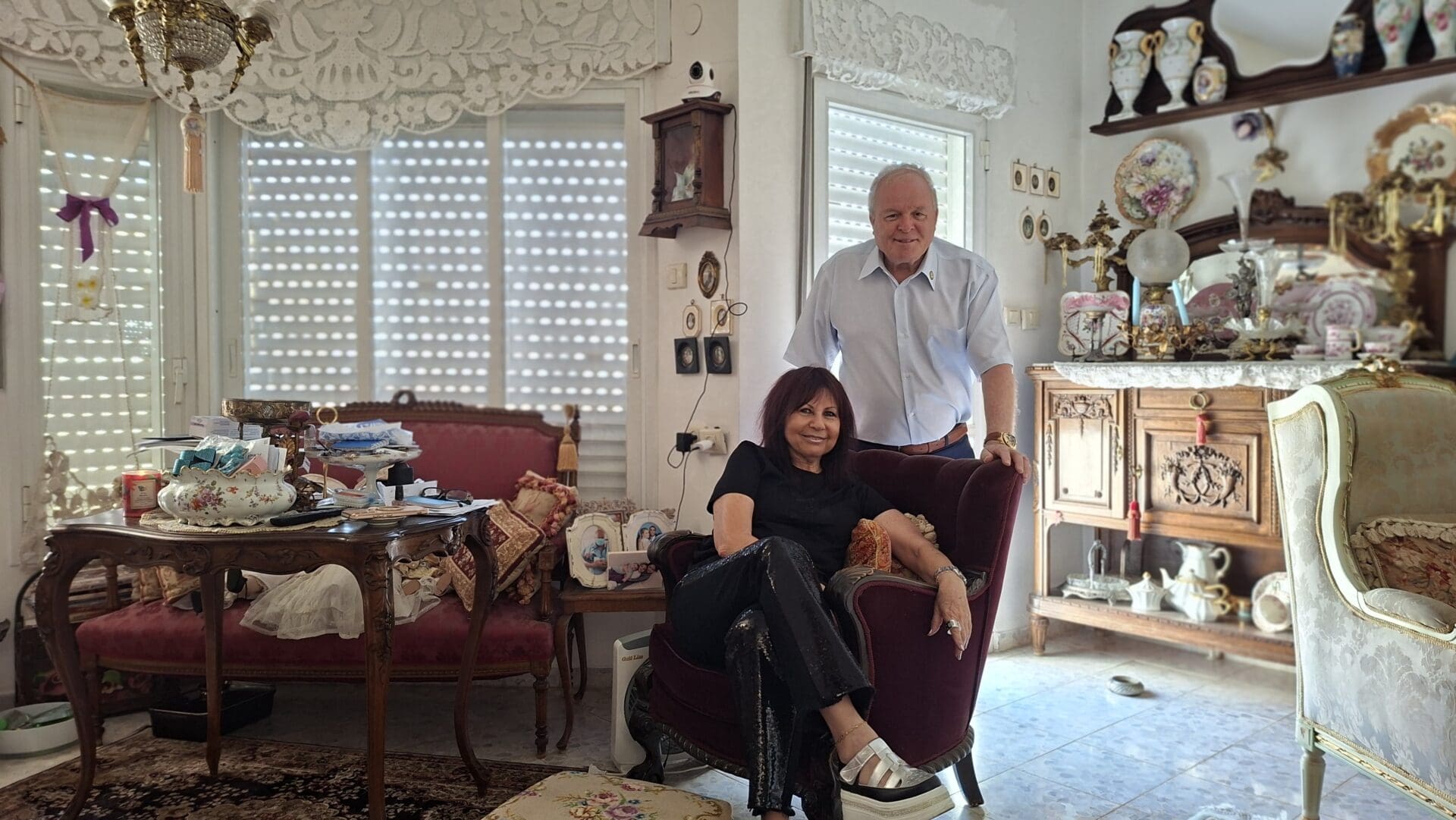
This time we will be staying at the impressive home of Yona Mazor and his eternal bosom friend, his wife Atara.
From the forests of Volyn to the shores of Carmel
When Yona Mazor was born in Haifa in 1952, just seven years after the end of World War II, he already carried with him a history that was not his own, but which would shape every aspect of his identity.
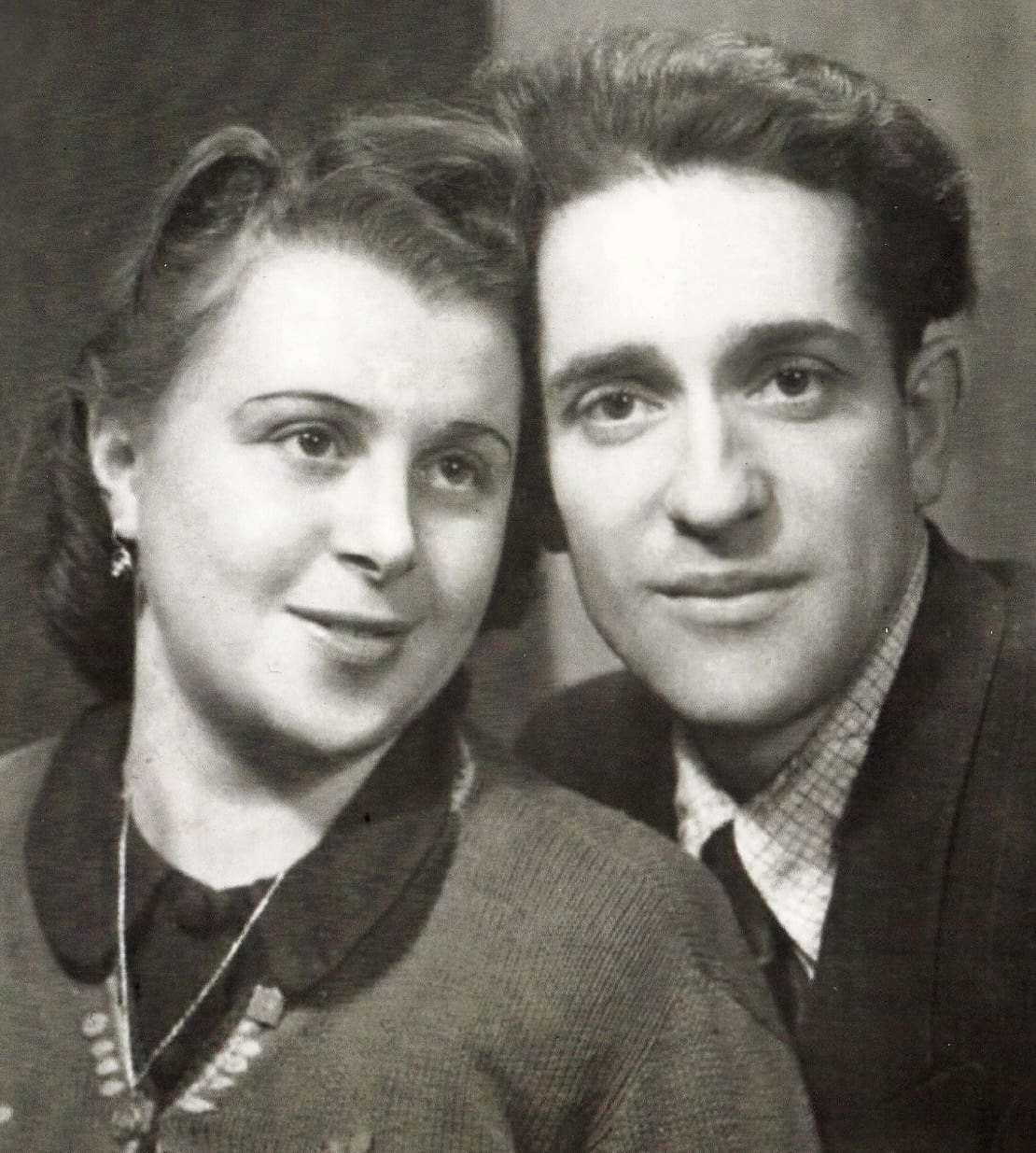
His parents, Shmuel-Syoma Mazorek and Mina née Zibelt, arrived in Israel in 1948 with their eldest son Pesach, after losing their entire family in the Holocaust.
They were natives of the Volhynia region of Poland, an area annexed to Ukraine after the war, and both carried with them memories of a Jewish world that had disappeared. His mother was only sixteen when the German army approached the city of Rovno. Together with her fourteen-year-old brother and their uncles, she managed to escape east to the Soviet Union. Her mother remained behind, waiting for her husband, unaware that he had already been murdered. Shortly thereafter, the Jews of Rovno were taken to the forest and there they were shot and massacred by the Nazis and local collaborators. The girl's journey of survival took her all the way to Uzbekistan, where she faced such severe hunger that she almost lost her life. A Jewish foreman at a grain warehouse gave her a job, thus saving her life. At the end of the war, he and his wife, who had no children, sought to adopt her as a daughter.
Jonah's father also survived against all odds. A native of the town of Ostrog, only twenty kilometers from Rovno, he served as a cavalryman in the Polish army and was sent to Siberia. He suffered from cold, hunger, and disease until he almost went blind. When he returned home, he discovered that his parents, brother, and sister had been murdered along with all the Jews in the town. He was the only person left of his family.
The two young men, each carrying with them an erased world, met after the war in the Pocking DP camp in Bavaria. The camp, established by the United States Army and the second largest in Germany, became a place where thousands of survivors tried to regain their lives. Their eldest son Pesach, the late (died 2019), was born there in 1947. A year later, the young family immigrated to Israel on the ship "Caseretta," which sailed from Marseilles to a newly established state.
A small house in a big country
They arrived in the land without parents to accompany them, without siblings, without property, without a profession, and without education. Their entire world consisted of a small child and the belief that in the new land they would be able to start anew.
In Haifa, they found an abandoned one-room Arab house on Mochlis Street, now called Y.L. Peretz Street. This room was their home for the first few years, and within its walls a new family was built on foundations of loss, perseverance, and faith.
The father began working as a porter at the Haifa port, a grueling job that was required of someone who had already carried an entire life on his back. Later, he found a job as a locksmith at a fertilizer factory in Kiryat Ata, where he worked until his retirement. The mother, who survived hunger and wandering, dedicated herself to building a stable home for her children. For both of them, every day of routine was a small victory over the past.
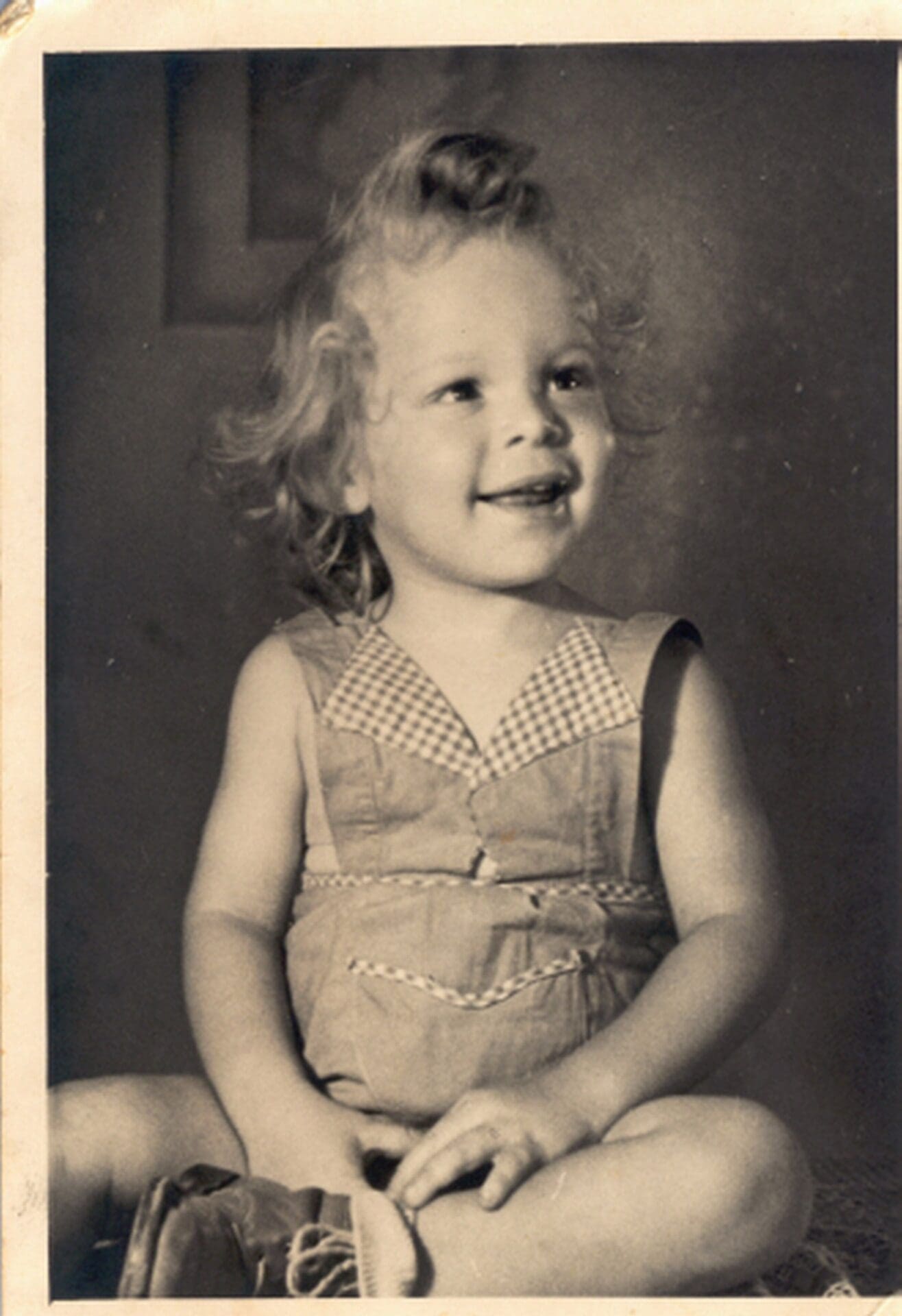
Into this reality came the twins Yona and Avi in 1952. They were born at the "Imahot" maternity hospital on President Boulevard, then Acorn Street.
The building in which they were born also had an extraordinary story. It was designed in 1936 by architect Shmuel Rozov as the home of the Rotenberg family, and was converted into a maternity hospital in 1945 at the initiative of Dr. Pinya Rotenberg. Not only Haifa's children were born within its walls, but also members of the Jordanian royal family, thanks to the friendly ties with King Abdullah I, who even gifted the hospital a large Bedouin tent where circumcision ceremonies were held. There was an almost poetic historical irony in this: in the same place where princes were born, the children of those who arrived destitute, after having lost an entire world, were also born.
The child born into memory
Yona did not know the grandparents who never got to see him, nor the uncles and cousins who were murdered before he was born. But their absence was present in the house, almost as if they were sitting around the Shabbat table. He grew up knowing that his parents were not just new immigrants, but people who managed to save their lives from the abyss and, with an almost unimaginable effort, built a new family out of it.
His childhood in Haifa was therefore more than the story of a child in a developing city; it was the story of a generation born into a young country, but inheriting an ancient memory of destruction, survival, and rebirth. The streets where he played, the port where his father worked, and the humble home where he grew up were not just a setting, but living testimony to a journey that began in the forests of Volin and ended on the slopes of Carmel. From there, from that humble and meaningful starting point, the story of Yona's life began to be written, a story that was destined to move away from loss, but never to be separated from it.

The happiness on the fourth floor
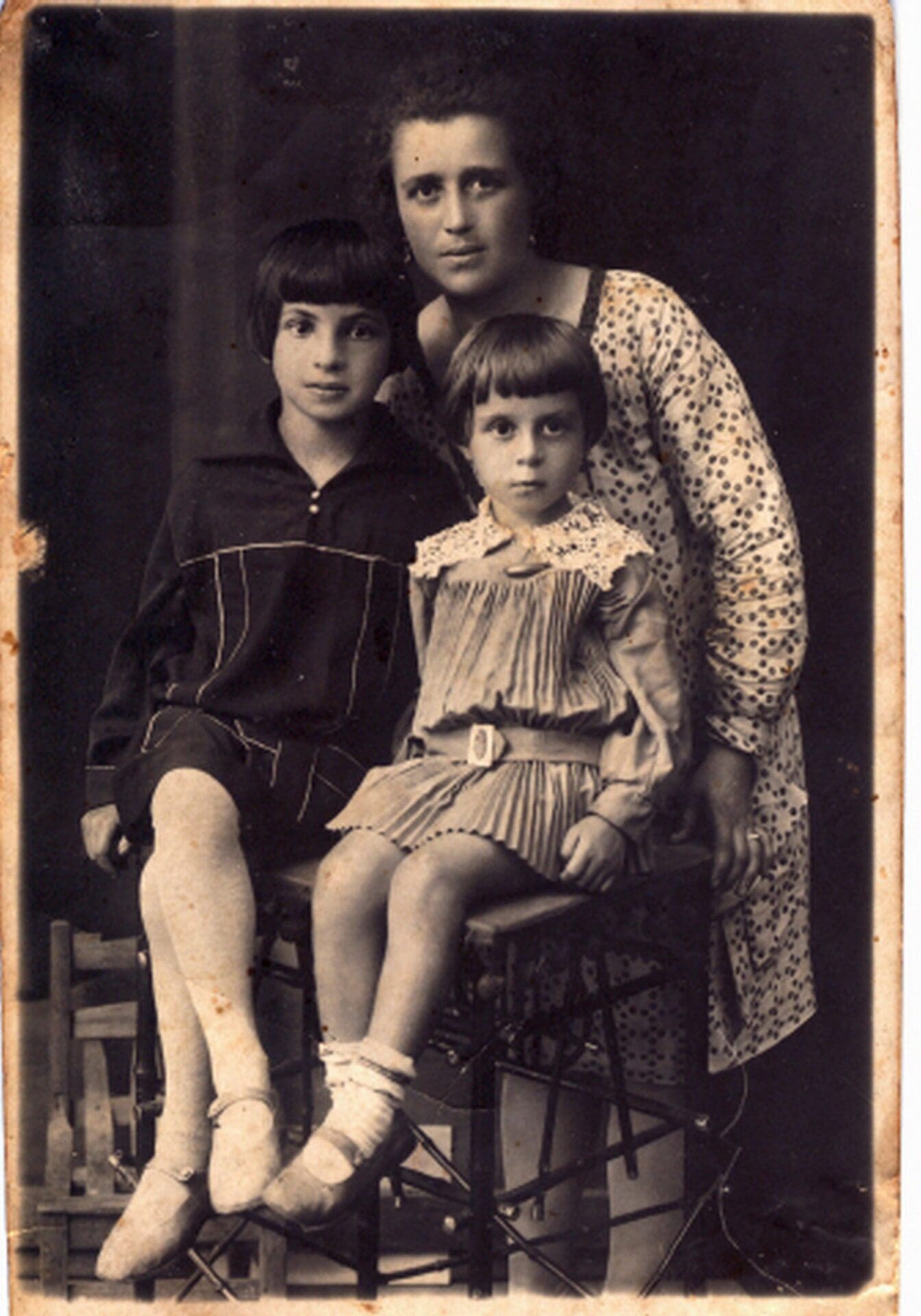
In 1957, when Yona was five years old, the family moved to a modest two-room apartment on the fourth floor of a building at 12 Rothschild Boulevard, in the Kiryat Eliezer neighborhood of Haifa. For a couple of Holocaust survivors, who had arrived in Israel with almost nothing, it was not just an apartment, it was the first time the future had an address. The neighborhood, built in the early 1950s for new immigrants and workers in the port and surrounding industries, was one of those neighborhoods of the young state where everyone started from almost the same point, working-class families, immigrants from Europe and North Africa and the Middle East, shared the same streets and the same economic reality. No one felt out of place, because almost everyone had a similar story of starting over.
From the balcony on the fourth floor, one could see the Kiryat Eliezer Stadium, which for decades was the beating heart of the neighborhood and of Haifa soccer. On Saturdays, the sounds of the games reached the house, while Yona and his brothers Avi and Pesach, the late, could watch Maccabi and Hapoel Haifa games from afar. The stadium, the streets, the children playing outside, and the urban landscape became the setting for a simple but happy, very happy childhood.
The house itself was very small. The parents slept in the living room, and the three children shared one room. The mother did not work until the twins were twelve, while the father worked seven days a week, twelve hours a day, to support his family. Until the age of eight, Yona hardly saw his father; he would leave early in the morning, while the children were still sleeping, and return at night after they had fallen asleep. But behind the physical absence stood a different kind of presence: a father who tried to give his children what was so lacking in his own life – security.

A house built beyond words
Despite the crowding and simplicity, the house on Rothschild Street was a place of love and togetherness. The family had no extended family to lean on, no grandparents, uncles or relatives to fill the gap, there were only the parents and the children, and within this limited circle a deep bond was formed. Yona's parents showered their children with love and cared for their upbringing and education, as if they wanted to make up for everything that had been taken from them.
At home, there was a quiet division between the world that had been lost and the world that had been built. The parents spoke to their children only in Hebrew, wanting the children to be Israelis in every sense of the word; among themselves, they still spoke Yiddish, the language that carried the memory of Europe and the people who had not returned. Gradually, the children became their parents' guides in the new world: they taught them Hebrew, reading, and writing, and thus the natural order was momentarily reversed. The children taught their parents the language of the future.
Yona and his twin brother Avi walked together through all the stages of their childhood. At the age of five, they went to kindergarten together in the neighborhood and at the age of six, they began studying at the "Dror" elementary school, where they spent eight years alongside friends who came from families of European and African descent. It was a childhood of deep friendships, playing in the streets and a complete sense of belonging. It didn't have many luxuries, but it did have a different kind of wealth: the knowledge that they were part of a community.
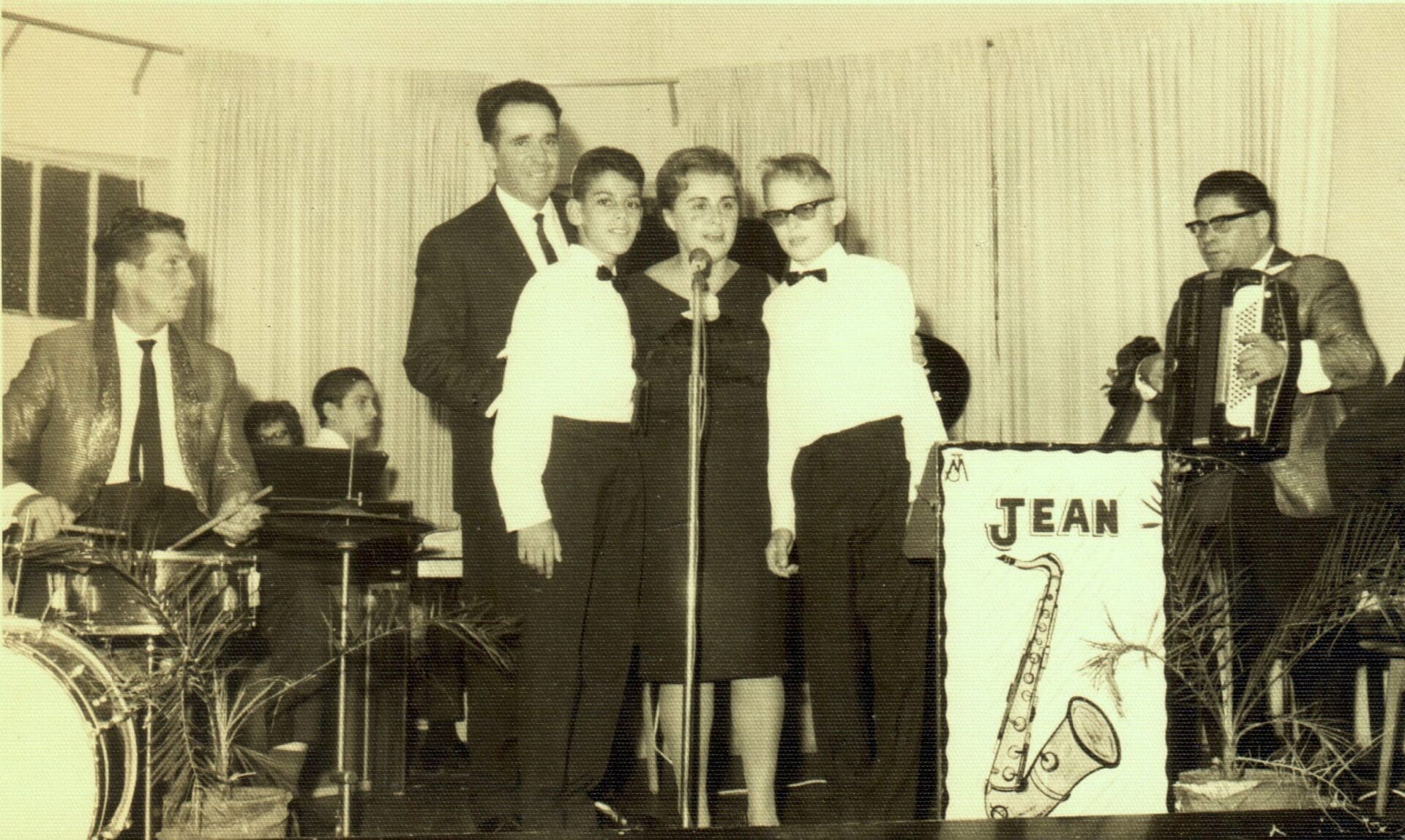
At the age of thirteen, a particularly symbolic moment arrived. A bar mitzvah party was held for Yona and his twin brother, at the "Casino" in Bat Galim, one of the historical buildings most associated with Haifa. Despite its name, it was not a place of gambling, but a social and cultural center built in the 1930s on the waterfront.
There, facing the sea, his parents celebrated their sons' entry into the adult world. For those who had arrived years earlier as refugees without family and without possessions, it was an almost inconceivable sight: two sons, friends around them, a new city behind them and a future ahead of them. For a moment, everything that had been lost in Europe was pushed aside and in its place stood the family they had managed to build.
From the electronics lab to the big world
After eight years of study at the "Dror" elementary school, Yona reached a new stage in his life. Instead of continuing on to a theoretical high school track, he chose to study at a theoretical-vocational high school towards a degree in "electronics technician." It was a practical choice, almost typical of a generation of working-class families, for whom a profession was not only a field of interest but also a key to independence and security. During his years of study, alongside the humanities subjects, he studied mathematics, chemistry and physics at a five-unit level, and at the same time delved into the basics of electricity, electronics and radio.
But the path to the profession was not easy. Studies and training continued day after day, from morning to night, leaving very little room for life outside the classroom. The friends, the street, and the spontaneous encounters of his childhood in Kiryat Eliezer were pushed aside. A world that was once full of games and friendships became a world of laboratories, drawings, and devices. It was a period of accelerated maturation, in which Yona learned not only how to assemble electrical circuits, but also how to bear responsibility and persevere in the path he had chosen.
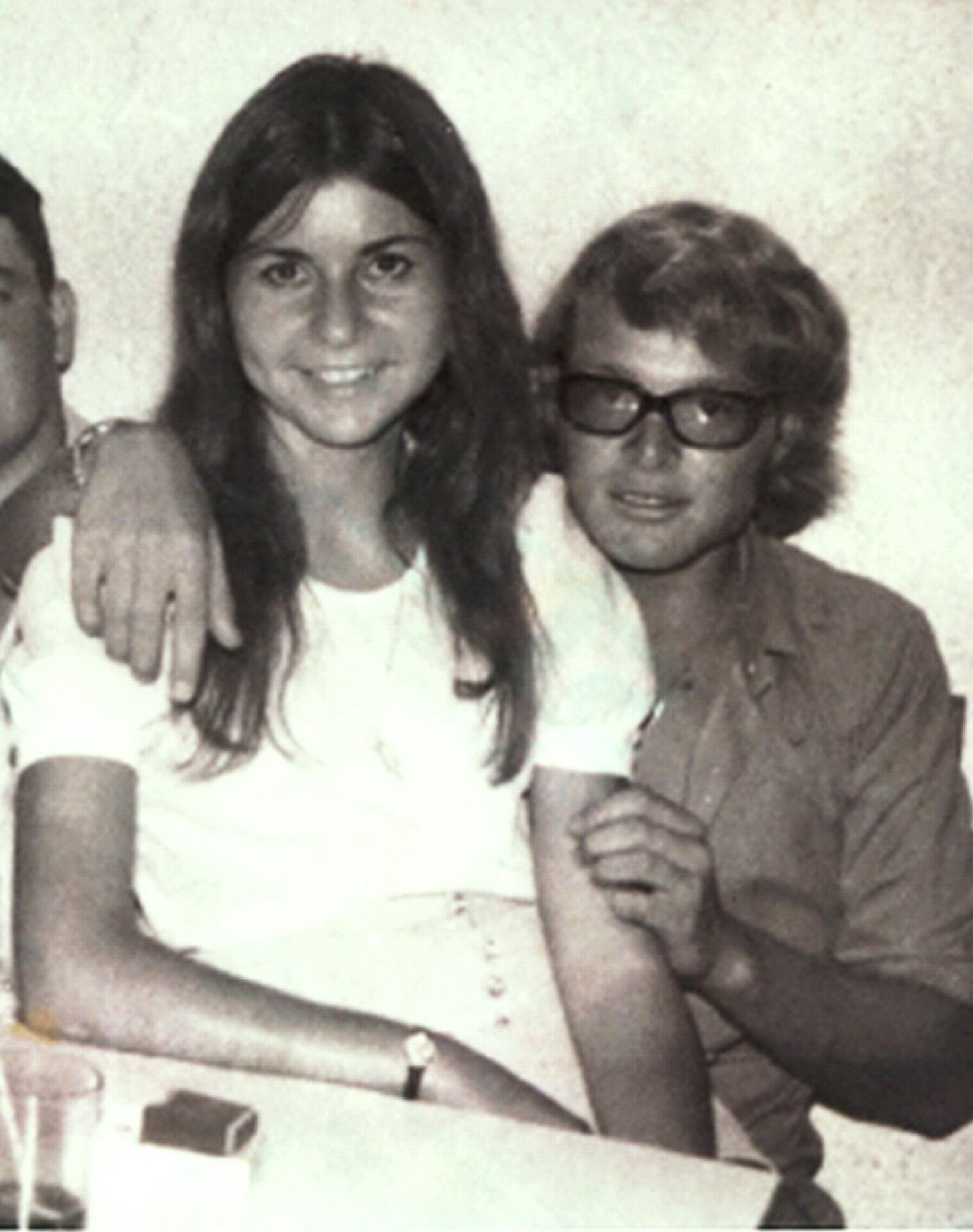
It was precisely during this demanding period that a meeting came that changed his life. In the twelfth grade, he met Atara, a 10th grader at the "New High School" in Haifa. She entered his life at a time when his world had been reduced almost entirely to studies and work, and brought with her a different space: friendship, closeness, and a sense of home. Since that meeting, their paths have never parted.
Between sea, war and mission
Immediately after graduating, Yona enlisted in the IDF. Due to his professional training, it was determined that he would serve in a professional corps, on the condition that he sign up in advance for an additional year of permanent service. Thus began four years that became the foundation of his military career: three years of compulsory service and a year of permanent service. In 1971, he joined the Navy, a professional but also family corps, where he would spend most of his adult life.
After a three-month training period, he began his career as an electronics technician at the missile ship and submarine base in Bat Galim, the same area of Haifa that he had known since childhood. He soon moved to the Navy training base, where he served as an electronics instructor at the school that trained the Navy's electronics technicians. He moved from the technical side to the educational side, from working with electronic systems to working with young people who were just starting out.
Then came the Yom Kippur War. In October 1973, Yona found himself not only as a professional but as a fighter. He served on the Navy’s missile boats, which went out to sea every night to fight enemy ships from Egypt and Syria. For a young man who grew up in a home of Holocaust survivors, just one generation away from the destruction in Europe, it was a particularly charged experience: Jewish history was no longer a story he heard at home, but a responsibility he bore in uniform.
After the war, he returned to the training base in Bat Galim, where he combined professional knowledge with the ability to pass it on to others. Over the years, he advanced through the ranks of the Navy, holding a variety of command positions, and finally retired in 1996 with the rank of Lieutenant Colonel, after twenty-five years of service.
A pair of pants, an empty apartment and the beginning of a home
In May 1975, just three months before the end of the fixed year to which he had committed in advance, Yona married Atara, a member of the Aharonovitz family, after four years of courtship and a courageous friendship. The wedding was held at the "Bat Gal" hall in Bat Galim, only fifty meters from the "Casino" in Bat Galim, where years earlier he had celebrated his Bar Mitzvah.
Two moments in his life met on the same coastline: the boy who celebrated his entry into the adult world there and the young man who began his independent life there.
The wedding was held in a modest hall. In Haifa at that time, there were more luxurious halls, but these were beyond their financial means. The first house they had purchased a short time earlier was also the result of great effort, not wealth. With the help of Atara's parents and a heavy mortgage, they purchased a modest apartment in Kiryat Sprinzak, an immigrant neighborhood with a low socioeconomic status, an apartment on the third floor of a building with columns. Yona's salary in the permanent service was a thousand liras, and the mortgage alone was five hundred liras.
Yona's parents, who had lived their entire lives in modesty and had even helped with his older brother's wedding a year earlier, were unable to help him financially. So, the day he left his childhood home, he moved into his new apartment almost empty-handed. The apartment had a refrigerator, a stove, and a double bed, but beyond that, almost nothing. He arrived with a pair of pants and a shirt he was wearing.
But it was precisely from this simplicity that a new chapter began.
After a childhood built on survival, and after a youth dedicated to studies and service, the moment came when Yona Mazor first built something that was entirely his own. And luck, as he himself would say years later, "the luck began to shine the moment he met Atara."

Between a blue sea and a big world
In the first years after his marriage, Yona Mazor continued to flourish within the Navy. Along with his professional success, he also earned great respect from his commanders and fellow unit members. The army, which began for him as a service framework, gradually became a professional and social home.
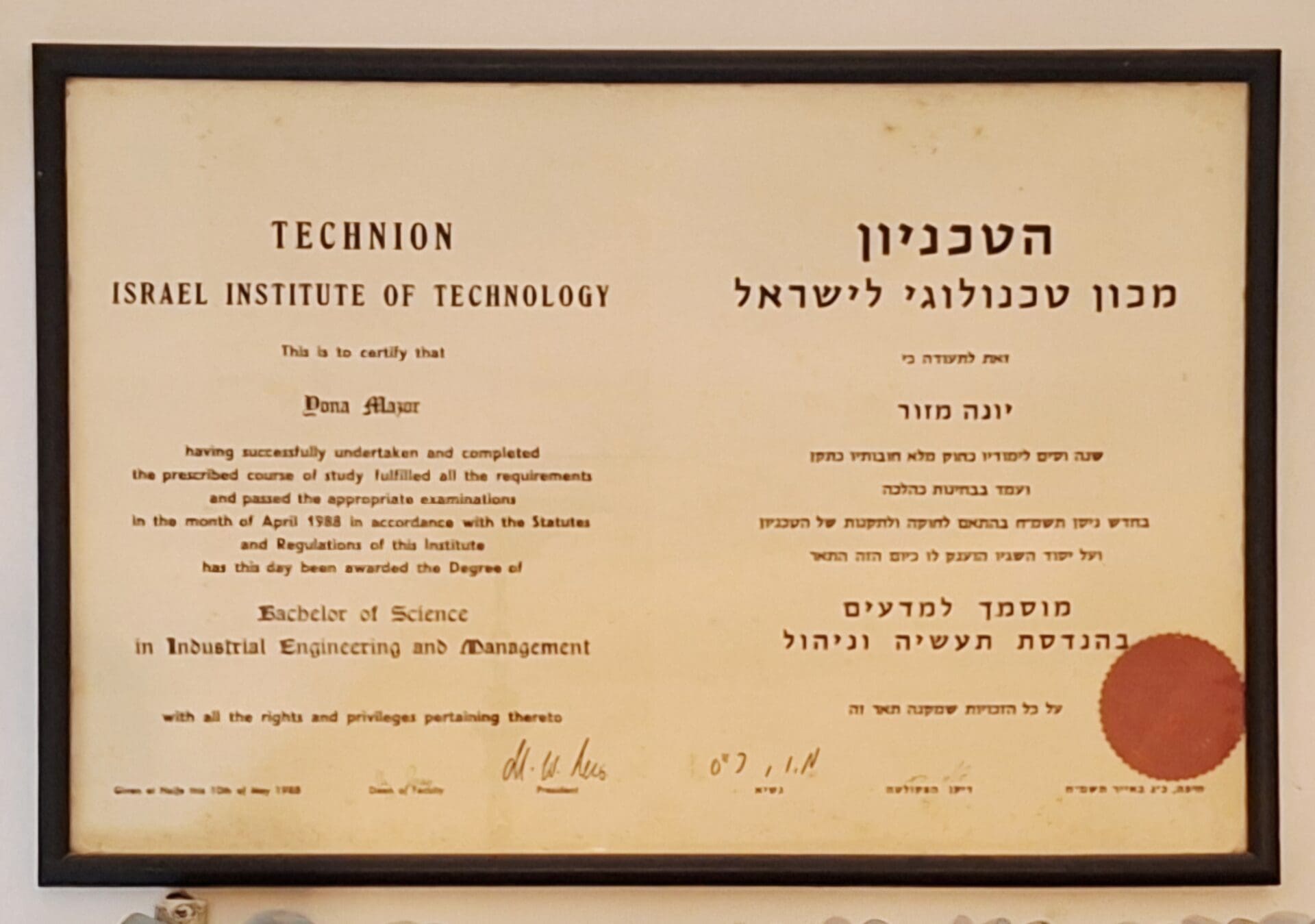
While serving in the military, he did not give up his studies, completing a degree in electronics engineering at the School of Engineering adjacent to the Technion. For a member of a family of survivors, who grew up in a small apartment in Kiryat Eliezer, education was not only a personal achievement but a direct continuation of his parents' dream: to give their children options they did not have.
Towards the end of the first year of permanent employment to which he had committed in advance, Yona began planning his next steps and was accepted into a job at Elbit in Haifa as an electronics technician.
But the Navy was not willing to give him up. His success in the roles he held, the professional knowledge he developed, and the trust he gained made him a person that the military establishment wanted to keep in its ranks. Just a month after his wedding to Atara, when he was still a young soldier and two months before his scheduled discharge, an offer arrived that changed the course of his life: to go with his wife to the United States for a year, to oversee security projects that the Navy had purchased for its missile ships and submarines.

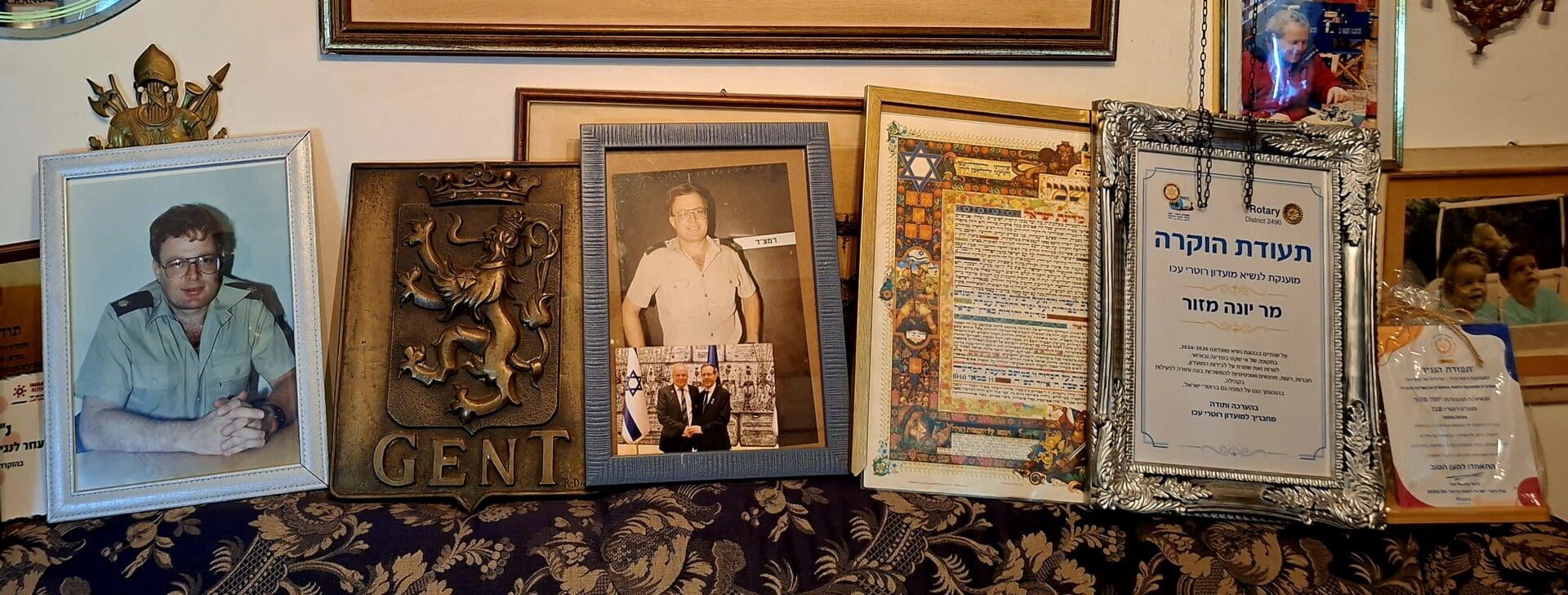
The Year of the Rising Sun in America
In July 1975, Yona and Atara left for the United States. They were twenty-three and twenty-one years old, a young couple with almost no life experience, leaving the country for the first time and embarking on a completely foreign world. They had no relatives overseas, no car, no deep familiarity with the English language, and no safety net to ease the transition. Yona had only a partial command of English at the time, and yet he soon found himself at the heart of American technological activity.
It was a period that became a memory of light and freedom for them. Alongside their professional work, they experienced a kind of long honeymoon across the United States.
Yona worked in electronics factories in Philadelphia on the East Coast and in California's Silicon Valley on the West. At the age of twenty-three, with the rank of first sergeant, he found himself single-handedly responsible for military projects worth hundreds of millions of dollars. He supervised the work of experienced American engineers and technicians, checking compliance with standards and certifying the performance of systems intended for use on the Israeli Navy's advanced vessels.
Without a doubt, this year was a school of life for the couple. They traveled the length and breadth of the United States, even reaching Canada, and in 1976 they celebrated the bicentennial of the United States' independence with the Americans. Beyond the experiences and landscapes, the mission gave them independence, self-confidence, and life experience that cannot be acquired in any educational institution. They managed to save money, return to Israel with essential items for their modest apartment, and most importantly, with a feeling that they were capable of facing the world.
Towards the end of their mission, the most significant turning point in their lives occurred. In 1976, when Atara was eight months pregnant, the couple returned to Israel, to the complex reality of building a new life, developing a career, and starting a family. Shortly after their return, their first daughter, Vered, was born, marking the beginning of a new chapter in their lives, one in which professional and family aspirations began to intertwine.
Between uniform and family
Upon his return to Israel, Yona returned to serve in the Navy, while Atara began her academic career at the University of Haifa, where she studied for a bachelor's degree in English and sociology. In parallel with her studies, she worked in the human resources department at Rambam Hospital, to help support the family. The first period as young parents was particularly difficult. Yona was absent from home a lot due to his military service, and the entire burden of raising the girl, her studies, and her livelihood fell largely on Atara's shoulders, especially at a time when they didn't even have a private car.
But out of this difficulty, a strong foundation of partnership was also built. Each of them continued to grow in their field. Yona advanced through the ranks, took an officer course, and became an electronics officer on the Navy's missile ships and submarines. He later studied at the Technion for a degree in industrial and management engineering, and specialized in the field of project management, a field in which he was able to combine the technological knowledge he had accumulated with the command and management abilities he had developed.
In the next stage, Yona was appointed head of the office of the Deputy Commander of the Navy in the field of procurement and maintenance of missile ships and submarines. The position required the family, which already included two daughters, to move to Ramat Gan for four years.
For Atara, this was a significant change: she left her position in the human resources department at Rambam and was accepted into a senior position in the human resources department at Ichilov Hospital, where she continued to build a successful career for herself.
Later, Yona joined the team that managed the procurement of the first three submarines purchased in Germany. He was responsible for contracts, budgets and construction processes, and as part of his role he moved constantly between Israel and Germany, to the cities of Hamburg, Kiel and Emden. For someone born into a family that was displaced from Europe, these journeys had an almost unimaginable dimension: the son of Holocaust survivors, whose life began with a story of escape and loss, returned to Europe as an Israeli professional leading strategic projects for his country.
In 1996, after twenty-five years of service, Yona Mazor retired from the Navy with the rank of Lieutenant Colonel.
He left the military system with a deep sense of satisfaction, with professional and social connections that lasted for years, and with the knowledge that the journey that began as a small child in a two-room apartment in Haifa led him to places he could never have imagined.
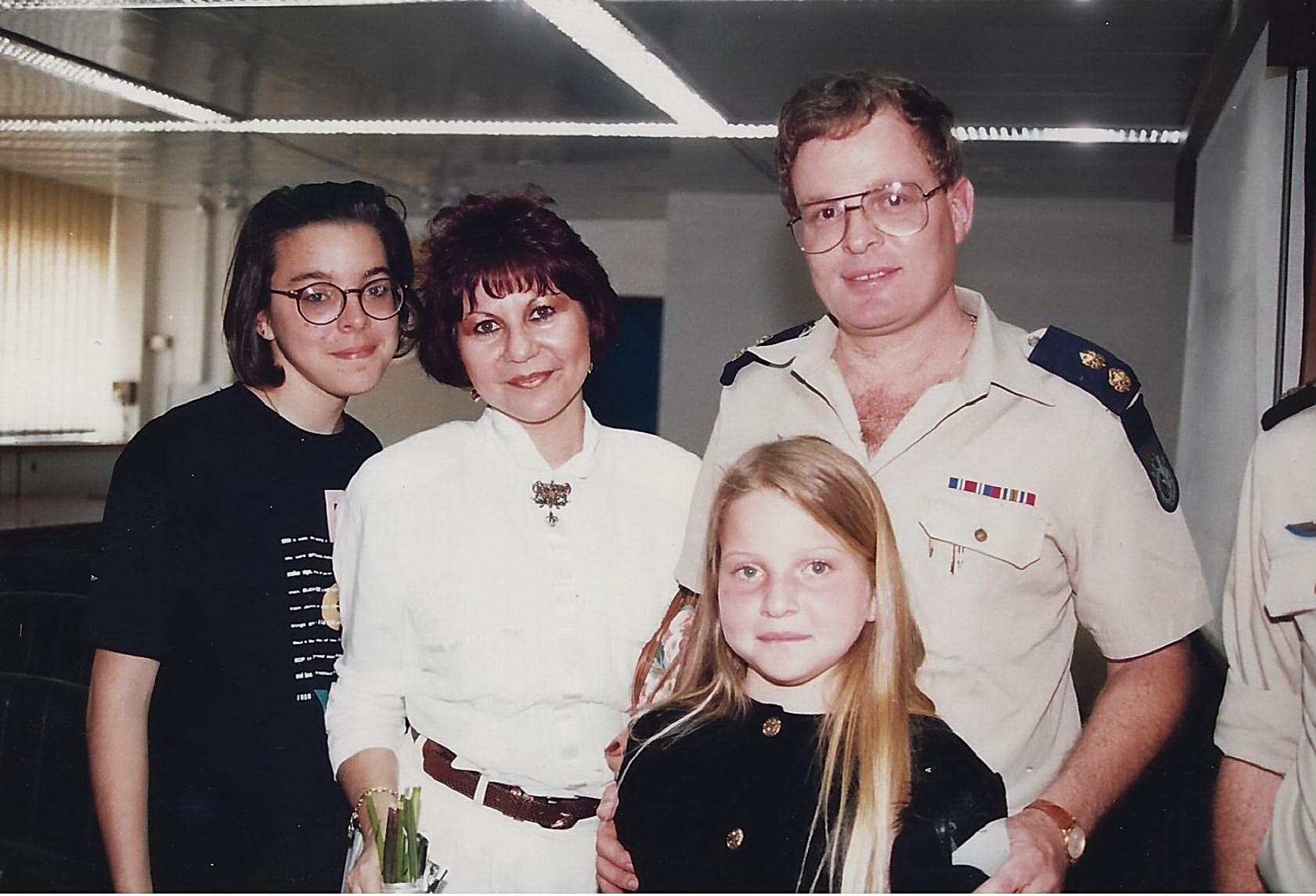

Return to Carmel, start over.
Upon his retirement from the Navy in 1996, after twenty-five years of service, Yona Mazor returned to Haifa with his family. After years of living according to military schedules, moving between bases, ships and international projects, the moment came when it was possible to stop and re-choose the next direction. The family moved to a new house in the Vardiya neighborhood on Mount Carmel, and there, for Yona and Atara, another chapter in their lives began: no longer a large military system with national missions, but a personal journey of creation, independence and rediscovery.
The transition to citizenship was not a retirement from work for them, but a change of form. Yona brought with him the world of engineering, project management and the ability to build complex systems, while Atara brought her many years of experience in the fields of human resources and management. Together they decided to turn a completely new page.
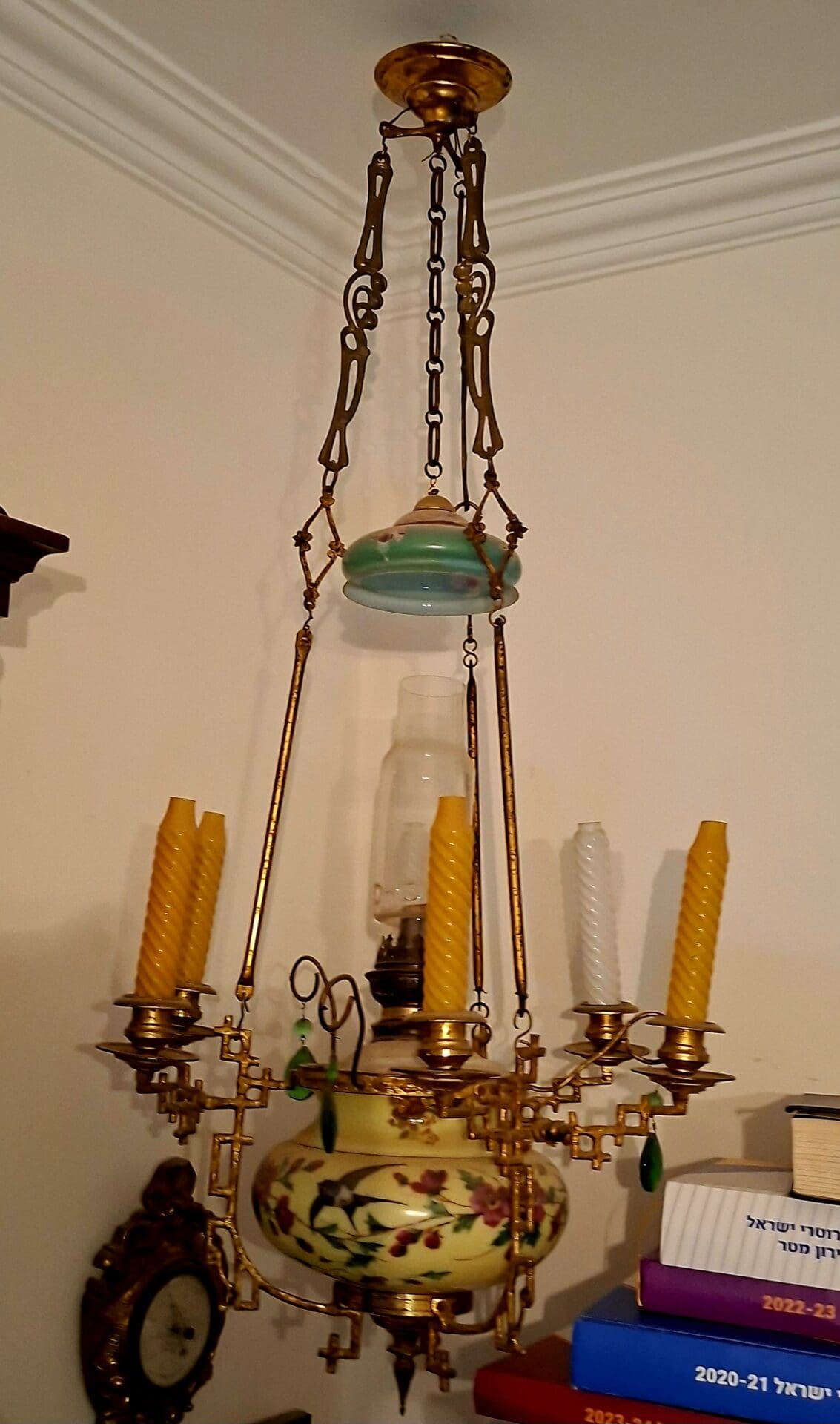
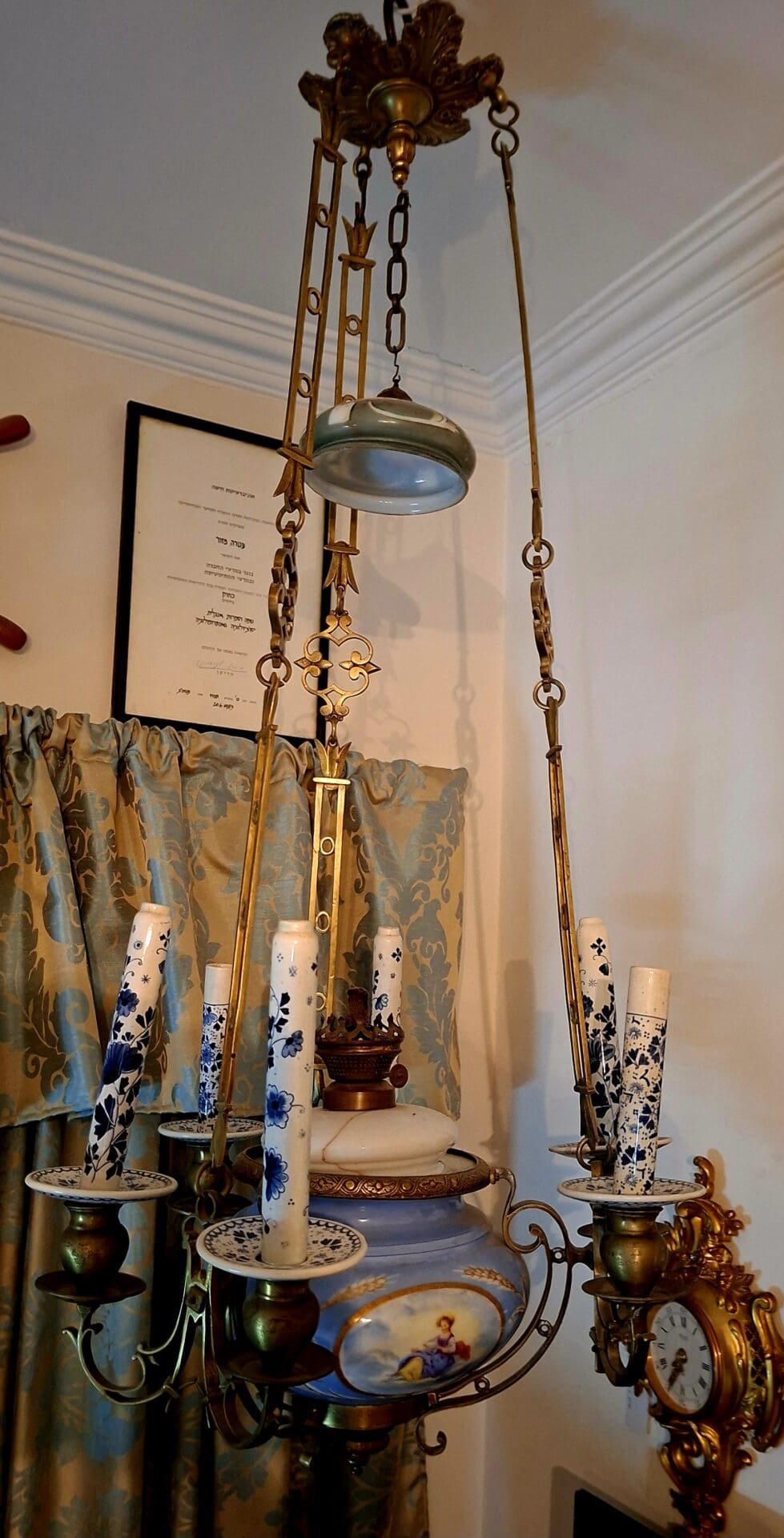
They purchased from an elderly jeweler, who felt it was time to sell his business, a spacious building that housed the old workshop "Orand", which manufactured and repaired chandeliers. The place quickly became a meeting point between history, art and the craft of renovation and restoration.
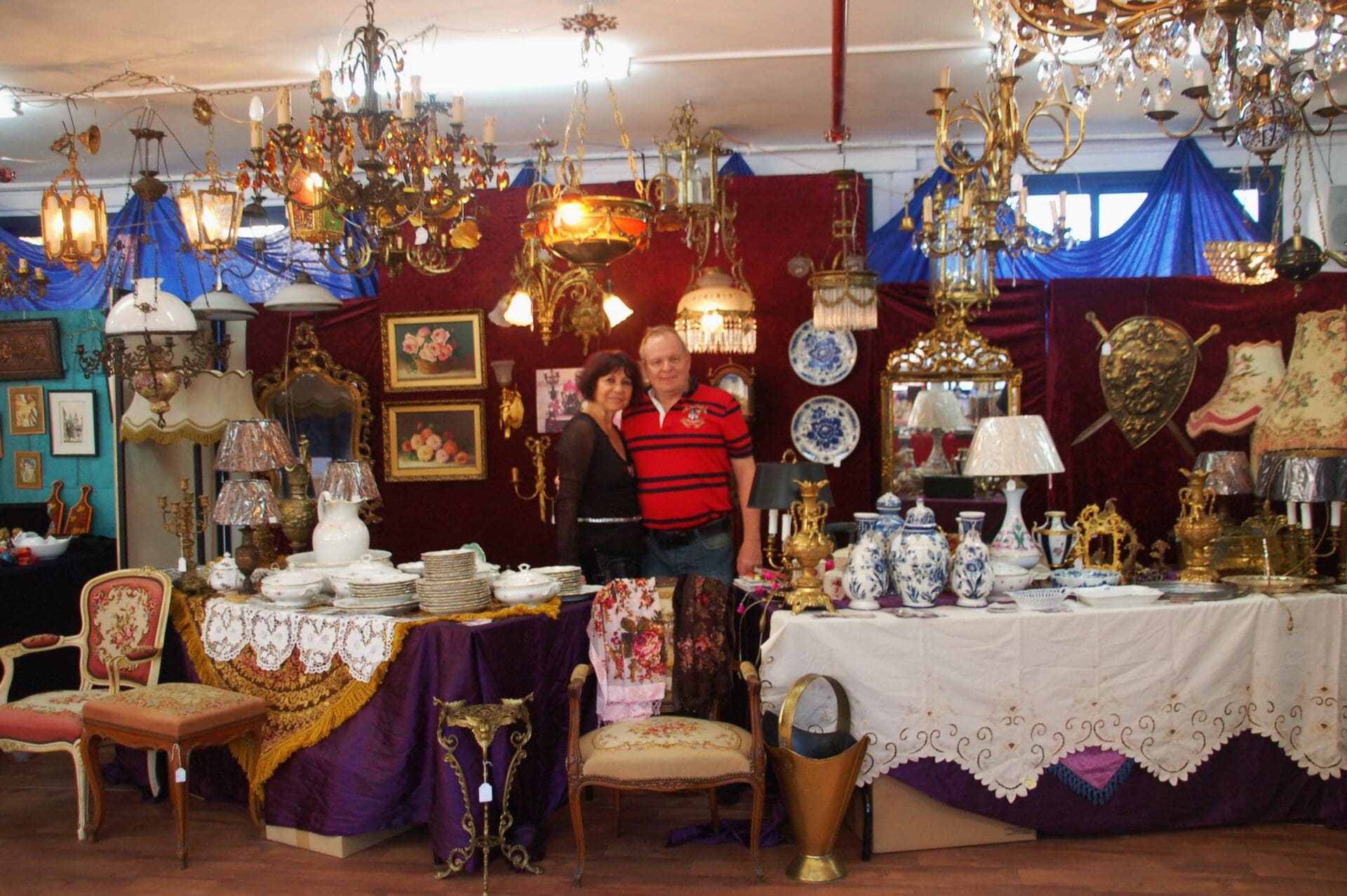
A weekend that changed the fate of "Orand"
1996 was supposed to be a year of consolidation. Shortly before, Yona Mazor had completed the acquisition of "Orand," a long-standing chandelier workshop, from its founder, an eighty-four-year-old craftsman, who had entrusted him with not just a business but a decades-long tradition, a reputation that had been meticulously built, and a workshop in which it seemed as if time had stopped. Mazor believed that his role would be to continue what was existing, to polish the craft, and to lead the brand into the future. But life, as often happens, decided to chart a completely different course for him. The big change was not born from a business plan, not from a management meeting, nor from market research. It began, rather, from a quiet family moment, at the request of his mother.
Between the treatment room and the antique market
His mother, Mina, needed medical treatment in the Netherlands with Dr. Meyer and his wife, a dietitian who accompanied the treatment method. She asked Yona to accompany her for an entire week.
Every day, from morning until one in the afternoon, she was immersed in treatments, while the weekends remained free. In one of the hotels, Yona happened to notice a small, almost marginal advertisement inviting visitors to an antiques market near the town where they were staying. He went there out of pure curiosity, but found himself in a world that seemed like something out of a European history book.
Between the stands stood dozens of antique chandeliers, made of crystal, brass, and glass, each bearing the marks of the era from which it came. He walked among them for long hours, fascinated by the works, the patina of the years, and the possibility of giving them new life. Finally, he chose five extraordinary chandeliers, carefully disassembled them into their parts, packed them into two small suitcases, and took them back to Israel with him.
From tradition to a journey of discovery
In retrospect, it was one of those rare moments when a person doesn't realize they are crossing an invisible line. The trip that was meant to accompany a mother on a medical journey turned into a journey of personal and professional discovery.
From that first visit, Yona and his wife Atara returned to the same markets in Europe again and again, searching not only for rare objects but also for the stories they contained. Gradually, the identity of "Orand" also changed. The workshop, known for years as a manufacturer of new chandeliers, began to become a home for antique chandeliers, carefully restored, alongside other antique items selected with a sensitive eye.
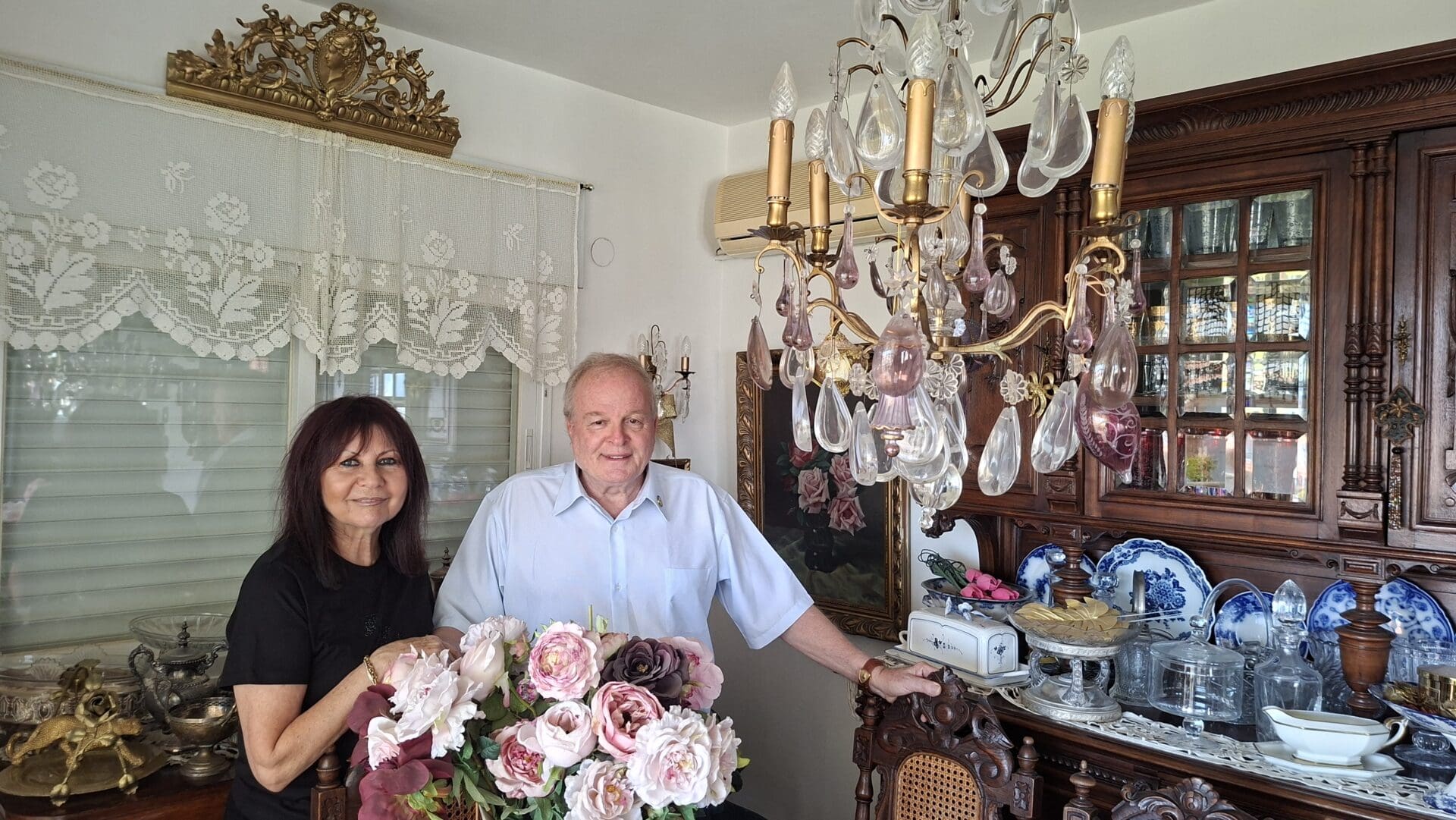
Atara deepened her knowledge in the field through studies at the Tirosh Gallery, bringing a professional understanding of the world of art and antiques to the business. Thus, a new identity was born for the place: no longer just a workshop, but a space where history is not kept behind glass, but continues to shine, literally, in the homes of new people.
The light that has been preserved for centuries
The gallery was not just a business. It was a journey into a world that had almost disappeared: a world of artisans, traditional crafts, and objects that carried with them memories of distant homes. Yona and Atra focused on antique chandeliers, clocks, porcelain, and rare furniture, and set out on journeys throughout Europe and the United States to locate items with a story.
They moved between antiques dealers and auctions in France, Belgium, the Netherlands, and various cities in the United States, and over the years they sent dozens of containers loaded with carefully collected items to Israel.
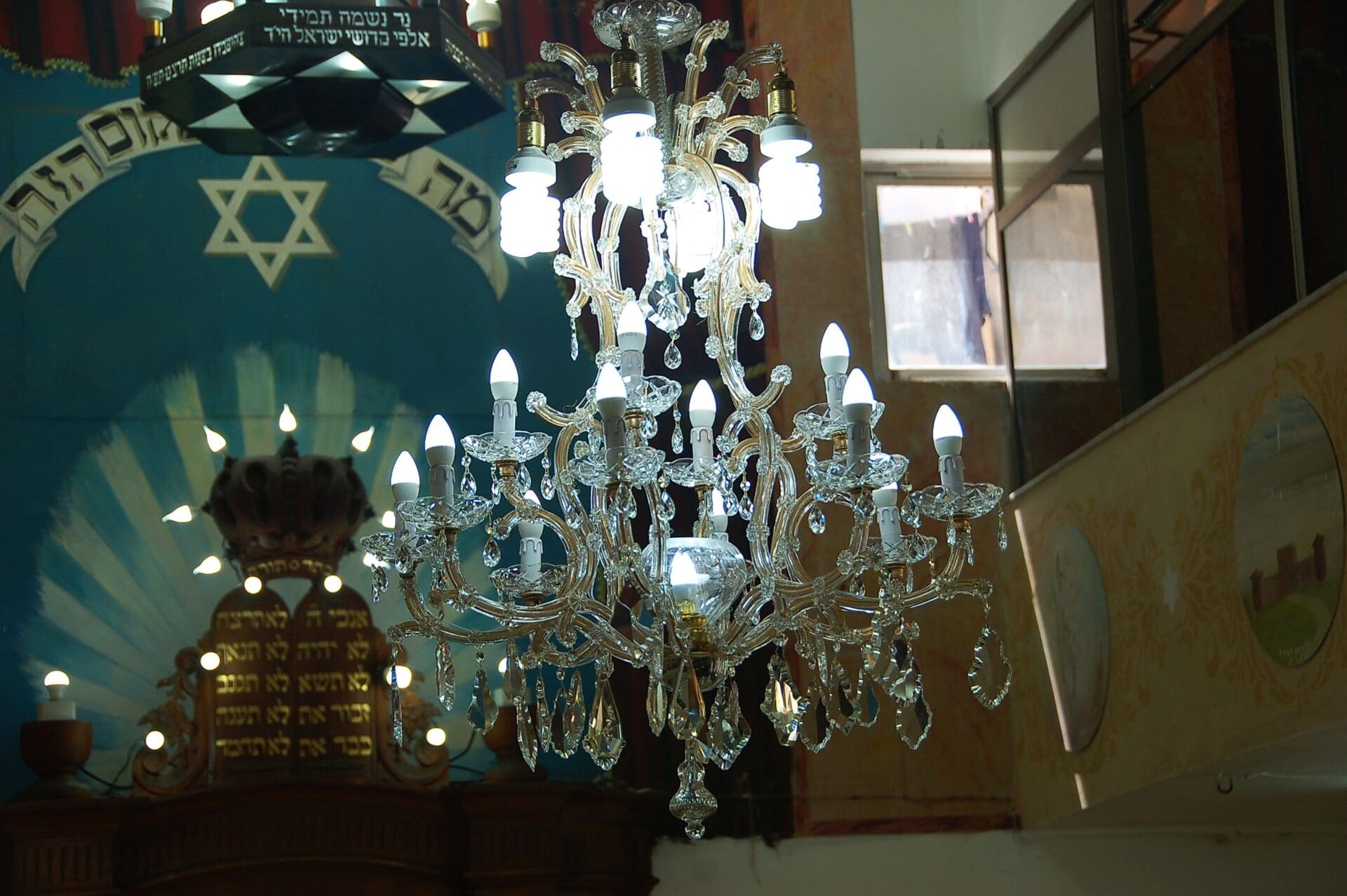
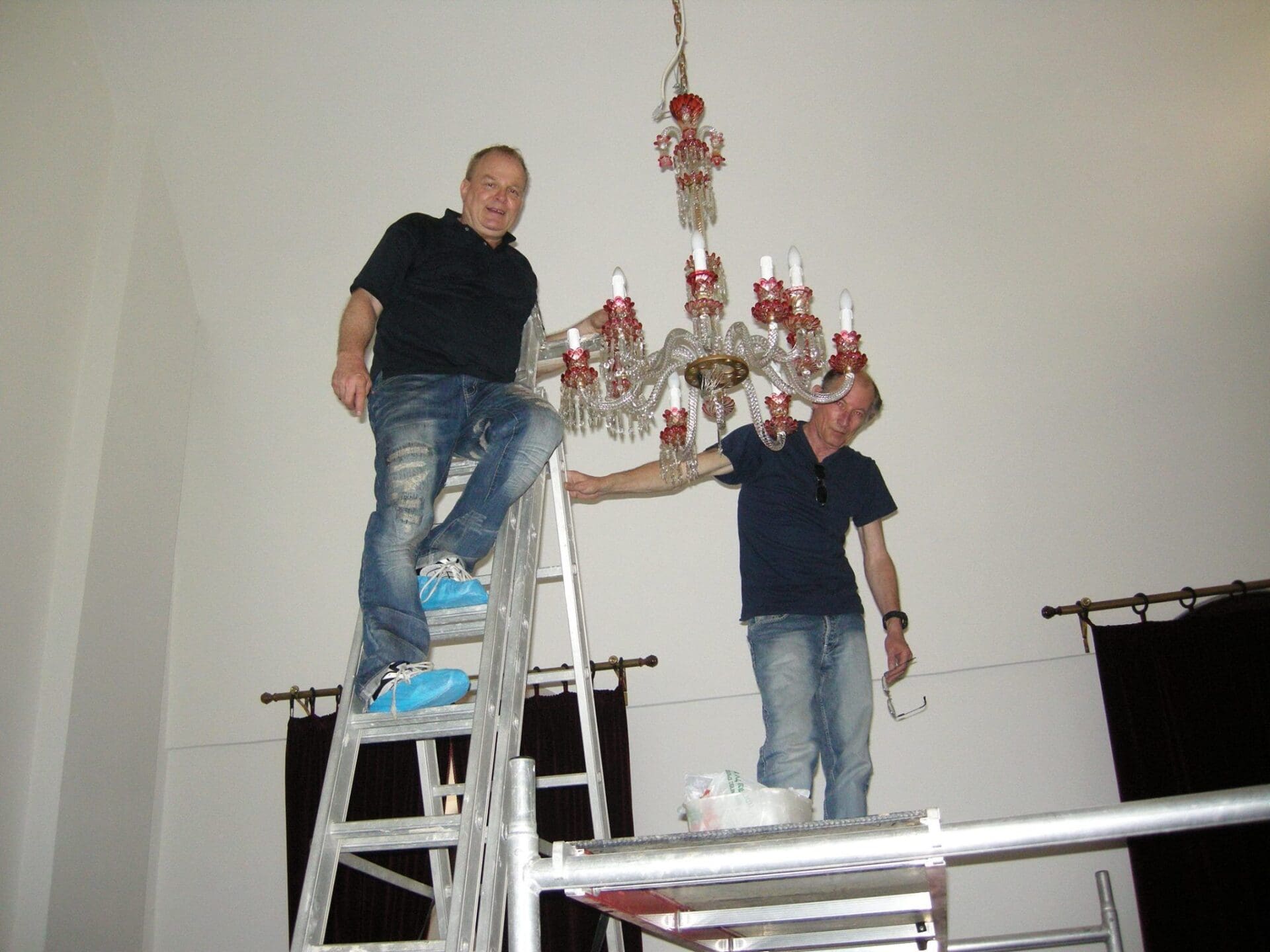
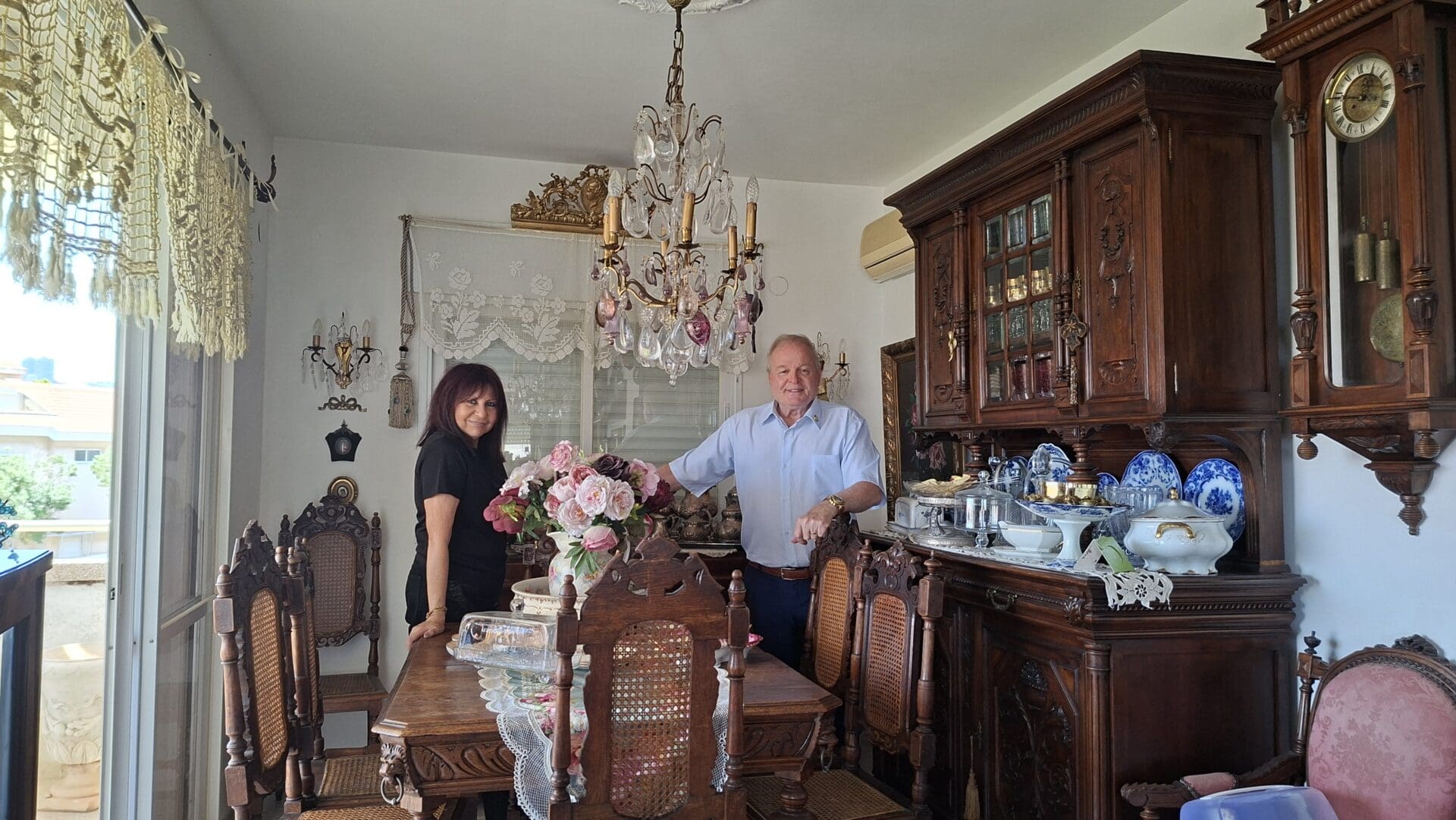
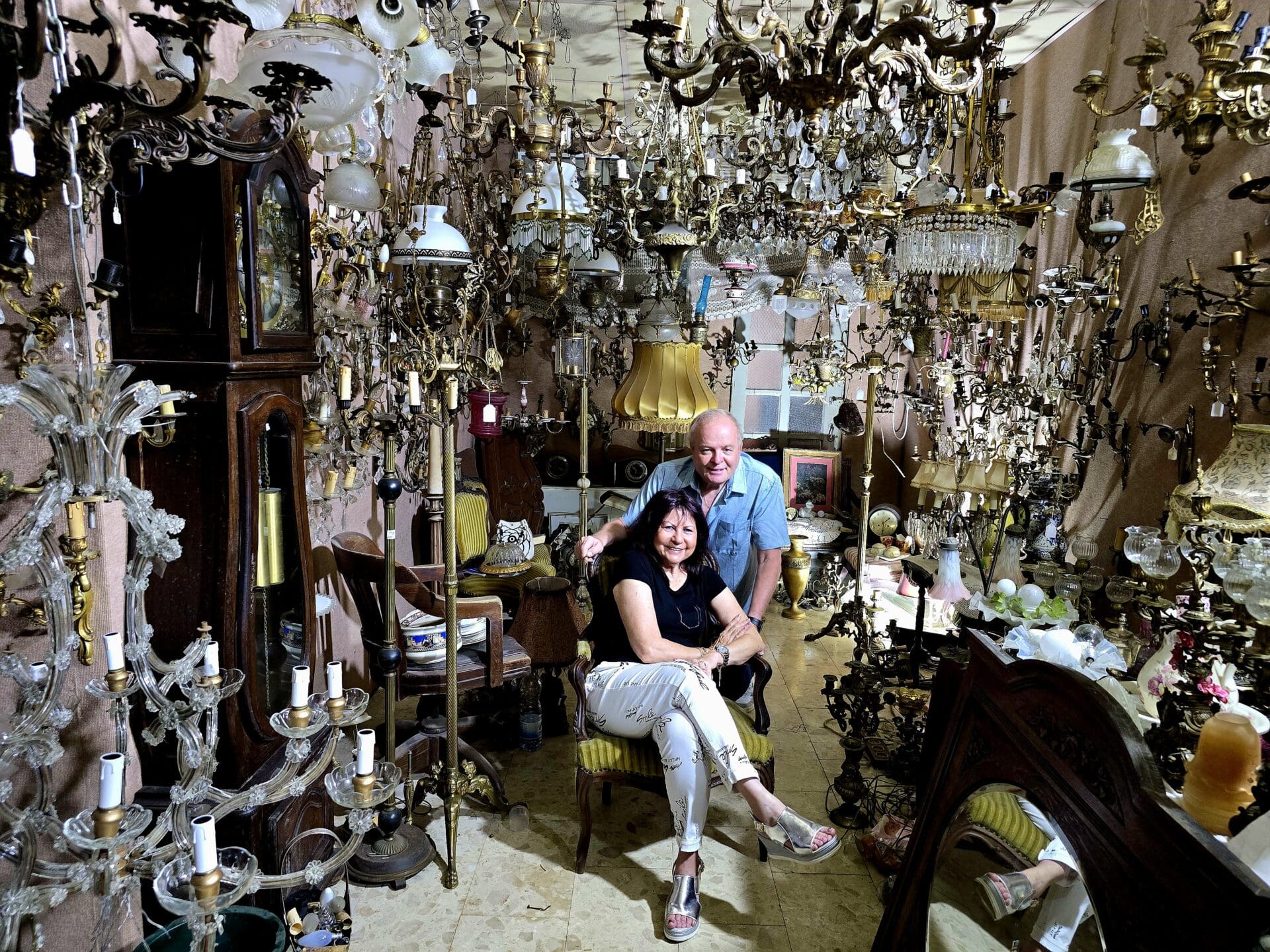
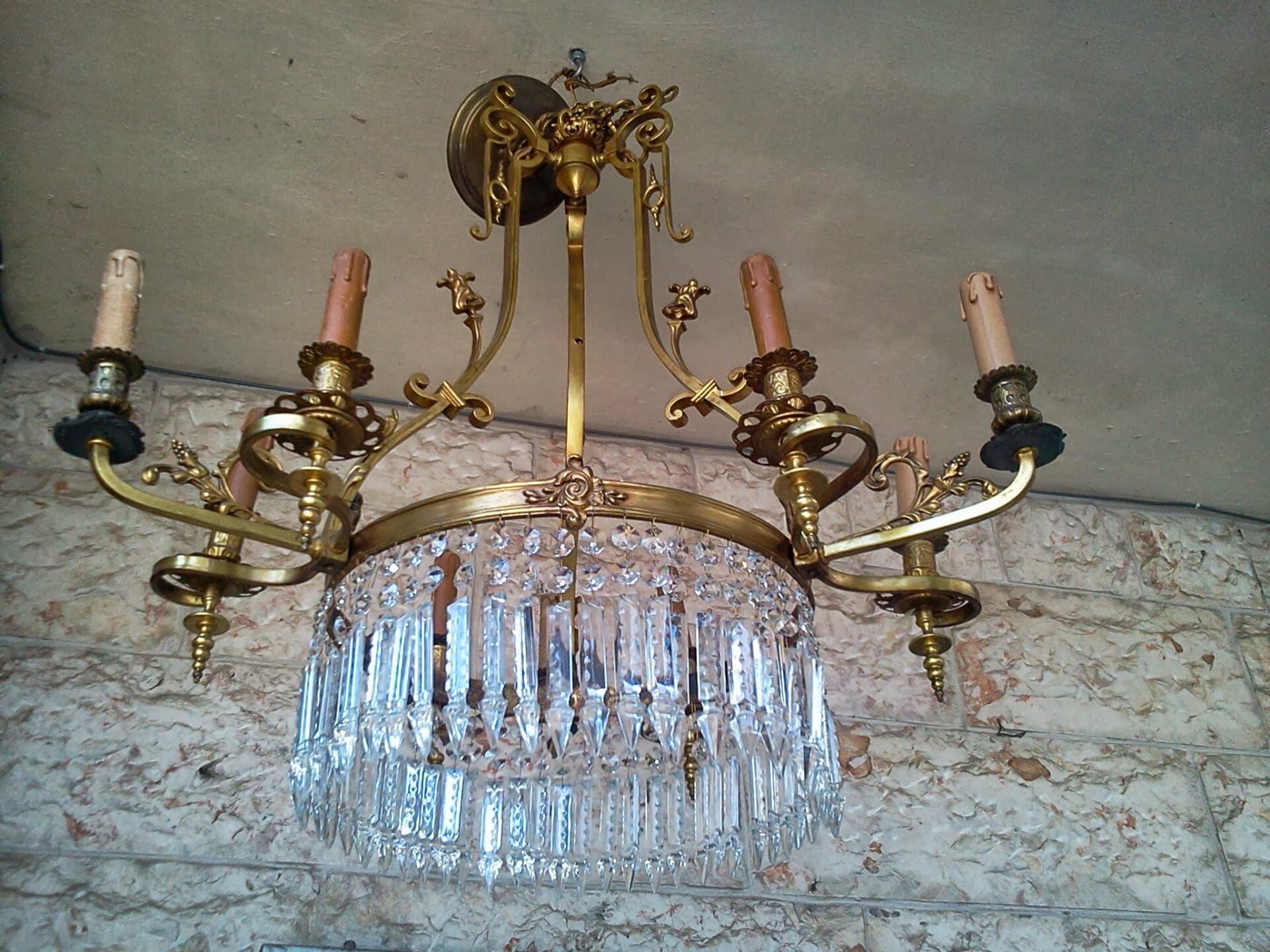
Among the items that arrived at the gallery were chandeliers and wall lamps that were centuries old, which were previously lit by candles, oil, and even gas. But Yona was not satisfied with collecting; from his technical background, he recognized the need to combine respect for the past with the demands of the present. Alongside the gallery, they established a professional workshop where the chandeliers were mechanically restored, new electrical systems, wires, and bulb sockets were installed, and they were adapted to the mandatory Israeli standards. Thus, the encounter between an engineer and the world of antiquities became a unique expertise: preserving history through modern technology.
It was precisely during the years when they built the gallery that the Internet began to change the world of commerce. For Yona and Atara, it was a real revolution. The network allowed them to locate new sources for purchasing items, establish connections with dealers around the world, and advertise their activities beyond the borders of Israel. At the same time, they published monthly in "Auction" magazine, a unique Israeli periodical that dealt with collectibles, art, antiques, and the valuables market, which was distributed, among other things, in the first classes of El Al planes and in prestigious hotels in Israel.
Over the years, "Orand Antique Lighting" has become the leading trading house in Israel in the field of antique chandeliers and the only professional restoration center of its kind in the country. Customers have come to them from all over Israel, from Metula to Eilat, including private homes, hotels, cafes, synagogues and public institutions. Among their customers was the Baha'i Center in Haifa, for which they sold and restored antique chandeliers. Their work has also reached overseas, to clients in Paris, Bucharest and New York.
From the house he built for himself to the house he built for others as well
The years at the gallery were a time of profound change for Yona and Atara. They not only changed professions, but learned a completely new language. Someone who had been an officer and engineer in large security systems for years became someone who was intimately familiar with objects created centuries ago, the stories of the craftsmen who created them, and the people who wanted to bring them into their homes. They enjoyed traveling in Europe and the United States, meeting different cultures, and the feeling that they were bringing life back to things that had almost been forgotten.
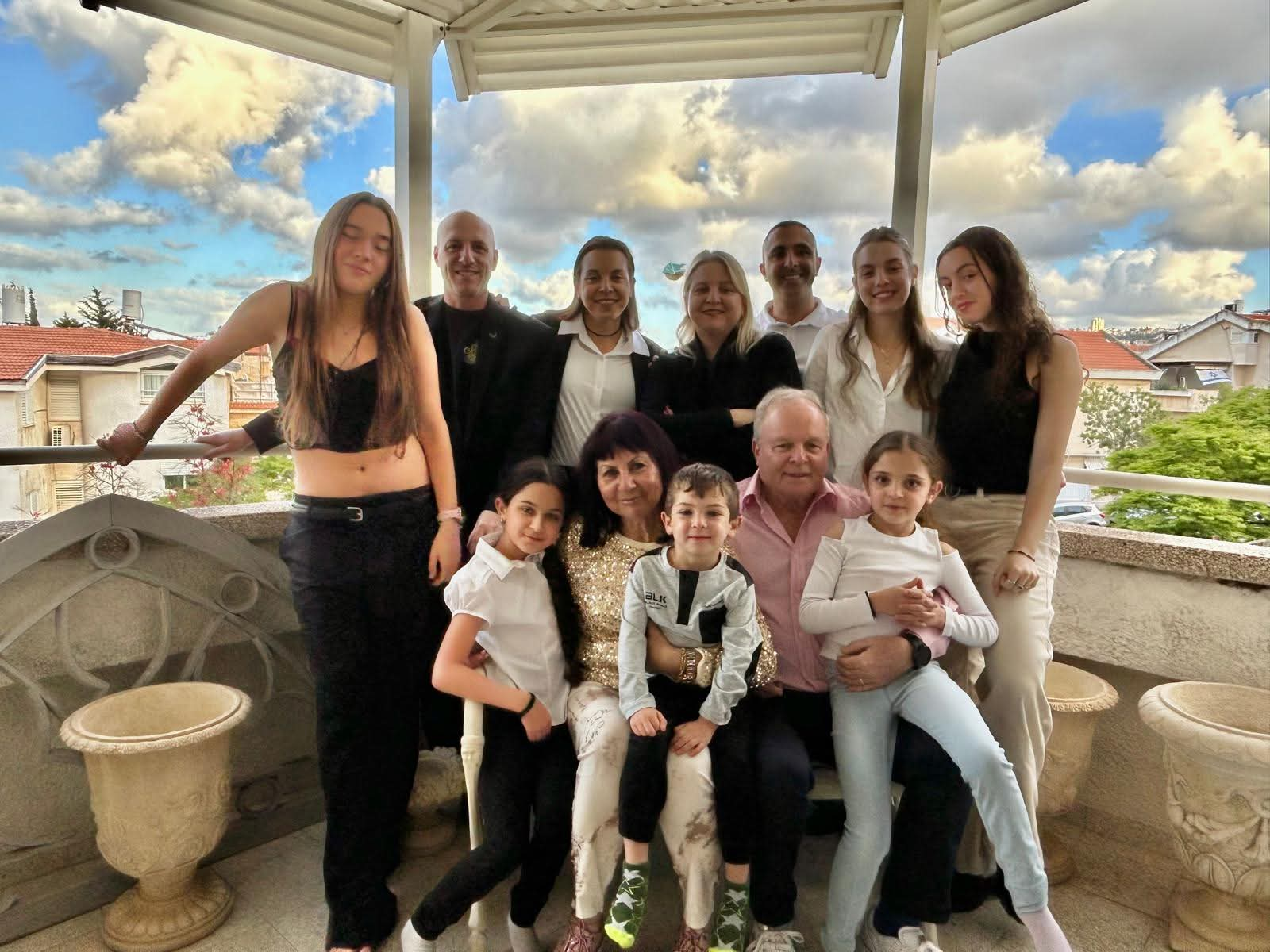
During this period, the family also continued to grow. Their two daughters, Vered and Anat, married and started wonderful families, each with three children.
When Ward was born, shortly after her parents returned to Israel, no one could have known that the baby who joined the family at the beginning of her journey would become a woman navigating complex systems in the digital world. Perhaps it was the spirit of the house that believed in perseverance, more than shortcuts, or perhaps it was the natural curiosity that grew between conversations about action, responsibility, and the pursuit of excellence. Either way, her path led her to the Faculty of Mathematics and Computer Science at the University of Haifa, where she acquired the foundations of the profession that became her calling.
Over the years, Vered has built an impressive career in the world of computing, a field where analytical thinking, decision-making, and the ability to lead people combine into a daily responsibility. While completing her MBA, she continued to advance to a senior management position at MAX Credit Card Company, formerly Leumi Card. This professional path reflects not only personal achievements, but also the values she absorbed at home: discipline, perseverance, and the belief that success is built over years, step by step.
If Vered chose the language of numbers and systems, then Anat was drawn to the world of humans. She did her military service as a T.S. officer in the Southern Command, a role that required sensitivity, listening, and the ability to deal with human distress in the most complex moments. Even after she took off her uniform, she remained loyal to her work with people and chose to study psychology at Tel Aviv University, out of a desire to understand in depth the forces that drive people and the delicate fabric of their lives.
Life has led her to the meeting point between humanity and organization. Today, she is in charge of the payroll system for about 1,100 employees at Playtika, one of the most prominent and influential companies in the Israeli high-tech industry in the field of mobile games. Behind the numbers, reports, and systems, stands a daily responsibility for the well-being of many employees, a responsibility that requires uncompromising accuracy alongside a deep understanding of the person behind the data. In many ways, this is a natural continuation of the same values of commitment, caring, and responsibility that have accompanied her since the beginning of her career.
When Yona reached the age of sixty-two, after the family had become financially stable, and his daughters and their families were on their own feet, he began to feel that another chapter had opened for him.
For years he had built systems, managed projects, preserved antiques, and built a successful business. Now he wanted to channel some of that energy outward, from personal success to contributing to society. For him, as throughout his life, this was not the end of a journey but a new beginning.
The end of a gallery, the beginning of a new life
There are places that don't close the moment the decision is made to retire. The end of a business's operations is a formal and clear process, but life within it doesn't stop as quickly. It continues to exist, quietly, among crowded shelves, wooden crates, carefully wrapped pieces of glass, and the familiar smell of old metal. Time seems to work differently there. In a place where rare objects have been collected for years, parting doesn't happen in a day either.
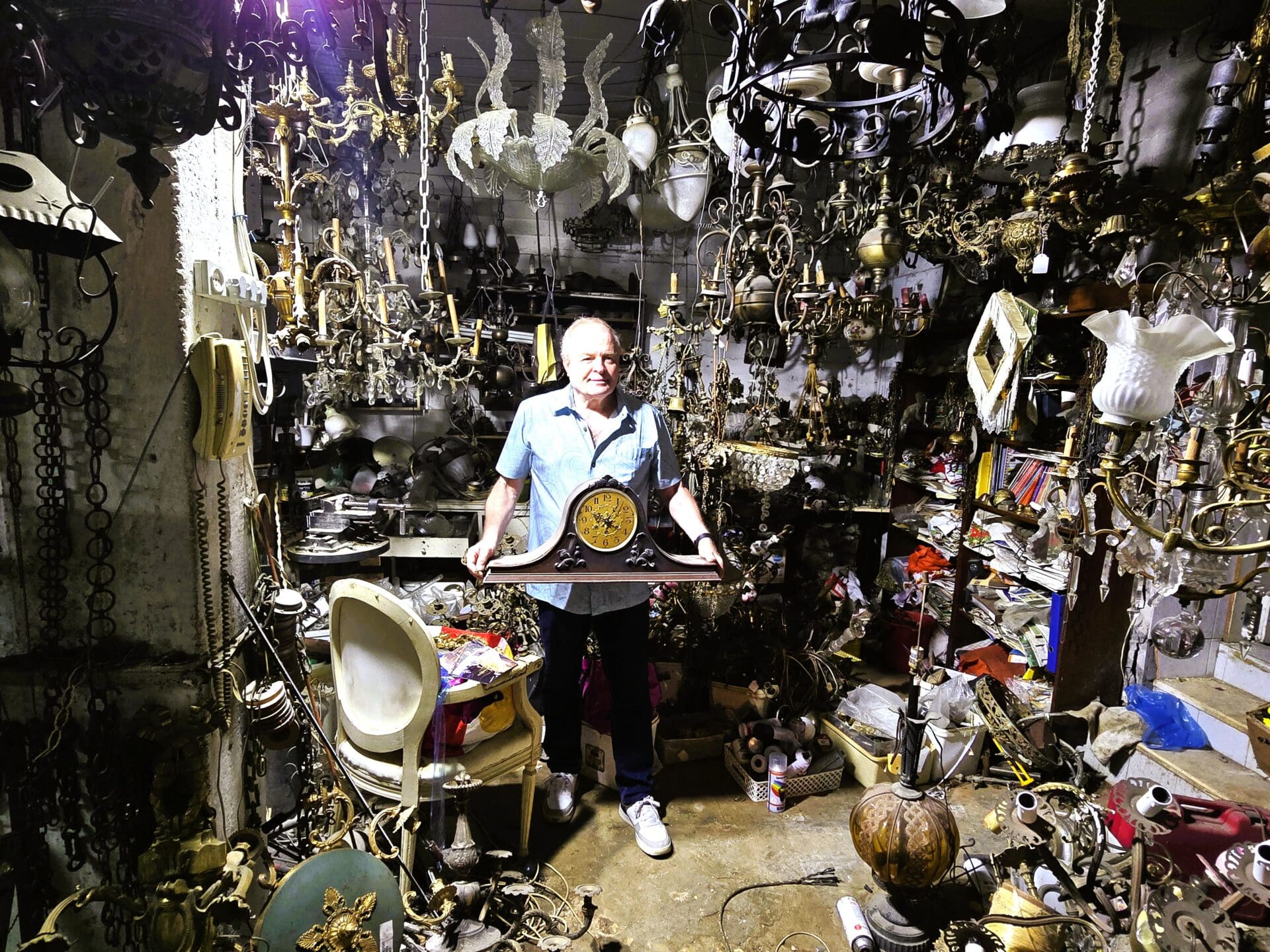
So is the "Orand" gallery. After many years of activity in the field of antique lighting and collecting, the business is currently in the gradual process of liquidating the collection in preparation for final retirement. The gallery's doors have not yet been completely closed, and it continues to be open to customers who are interested in seeing the remaining items, by prior arrangement with Yona and Atra. In addition, the gallery's website is no longer active and the activity is gradually moving from the state of an active commercial gallery to a stage of ending a long journey and clearing out the collection that was built over years.
The workshop still preserves a large part of the collection that was gathered over many years of searching, locating and preserving. Antique chandeliers, rare lighting fixtures and unique items, each with its own story, await among the shelves. Some came from ancient residences, others from public buildings, hotels or historic buildings in Europe. Over the years, they were collected one after another, not as a random collection, but as a result of a professional eye, extensive experience and a deep familiarity with the world of ancient lighting.
Dismantling such a collection is not like clearing out a regular warehouse. Each item requires care, inspection, and packaging, and sometimes a difficult decision about how to part with it. Yona and Atara continue to engage in this work patiently, knowing that this is the end of a long journey that has lasted many years. It is a slow process by nature, and the circumstances of the period also contributed to this. The security situation slowed down the entire economy, affected the movement of buyers and the pace of renovations and relocations, and even those who planned to purchase a special item sometimes preferred to wait for quieter days.
The result is that a significant portion of the collection is still in the workshop. Precisely because the goal is to complete the evacuation process and move on to the next chapter, prices are currently set that do not necessarily reflect the full collector value of the items. Sometimes the main consideration is not to extract every shekel of the value of a rare item, but to find a new place for it where it will continue to fulfill its purpose.
There is a certain degree of closure in this. Antique objects are not created to remain forever in storage boxes. For decades and even centuries, they have been passed down from hand to hand, from house to house and generation to generation. Each period has added another layer of history to them. Even today, they continue this journey. A chandelier that once illuminated a magnificent hall may find its way to a private home. A light fixture that hung in an old stone house may become the center of attention in a modern apartment. The objects remain the same objects, but the environment changes, and with it the story they tell.
Anyone who wants to know what items are still in the collection can contact Yona and Atara via the Facebook page or Messenger, and arrange a visit to the gallery. Sometimes, a short conversation reveals that an item they have been looking for for a long time is still waiting on one of the shelves, just before it continues on its way.
Perhaps this is the most beautiful way in which a gallery's story can continue. Not through an active exhibition space as it was in the past, but through the objects themselves. Each item that finds its place in a new home will also carry with it something of the path it has taken, of the people who located it, restored it, and cared for it over the years. In this sense, "Orand" does not truly end. It simply disperses to new places, where the old light will continue to shine and the story will continue to be written, once again, in another home.
From the light in the chandeliers to the light in the community – leadership born of service
As mentioned, after years in which Yona Mazor was engaged in building a career, starting a family, preserving treasures from the past, and leading complex systems, a stage came when he wanted to turn his gaze and experience to another space: the community and society around him. For decades, he was involved in leading people, managing large-scale projects in the Navy, building an independent business, and in the world of antiquities, but now he wanted to expand his circle of influence and turn the life experience he had accumulated into action for others.
In 2014, at an age when many seek to slow down, he chose to deepen his public involvement and joined the Rotary organization, an international volunteer movement that unites approximately 1.2 million members worldwide.
In Rotary, Yona found expression for a value that had accompanied him throughout his life: the understanding that a person's strength is not measured solely by their personal achievements, the roles they have held, or the recognition they have received, but rather by their ability to contribute to their environment, connect people, and build a stronger community. For him, this was not an entirely new chapter, but rather a natural continuation of a life path that had always been based on responsibility, service, and commitment to others.
Joining Rotary was not a change of direction for him, but a natural continuation of his life's journey. As in previous stops, here too he did not seek center stage but rather the place where he could contribute, organize, and connect people. His journey began at the "Rotary Carmel" club in Haifa, where he held the positions of treasurer and secretary, and continued from there to the national circuit of Rotary Israel, which includes 57 clubs throughout the country. Over the years, he became one of the central figures in the movement, combining managerial experience, organizational knowledge, and a rare ability to listen to people.
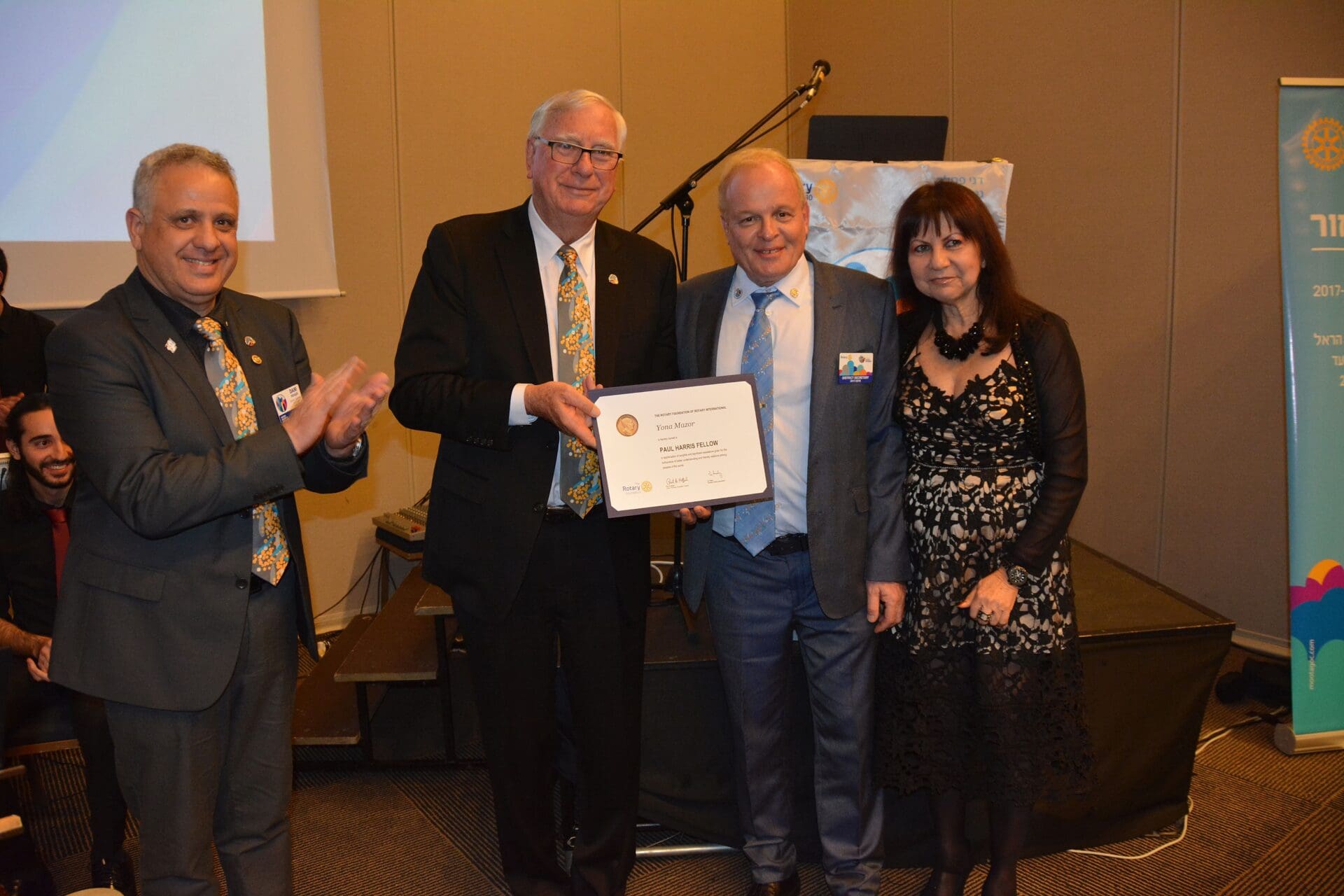
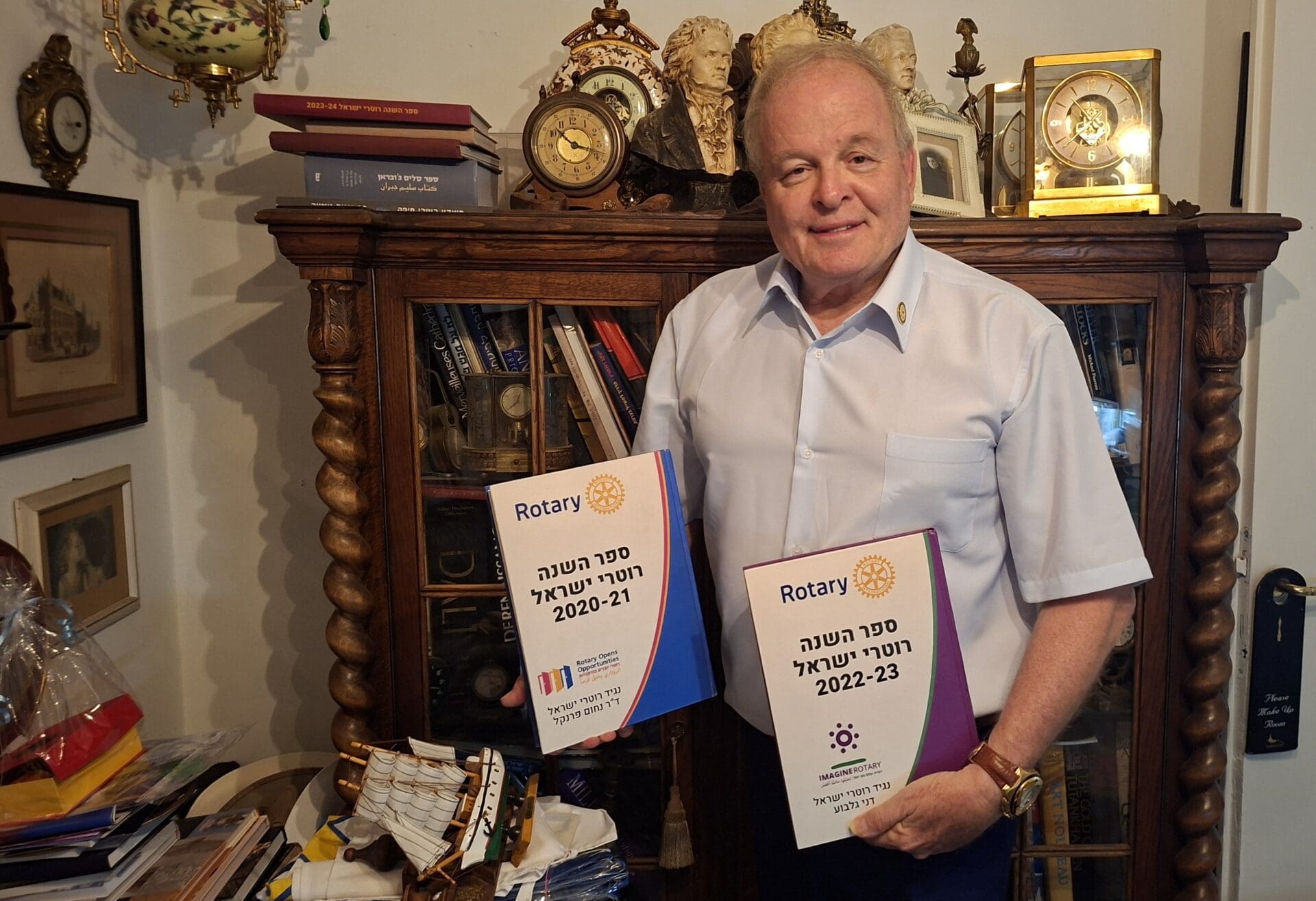
For ten consecutive years, Yona Mazor was a member of the Rotary Israel board in the most senior positions, an achievement that is unprecedented in the history of the organization in Israel. He served as secretary of Rotary Israel six times, served as an instructor and lecturer, and accompanied clubs and members in various organizational processes. He was awarded nine Paul Harris Awards, the highest number of awards in Israel, in recognition of his commitment and ongoing contributions.
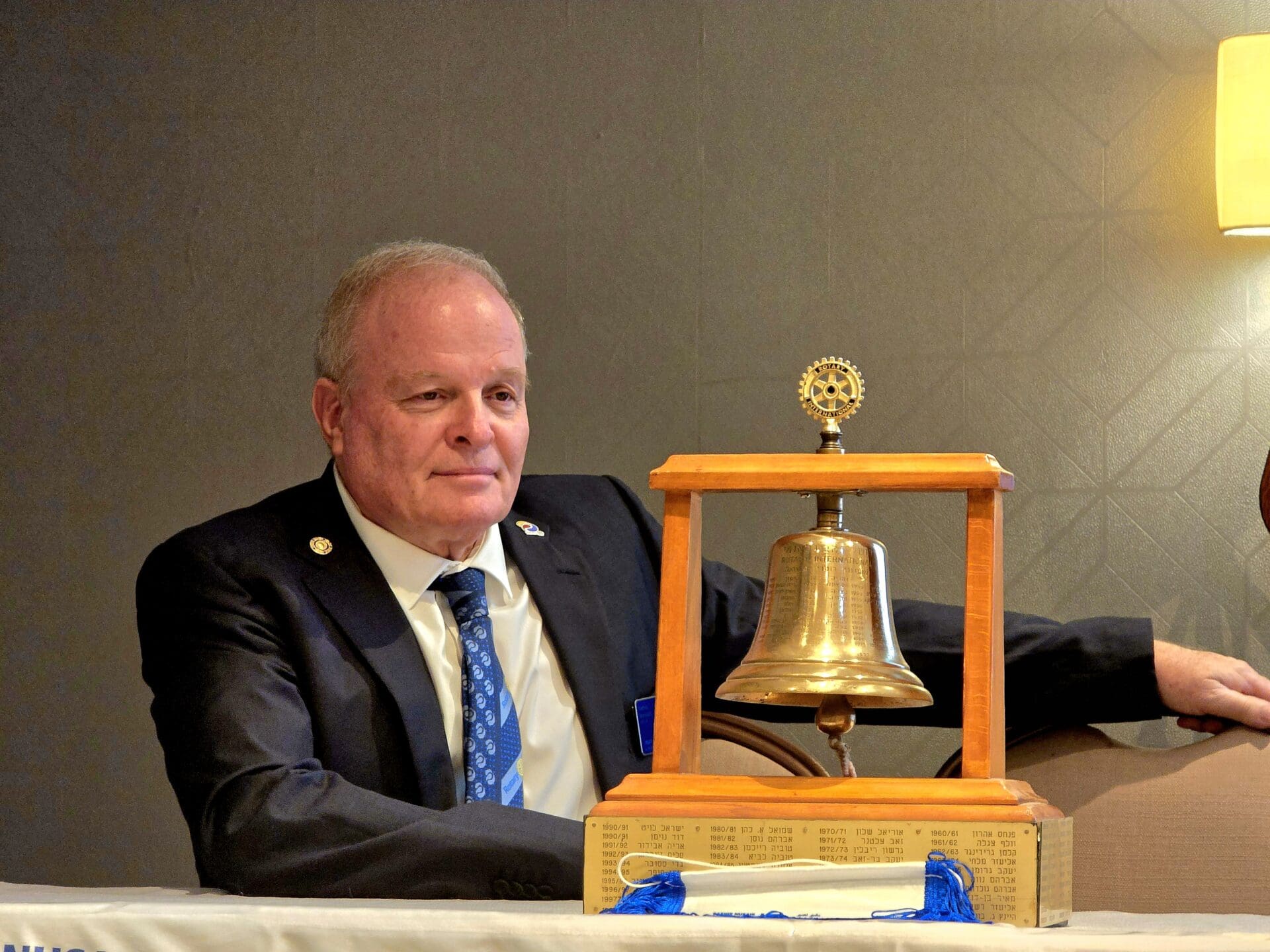
Preserving the past to build the future
One of the areas in which Yona found a special interest was organizational memory. Perhaps it was no coincidence that a man who grew up in a home of Holocaust survivors found himself involved in preserving the history of a long-standing organization.
For him, an organization does not exist only through the activities it carries out in the present, but also through the story it tells itself about the path it has taken.
With this in mind, he documented the history of Rotary International, from its inception in 1905 to its development throughout the years. He collected information, researched documents, and presented the organization's story to its members, with the desire to give them a sense of continuity, identity, and belonging to a long tradition of service. For him, the past is not a closed museum, but a source of strength that allows the next generation to understand where it came from and where it can continue.
Despite his many roles and achievements, he sees himself first and foremost as a member of a community of people who seek to do good. His leadership is not based on loud charisma, but on perseverance, precision, responsibility, and the ability to motivate others with trust.
In addition to the nine Paul Harris Awards he recently received, Yona and Atara were also awarded the Major Donor Award – the highest honor in the Rotary organization, awarded to private donors of an international foundation that works for the global community. Among its initiatives are projects to eradicate polio in developing countries, a reminder that for the couple, generosity does not end at the borders of the immediate community but seeks to touch even the most distant places.
From quiet action to national leadership
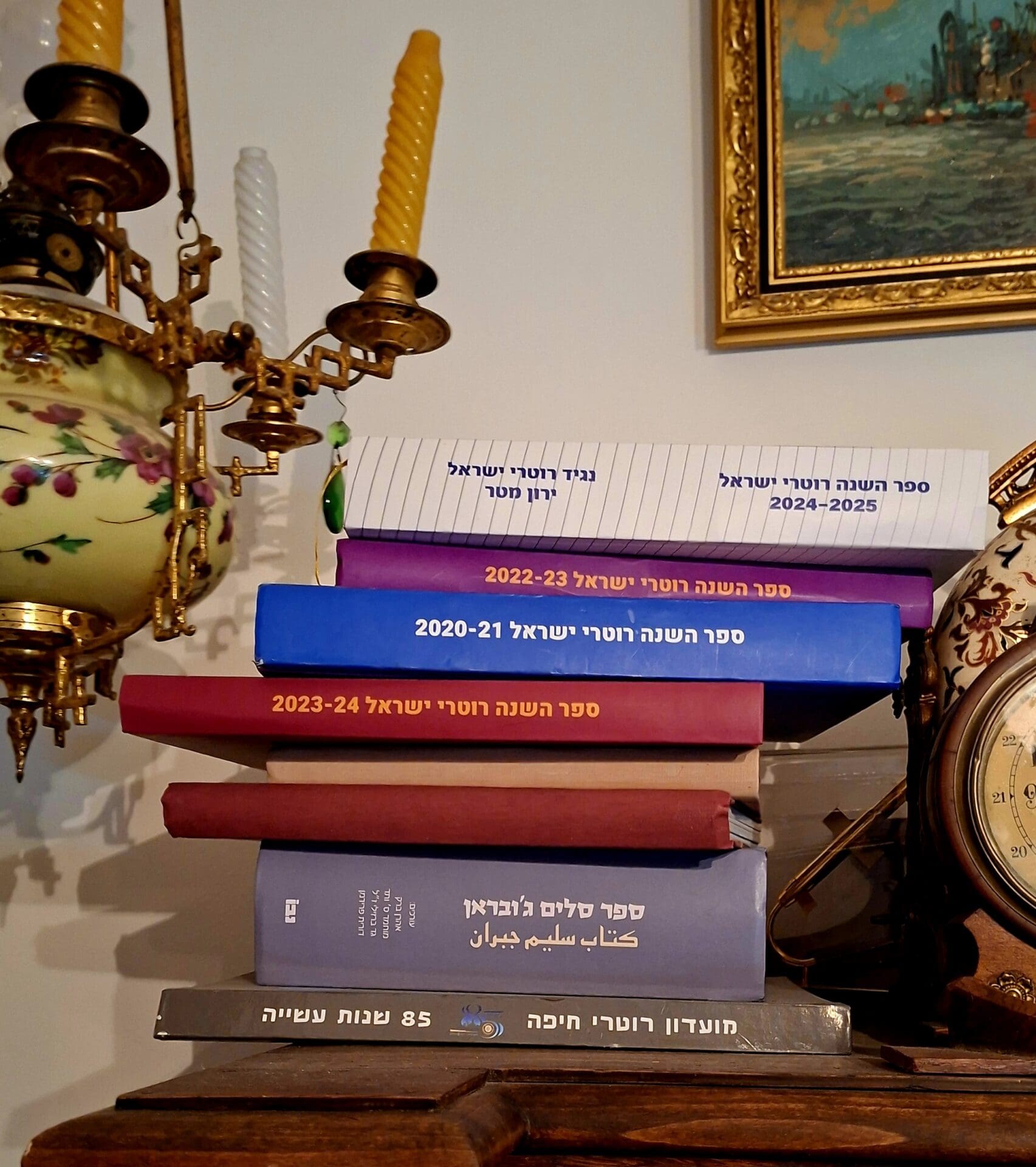
In 2024, Yona Mazor was called to another task when he was asked to move to the Acre Rotary Club, after the club had difficulty appointing a president and was facing the threat of closure. The request, which came from former president Salim Joubran, the late, and Rotary Israel President Yaron Matar, was in fact a call for a person who knows how to enter complex systems, understand their needs, and restore stability to them. Mazor accepted the challenge and served as president of the club for two terms, from 2024 to the present.
He currently serves as the Governor-Designate (DGN) of Rotary Israel in preparation for his future role as Governor, the most central and influential position in the organization. The position requires vision, management ability, responsibility for dozens of clubs and hundreds of members, and most importantly, the ability to lead different people around shared values. These are precisely the qualities that have shaped Mazor's path throughout his life.
Looking back, the trajectory seems almost remarkably consistent. The boy who grew up in a small apartment in Kiryat Eliezer, the son of a family of survivors who rebuilt themselves, became an engineer, an officer, an entrepreneur and a public figure. At each stop, the same pattern repeated itself: taking responsibility, building systems and creating connections between people. Rotary found the place where all these pieces met.
Some leaders are remembered for great moments. And some leaders are measured by leaving behind a stronger organization, more connected people, and a community that is more confident in its path. Yona Mazor belongs to the latter type. His leadership does not seek a title for itself, but rather continues a long tradition of service, responsibility, and commitment to others.


A house chosen for its light
Over the years, Yona and Atara wandered between different addresses, as if each house was a stop on a long journey of maturation and search.
They lived in several apartments around Haifa, lived and spent a year in the United States, and then four years in Ramat Gan, until they returned to the Carmel in 1995. They found their current apartment in Wardiya when it was still a construction site, a concrete skeleton that had not yet taken on life.
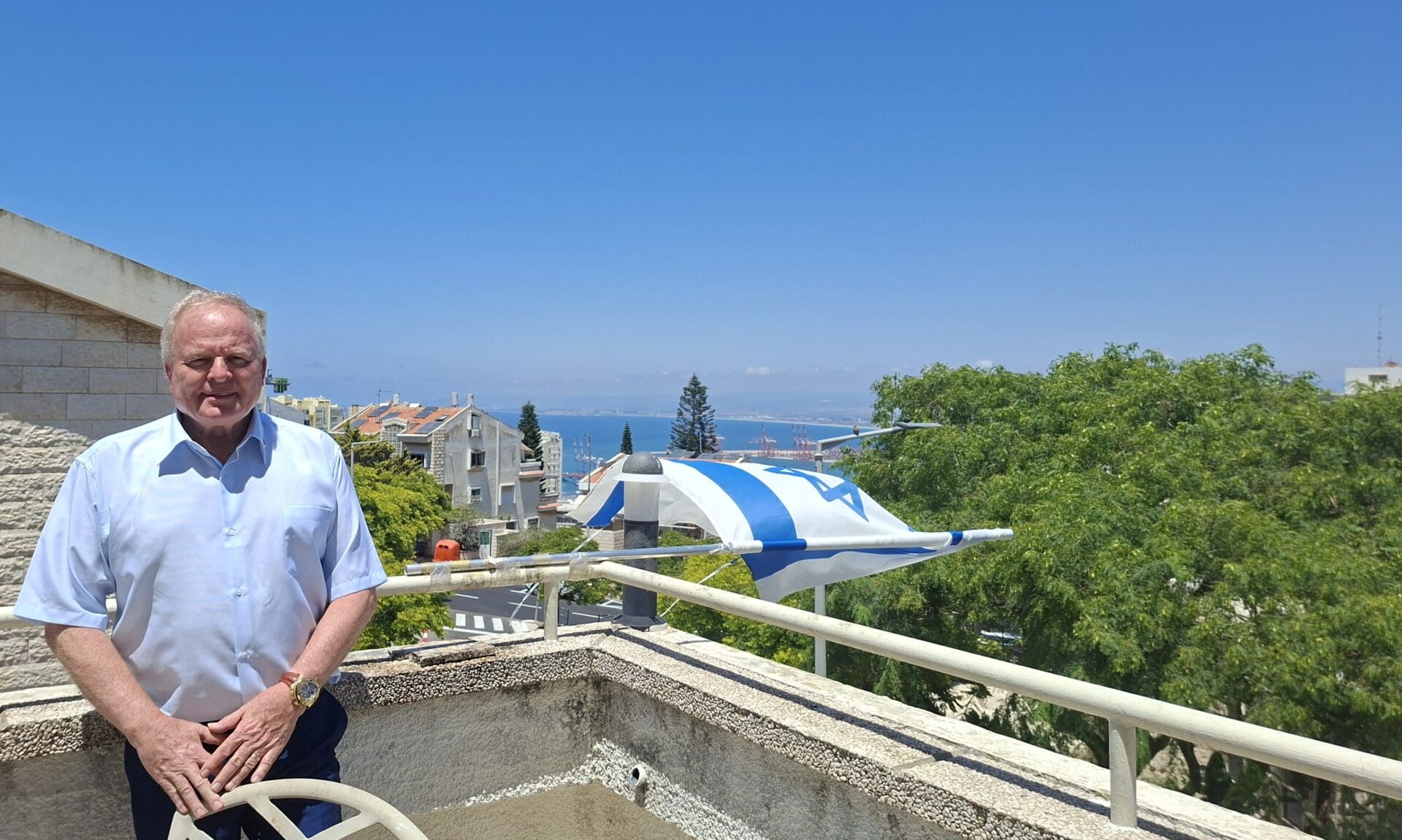
From the first visit, they knew that they were not falling in love with the walls, but with what was visible through them. From the wide windows and the three balconies, the Haifa landscape unfolded in all its glory: the Carmel Range descending to the sea, the horizon changing with the hours of the day, and the constantly changing light. The location of the apartment, the elevator, and the central heating system, which were a real novelty in those days, also reinforced the feeling that they had found a place that could accompany them for years. Atara had reservations about the flooring and the small kitchen, but these seemed like marginal details compared to the feeling that the entire house was bathed in natural light.
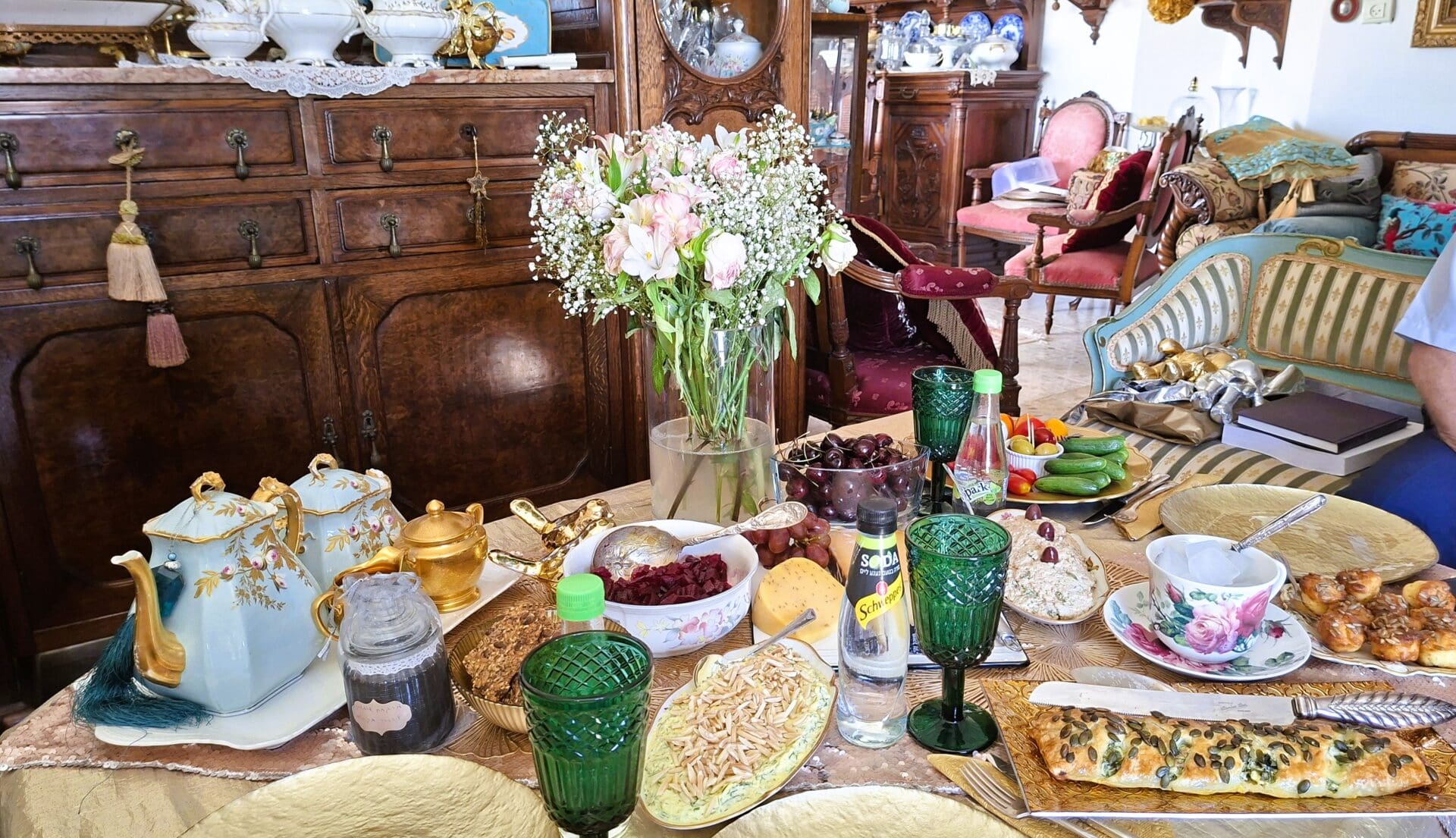
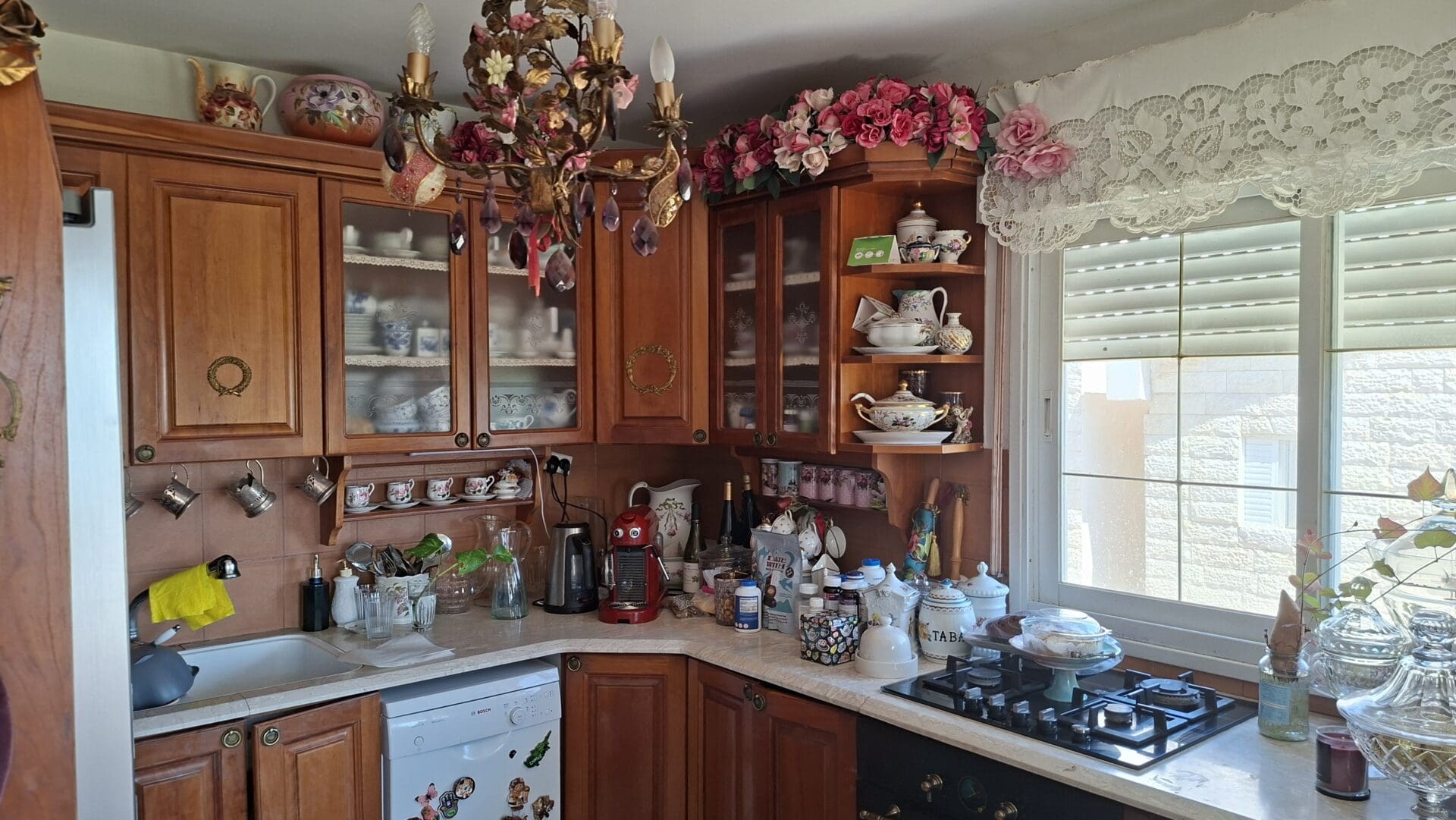
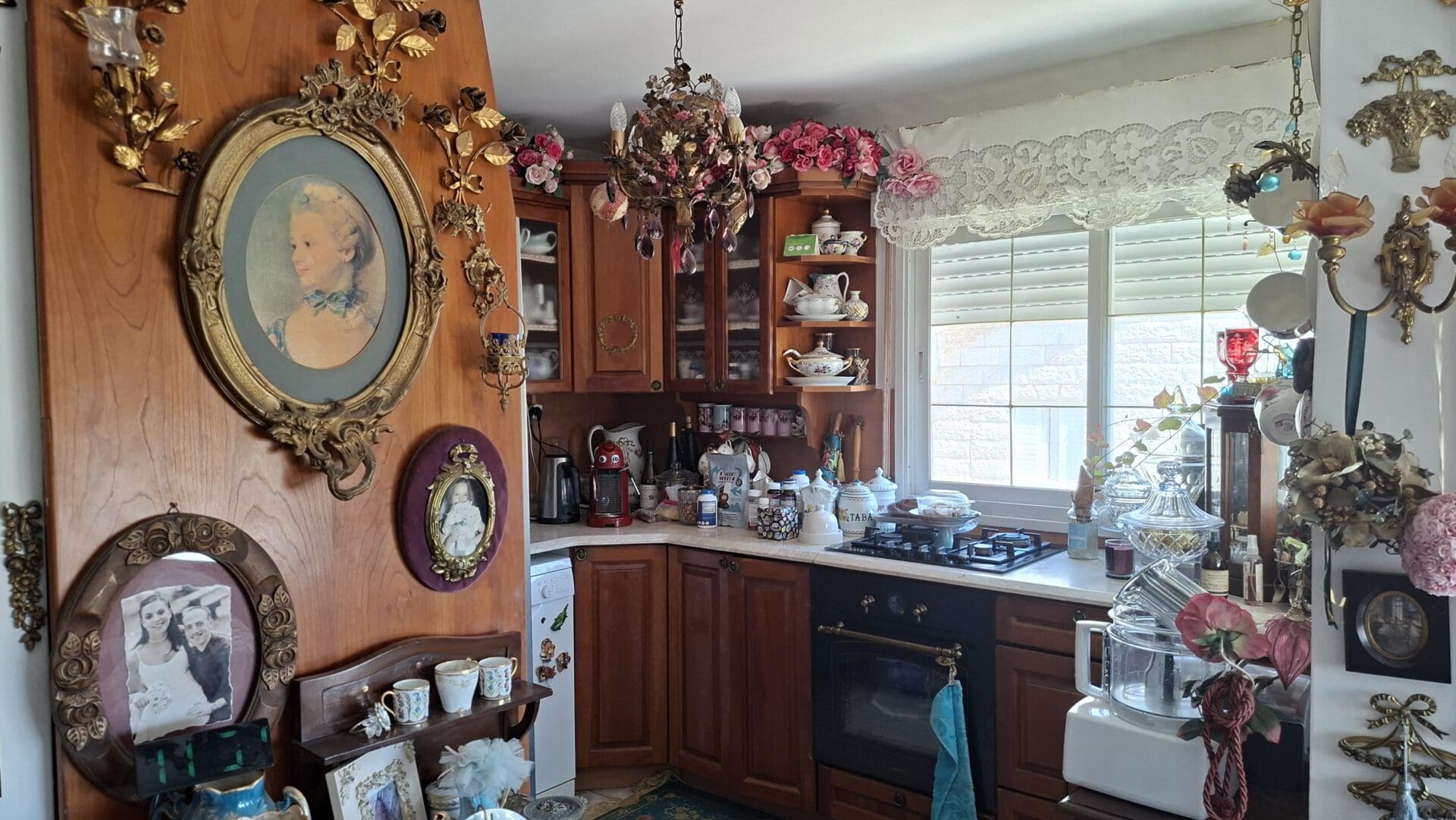
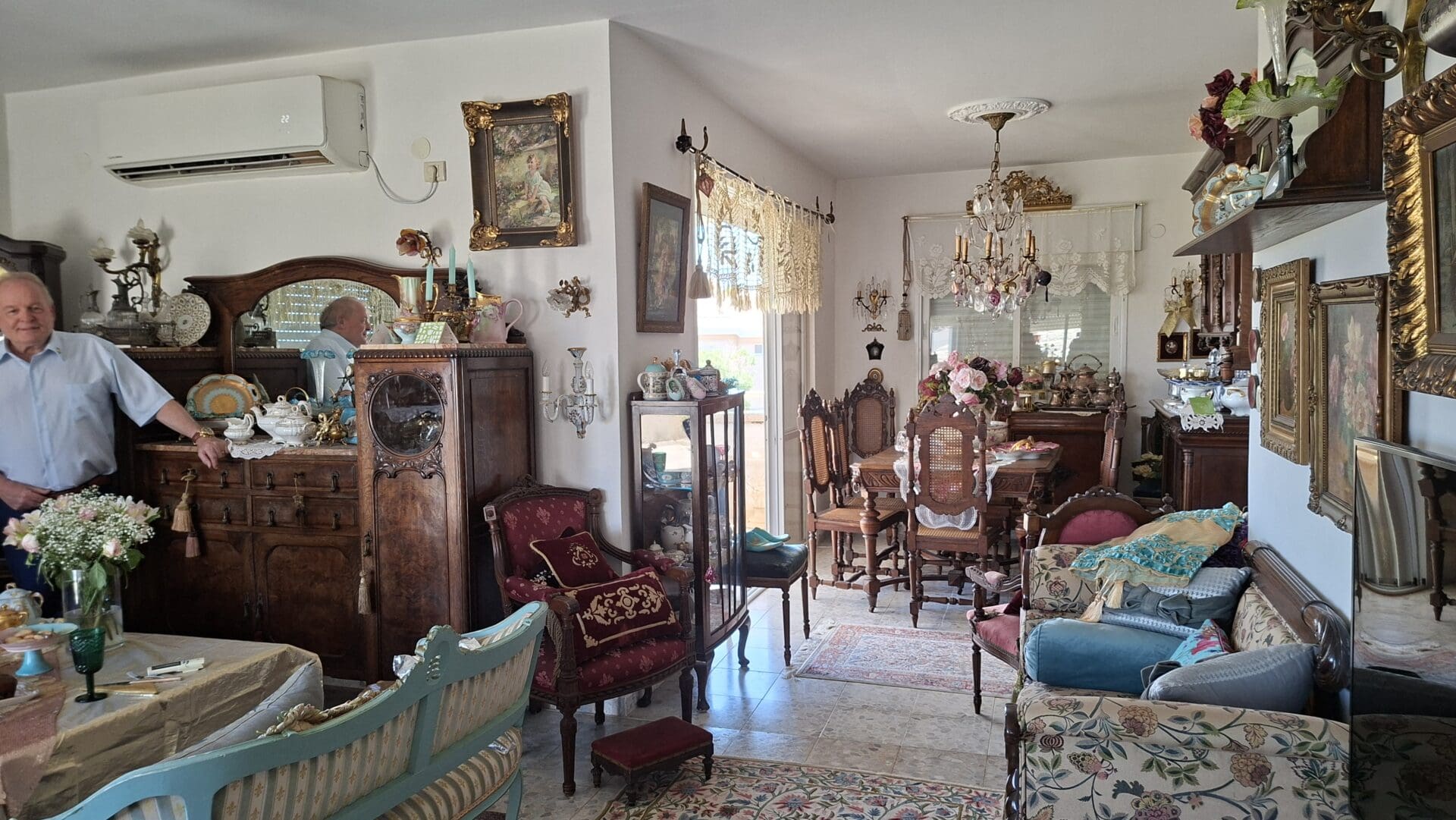
Over the years, that light has become a hidden partner in the design of the space. It refracts through crystals, caresses the antique bronze, deepens the shades of wood, and gives every chandelier, every clock, and every object collected on their travels a sense of almost theatrical presence.
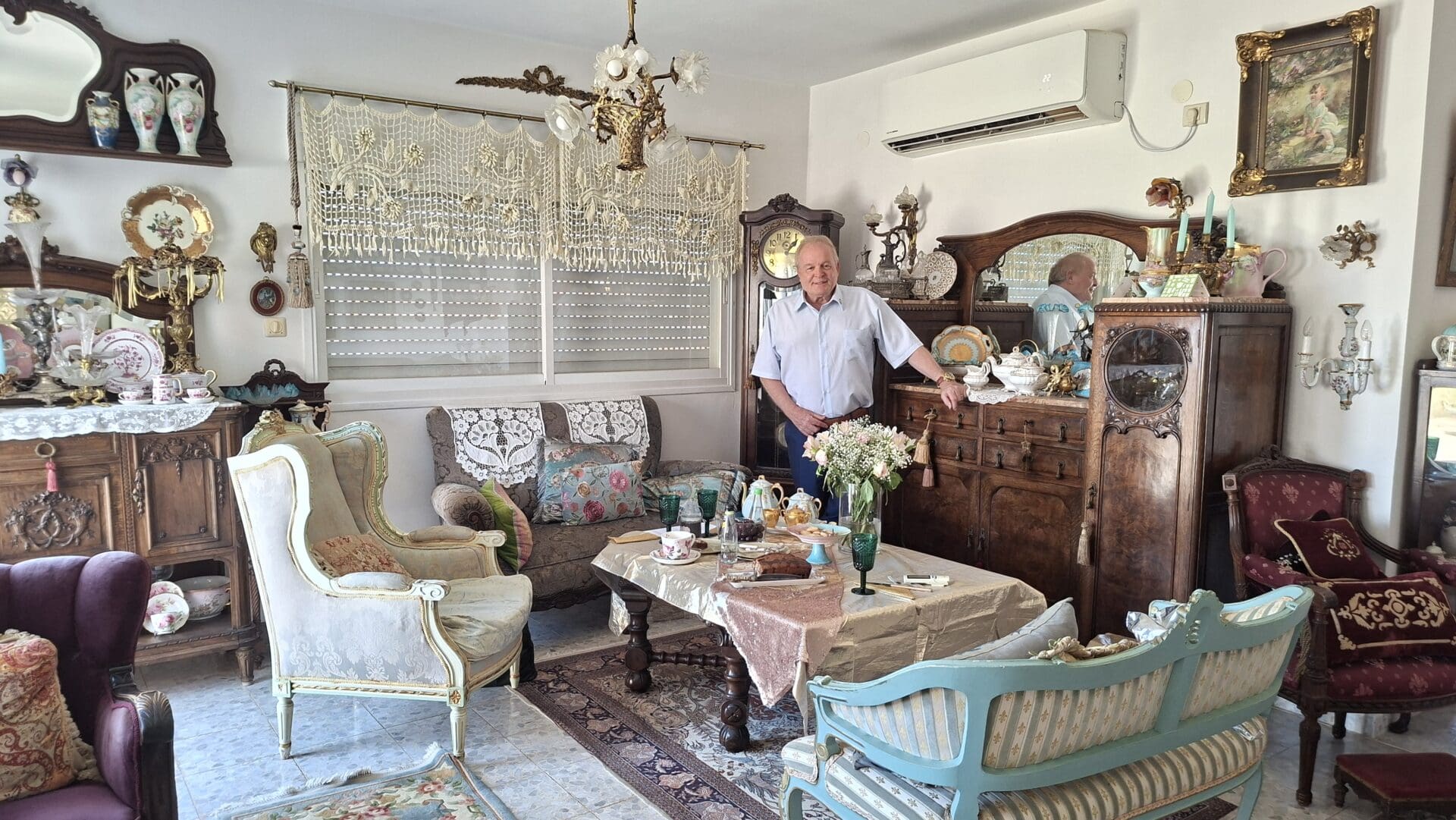
The apartment ceased to be just a place to live and became a kind of quiet stage, where every item carries with it a memory, and every ray of sunlight gives it renewed life. Whoever enters the house does not initially sense the richness of the collections, but rather an atmosphere that is difficult to define in words: a rare feeling of a place where light itself has become part of the collection.
The room where time gets a voice
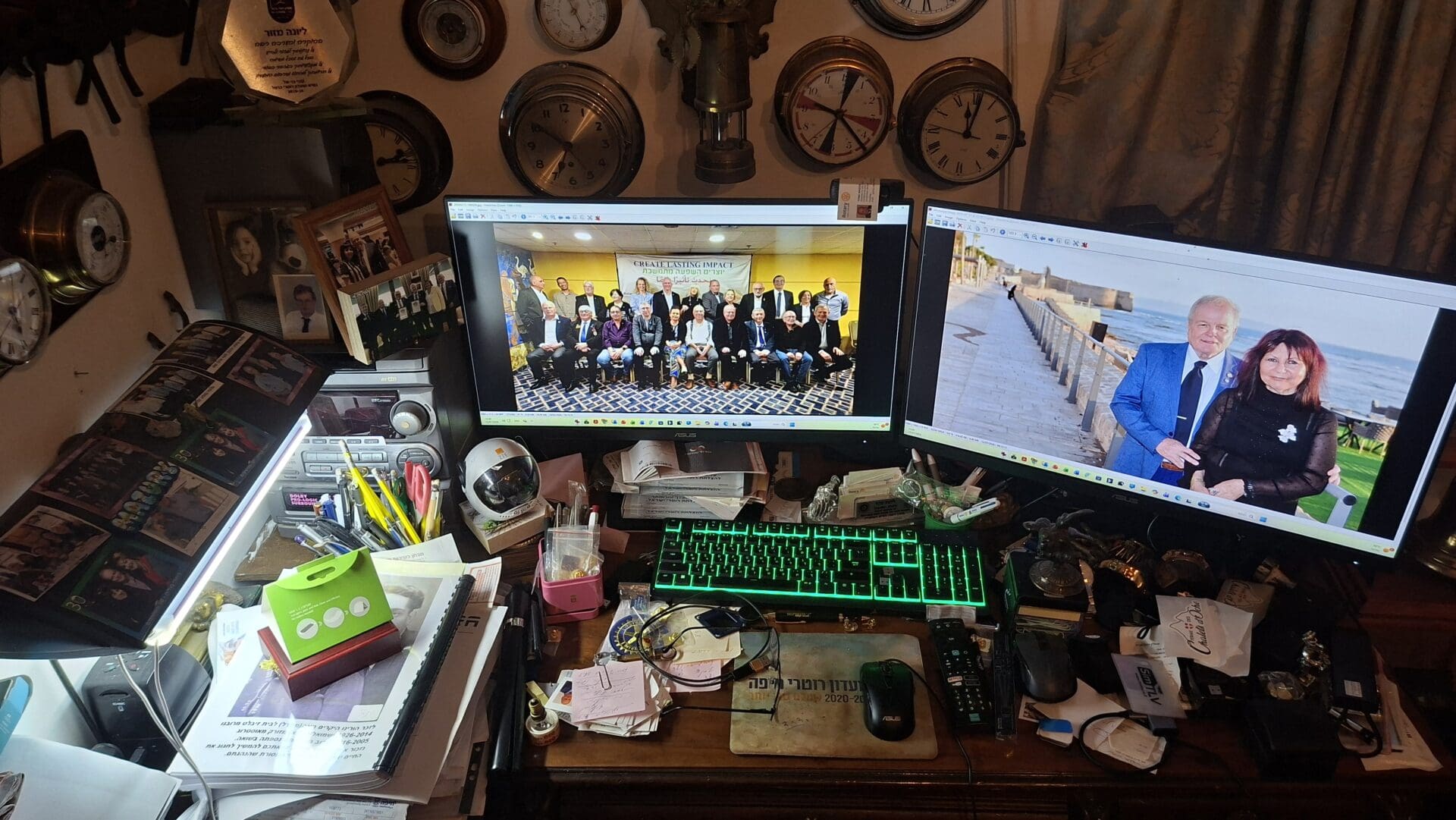
If the living room and the three balconies that open to the Carmel views give Yona Mazor a sense of breathing and space, then his study is the place where his inner world comes together into wholeness.
It is a room where almost nothing is accidental. Behind the desk and computer, from which he manages daily contact with clients from all over the country and the world and devotes long hours to his volunteer activities, a small universe is revealed, built over decades of curiosity, patience, and love of the craft.
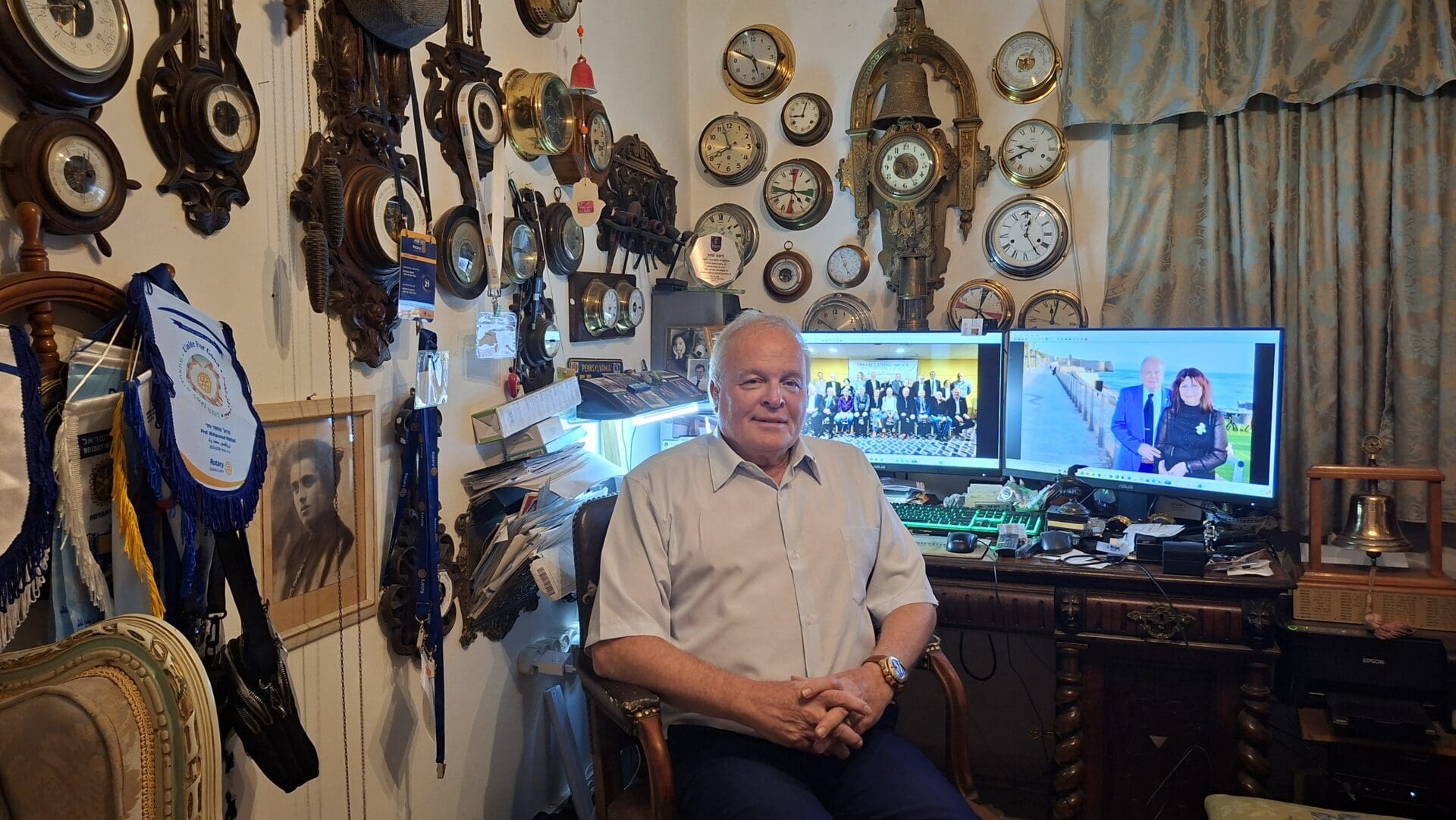
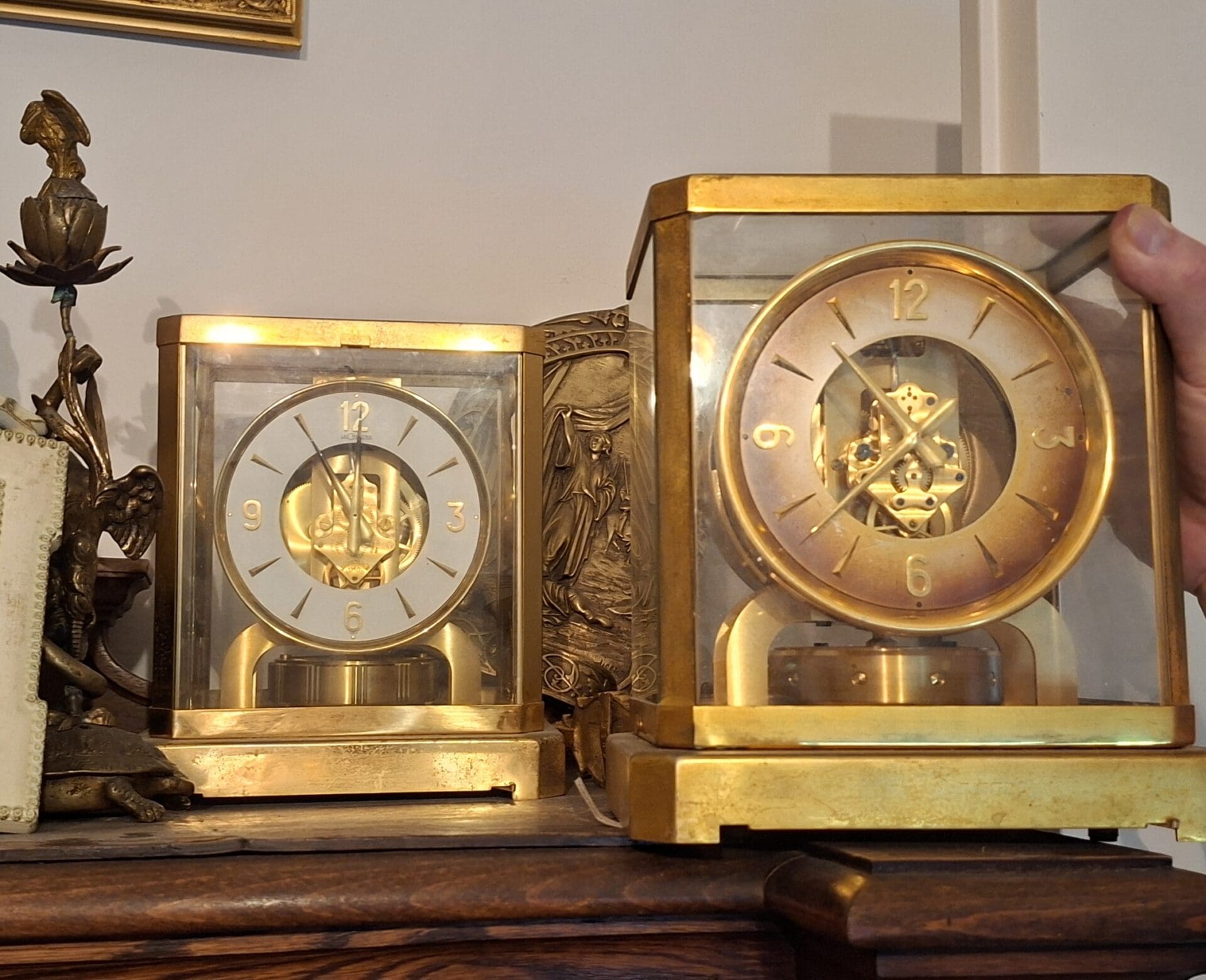
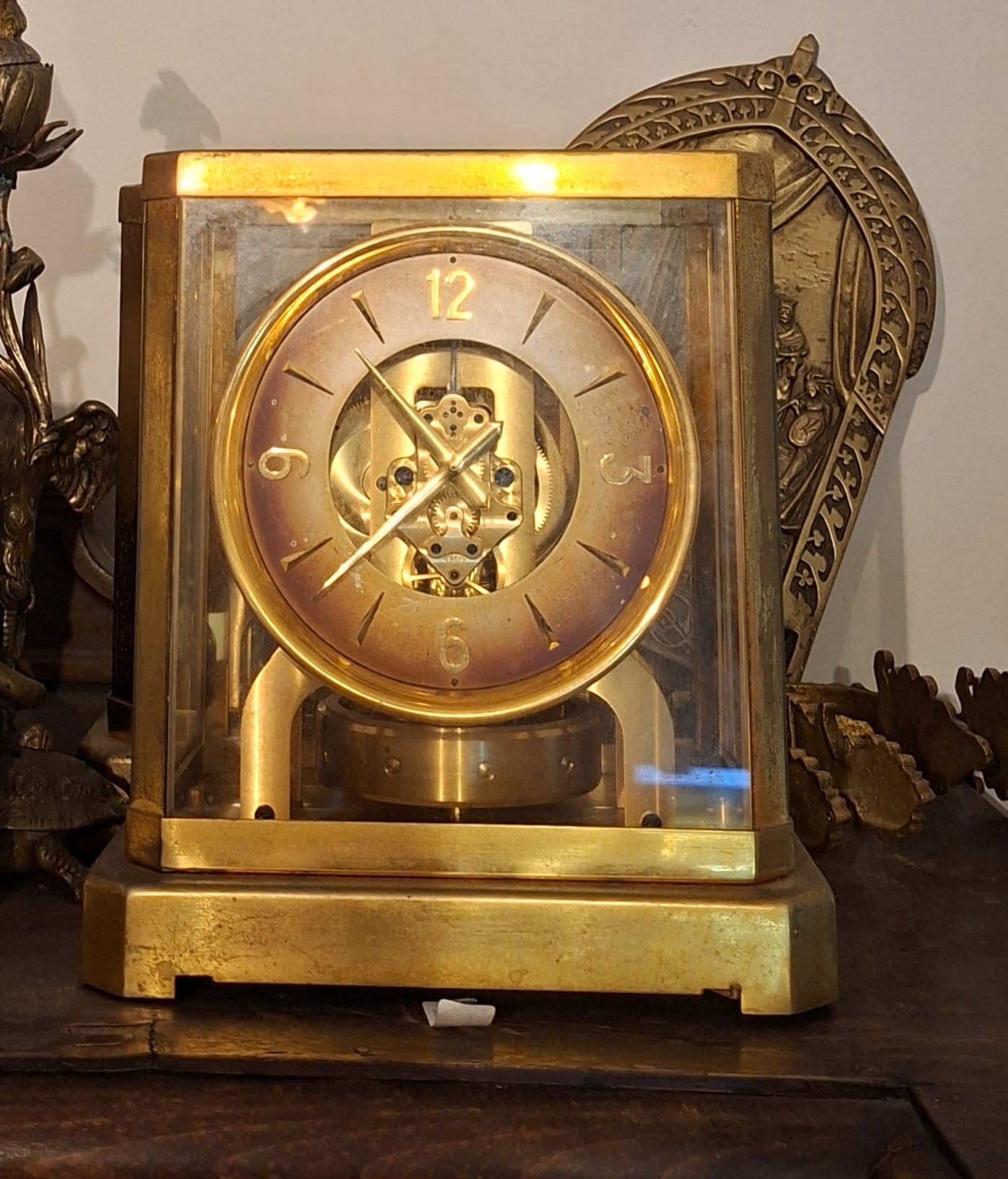
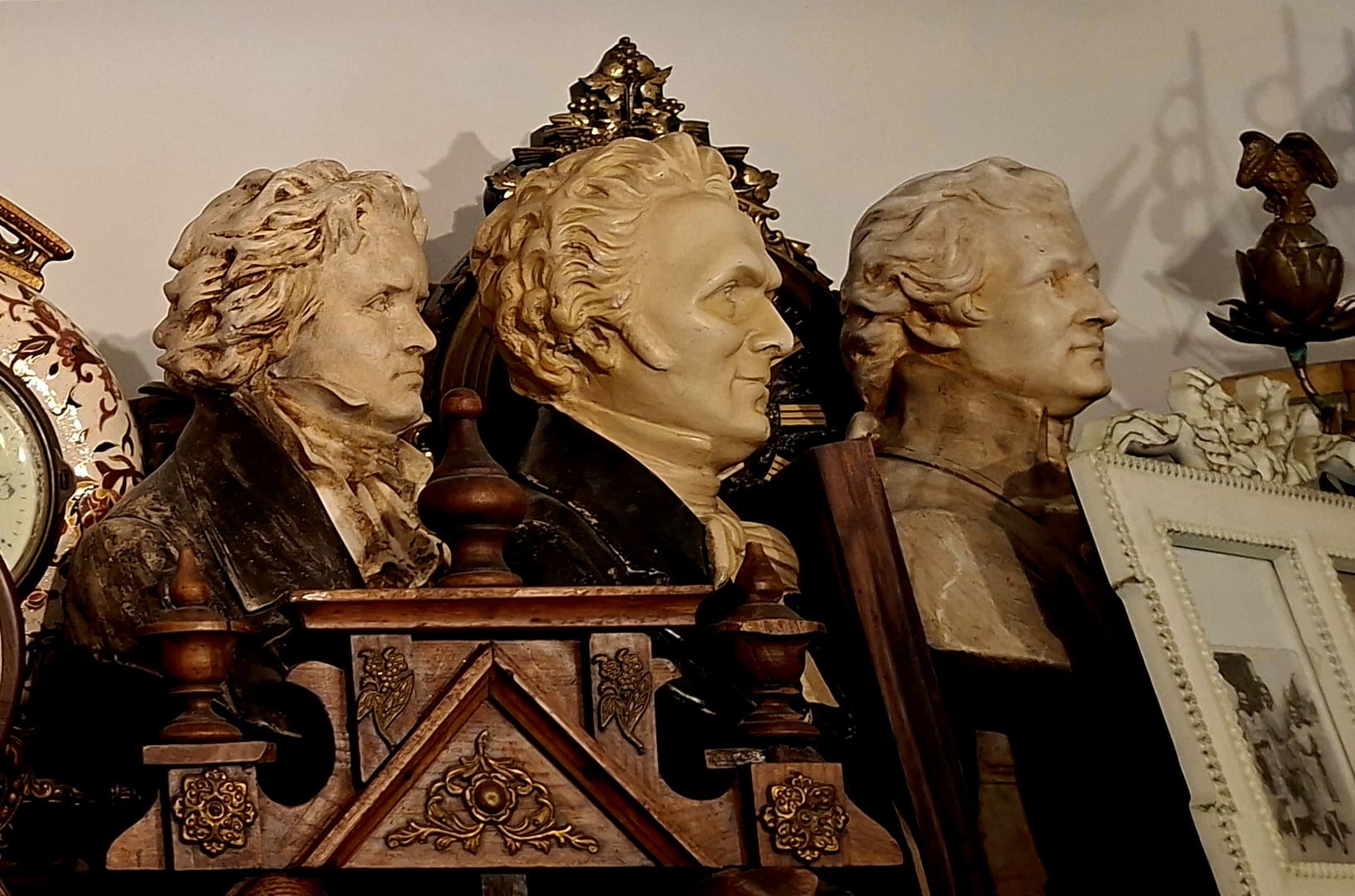
Every shelf, every wall, and every display case tells a different chapter in his journey, but above all, an extraordinary collection of ship clocks dominates, those round clocks that once accompanied vessels through stormy seas and helped their crews measure shifts, keep track of time, and navigate in a world where precision was sometimes the difference between reaching a safe shore and losing their way.
From those clocks emerges an entire culture that has almost disappeared from the world, and they fill the room with a quiet but powerful presence, as if each of them continues to listen even today to the distant echo of waves and the metal clank of ship decks.
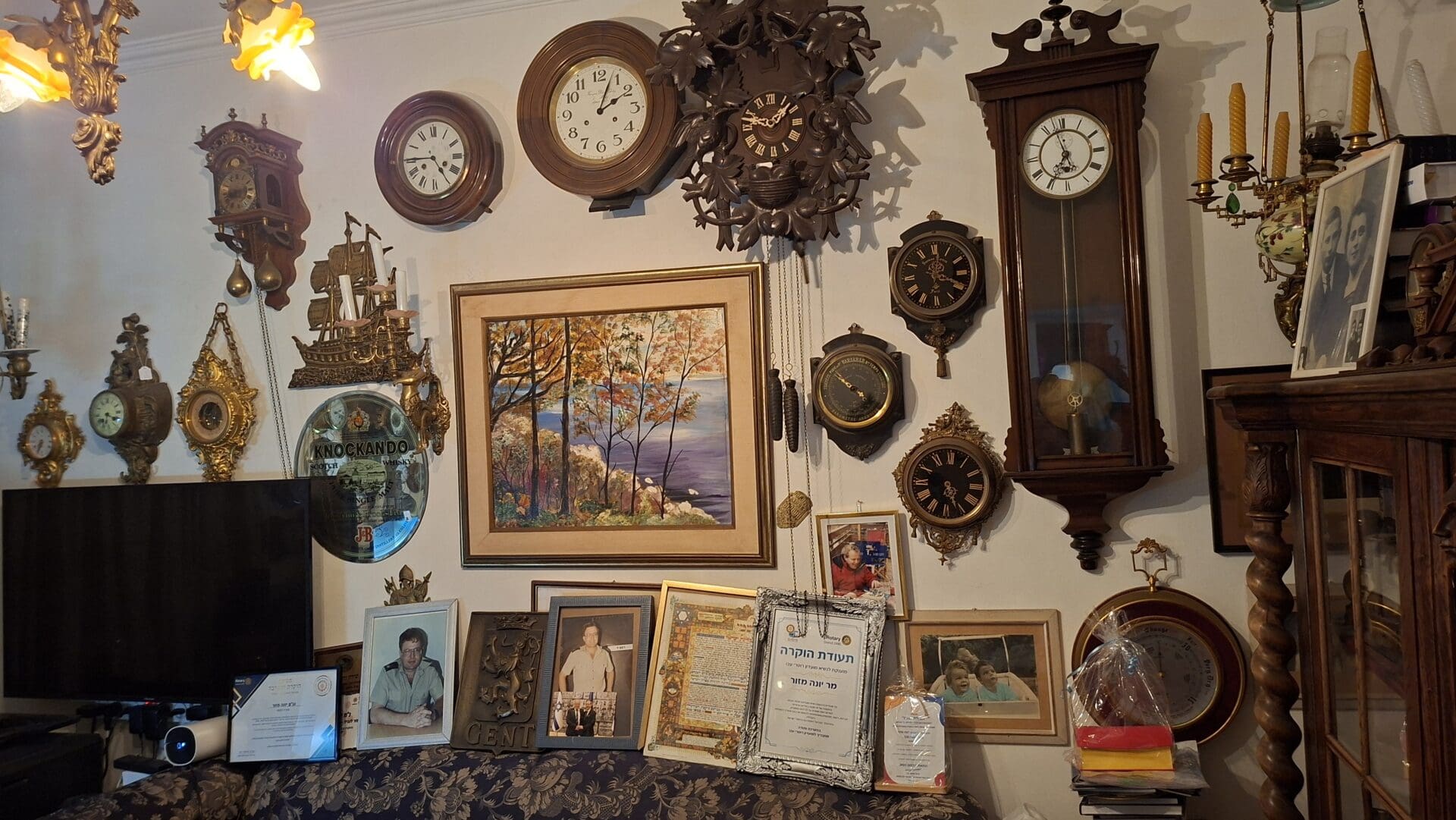
Alongside them stand some of his most treasured watches: several Atmos watches, which measure time with almost no human intervention, and a rare EGER LECOULTRE watch with a “baguette” bezel. It is a creation in which Swiss engineering and Art Deco aesthetics meet with rare elegance.
In this room, time ceases to be an abstract concept. It takes on body, weight, and sound. Each tick joins its predecessor, and each clock adds another voice to the silent chorus of hundreds of mechanisms, each of which has survived a different era, a different continent, and a different life. Perhaps that is why, more than any other room in the house, this is the place where it seems that Yona not only guards his collections, he also serves as the keeper of their time and perhaps, to some extent, of his own time as well.
The living room where history continues to pulse
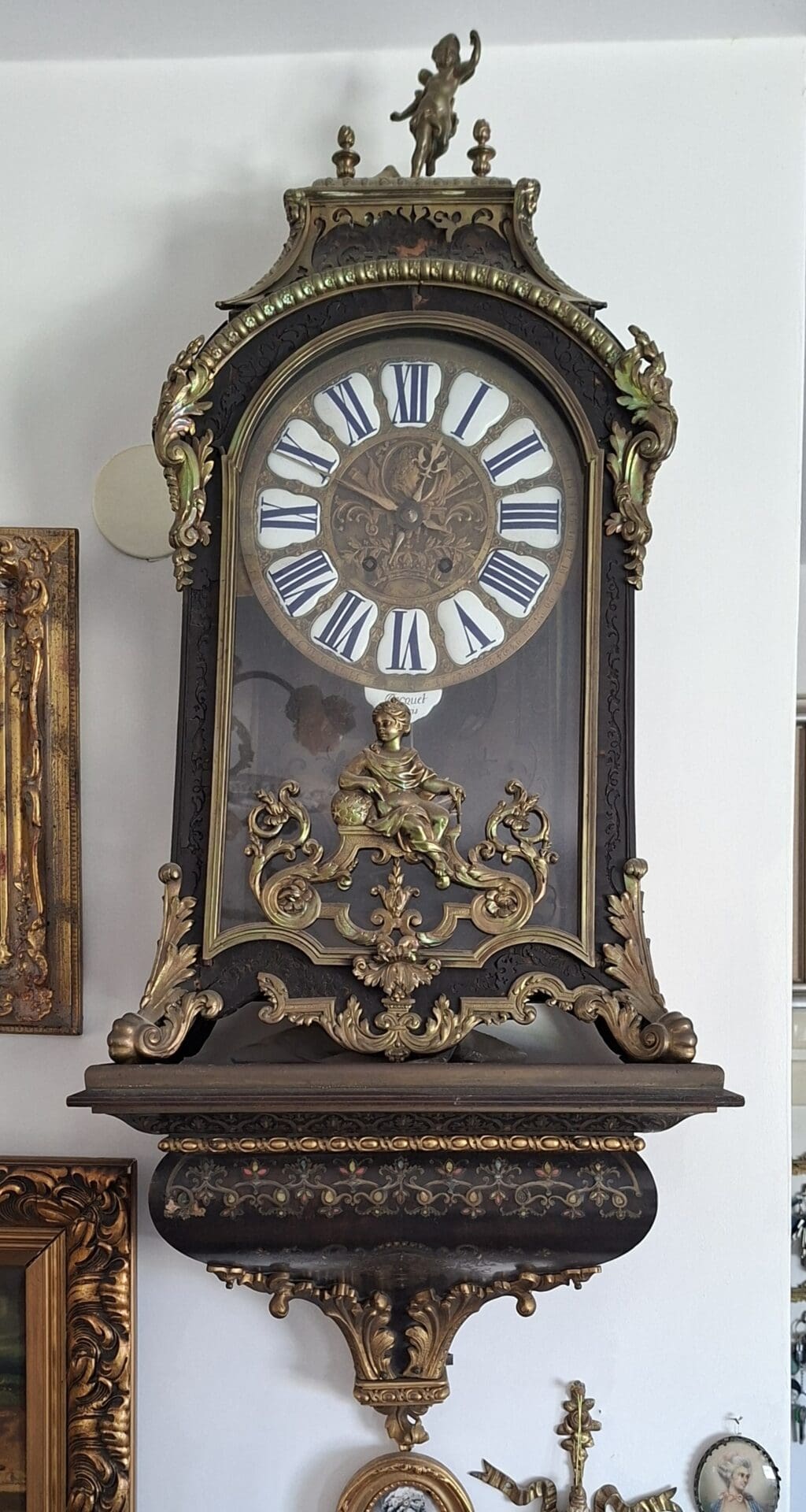
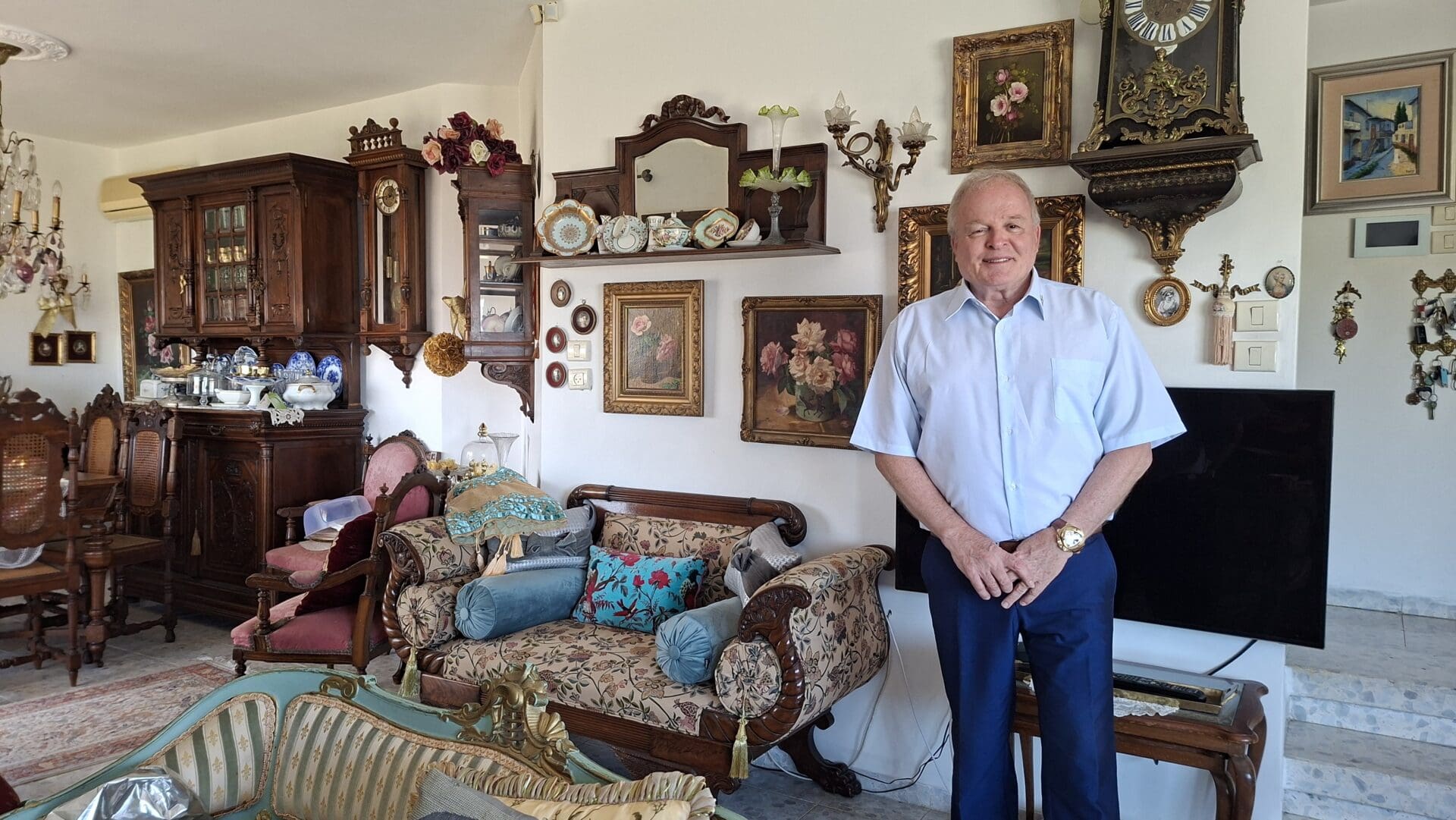
At the heart of the living room stands the true gatekeeper of the house: a rare French clock, a spectacular creation originating from previous centuries, attributed to André Charles Boulay, the famous furniture and inlay artist who worked at the Palace of Versailles for the court of Louis XIV and made his name synonymous with French grandeur.
The clock, created in the style associated with Bulle, is not just a time-measuring device but a living sculpture of craftsmanship. Its wooden case is inlaid with gilded bronze and the famous inlay technique that combines tortoise shell, a material that was considered the height of sophistication and prestige at the time. In the sunlight streaming in from the balconies, the bronze glows with a warm hue, and the tortoise shell changes color almost every hour, as if it too responds to the passage of time measured by the clock.
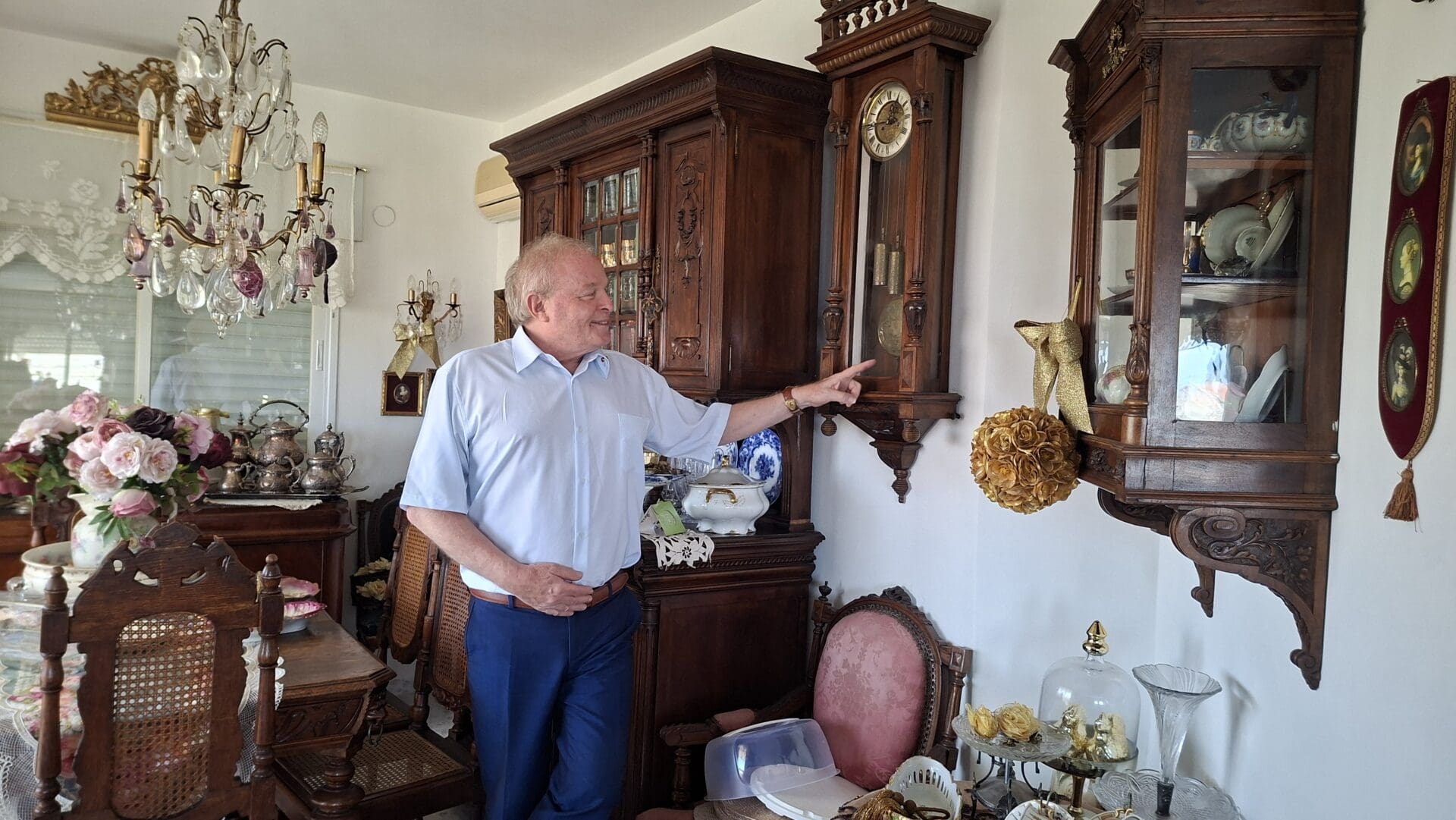
A little further on, in the dining area, an antique Viennese clock hangs on the wall, more modest in its materials but not in its importance. The two clocks do not compete with each other, but rather conduct a silent dialogue between two different European traditions: one born in the royal courts of France, the other in the artisan workshops of Vienna, a city where mechanical precision has become almost a national art.
When the house is silent, their ticking seems to blend together like two voices in a conversation spanning centuries. For Yona Mazor, they are not collector's items designed to impress guests. They are living testimonies to the hands of craftsmen who are no longer there, to cultures that believed that beauty and precision were not luxuries but a way of life. In his house, history is not imprisoned like a museum. It continues to breathe, illuminate, and count the hours.
The sofa that was not bought, but received as a gift
In a house filled with rare collections, centuries-old clocks, chandeliers that came from antique markets in Europe, and furniture that tells the story of an entire continent, Yona Mazor's choice is surprising when he is asked which object is most precious to him.
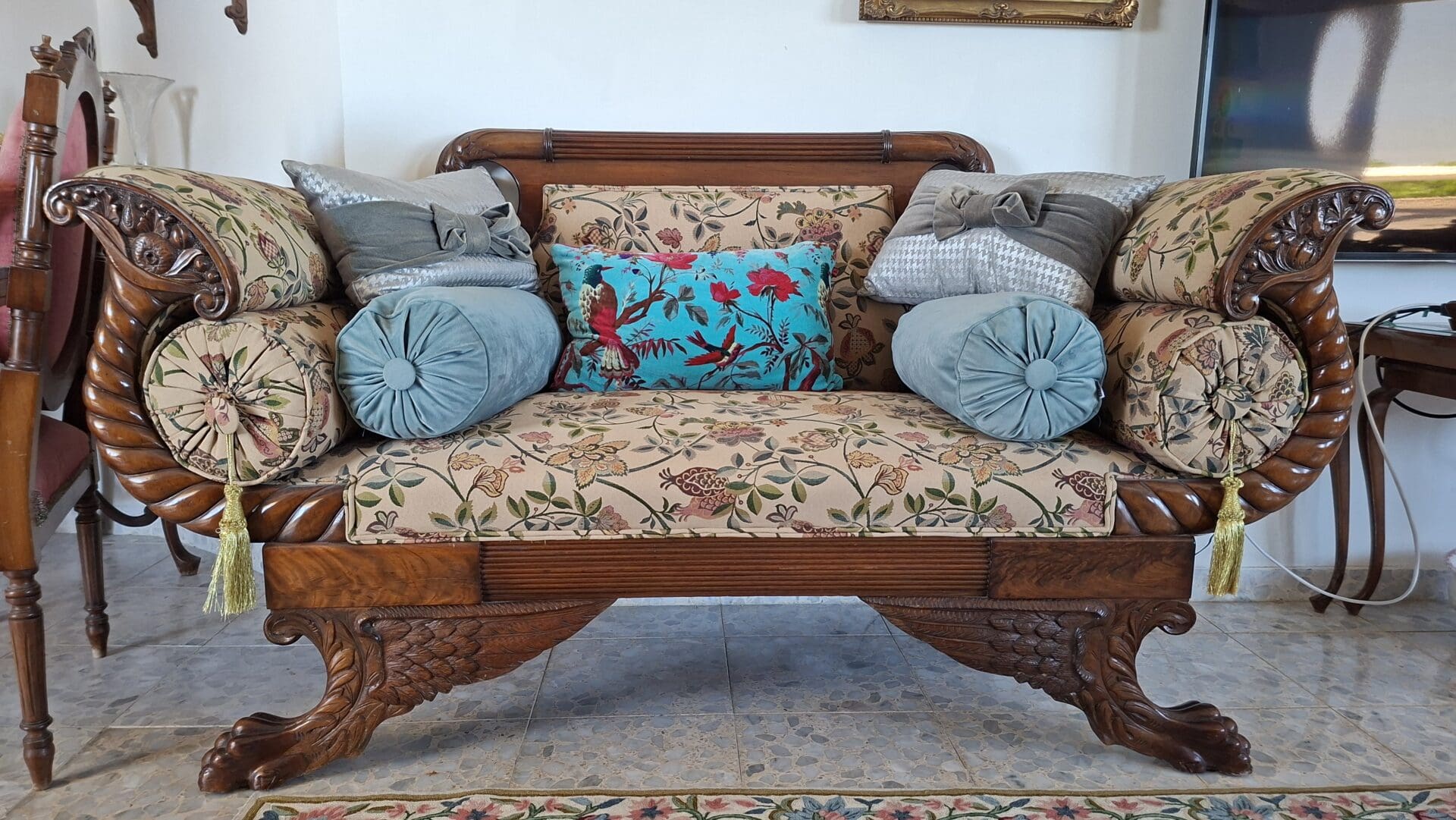
It's not a rare watch or an item estimated to be worth a lot of money, but an antique French sofa, quiet and modest in appearance, on which he sits almost every day. In his eyes, its value is not measured by its rarity but by the way it came to him.
It belonged to an old client, a professor of Chinese art, who lived on Yaffe Nof Street in Haifa. Over the years, a bond developed between them that went far beyond the usual relationship between a professional and a client. When she decided to leave her apartment and move to a smaller house, she chose to part with the sofa and give it to him, as a gesture of appreciation and trust.
When the sofa arrived at his home, it was far from the splendor it radiates today. Its frame was damaged, the upholstery was tired, and the wood bore the scars of years.
Many would have seen it as a piece of furniture that had ended its life, but Yona saw in it exactly what he usually sees in every antique object that comes into his hands: not its condition, but its inherent potential. With the patience of a heritage conservator, he restored its stability, beauty, and dignity.
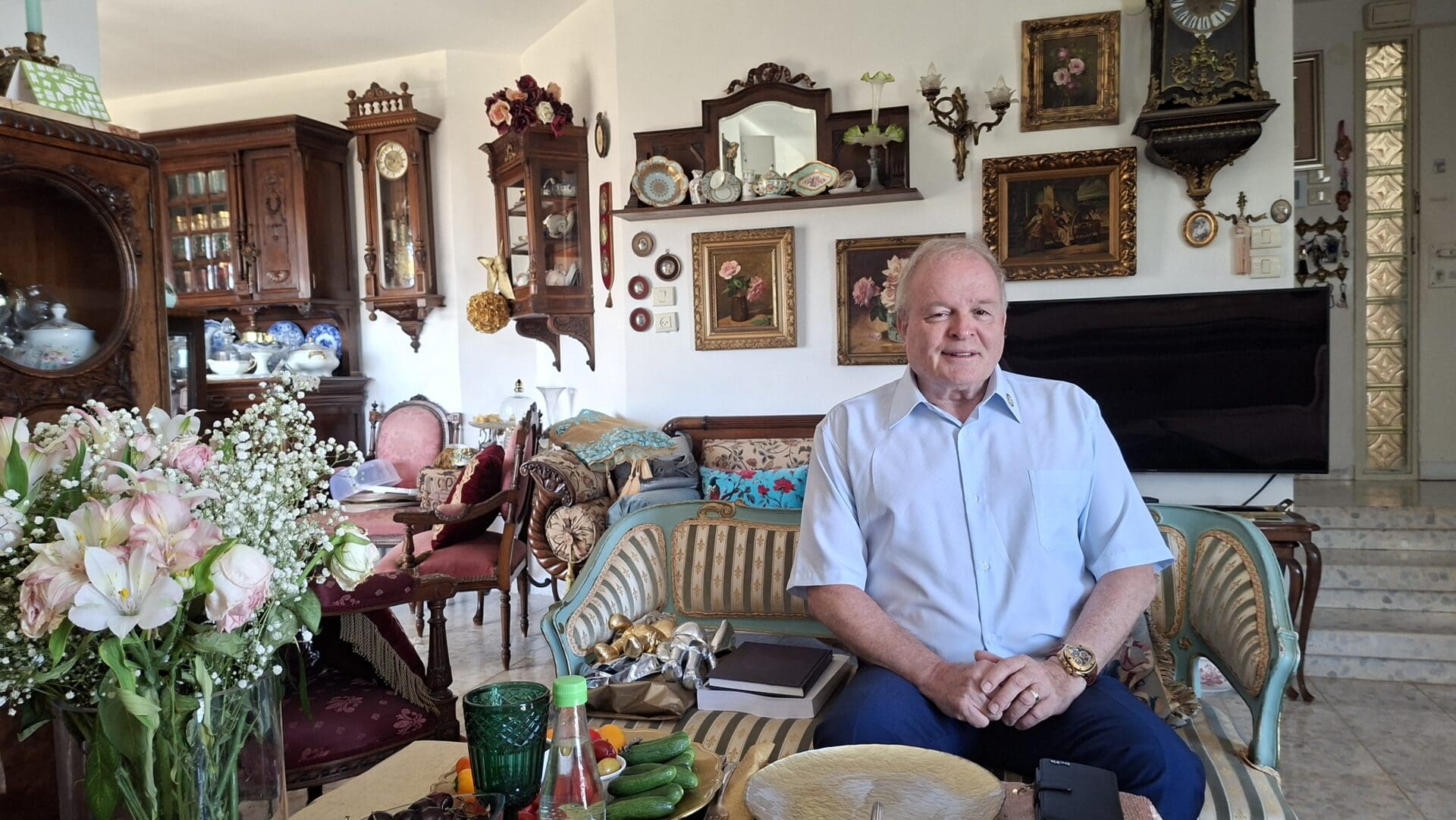
It has stood in the living room ever since, and with a smile he calls it "my sofa," as if it had adopted him no less than he had adopted it. Perhaps precisely because it was not purchased with money, but was given out of trust and appreciation, it has become the item closest to his heart. In a world of collectors, where rarity and monetary value sometimes take center stage, this sofa reminds us that the objects that stay with us over time are not always those worth the highest amount, but rather those that carry within them the delicate weight of a human connection.
The book that was pulled out first
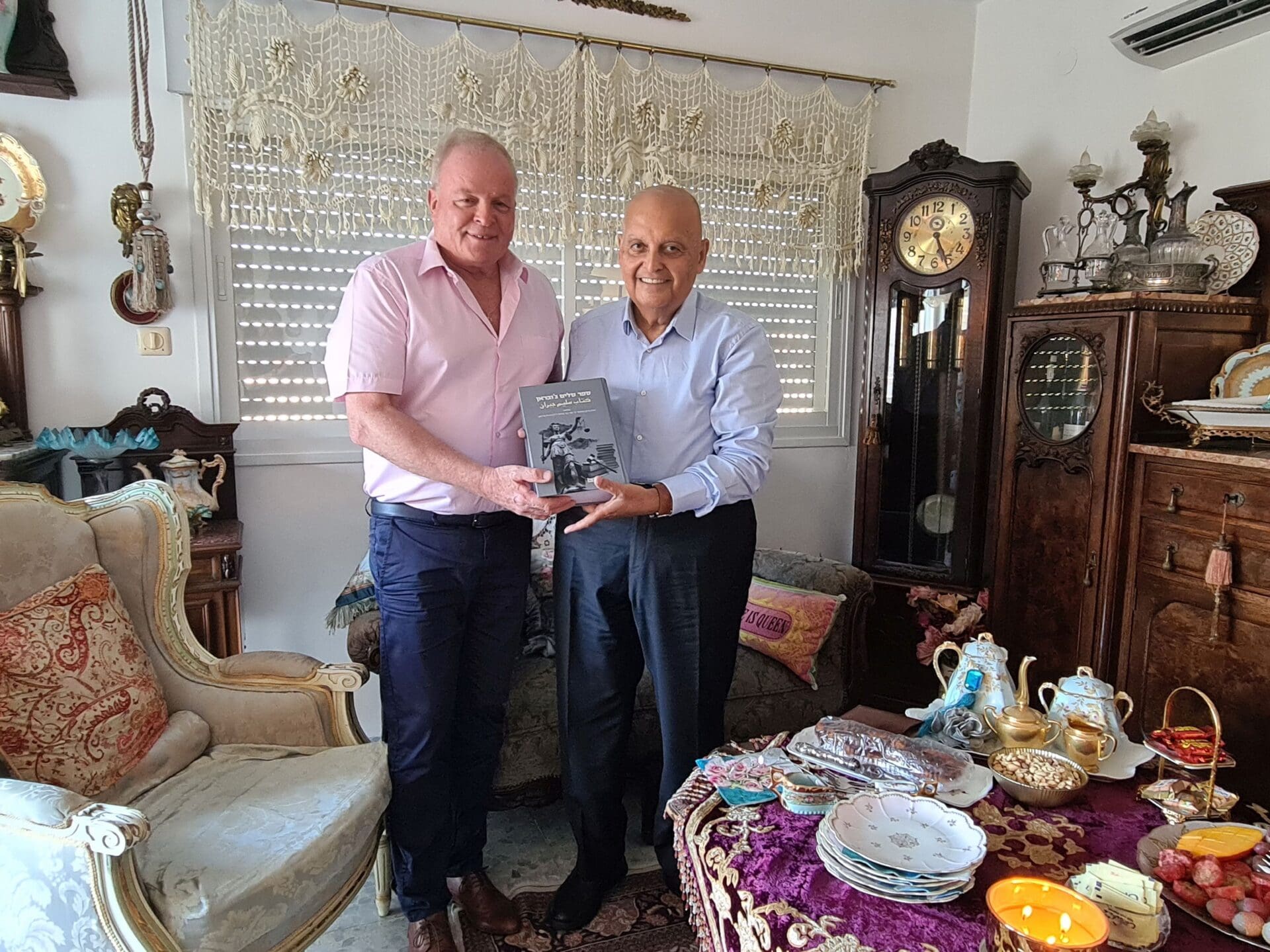
When Yona was asked to point out the book most dear to his heart among the volumes scattered around his house, there was not even a second of hesitation. His hand reached for the shelf almost instinctively, and pulled out the biography of Salim Gibran. It was not just a choice of a favorite book, but a gesture that revealed the way Mazor measures people.
Gibran, who was born in 1947 in the German colony in Haifa to an Arab-Christian family from the Maronite community, grew up in a city where Jews, Muslims and Christians shared a complex but vibrant space. From the Terra Santa School in Acre, he continued his law studies at the Hebrew University, and after more than a decade as a private lawyer, he began his journey to the bench. He advanced quietly, almost without dramatic gestures: from the Magistrate's Court in Haifa to the District Court, and from there to the Supreme Court, where in 2004 he became the first Arab to be appointed to a permanent position. An expert in criminal law, a judge who preferred to listen before he spoke, a man who believed that the power of the court lies not in the thunder of its rulings but in the trust it inspires. Even when he served as Deputy President of the Supreme Court and Chairman of the Central Elections Committee, he saw his role as a civic mission designed to protect the democratic rules of the game precisely at moments when society is cracking under its divisions. Outside the courtroom, he taught at Haifa University, was active in Rotary, helped promote legal research, was among the founders of the Jewish-Arab Cultural Center in Acre, and believed that a shared society is built not only through laws, but also through conversations, acquaintances, and trust. He did not seek to be a symbol of coexistence or a historical breakthrough. He sought to simply be a good judge, and precisely because of this, he became one of the quiet and profound symbols of Israeli society.
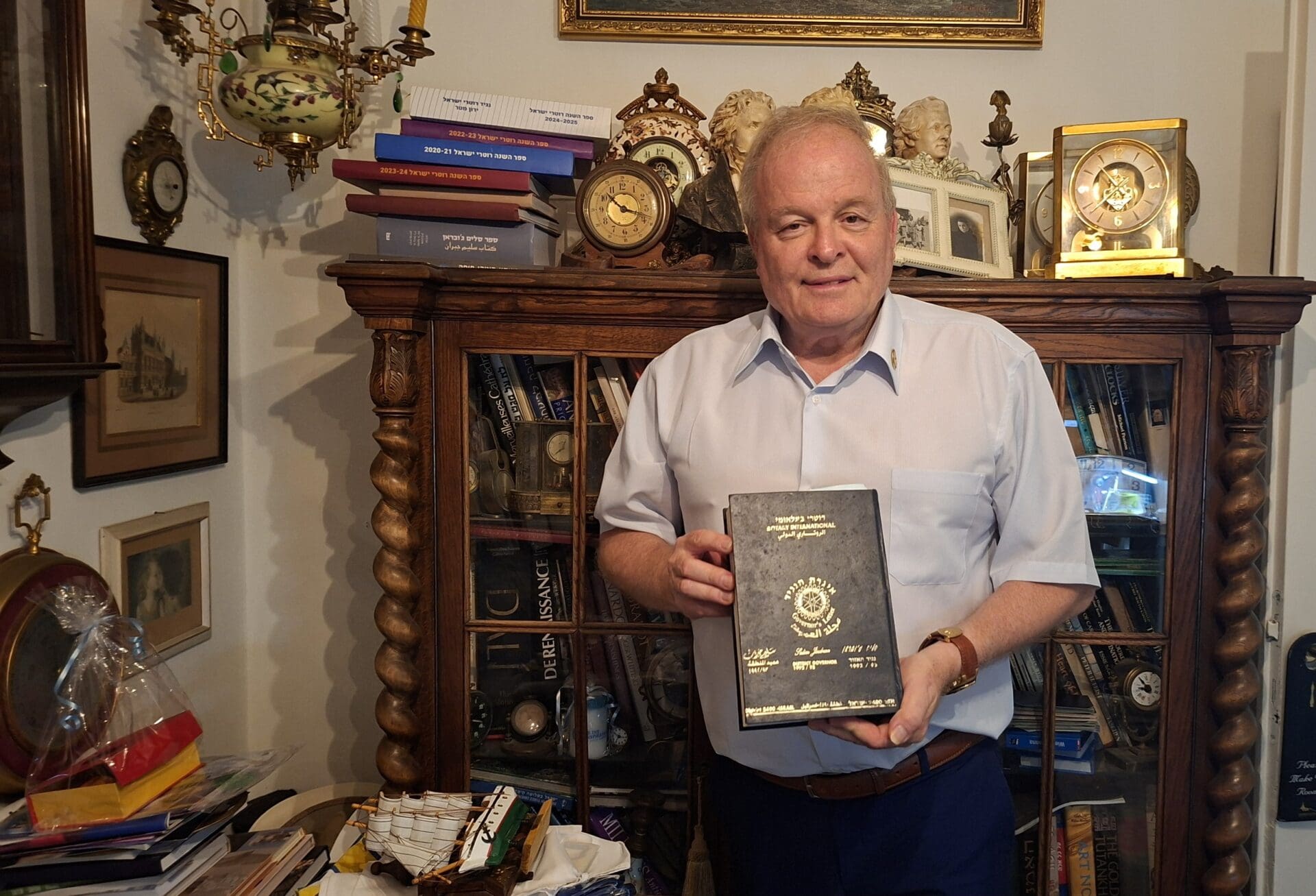
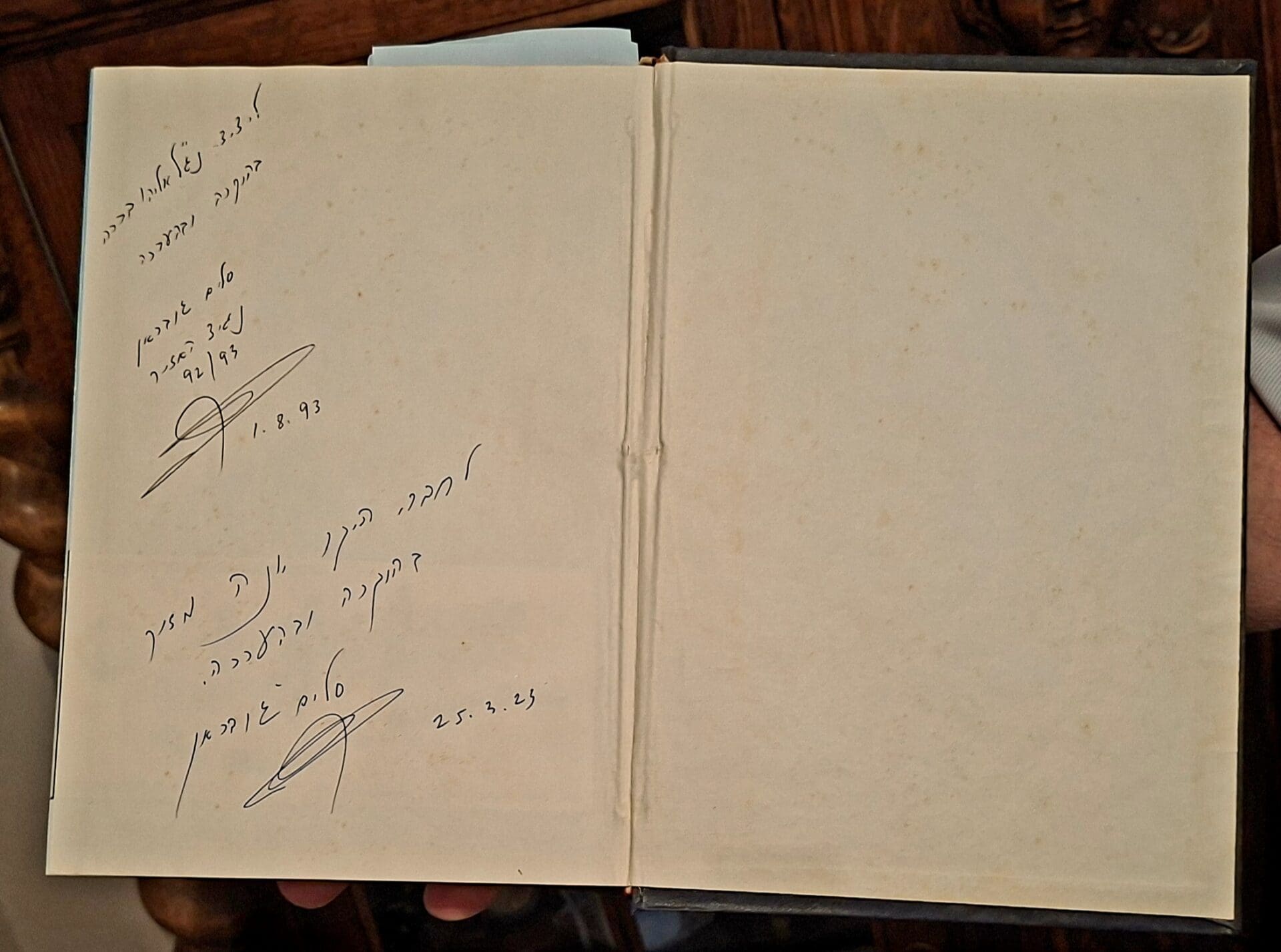
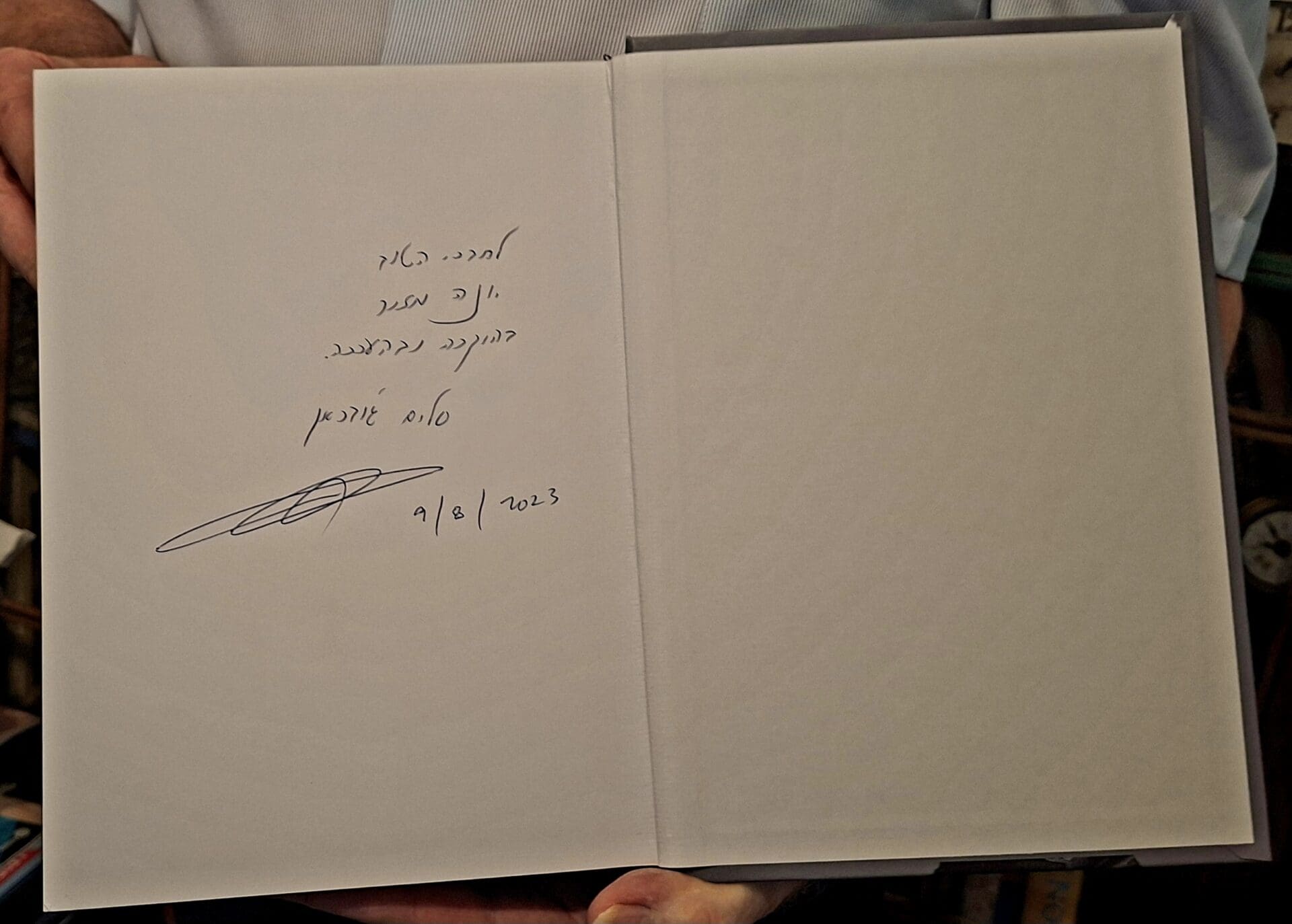
For Mazor, this public figure was also a familiar face around the dinner table. Their relationship began more than a decade ago at the Rotary Club, where Gibran was a longtime member, and deepened until it became a rare family friendship.
Alongside his wife Nina, the Gibran couple were among his closest friends. They traveled together to Crete and Hamburg, repeatedly stayed in each other's homes, and every Christmas when Nina and Salim opened the door to their home, the guests found themselves sitting around a magnificent fir tree, not as guests at a festive ceremony but as family members.
At Gibran's personal invitation, Mazor was granted a private visit to the Supreme Court, but the truly significant moments he remembers are from everyday life: long conversations about current affairs, books, people, and Rotary activities. And so on, until he became Gibran's unofficial "personal secretary" in all matters concerning the organization.
Their friendship was based on that rare quality that Mazor knows how to recognize and cherish: people who do not seek to leave an impression, but to leave behind a slightly more decent world. Perhaps that is why, of all the books in his library, the life story of Salim Gibran is the first to be pulled from the shelf. Sometimes, a book is not just a biography. It is a testament to friendship, to deep appreciation, and to a human encounter that itself became a chapter in the writer's life.
When the circle closes, the road continues.
There are people whose work is difficult to measure by the number of positions they have held, the number of decorations that adorned their lapels, or the years of service they have accumulated.
Yona Mazor is one of them. His life path, which began as a Haifa boy between the slopes of Mount Carmel and the sea, passed through the decks of the Navy, the classrooms of the Technion, the workshop where he gave new life to antique chandeliers and clocks, and continued through years of relentless public activity, coalescing into a single story of commitment.
For nine consecutive years, he held senior leadership positions in Rotary Israel, initiated and established new clubs, accompanied generations of members, and today, as Secretary of Rotary Israel and simultaneously as President of the Acre Rotary Club, he continues to see service to others as a daily mission and not an achieved goal.
Paul Harris' nine Fellow awards, including two awarded to him by Rotary World Presidents, are merely outward symbols of a lifelong journey of giving and involvement, which over the years has become an inseparable part of his identity. His election as Rotary Israel Governor for 2028/29 is recognition of a man of many rights, who has worked for years for the benefit of the community. For Haifa, the city where he was born in 1952, grew up, was educated and shaped his world, it is also a moment of quiet and meaningful pride.
The article about Yona Mazor, "The Man of the Lamps," is a masterpiece that brings focus to a humble man whose contributions, past and present, are worthy of appreciation.
You skillfully overcome the difficulties involved in writing the "life story" of another person. As is known: a biography and a memoir are written works that pose an extremely difficult challenge because they involve a choice. You chose correctly! In your excellent article, you presented Yona Mazor as someone who knows: "Where he came from and where he is going." You wrote about the family and its experiences during the Holocaust, you described the modesty of the parents, the devotion to the land, which bore fruit - Yona's contribution to the country as a military man. You addressed his dreams and their realization, and you also addressed his family, his wife and daughters. You paid tribute to his significant position in Rotary.
How symbolic that the man who brought "light" to many homes was awarded the article "Illuminated" in Or Yaqorot.
well done!
To Rivka Tzur Berzanitz,
You moved me greatly with your words. I read them over and over again, and I felt how much you were able to see not only the article, but also the intention behind it.
Writing another person's life story is truly a great privilege, but also a considerable responsibility. Choosing what to tell, what to touch on, and most importantly, what to leave the reader feeling, requires a lot of listening. In Yona's case, I felt like I was meeting a person whose light he brings to the world is not only found in the lamps he created and renovated, but also in the way he lives, in his family, in the values he received from his parents, and in his contributions over the years.
Your sentence, that the man who brought "light" to many homes was awarded an "illuminated" article in Or Yaqarot, particularly touched me. What a beautiful and precise way to summarize the article.
Thank you, Rebecca, for your deep reading, your generosity, and your ability to see between the lines. Your words are a great gift to me, and I cherish them very much.
A welcome initiative to tell the life stories of Haifa figures. Thank you for the opportunity to get to know in depth charming and impressive people like Yona and Atara. I learned a lot about them through this article. You are very talented in conveying their fascinating life story and when combined with the photos, you get a wonderful experience. Yashar Ka'ah
Good luck to Ilana,
Thank you very much for the warm and moving words.
The essence of your response is a real gift to me.
It moves me to know that the story of Yona and Atra was able to open a window into their world, and bring to readers not only the story of their lives, but also something of the person, the spirit, and the city of Haifa that they represent.
Thank you very much for your appreciation, for your sensitivity, and for truly reading,
In the eyes and in the heart.
Hello Rachel. I usually skip long articles like this, but you know how to infuse the first few words with charm and interest that arouse curiosity.
You have skillfully painted a combination of an interesting personality and interesting choices in her life.
Objects and furniture and roles.
Thanks
For Nili,
There are words that are read, and there are words that are touched.
Yours touched me.
If I managed to stop you for a moment, open a door of curiosity for you, and lead you into the character's world, then that is the greatest gift any writer could ask for.
Thank you for walking the path with me,
And thank you for the broad heart that is found through your words.
A stunning article. Congratulations to the journalist who wrote a thoughtful article. Yona, you deserve a huge hug, a true champion. May you be blessed for all the wonderful and wonderful work you do for the community. Rotary appreciates and cherishes your kind heart, which is not taken for granted. I wish you and Atara health and happiness with great love.
To Matti Golan,
Thank you very much for the warm and moving words.
Your appreciation for the craft of writing, for the investment and attention to detail touched my heart.
I'm glad the article was able to convey the story and the action in the way you felt it. Thank you also for the generous support.
I read very carefully about a dear man I have known for a short time. Through your article, I learned a lot about Yona, his family and his development. Yona the baby, the child, the teenager, the adult, and the officer and gentleman.
On the one hand, there is the pain of loss, and on the other hand, there is the strengthening of the spirit, the success, the strength, and the ability to make great things out of nothing….
Yona Mazor is a story worth learning.
Great article about a child from the resurrection and rebirth generation from the salt of the earth. Well done. Congratulations to the journalist!!!!! For interesting writing.
To Yaakov Barel,
Thank you very much for the exciting response.
I was very happy that you read the article and found it interesting.
Your words about "a child from the generation of revival and rebirth" and "the salt of the earth" are particularly moving.
Thank you also for the support for the writing. I really appreciate it.
What an amazing article. Like a book. I knew most of his life story from the stories he always talked about, but to read everything again from the beginning from mom and dad and his desire to reach the top that started back on Mochlis Street and continued in the army, in the United States, at the Technion, in commerce, while establishing a glorious family and finally contributing his incredible ability to Rotary and the community and investing all his professional and organizational skills at every stage of his life - and everything is summarized in the article. There is no other word than to say - good luck and congratulations to my friend Shiona. Thank you to the talented journalist for amazing writing.
To an animal, a file,
I was very moved by your words. Thank you from the bottom of my heart for your appreciation and for your sensitive and profound reading.
As a writer, there is no greater satisfaction for me than knowing that I have managed to take a life story, gather the moments, memories, and key points, and transform them into a narrative that manages to touch the hearts of readers. The writing process was for me a journey of listening, observing, and searching for the person behind the story.
Thank you for the great compliment that the article felt like a book to you. This is exactly my ambition in writing: not only to convey and convey information, but to create a human experience, to bring characters to life and give the reader the feeling that he is walking with them on their life's journey.
Thank you for the kind words and the sensitivity with which you received the article. You touched me very much.
Good evening - I have a suggestion for a very similar article about Eliyahu Zuckerman, z"l, of Kiryat Haim, who served as secretary of the Haifa port workers, built the dedicated port workers and then replaced Yosef Almogi in his position when he was appointed a member of Knesset. In those days, the port was built on its talented workers. You should check it out and see. Thank you. I built it and will be at your disposal. We had a shared life with the Almogi family, z"l. A nice and fun life in Kiryat Haim. Every Saturday at 10 am, a meeting on Zuckerman's lawn on G Street with the people of Haifa, the port workers at that time. You can contact me as Tirzu. Thank you. Father, z"l, was one of the founders of the labor movement in Haifa with Yosef Almogi, z"l. Thank you.
To Adi Zuckerman,
Thank you very much for your contact and the interesting proposal. The story of your father, the late Eliyahu Zuckerman, and his contribution to the Haifa Port workers and the labor movement are indeed important and worthy of appreciation.
However, our section, "I Live Here Too," focuses on people currently living in Haifa, hosting them in their homes, and getting to know their personalities as reflected through their homes, their living environment, and the objects that accompany their lives (see a paragraph discussing this in the body of each article!).
We would be very happy if you could recommend someone currently living in Haifa who might fit the character of the section. Of course, we would also be happy to hear about interesting figures whose lives, homes, and personal stories reflect unique aspects of life in the city.
Thank you for thinking of us, and we wish you and your family all the best.
An interesting and fascinating life story from doom to growth and greatness
Estherina has three,
Thank you very much for your response and the perspective you provided.
I just wanted to clarify a small point:
To me, this is not a story of doom, but rather a story of growth and transcendence. The loss and trauma belong to the story of his parents' family, Holocaust survivors.
From this complex reality, Yona Mazor absorbed strength, values, and determination from his parents, and built his path to becoming an officer, engineer, businessman, and today he heads a volunteer organization.
This should be seen as evidence of the power of man to grow from a legacy of pain, to choose a life of action, of giving and influence, and to transform the past into a source of strength.
A beautiful and thoughtful article. It's a shame that there's only an excessive indulgence in coexistence. Any sensible person understands that our people are hated by all the peoples around us who see us as enemies. If we weren't strong, we would simply be expelled from our country. So what kind of coexistence is a shame? It's naivety.
To the bird,
Thank you very much for reading the article and for honestly sharing your feelings. I appreciate the time you took to do so.
It is important to clarify that the essence of the article does not deal with the idea of coexistence or the expression of a political position.
The article seeks to tell the story of Yona Mazor's life, his personal path, and the people he met during his life, as they were part of the reality he experienced. This is a biography of a person, not an ideological article about coexistence.
Thanks again for both your consideration and your reading.
Wow, Rachel. How much wisdom, sensitivity and observation you have throughout the writing process. How you have woven an inspiring journey of life and objects. Yes, Yenna and Atara are an extraordinary couple. Truly spreaders of light and goodness. Orand was for me the place where I searched for my home lamps. I found there treasures of culture and beauty that fill my home. Yona is an extraordinary man. With golden hands. Generous. Thank you Rachel for another fascinating article. Blessings. A journey of life that reflects a different standard. We rise from the brokenness with humility and begin a new journey of life in the State of Israel.
To Leah Popper,
What a moving response. Thank you very much for the warm words and for your attentive reading. I was especially happy that you felt the spirit of the times and the life journey that I tried to weave into the article.
Yona and Atara are indeed extraordinary people, and it was important to me to bring their story as it is. It is exciting to read that you also have personal memories of Orand and that their belongings accompany your home to this day. This gives the article another dimension of life.
Thank you for your blessing and encouragement. Comments like yours give me the strength to continue writing and bringing the stories of people who deserve to be remembered.
Beautifully written and photographed by Racheli Orbach.
Yona Mazor and the good people of Kiryat Eliezer of old who lived in small apartments but the atmosphere was special, new immigrants of that time and Sabras, and all of them Zionists who loved the Land of Israel.
To the bear,
Thank you very much for your warm words. I was glad that the article brought back the spirit of Kiryat Eliezer in those days. Indeed, beyond Jonah's story, it was also important to preserve the memory of a time when people lived simply, shared with each other, and built a new life here out of faith, work, and love of the land.
Thank you for reading and sharing your memories.