


A story about a building – the Great Synagogue of Paris: Every now and then, the "Story of a Building" series travels outside of Haifa, following extraordinary buildings that have a story worth telling. Even after the planned visit to the Great Synagogue of Paris did not materialize this year, the research I conducted and the material I collected over the years made it possible to bring here the story of the building – and the story of French Jewry over the past hundred and fifty years.
While France will celebrate next week, as it does every year on July 14, the Bastille Day – A symbol of the revolution that gave the world the ideas freedom, equality And the brotherhood – In the heart of Paris stands the Great Synagogue on Rue de la Victoire, a building that reflects the long path of French Jewry towards the realization of these ideals.
Jews of Paris
Paris is one of the cities most identified with the culture, art and history of Europe. A Jewish community has existed there for nearly two thousand years. From the days of Roman rule, through the Middle Ages and until the French Revolution, the community has known periods of prosperity alongside expulsions, persecution and discrimination. The French Revolution brought about a historic turning point in the status of French Jews, and Emperor Napoleon continued the process and worked to regulate the equal civil status of Jews in the country.
In the second half of the 19th century, with the growth of the community and its increasing integration into French society, the need arose to establish a new central synagogue – a representative structure that would express the community's new status and its integration into French life.
History of the establishment
In the second half of the 19th century, Paris underwent an unprecedented development boom as part of Baron Haussmann's urban renewal plan. The new Opera district became the city's economic and social center, and many members of the Jewish bourgeoisie moved there.
At the initiative of Chief Rabbi Lazar Isidore and with the support of community leaders, it was decided to build a new central synagogue. The imperial family gave the community a plot of land on Rue de la Victoire – “Victory Street” – whose name commemorates the victories of Emperor Napoleon. Napoleon and Josephine lived on the same street at the beginning of his rise to power, a fact that adds a historical and symbolic dimension to the place.
The main funding for the construction came from the Jewish community, primarily the Rothschild family. Work began in 1867, was interrupted by the Franco-Prussian War (1870) and the Paris Commune (1871), and was resumed later. The synagogue was inaugurated in 1874, and has since served as the central synagogue of Paris and the seat of the Chief Rabbi of France.
Architecture
The Great Synagogue of Paris is the largest in France and the second largest in Europe, after the Great Synagogue of Budapest. Its design was entrusted to the architect Alderoff (Aldrophe), who designed a monumental stone structure that blends harmoniously into the architectural landscape of Paris.
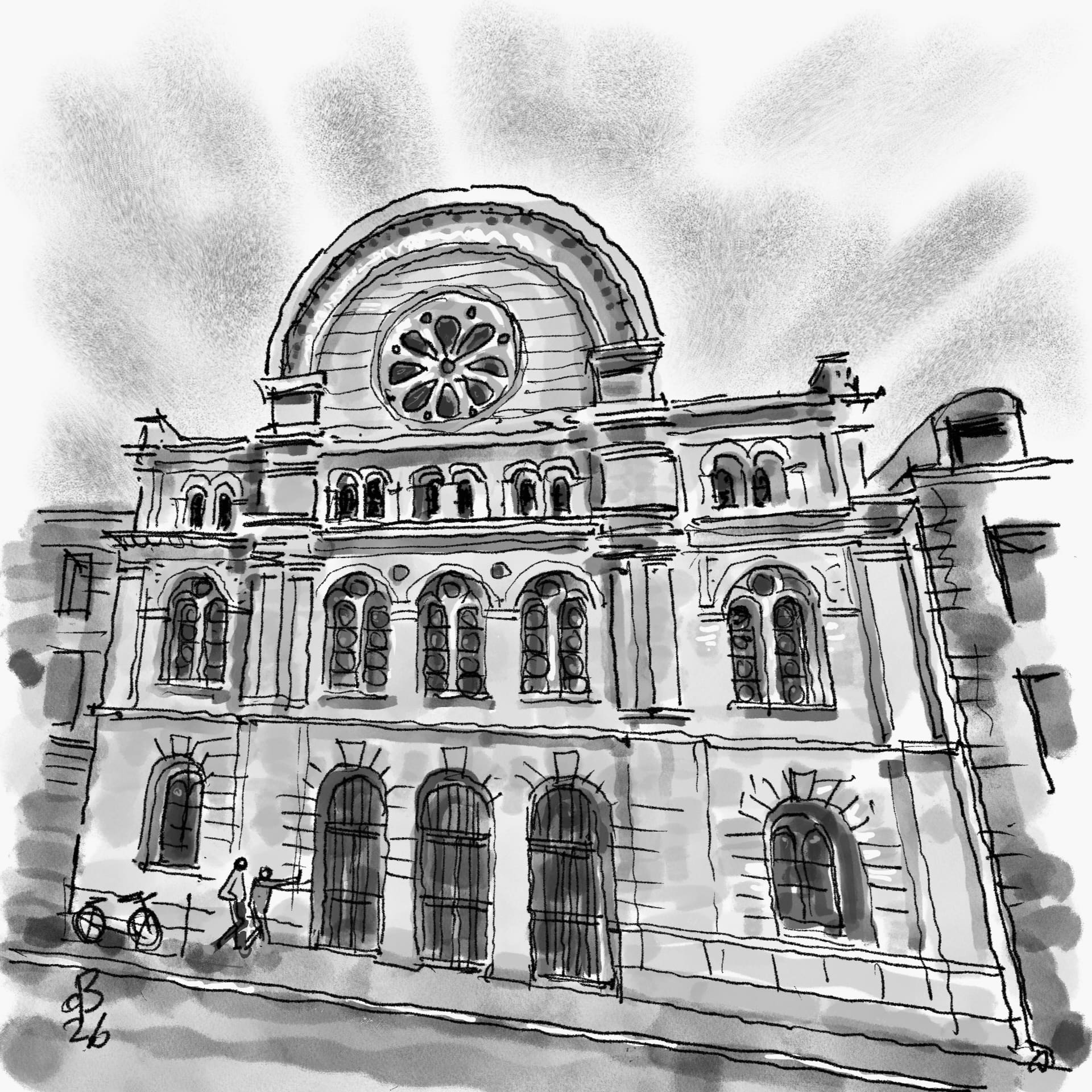
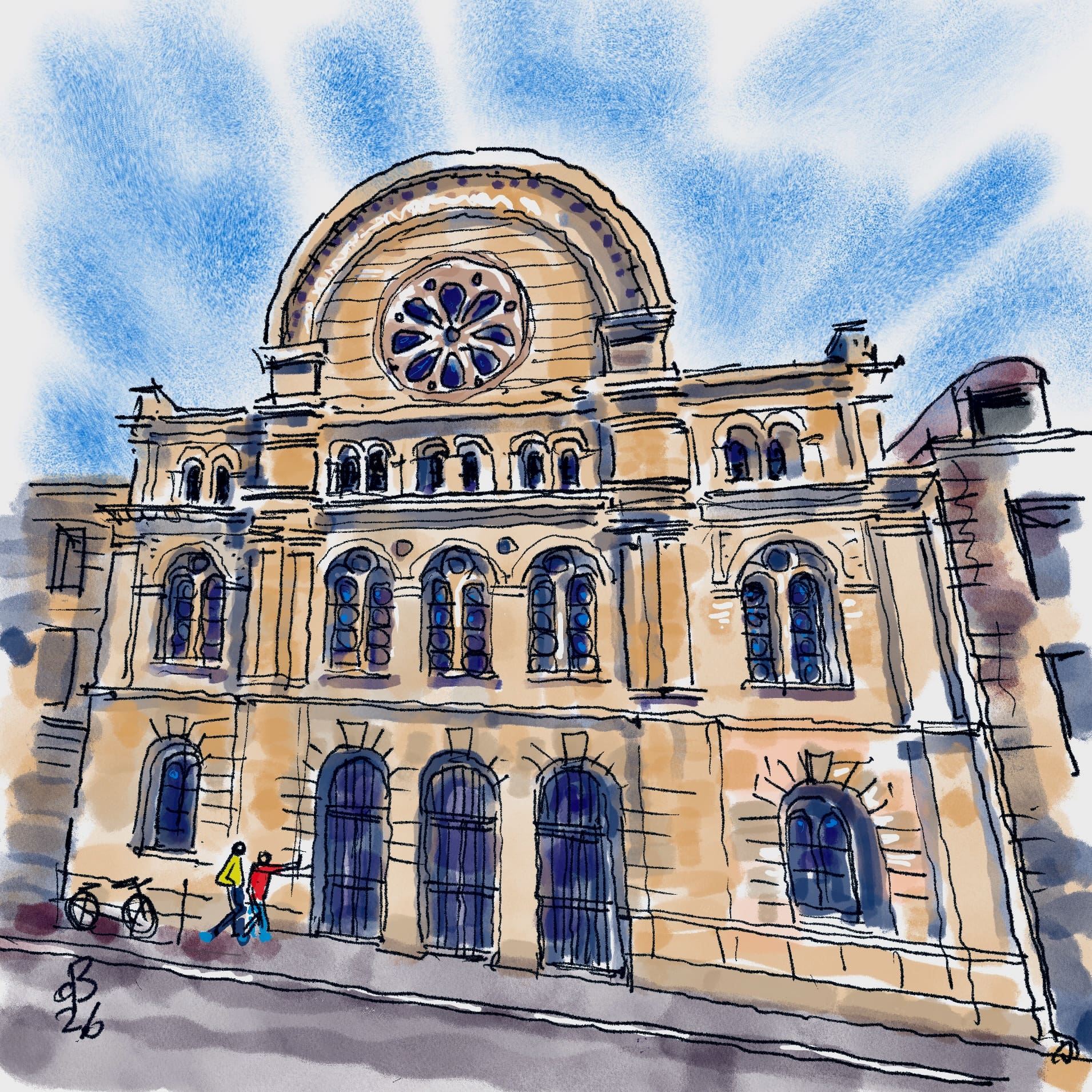
Unlike many of the synagogues built in Europe in previous centuries and hidden among residential buildings, the Great Synagogue of Paris proudly presents itself as a central public building in the heart of the city. Its impressive facade, built of light stone, combines Roman arches, columns and rich decorations. In its center stands a large rosette – a rose window – reminiscent of the famous rosette of Notre Dame Cathedral.
This is not a copy of Notre Dame, but an architectural dialogue with it – a dialogue that also reflects the Jewish community's tightening relations with the French society within which it lives.
Alderoff adopted motifs from French religious architecture and gave them a new interpretation in the synagogue.
The metal frame of the building, which was made by his company Gustave Eiffel (Eiffel) - later the designer of the famous tower - made it possible to create a spacious, open and bright prayer hall - an impressive engineering achievement for its time.
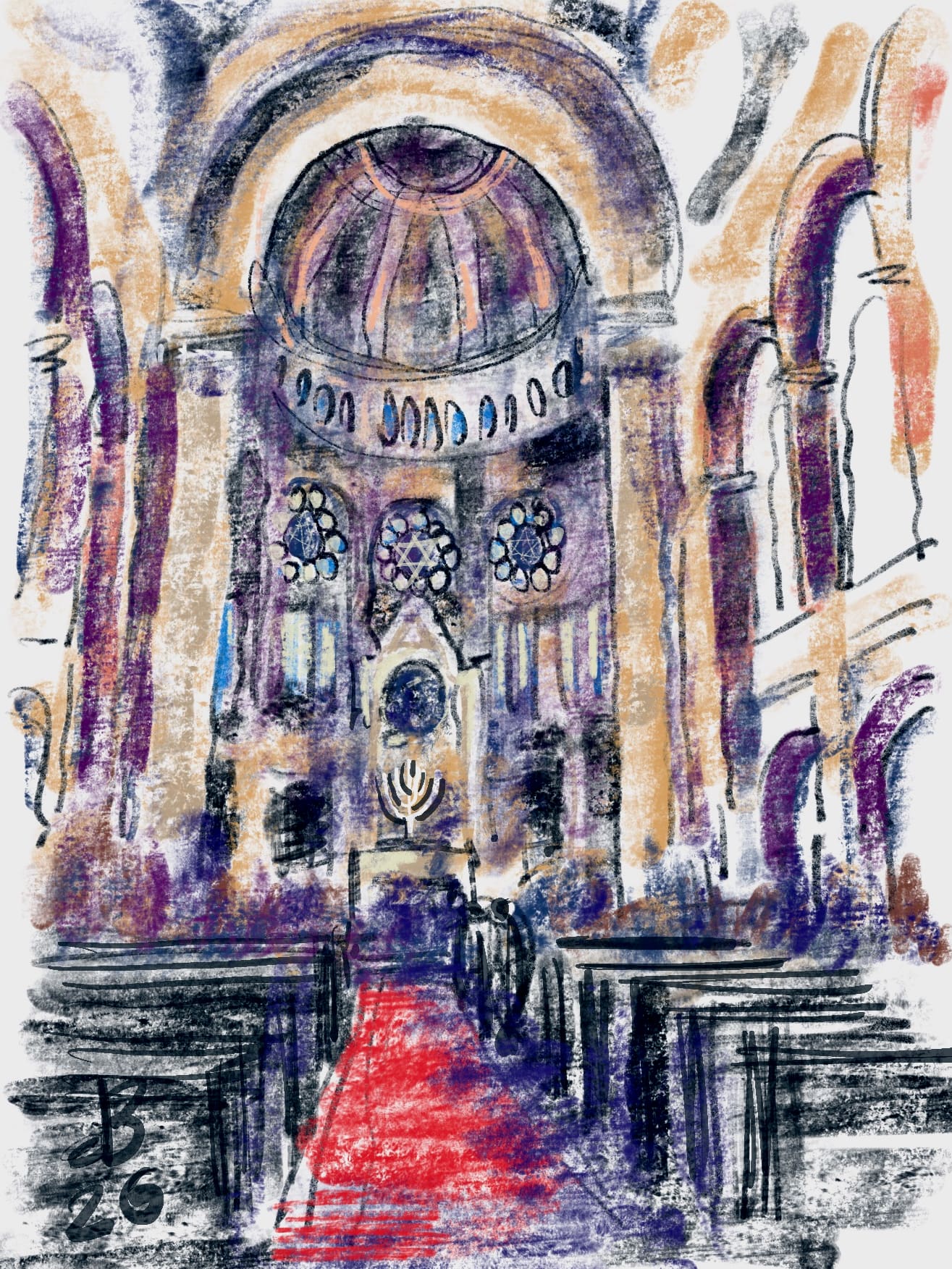
The entrance through the portico – now closed for security reasons – leads from the busy street into a festive and spacious prayer hall, flooded with natural light that penetrates through the stained glass windows. Despite its impressive dimensions, the space maintains a human scale that creates a sense of closeness and gathering. The gaze is drawn to the Ark of the Covenant on the eastern facade, while the large organ and choir complete the ceremonial character of the synagogue.
More than one hundred and fifty years after its inauguration, the Great Synagogue of Paris continues to be not only an impressive work of architecture, but also the public symbol of French Jewry.
150 years of community
Since its inauguration in 1874, the community that prayed within its walls has changed beyond recognition. In its early days, the synagogue served mainly the Jewish bourgeoisie of Paris and the Jews of Alsace-Lorraine, who moved to the capital after their regions were annexed to Germany following the Franco-Prussian War (1871). At the beginning of the 20th century, they were joined by immigrants from Eastern Europe, and after World War II, tens of thousands of Jews from Algeria, Morocco, and Tunisia arrived, changing the face of the community. The synagogue, which initially served mainly an Ashkenazi community, today reflects mainly the heritage of North African communities.
The upheavals of French Jewry were also reflected within its walls. It witnessed the upheaval caused by the Dreyfus Affair, the tragedy of the Nazi occupation and the Holocaust, and the renewal of Jewish life after the liberation of Paris. Even in recent decades, in the face of the wave of anti-Semitism and terrorist attacks in France, the synagogue continues to serve as a center of prayer, remembrance, and solidarity.
The synagogue's stones have hardly changed since 1874, but the community that prayed within its walls has changed beyond recognition. As such, it tells not only the story of a building, but also a central chapter in the history of French Jewry.
Dear readers,
The articles in this section are based on open information published in sources such as Wikipedia and other websites and may include various historical inaccuracies arising from the aforementioned sources.
We invite our readers to suggest buildings as subjects for articles and if interesting stories are found behind them we will be happy to review them in this section.
For a change, a really moving and interesting article about the places sacred to our people.
Thanks for the interesting article!!!
I would love to see more articles like this…
I understand that if they put in an organ, then they would be on the path to assimilation like the Jews of Budapest, and maybe the similarity between the buildings is not coincidental???
Be ashamed of the synagogues in Haifa. While the churches, mosques, and Baha'i temples are magnificent and large, only the synagogues in the city are small, outdated, and in the hands of the ultra-Orthodox who neglect them.
Think about a tourist who comes to any synagogue you take him to, to no one. This is the truth. Tel Aviv is now renovating the Great Synagogue. In Haifa, it is neglected and closed to the public.
Yael A synagogue has been a holy place of prayer for our people for thousands of years and is not intended or intended for tourist visits. Tourists can visit the places you mentioned or designated recreation areas for them.
The synagogue is supposed to be clean and tidy, and its simplicity and modesty sometimes reflects the community around it, and some would say gives strength and connects more than beautifully designed, eye-catching places.
Beautiful and fascinating article, Dr. David Bar On, right.
Unfortunately, the wave of anti-Semitism has not stopped and has even intensified these days throughout France and other European countries in light of the waves of immigrants flooding the continent and influencing it demographically and politically.
And may we be able to unite in our country in the face of enemies both abroad and at home.