

A story about a building in Haifa: At the corner of Golani Brigade and Kibbutz Galuyot streets, on the edge of Haifa's downtown, stands a stone building from the 1930s that at first glance seems quite ordinary. But behind its facade lies a rich urban story — of coffee, of transportation, and of a meeting between worlds.
On the ground floor, “Café Israel” operated for years, a lively social institution that attracted immigrants, vacationers, and passersby.
Building: Between Nazareth Road and Iraq Street
The three-story building was designed in the international style by the architect Moshe Gerstel For the entrepreneur Suleiman Kothran, stands on a narrow corner lot between Nazareth Road (Golani Brigade) and Iraq Street (Kibbutz Galuyot). The ground floor was intended for commerce, and above it were residential or office floors — a typical pattern of the fabric of Haifa's downtown during the Mandate years.
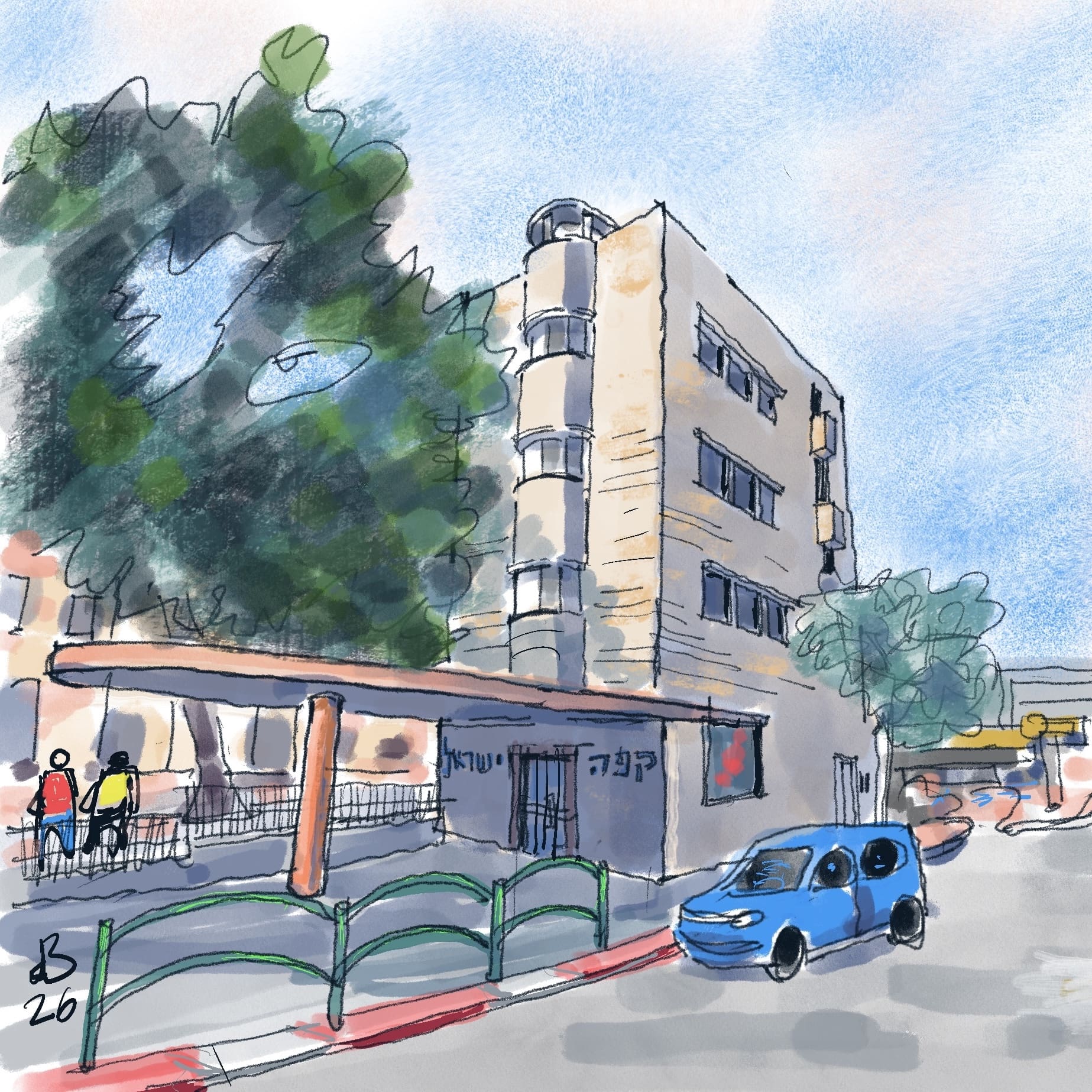
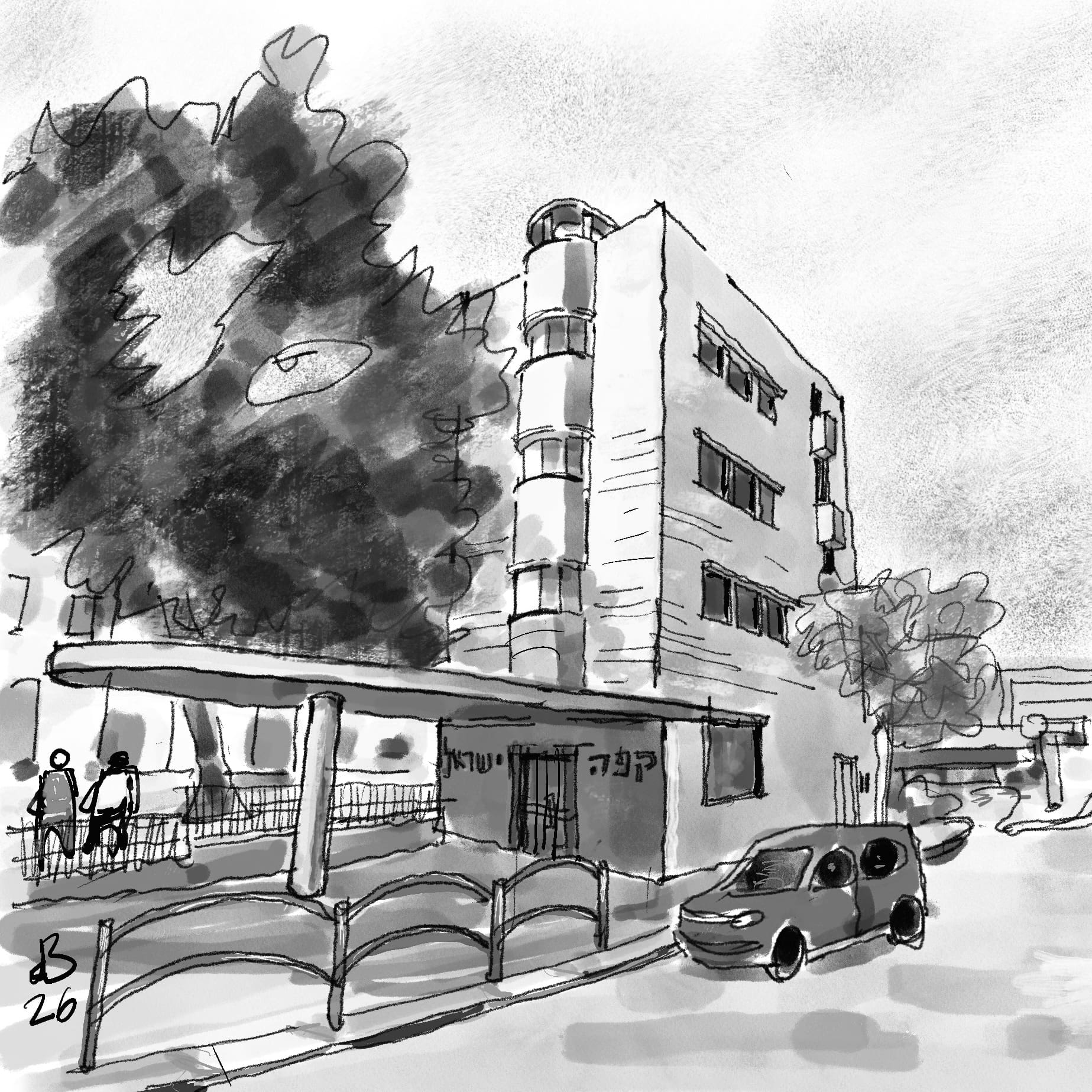
The building has a clear horizontal accent in the form of a concrete roof with a rounded corner — a continuation of the shape of the lot — a rounded balcony. The facade facing Nazareth Road features horizontal window strips, while the eastern facade features a vertical row of semicircular balconies, according to the formal dictionary of the International Style. This row ends with a circular pergola above the roof of the building. The building is clad in local stone, as is customary in many buildings in Haifa, which combine modernism with local building tradition.
Developer: Suleiman Kothran
The building was built for Suleiman Kothran, a prominent figure in the Orthodox Christian community in Haifa. Kothran belonged to the same urban stratum of merchants and property owners who shaped the character of the lower city during the Mandate period. He was a successful businessman from a young age, did not leave Haifa during the War of Independence and kept his assets. Among other things, he was one of the initiators of the establishment of the Arab Orthodox High School in the city, which is considered one of the most prominent of its kind.
As was common among entrepreneurs of his time, he did not operate the business himself, but rather established a rental building that combined commerce and residences.
Coffee Israel
On the ground floor, it operated for years “Coffee Israel”, which became a vibrant social hub in the heart of the lower city. Its location — next to a bus stop for line 41 to Bat Galim (which also operated on Saturdays), and across from a stop for the Haifa-Beirut intercity line — placed it on an active traffic route and brought residents, vacationers, and passersby to it.
According to later evidence, the café served as a daily meeting place for Romanian immigrants. Additional evidence attributes its operation, at one point, to two brothers from the village of Reina — although the details of the periods and identities are not fully known.
At the other end of that urban axis—Iraq Street during the Mandate—operated “Coffee Ice Cream Yonk.” Between these two cafes stretched a small but lively urban continuum of meeting and entertainment. It seems that “Coffee Israel” was not identified with a single figure, but with a diverse human space, in which different communities integrated and an urban atmosphere typical of Haifa of those days was woven.
Architect: Moshe Gershtel (1886–1961)
The building was designed by architect Moshe Gershtel, one of the most prominent figures in architectural activity in Haifa in the 1930s, and the one who won the competition to design the Talpiot Market.
Gerstel, born in Galicia (Poland), studied architecture in Vienna and graduated in 1914. During World War I he served as an officer in the Austrian army. After the war he developed a successful professional career, and in the 1930s — against the backdrop of rising anti-Semitism — he immigrated to Israel from Romania (Bucharest), where he ran a thriving office.
Moshe Gershtel's first work in Haifa, Beit Asfor, received positive feedback and strengthened his standing. Later, in addition to the Talpiot Market, he also designed the old Carmel Hospital, the Industrial House, and many buildings for the city's wealthy population. He became known as a modernist architect who knew how to combine the principles of the Bauhaus with the elements of local construction. Here too, a functional-modernist approach is evident: a commercial facade open to the street, orderly floors, and a clean design language, devoid of unnecessary decoration.
Who named the place “Café Israel”?
The story of Cafe Israel teaches that sometimes there is no need for one central figure. The building, the developer, and the architect are the framework—but life itself happened on the ground floor, around the coffee tables and at nearby bus stops.
Here, between Bat Galim and Beirut, between Saturdays by the sea and weekdays of commerce, a space was created where Haifa met itself — and the world around it.
But one question remains open: Who named the place “Café Israel”?
The identity of the cafe's operator has not yet been fully revealed. If any of these readers have information that would allow them to first identify the name of the person who operated the place — and perhaps also the person who gave it its name — I would be happy to hear it and complete a missing chapter in the cafe's story.
Thanks
My thanks to my friend Aryeh Zuckerman, which drew my attention to this building, and to Ms. A blunt statement From the Haifa History Association, for their assistance in finding essential information to complete the article.
Dear readers,
The articles in this section are based on publicly available information published in sources such as Wikipedia and other websites and may include various historical inaccuracies stemming from the aforementioned sources.
You threw me back to my childhood days (I was born in 1949 at 93 Shivat Zion Street, in the building next to the Al-Istiqlal Mosque). Cafe Israel was a permanent part of my childhood landscape.
The Kibbutz Galuyot and Yehuda Halevi area is officially the most neglected urban area in the State of Israel.
Peace…
My name is Marcel Amsalem.. To my great joy, I lived across from Cafe Israel at 130 Kibbutz Galuyot St. I have many childhood memories of the neighborhood. A round cafe all week long, lots of customers from all ethnicities. I remember that on Fridays and Saturdays the place was open as an oriental restaurant… hummus, beans/meats/fish.
Opposite is a bus stop towards Hadar…ahead is a stop towards Bat Galim and Agad.
Down towards the east is a bus stop towards Nazareth.
We came from Algiers in 1961..we lived in a building across from Cafe Israel…next to a cold storage. Grocery stores…one of the best times of my life…
Hi Marcel, how are you? Shari, Rafi Ben Hamo's sister. Across from Cafe Israel was a grocery store owned by the late Yitzhak Fedida, the gabai of Rabbi Meir Baal HaNesh, where my late father prayed. My sister Ruhama was run over by an Egged bus in 1970, and the person who rushed her to Rambam Hospital saved her life as a 17-year-old girl. It was none other than Pinchas Suisa from the refrigerators at Kibbutz Galuyot. He is still there today. My parents also immigrated from Algeria in 1955. And I have many childhood memories of the area. In particular, my sister's accident. The police station was also in the same area until they moved. If you want to know who owned Cafe Israel, ask Pinchas from the refrigerators. He is the most knowledgeable about the area. Good luck
Yes, I also lived on Yehuda Halevi Street and we would sit at Cafe Israel. And almost every Shabbat we would travel from the station that was next to Cafe Israel to the quiet beach. What nostalgia…
It's fun to read your articles and thank you for bringing up a bit of Haifa's heritage.
In the 60s, the place functioned as a cafe during the day, but on Saturday nights it would become a dance club with a live band.
As a child, I was fascinated by women's elegant clothing and puffy hairstyles.
I miss that time.
Houses of glory and honor, and we are little ants that no one sees.
As a child, I would go there with my grandfather Zalman Mert, who was one of the owners of the Carmel Beach, which was bought from the Kiat family. A policeman lived in the building. We called him Nathan the Policeman, and he was a close friend of my grandfather. This was in the early seventies.
There were times…
I was happy to read about Cafe Israel. As a child, I spent many hours there because my grandparents had it on the second floor. I remember the roof of the building where the kids would go up to play.
thank you for your response!