

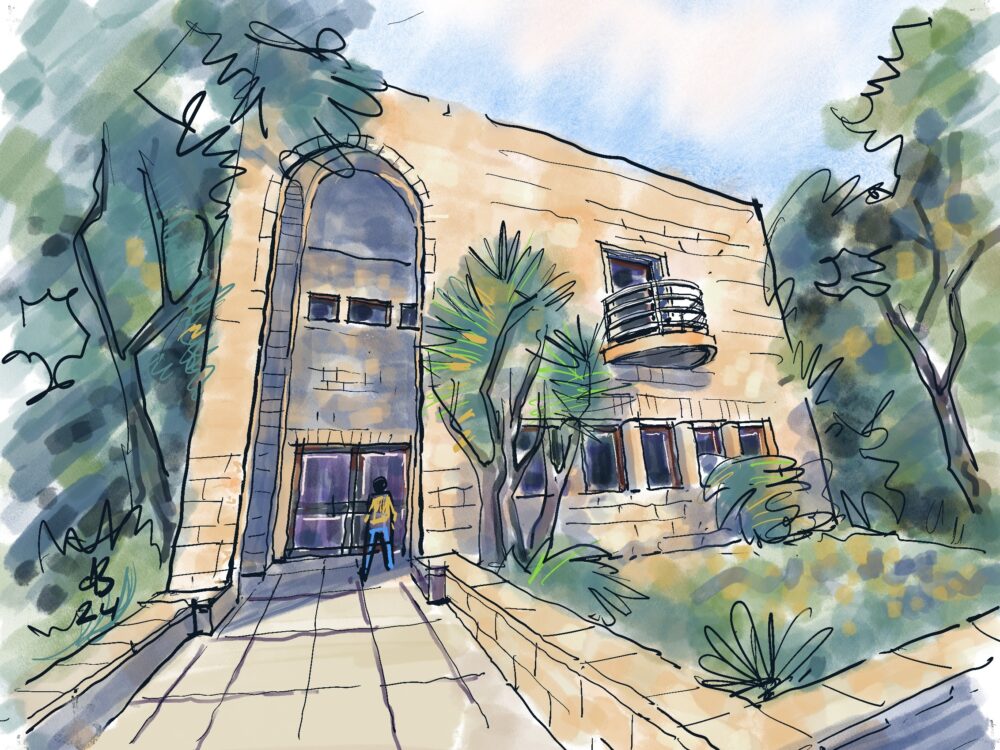
On Tschernihovsky Street today, there are several villas from the 25s, which deserve special attention both because of their design and because they were the result of an interesting collaboration between Jewish architects and Arab clients during the Mandate period. One of these villas, Beit Asfor, is located at XNUMX Tschernihovski Street.
Beit Asfor
This house was designed in 1934. This was the first work of the architect Moshe Gerstel who immigrated and settled in Haifa only one year earlier, in 1933.
Fascinating cooperation in the construction field between Arab entrepreneurs and Jewish architects
The building represents a series of buildings built in Haifa as a result of a fascinating collaboration in the construction field between Arab entrepreneurs and Jewish architects. The building excels on the one hand in its clean lines and the simplicity of its volumes and on the other hand in the use of traditional Arab building elements, such as the arch and the stone finish.
The general minimalist design, combined with rounded balconies with metal railings, associate the building with the international style. As I remember, this style was born in the Bauhaus in Germany and was brought from Europe mainly by the architects who came up on its fifth floor from Central Europe.
The interior design of the building was also revolutionary for its time and included an open central space with a staircase that led to the bedroom floor. The impressive living room, located on the ground floor, was transformed to a height of two floors. As mentioned, the finishing of the building was in finely processed stone.
Hana (John) Asfor
Hana Asfor was a Christian-Protestant Arab lawyer, the son of a well-to-do family from Shafaram. He was a prominent activist in the Palestinian national movement and served as a member of the Haifa City Council. He was also a board member of a number of Palestinian institutions. In a surprising twist, Attorney Hana Esfor, who must have been well rooted in the Arab circles of the city, entrusted the planning of his private house to a not very well known Jewish architect who arrived in Haifa only a year before. This decision of his must have caused bewilderment, but upon completion of construction, the house generated a wave of enthusiasm, both on the part of the Jews and on the part of the Arabs.
The architect Moshe Gerstel (1886-1961)
Moshe Gerstel has long been known to readers of our generation. Recently, he was mentioned as the architect who won the architectural competition for the design of Haifa's Talpiot Market.
Nevertheless, we will mention a few biographical details. He was born in Galicia (Poland) but studied architecture in Vienna and graduated there in 1914. In the First World War he served as an officer in the Austrian army. After the war he started a successful professional career. Following the rise of anti-Semitism and the rise of the Nazis, he immigrated to Israel in 1933 from Romania (Bucharest) where he had a prosperous office. As mentioned above, Beit Asfor was his first work in Haifa. The enthusiastic responses to Beit Asfor strengthened Gerstel's reputation. Later he planned in Haifa, besides the Talpiot Market building, the old Carmel Hospital building, the Industry House and more. He became known as a modernist architect who knew how to combine the principles of the Bauhaus school with the elements of traditional Arab construction.
The incarnation of a building
The Asfor family lived in this beautiful house until the war of liberation. After the war, until the 90s of the last century, the house was used by the Navy personnel as an "officer's club".
In 1991, the building was declared a building for conservation by the Haifa municipality. Today, after undergoing careful renovation and preservation, the building is used as the office building of the family construction company "Sharbiv". The beauty of the building is well preserved, to the glory of the international style architecture in Haifa.
Dear readers,
The articles in this section are based on open information published in sources such as Wikipedia and other websites and may include various historical inaccuracies arising from the aforementioned sources.
Did the article interest you?
In 1934, my parents, Adel and Yosef Meman, moved from Tiberias to Haifa. After their marriage, the couple lived near Sidon Street in a building owned by Hana Asfor. I was born in the "Batar" hospital and as a very small girl (three years old) I remember two or three childhood photos from our apartment in the Hana Asfor building. I have at least one photo of our dog on the outside steps of the building. OK, I am one of the elderly among Israelis today, that's true. Thanks for the interesting list!
Thank you very much for the lovely testimony. I'm glad you found interest in the article, have a good week!
Yes, but it's also worth reading on Wikipedia for those who have forgotten about the events of 1939, about two years later, about the concept that we've been living in for at least a hundred years.
If you insist on mentioning the cooperation in almost every article and the reader almost believes that there was a paradise here, we must not forget to mention the full picture: attacks that did not stop and its cruelty towards our people even before we returned to our country let alone after.
Shabbat Shalom!
thank you for your response. The fact that I mention the cooperation in a certain area, does not make the other historical events forget. Shabbat Shalom!
A well-to-do and not well-to-do family..
Thanks, will be fixed, of course! Shabbat Shalom!
In the thirties of the last century, the term "Palestinians" did not yet exist.
thank you for your response. The concept did not exist, the people did. Shabbat Shalom!
This is not his first job in Haifa. And he was here before and back again.
Thanks for your response, this fact is excellent on Wikipedia. Shabbat Shalom!
estimation. No. resistance.
Thank you very much for the article
The yard of our house at 10 Ze'ev St. bordered the yard of the officers' club, and as children we would sit on the common fence and watch performances. I remember the duo Ilka and Aviva and the North Command band starring Lolik (Levi)
Thanks for your comment, nice to remember. Shabbat Shalom!
All the best to you my friend Dr. David Bar On. Shabbos Shalom to you
Thank you very much, my friend, Rafol and Shabbat Shalom!
Thank you Dr. Bar On for your historical spotlight on special buildings in the city.
I would appreciate it if you could refer to the Hapoel Pool building on Hapoel St. in Haifa, which has been abandoned for decades.
Thank you very much for your encouraging response. As for the Hapoel pool - we will consider.