


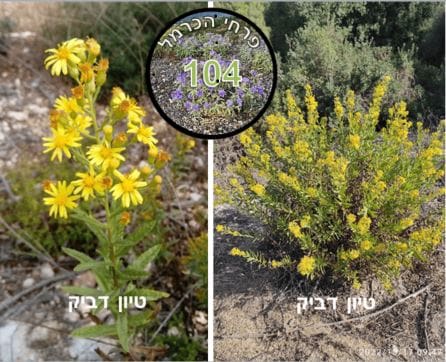
Carmel presents us with flowers in all seasons.
In this column, we will always feature one of the Carmel flowers, in parallel with its appearance in the field, and you will be invited to visit it in one of the places where it blooms this week.
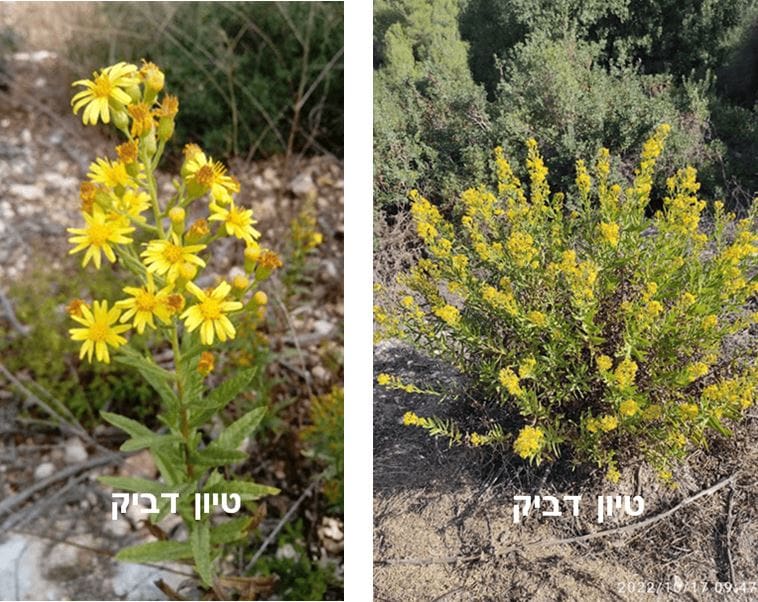
Sticky ditsy – Dittrichia viscosa
A branched shrub that splits from its base, 50-100 cm tall. The shrub is deciduous in winter.
Sticky toadstool is a plant that grows where almost no other plant can grow, and slowly, as the area recovers and soil forms in the area, it disappears and other plants appear underneath. The plant's stems, leaves, and inflorescences are densely covered with tiny glandular hairs. These glands secrete resinous substances with a strong, pungent odor. The pungent odor and sticky texture of the plant's parts deter herbivorous animals from eating the plant.
Type name – “Tyun” was adopted from the popular Arabic name for the plant טיון - تيّون. As part of the adoption of traditional Arabic names for plants in the Land of Israel.
Species name – “Glutty” is derived from the stems and leaves, which are covered in glands that secrete a sticky, fragrant resin.
The entire stem is densely covered with glandular hairs that secrete a sticky resin with a pungent, aromatic, and very characteristic odor. In addition to the glandular hairs, the stem sometimes bears dense hairs that give it a slightly rough appearance.
The leaves along the stem are lanceolate, sessile. They are 5–10 cm long, 1 cm or more wide, and are finely serrated with few, widely spaced teeth.
Sticky thyme blooms from July to December, mainly from September to November.
In the scalp of the sticky toad, as in most members of the complex family, there is a clear morphological and physiological division of functions between the lingual peripheral flowers and the tubular central flowers.
The flowers are clustered in panicles arranged in a raceme or in a long, narrow cluster, the diameter of the panicle is 15-20 mm. It is flowerless and consists of two types of flowers: 20-30 tubular, bisexual, dark yellow central flowers whose main function is to produce nectar, pollen, and reproduction, and around them 10-15 yellow, female linguineous peripheral flowers whose main function is visual advertisement and attracting pollinators from a distance to the panicle.
The fruit of the sticky toad is a cypsela – a dry, unopened fruit containing a single, small, brown seed.
The fruit of the central flowers has a developed, long tassel (Pappus) made of thin white hairs. Dispersed over a distance by the wind.
The fruit of the pericarp flowers has a very short and narrow tassel. It is distributed by dropping the spores near the mother plant.
The source of the characteristic, pungent odor of sticky toadstool is not in the flowers, but rather from resin glands that cover the leaves and stems.
The flowers of the center are the almost exclusive producers of nectar and the sole producers of pollen in the scalp. Pollinators of the plant are mainly honeybees, hoverflies, wasps and butterflies.
The plant is very common in habitats created by humans, such as roadsides, especially on new roads that have been opened in recent years, in empty lots that have been prepared for construction, and along the edges of sidewalks.
Distribution in Israel: Golan, Hermon, Galilee, valleys, Gilboa, Carmel, mountains and desert of Samaria and Judea, Dead Sea Valley, Ein Gedi, coastal plain, northern Negev, Arava, Jordan Valley.
ID
| family: | Compositae – Compositae steraceae |
| root: | Deep and extensive. |
| height: | 100-50 cm. |
| Leaves: | The leaves of the tsion are soft and lanceolate, 10-10 cm long, 1 cm or more wide, densely covered with large, sticky glands. |
| stalk: | The entire stem is densely covered with glandular hairs that secrete a sticky resin with a pungent odor. |
| rash: | In late summer and autumn, mainly in the months of September - November. |
| flower: | A yellow scape with ligulate flowers on the periphery and tubular ones in the center. |
| The structure of the flower: | The diameter of the scalp is about 20 mm, the scalp is flowerless: with about 15 female lingual flowers and about 25 bisexual tubular flowers in the center. |
| fruit: | A dry, one-seeded fruit. The central seeds are dispersed by the wind via a tassel with white hairs, and the peripheral seeds fall near the mother plant. |
| smell: | Most of the characteristic, pungent odor of sticky toadstool is secreted from resin glands that cover the leaves, stems, and sheath. |
| nectar: | The tubular central flowers are the almost exclusive producers of nectar in the inflorescence. |
| uses: | In folk medicine for the treatment of herpes and arthritis. Extracts from the plant are used to treat herbal diseases. |
A place to meet the flower of the week
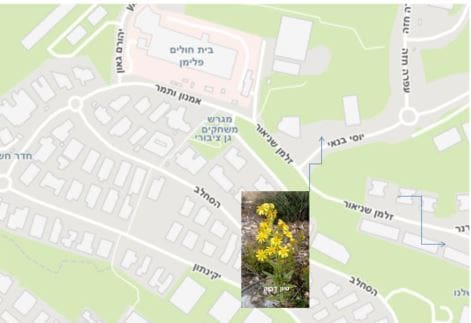
- Ramat Almogi / Givat Zemer: In the empty lot between house number 7 on Yossi Banai Street and the square at the intersection of Yossi Banai and Zalman Shneur Streets.
If you go to visit the flower in the company of children, you can tell them the legend of the sticky toad.
The Legend of the Sticky Tiyon
Once upon a time, at the end of the path by the stream, there lived a little flower named teapot,
The plant had green, slightly sticky leaves, and golden-yellow flowers like little rays of sunshine.
But all the flowers in the field called him The sticky note And they laughed at him:
"Ugh! Who wants to sit next to a flower with every grain of sand stuck to it?"
"Look at your leaves, they're full of dust!"
The little toad was very offended. He didn't understand why he was born like this, with sticky leaves and such a strong smell.
So he decided to stop blooming.
One day, it closed its petals and remained sad and silent.
The next morning a little bee arrived in the field,
She floated from flower to flower, but almost all of them had already withered.
When she reached the setting, she stopped in midair:
"What a special smell!" she said.
It landed on him and stuck.
"Oh no!" cried the bee, "I can't move."
"Sorry..." The boy whispered sadly. "I'm just clingy. Everyone makes fun of me for this trait."
The bee smiled:
"Don't be sorry, dear flower. Your stickiness saved me! I was very tired, and if you hadn't stopped me, I might have fallen into the river."
The young man looked at her in amazement:
"really?"
"Yes," said the bee. And one more thing, "Your scent attracts us, the bees, to help you bring new seeds. You are very important to us and to nature."
From that day on, the garden flourished again with all its might.
The bees arrived in droves, enjoying the smell and a little of the stickiness, and transferring the pollen from flower to flower.
The entire field was filled with golden-yellow flowers again.
And ever since, when someone makes fun of someone else for being "tacky" or "different"
Everyone remembers the legend of the sticky toad plant.
Who realized that what is initially considered strange is sometimes exactly what helps.