

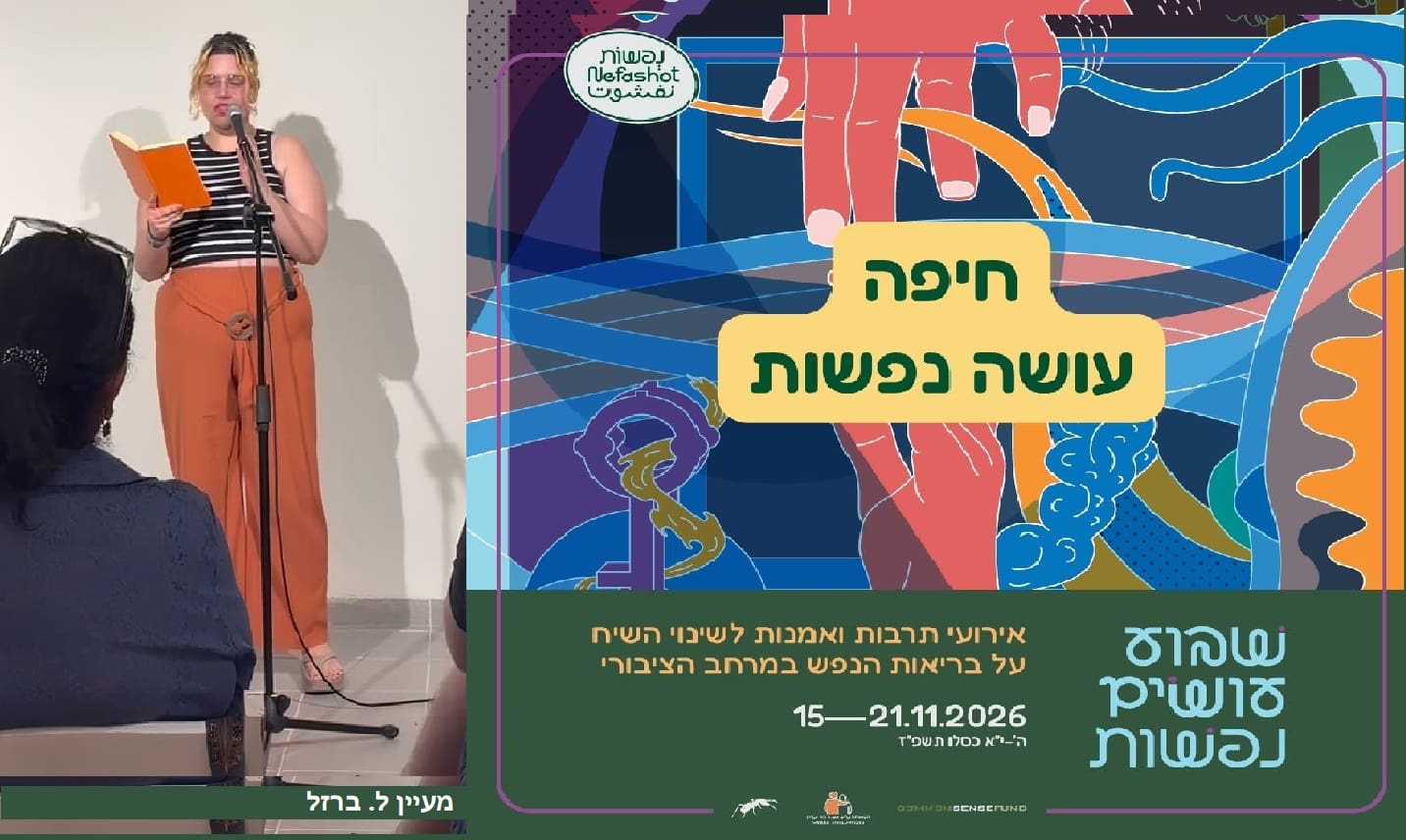
Approximately 80 cultural, art and discourse events will take place across the country as part of the "Making Souls" festival, which seeks to reduce stigma, open a dialogue about mental health and give a platform to those whose stories sometimes remain behind closed doors. A special event will also be held in Haifa, where poetry, music and personal stories will make mental coping a topic that can be discussed openly.
A space where pain meets bliss
"Souls" is a community social enterprise, taking place this year for the ninth consecutive time. The enterprise promotes open discourse on mental health through theater, music, poetry, and art. During the week of November 15-21, dozens of events will be held across the country as part of "Making Lives" Week., in which creators, people struggling with mental illness, their families, and people of art and the community will present works and personal stories, with the aim of reducing stigma and enabling direct human encounters.
In recent years, against the backdrop of events in Israel, the festival has taken on a particularly profound meaning. The work and the stage allow for emotional processing and healing and create a safe space where pain meets acceptance. Opening the public discourse on mental distress, even the darkest places, is a cornerstone of suicide prevention education and gives those facing it a sense that they are not alone.
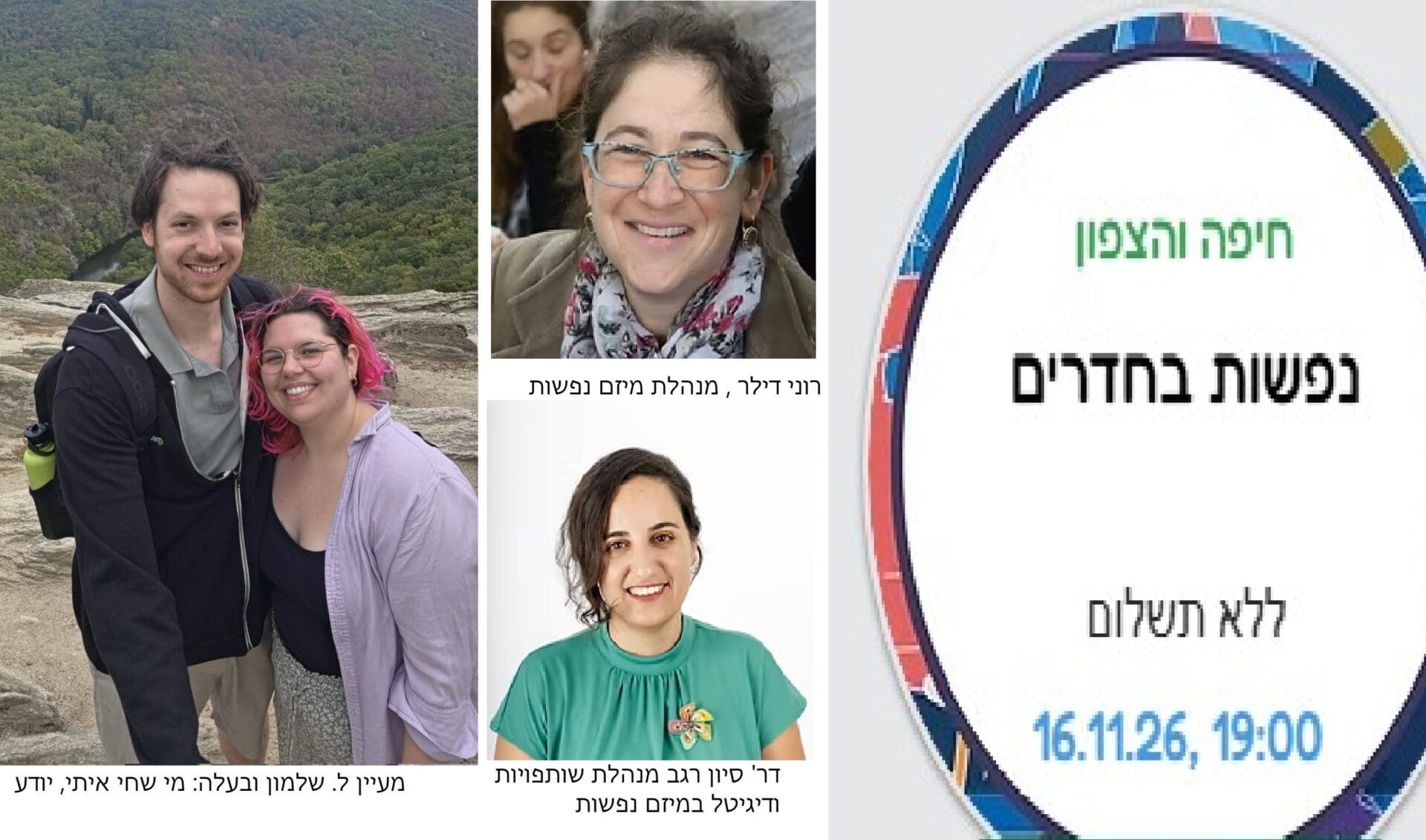
The events will take place nationwide and online, and will include art exhibitions, writing workshops, music, poetry and theater performances. The opening event will be held in Jerusalem, with activities taking place in Haifa. One of the Haifa events will be held On November 16th at the "Hederim" Center for Israeli Jewish Culture, on Kiryat Sefer Street, and will deal with the connection between mental coping, creativity, and the ability to open a door to what usually remains closed.
The festival is unique in that it is not dictated from above. The events are born from within the community itself, initiated by the contestants, their families, artists and professionals, who work together voluntarily and in partnership.
Open stage, community gathering
Behind the project are: Dr. Sivan Regev and Roni Diller, both occupational therapists who worked in community settings with people struggling with mental illness and saw how significant creativity is in the rehabilitation process. Dr. Sivan Regev completed her doctorate at the University of Haifa and currently works at Ben-Gurion University in Beersheba. She met Roni Diller in the framework of their joint work. "Roni was my advisor in my last year of studies. She always says that if you want something to work out, you have to find a busy woman. Busy women know how to do everything," she says.
It all started almost ten years ago, with the desire to create an open stage for people struggling with mental illness in the public sphere. "Roni was running an employment framework, and there she met a student who wanted to perform and was looking for a place that could accommodate his work. We discovered that there were other people struggling with mental illness who wanted to perform and open a door. We created an open stage for the first time around Tolerance Day. It was an artistic, community and social festival," says Dr. Sivan Regev.
Over the years, the project expanded and became a week-long national festival called "Making Souls," around World Mental Health Day, which began in October. In Israel, due to holidays and war issues, the event was moved to November. Later, an annual exhibition of "Souls" was also added, and this year is the second time it has been held. As part of a call for entries, contestants, family members, and professionals are invited to submit works and bring the issue of mental health to the forefront.
Creation and conversation • Remove stigmas
The path to establishing the festival was not easy. At the beginning, the initiatives did not know how to produce a festival, but many organizations helped them grow and still support their work. Regev and Diller emphasize the importance of cooperation with local authorities and organizations in the community. According to them, residents contacting their local authority can have a significant impact in driving such initiatives.
The initiative was born from years of professional work in the community. "We saw that art works. It has a place to say what you want, the boundaries are blurred and belonging is strengthened. People who don't leave the hostel suddenly come out, hear a singer singing what they feel and discover that it is possible to speak. This is a very strong motivator for us," says Dr. Regev.
Even in the year the war broke out, they didn't give up on the festival. The event was supposed to take place on November 12, and after debating whether to hold it, they turned to the participants and asked for their opinion. "There was a very strong statement that yes. They said they had something to give to Israeli society, which had gone through a fracture, because they had also gone through things. We did a lot on Zoom and there was participation. It was strong."
Niko Nitai Theater supported the first Zoom meeting. The texts that were read were not simple, and touched on the trauma that occurred at the time. Professional responsibility is also required behind the scenes. Just before a show, contestants may experience a drop in mood and it is necessary to hold the space for them. "We don't give up on people. We try to hold events with many participants, so that if someone is having a hard time at that moment, the others can hold them. Each event has a manager, and the partnerships that have been built over more than ten years have created a strong community. Every year, new people, artists and contestants join who bring their stories," says Regev.
The balancing power of art
Additional initiatives were born from the meetings. At one of the events, a woman participated who emphasized that she did not speak Hebrew well. Following the conversation, the desire arose to create an activity for the Russian-speaking population as well. A friend in the studio suggested issuing a call for an exhibition for immigrants, and thus the project "Lonely Souls" was born, which deals with immigration and mental health.
In Haifa A collaboration was created with "The community house"In Hadar, with the "A" organizationMyths", which makes activities and leisure accessible, and with "Room Center"", whose directors were happy to cooperate with the project. Three women will take part in the Haifa event: Maayan L. Barzel, to read from her poems, And Nurit Karni and Michal Weisberg, musicians who write songs and perform works born from their personal struggles. The events are held on a voluntary basis. A music event will also be held in Kiryat Bialik in collaboration with the "Amitim" organization and the "Yalla, Kvutzat Shekhulu Tov" organization.
Dr. Sivan Regev wants to expand the collaboration with the Haifa Municipality as well. She believes that we need to find the person who will take the initiative and lead it. "We need to find someone who will get excited about it and help motivate. Someone who understands the power of creation, singing, and performing in the process of mental rehabilitation. People think in terms of treatment, and it's important to me to say that art has a lot of power."
Explain what the soul feels
One of the women who brings the creative spirit to the Haifa event is Maayan L. Barzel, 30, is a mental health professional and has a degree in educational counseling. She writes poetry and participates in reading events and conferences. She came to the project almost by chance, following a call for a reading event for mental health professionals that took place in Tel Aviv. "I sent in, I was accepted, I read, and that's how I was exposed to this whole project."
Maayan has been dealing with complex post-traumatic stress disorder since a young age, along with depression and anxiety. Writing has become a significant way for her to express emotions and sometimes also understand them. "When there is a strong or unclear emotion, writing is a way to get it out. Recently, someone hurt me. I wrote a poem and it helped me release it. One of the symptoms of my post-traumatic stress disorder is detachment. Sometimes I don't understand what is happening inside me, and only when I go back and read the poem I wrote, am I able to identify and understand my feelings."
Along with coping, she has a significant support system in her life. She is married to her partner, with whom she has been together for 12 years, after they were friends. "He knew what he was getting into and he is very supportive and is always there for me. There were times when he came home in the middle of a workday because I was having an anxiety attack. When he was abroad, he called my dad to come and remove the cockroach that was in the house in the middle of the night." His family also accepts her and knows the difficulties. At Friday dinners when she didn't have the strength to participate, they allowed her to sit quietly on the couch without making it difficult for her. Her own family is also supportive and she has a brother who is two and a half years younger than her, with whom she is good friends.
Maayan describes herself as an open person who doesn't hide her struggles. "I talk about things, and people who know me know pretty quickly what's going on with me. If they don't want to accept me, they can leave. There were some who left and there were some who stayed, but they didn't know how to handle it and I helped them leave. It's legitimate, it's hard and not everyone can. But I need to be with people who can handle it." She says that she's always felt older in her soul and currently participates in pensioners' clubs in the country and feels part of the guys.
""Souls in Rooms" talk about everything
Maayan currently writes mainly for herself. "When enough poems accumulate to fit into a book, I will consider publishing it. In the meantime, I am sending poems to events and magazines. In the past, I published a book called 'Love Letters,' a book of poems that, despite its name, not all of the poems in it are romantic."
"I want to get on the dance floor and just break free for a moment from everything." She writes in one of her poems. At the Haifa event, Maayan will read from her poems, and alongside the performances, there will be a discussion about mental coping and the place of creativity in the process. "We really hope there will be a discussion, because the idea is to open a door, for the audience to ask questions and perhaps be able to better understand coping, mental health, and creativity as a way of coping."
Writing has accompanied Maayan since childhood, but the path was not easy. Her aunt, who was very close to her, fell ill with cancer and Maayan held a lot of pain inside. At school, they recognized her sensitivity and understood that she was dealing with anxiety, even before the official diagnosis came in the tenth grade, after she began to experience anxiety attacks almost daily, to the point of difficulty functioning. Later, she realized that her natural place in writing was poetry. Her grandfather loved poetry very much and taught her to read at a young age. When she was eight years old, he passed away, and gradually psychosomatic pain, anxiety, depression and suicidal thoughts began to appear. It was also a difficult time for the family and her father, who was the breadwinner in the family, tried to support her.
She is also in a learning process in her relationships with her friends. "My friends know what I'm dealing with, but they don't know how I'm doing at the moment. I don't share when times are tough. I'm always there for them, to help and advise, but only those who live with me can notice what's really going on, because there's no way to escape it."
Perhaps this is one of the things that makes the encounter at "Souls in the Rooms" so meaningful. Behind the songs, music, and works are people with stories, pain, strength, and abilities. Not just those who ask to be listened to, but also those who have a lot to give. The festival seeks to remind us that mental health is not an issue that only affects those who are dealing with mental difficulties. It is a part of all of our lives, and sometimes an encounter, a song, or a work of art with a personal story is all it takes to open a door to understanding.