


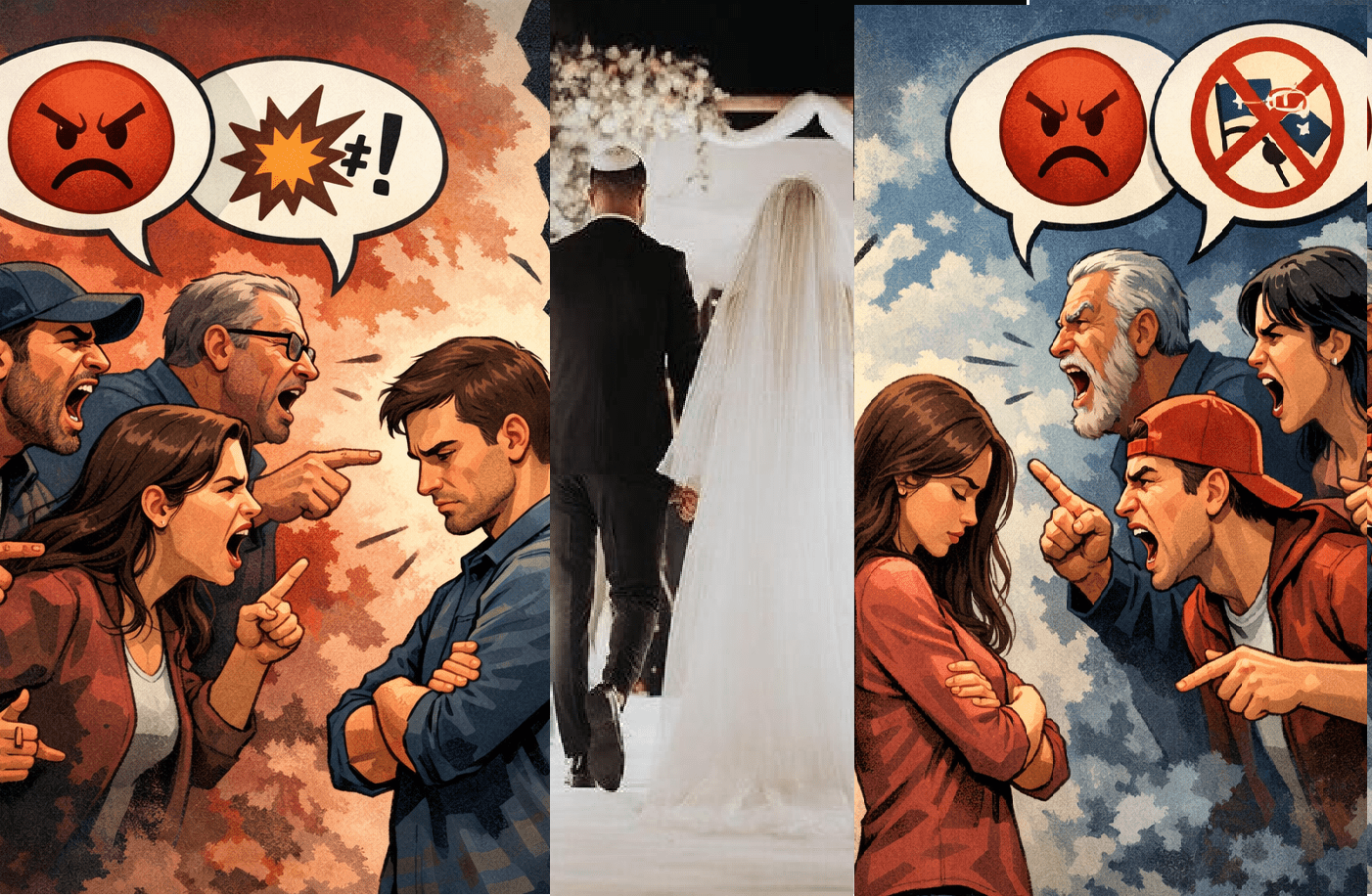
In times of polarization, an argument is an expression of pain, a declaration of loyalty, belonging, and values. When there is no agreement, pain begins. Surely you have encountered this. Perhaps you have published a post on one of the social media channels and received angry responses, or you have cut off ties with someone whose opinions differ from yours because the conversation between you became angry and ugly, perhaps you were even surprised to discover the opinions of your friends and, to your regret, a friendship of many years was destroyed against a backdrop of ideological and political polarization. This is what happened to Moshe and Liat.
Moshe admires Yair Lapid. Liat admires Bibi. He thinks the government should be replaced, because it is not working for the good of the country and the citizens, and she believes that everyone is lying and that Bibi is king and that he should be given all the credit. After days of arguments that began with arguments and turned into shouting and harsh words that the page does not allow to be repeated, they came to me to consult on how to proceed. According to them, there is love, there is mutual concern, but the disagreement tears the bond, and each of them has already managed to break away from past friends due to harsh words of political disagreement. Perhaps what they were actually saying is, there is only a memory of love and not real love. So what do you do with relationships in times of polarization, how do you stay in touch when opinions separate, and how do you know if and when friendship is more important than the discussion?
On the damage of a negative feedback loop
Research on couple communication emphasizes that when each party feels unheard and experiences a cumulative lack of understanding, there is a loss of a sense of belonging and emotional distance and internal polarization are created. This happens in relationships, families, and society even without a direct connection to politics or ideology. Even more so when there is ideological and political polarization between the parties.
Moshe: She sits down at the Friday table, enters into a discussion with the family, with old friends, and everything revolves around the same topic. She doesn't just talk about policy, she talks about identity, about values, as if anyone who doesn't think like her has no values. Every time someone from the family or friends dares to say something different, she bursts out with words like "Israeli invader," "traitor," "enemy," and these are other mild epithets. After that come curses and wishes for a future full of suffering, and in the end she blocks. That's how it was with my sister, with the wife of a good friend, and slowly I find that we are disconnecting from people. I no longer trust her, and it's okay to meet friends when she's around.
Liat: His sister is not the sharpest pencil in the pencil case, and I have never been comfortable with her. The way she speaks, you can see that she has no loyalty to the country and all she is interested in is slandering and spreading lies that she hears on television channels. All the conversation with her is just against and slandering all the ministers and the government. And this friend, who he calls a good friend but actually goes to demonstrations, publishes negative posts about the government, and takes part in trying to stage a coup here and destroy the country. This is not a friend. This is an enemy. I am not willing to let enemies into the house. People have different opinions, but it is no longer an opinion, it is already a feeling of betrayal.
The painful question I asked is how is it possible for a relationship that has been built over years to be undermined by an opinion? The answer is that it is not just an opinion. It is a sense of threat. Is there really a threat in a relationship? No. But polarization is an emotional issue. Studies in couple psychology have found that when there is polarization in political opinions, the level of support in other areas of life decreases, there are fewer expressions of love, fewer compliments and fewer positive statements, which damages the quality of the relationship and undermines relationships. This is called a negative feedback loop. To save the relationship, you need to switch to a positive feedback loop.
Silence, ignoring, and feeling rejected
A 2025 study found that partners in relationships with opposing political views are at higher risk of separation or divorce, especially during times of high political tension. What stabilizes relationships is sharing the central values of life. It turns out that in family and close friendships, we are not just looking for agreement. We are looking for recognition. When a close person expresses a position opposite to our own, especially on charged issues, the brain does not always interpret this as different views. It interprets this as not being listened to or seen. When the person is not on our side, opposing our opinion, we see them as a traitor to society. Studies in social psychology show that political and value positions, in times of crisis, become part of personal identity. Disagreement is experienced as an attack on who I am, not just on what I think. The result is that arguments today feel bigger than the issue itself.
You can meet parents who feel alienated from their children. Siblings who discover value gaps they didn't know existed, and distance themselves from the family. Friendships of decades that are cracked because of a Facebook post. The media reality creates resonance. We consume content that reinforces our position, and distance ourselves from other voices. Algorithms are authoritarian. The discourse is shortened. Empathy is eroded. The world feels unsafe and people cling to their position more tightly. The position becomes an anchor. In all this mental turmoil, we forget that the person in front of me is not just his opinion. He is also the shared memories, the small kindnesses, the history.
Set boundaries to save the relationship
Not every discussion has to take place. Not every post requires a response. Silence is sometimes maintaining contact. It is possible to agree to disagree. It is a mature skill. We are different and we stay in contact despite this. There are moments when the conversation hurts, invalidates, humiliates or incites. A boundary is needed, in order not to experience ongoing disdain for identity or pain, in order to understand that the relationship is causing distress because there is really no conversation but expressions of aggression. A boundary is not necessarily a disconnection. A boundary is a statement: Don't talk to me like that. Don't treat me like that. Sometimes setting a boundary actually saves the relationship, because it prevents the accumulation of silent anger.
The resilience of a society is not measured by the absence of disagreements. It is measured by the ability to manage them without tearing everything apart. Relationships are not a contract for a uniform identity. They are an ongoing practice of humanity. And this is not easy, because we would like to have a sweeping agreement with our opinions, a feeling that together, in full agreement, we can leverage the relationship without wasting energy on seemingly arguments. But it is impossible to avoid the price of the right to think for ourselves and believe what we choose to believe. Maintaining a relationship at the cost of disagreement takes energy, requires inner strength, but disconnection also takes a painful price. The choice is not between good and evil. It is between different values: belonging versus inner wholeness. Home peace versus authenticity. It seems that the real question is whether we are able to contain complexity, to stay in touch with a person we disagree with, without erasing them or ourselves.
Ruthie and her sister Naomi were a loving couple all their lives. The same room as children, the same private jokes, the same endless nighttime conversations. When their parents passed away, they leaned on each other. But in recent years, arguments have erupted between them. At first, they were small comments, then arguments and hurtful sharing on social media. What broke the bond was one argument that flared up. “I can’t believe you can think like that, as if you’re some kind of idiot,” Ruthie said. “And I can’t believe you’re so blind that you can’t distinguish between truth and lies,” Naomi replied.
These sentences tore apart connections of years. It wasn't a debate about policy. It was about morality. About good and evil. About who is more human. From that evening on, something broke. They continued to meet at family events, but the connection became technical. They don't talk politics. They don't touch on the subject, but they don't touch on the truth either. Ruthie told me that she misses her sister. "But every time I see her, I see her opinion before I see her." This is the moment when polarization becomes an emotional disconnect. Not because there is no love, but because there is no sense of security. And when there is no security, the heart closes. I thought that Naomi must miss her too, but Ruthie emphasized that when she tried to talk to Naomi, she received a cold shoulder.
Sensitive consideration that saved friendships
Is it possible to love a person who holds a worldview opposite to mine? Am I able to not lose myself in this love, and still respect and love the other and myself? We have already said that social polarization is a political phenomenon. Dealing with it is an emotional issue. A relationship falls apart when there is disdain, cancellation, ridicule, a feeling that there is no place for my voice. A relationship can survive if there is curiosity, recognition of the other's pain, the ability to listen without agreeing, and setting clear boundaries for the conversation so that it is not offensive. There is also a third situation. People who stay in touch but pay an internal price. They remain silent so as not to create an argument. They laugh when they don't find it funny. They change the subject every time their heart contracts. This is not mediation. This is disappearance. Sometimes that is precisely where a boundary is needed in order to remain whole. In order not to cancel and abandon ourselves.
Michal and Yoav have been close friends for over thirty years. They are not only politically different, they are almost on opposite ends. They argue passionately at every opportunity. Once they even slammed down the phone. But then something interesting happened. In one meeting, after a long argument, Michal stopped and said: “I understand that you are afraid. I am simply afraid of something else.” This sentence changed the tone. Instead of fighting for justice, they began to talk about fear. Her fear of losing freedom. His fear of losing security. They both understood that they were driven by the same basic emotion. Fear that what would happen would be terrible and irreversible. From that day on, they established a rule between them: talk, but not disparagingly. Stop if the tone rises. Remember that the relationship precedes the discussion. They did not change their opinions, but they changed their approach, and the relationship remained alive. What distinguished between a breakup and mediation was the quality of the discourse.
Polarization in organizations affects efficiency
Polarization is a natural part of social systems, but it can be managed by creating trust-based relationships between groups, helping companies and organizations survive times of social division. Research in organizations indicates that political polarization and different strong opinions harm trust, cooperation, and achievement. Research on political polarization in the workplace found that untreated polarization harms trust between employees and leads to conflicts and decreased team effectiveness. The study’s conclusions highlighted the need to create empathy and manage conflict to maintain good performance. Organizations that fail to manage differences of opinion experience a decrease in the ability to achieve goals. Supporting psychological safety and honest communication helps maintain stability.
Polarization around public issues may affect the activities of companies and organizations and the loyalty of their customers. In today's digital and social world, many companies take a position on ideological issues such as social justice, air and sea pollution, gender equality, and the like. A study of such organizational activity that examined many companies found that the public's reaction to companies' ideological activity depends on the degree of social polarization, the political leanings of the target audience, and their positions. In other words, the positivity or negativity of the audience's reaction is not unambiguous and varies according to the political context. The conclusion of the study was that a company's public position can strengthen the loyalty of some customers, but harm others, and in companies where the company is not culturally or ethically aligned with its audience, this can harm business stability. For example, a company that markets to a very religious audience in an attempt to present gender equality may face severe criticism.
Sociological models suggest that when emotional polarization, hatred between groups, outweighs incentives to create contact between groups, the likelihood of reaching joint action decreases. This means that even companies and organizations that try to represent a variety of opinions can find themselves in a situation where they have difficulty creating coordination. Actions that try to create intergroup bonds, connections between people with different opinions, can reduce polarization and contribute to social and organizational stability. Studies on organizational culture emphasize the importance of creating psychological safety, a state in which employees feel they can express different opinions without being punished, in order to strengthen intra-organizational stability.
Did the article interest you?
Thanks for the article
It is interesting and turns the conversation around to looking inward, to become stronger in accepting the other as he is.
In social groups, we set boundaries, and that's how we maintain the systems.
Thanks
Thank you for a very important article.
Thanks!
I identified very much. I learned from the research and from reality - friendship precedes political discussion.
Thanks for the enlightening article.
Thanks!