

Until a few months ago, I never gave walking a thought. I got up in the morning, went down the stairs, left the house, went wherever I wanted. Then, within a few days, my body stopped obeying me. The legs that had carried me my whole life were suddenly unable to carry me even a few steps. Thus began my encounter with Gillian Barre Syndrome. Every simple action, like getting out of bed, standing, or walking, became a challenging and frustrating task that sometimes ended in tears.
When the body stopped listening
It all started one morning before Passover, with a vague feeling of numbness in my legs. I ignored it. There was also tingling in my fingers and a slight unsteadiness when walking, but I explained it to myself as a result of stress due to the situation in Israel, the strain of life, and a back that was probably strained because I slept on my side. I continued with my routine. After a week, my walking became more and more of a limp, and I moved into what felt like slow motion. "This will pass," I continued to tell myself and prepare the house for the Seder night.
When the numbness got worse and spread to my hands, my close circle interpreted it as stress. "You need to rest," they told me. I wanted to believe them, but my body was already screaming something else. One evening I bent down to put food out for the cat in the yard and couldn't get back up without help. I didn't understand what was happening to me until the next morning.
I was walking down the stairs on my way to the local country club. Suddenly my legs just stopped cooperating. I tried to take one more step and my body collapsed forward. I lay on the floor, injured, terrified, and unable to get up. At that moment, I didn't yet know the name of the disease, but I knew for sure that something deep was wrong.
Walking is not just a technical act. It is freedom. In a matter of hours, I went from being an active and independent woman to someone who needed help with every action. My husband, my personal hero, carried me from place to place in the house, until even his back could no longer handle it. The fall, it turned out, was just the beginning of a harrowing medical journey, during which I discovered how complex the path to a correct diagnosis can be.
They have eyes but they will not see.
The muscles weakened, ached, and contracted. At first I could barely walk, and then my legs and fingers stopped responding. What I didn't know yet was that the immune system was attacking my peripheral nervous system right now. I was in a lot of pain. Everything hurt. I sought medical help and experienced an unimaginable process. You could even say it was crazy. One doctor prescribed muscle relaxants. It didn't help. Another doctor recommended Western acupuncture. That didn't help either. In the evening, I called an ambulance to Rambam Hospital. MDA volunteers took me down the stairs of the house in a special stretcher chair, because I could no longer walk. In the letter they gave me a few hours later, they wrote that I was weak. It was a war period, the hospital was particularly busy, and after a short time I was sent home.
The next day I called an ambulance again and this time I asked to go to Bnei Zion Hospital. They checked, took pictures, observed, politely explained that the protected areas in the hospital were really busy because of the war and recommended that I go home and see a rheumatologist later in the week. I felt that something here was dangerously inaccurate. After all, I arrived at the emergency room on an MDA stretcher when I could barely stand on my feet. I told them about the numbness, the tingling, the feeling that the paralysis was climbing up my body. I waited for someone to connect the dots. Someone to see what I was feeling. But time after time, I returned home without an answer. Today, when I know how dangerous the disease can be, that thought still chills me. In retrospect, it was a conversation with a doctor friend that led to the correct diagnosis. I don't know where I would be today if it weren't for that friend.
I called my dear friend, Dr. Netta Golomb, a senior physician in the respiratory intensive care unit at the North Medical Center, which is the Forier Hospital. I don't usually talk about myself and certainly not about illnesses, but I didn't know who to turn to anymore. I told her about the numbness, tingling, paralysis, and weakness. She listened and said, "It sounds like Gillian Barre syndrome, but let me consult with the director of the neurological department, Dr. Nizar Hourani. After a moment she called and said I should get to the hospital as soon as possible, and that Dr. Nizar also thought that this was the diagnosis. Gillian Barre Syndrome. When those words were said I felt two things at the same time. Fear, because I understood that this was a serious illness, and relief, because there was finally a name for what was happening to me. Finally someone believed what my body had been trying to tell me for days.
While talking to Dr. Neta, my dear husband, who accompanied me to the hospitals and was not at ease with their diagnoses, entered the description of the symptoms I described into the GPT chat, and one of the possibilities that came up was Gillian Barre syndrome. At that point, I was already exhausted, confused, and mostly distrustful. My brain gave the command to get up, move a leg, walk, and nothing happened. The belief that my body would always be there for me was put to the test. I discovered that a sense of independence is not just the physical ability to walk from place to place. It is about identity, holding onto self-confidence, and managing hope.
Trust in treatment, believe in recovery
By the time I arrived at the North Medical Center, I had already lost feeling from my feet to my thighs, and my hands were also starting to hurt. Simple actions like holding a phone or buttoning a shirt became an impossible task.
At the North Medical Center, they didn't hesitate. They put me through a series of tests. A lumbar puncture found a protein typical of Guillain-Barré syndrome, and electrical conduction tests showed that the nerves in my legs were not transmitting signals. That same day, plasma exchange treatments, 'plasmapheresis,' began. It's a complex and quite scary process. A tube is inserted into a blood vessel in my neck, from which the blood is transferred from my body, to a machine that filters the blood fluid containing antibodies and harmful components, and returns blood to the body with replacement fluids and plasma from donors. Four hours each treatment, once every two days, five treatments in total. It's almost painless, but it's exhausting. You have to lie still during this time, allow the magic to happen, and believe that in the end, it will get better.
My daughters sat by my side for hours, holding my hand during treatments and reminding me that even in the most difficult moments I am not alone. My family and friends surrounded me with love. It was clear that there was no way to rush the body. You have to wait, hope and persevere. Fortunately, the staff at the North Medical Center were patient, professional and kind. It made the difference between collapsing in pain and fear of the uncertain future, and continuing to trust in the treatment, believing that you can recover.
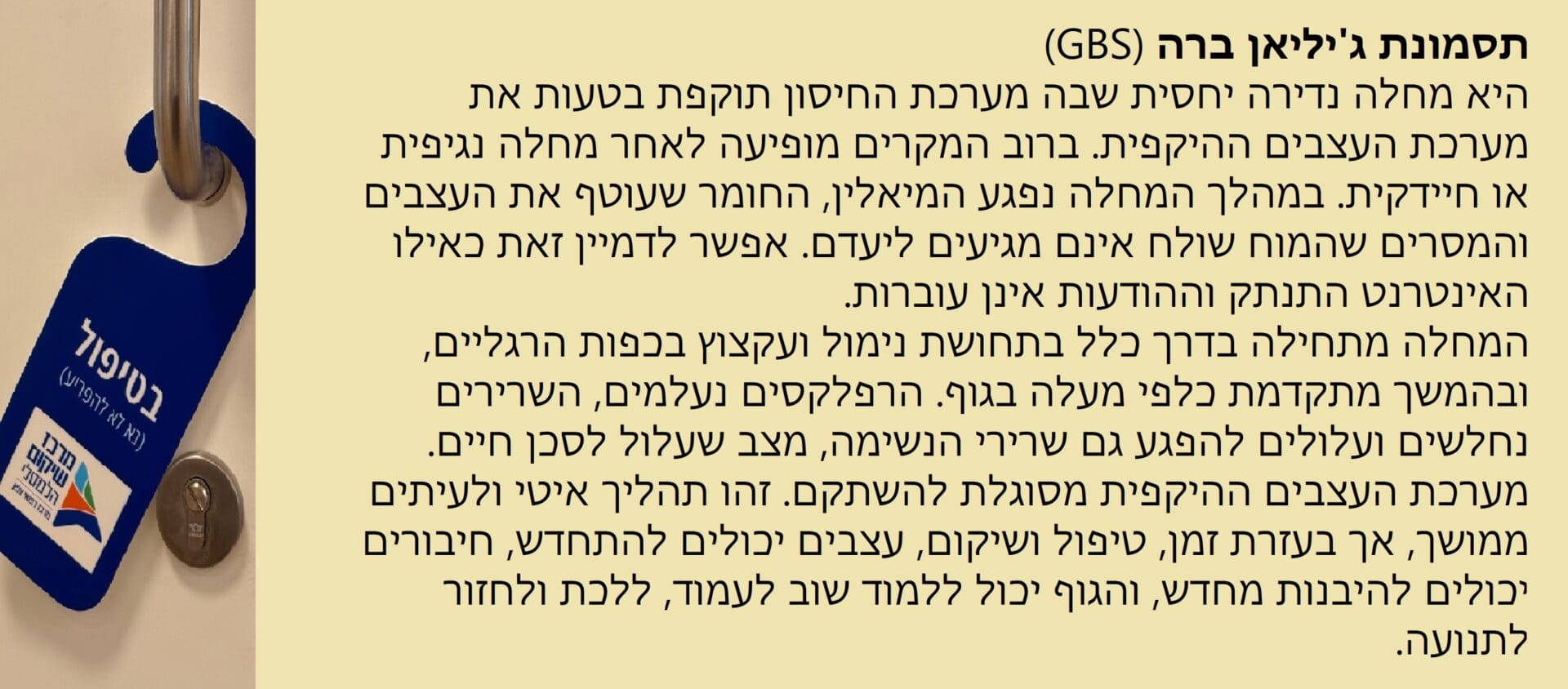
My mood fluctuated between abysses and peaks during those times. In the first few days, I couldn't get out of bed, and the feeling of helplessness, dependence, and the need to rely on the staff for the most basic needs, plunged me into deep despair. I had difficulty seeing how I could return to the life I knew. Then better days came. I found in Psalms chapter 31 a place to temporarily put aside my fear of the future, "You have heard the voice of my supplications when I cry out to you," and this calmed me down. As the treatments progressed, the seeds of recovery began to appear. At first, these were small changes that were almost impossible to see from the outside, but to me they meant a world to me. After the second treatment, I was able to move from bed to wheelchair on my own. After the third, I was able to shower alone, and after the fourth, I rolled into the kitchenette and made myself a cup of coffee. Simple, everyday actions that on other days don't receive a second thought, became moments of victory.
Every step is an exciting achievement.
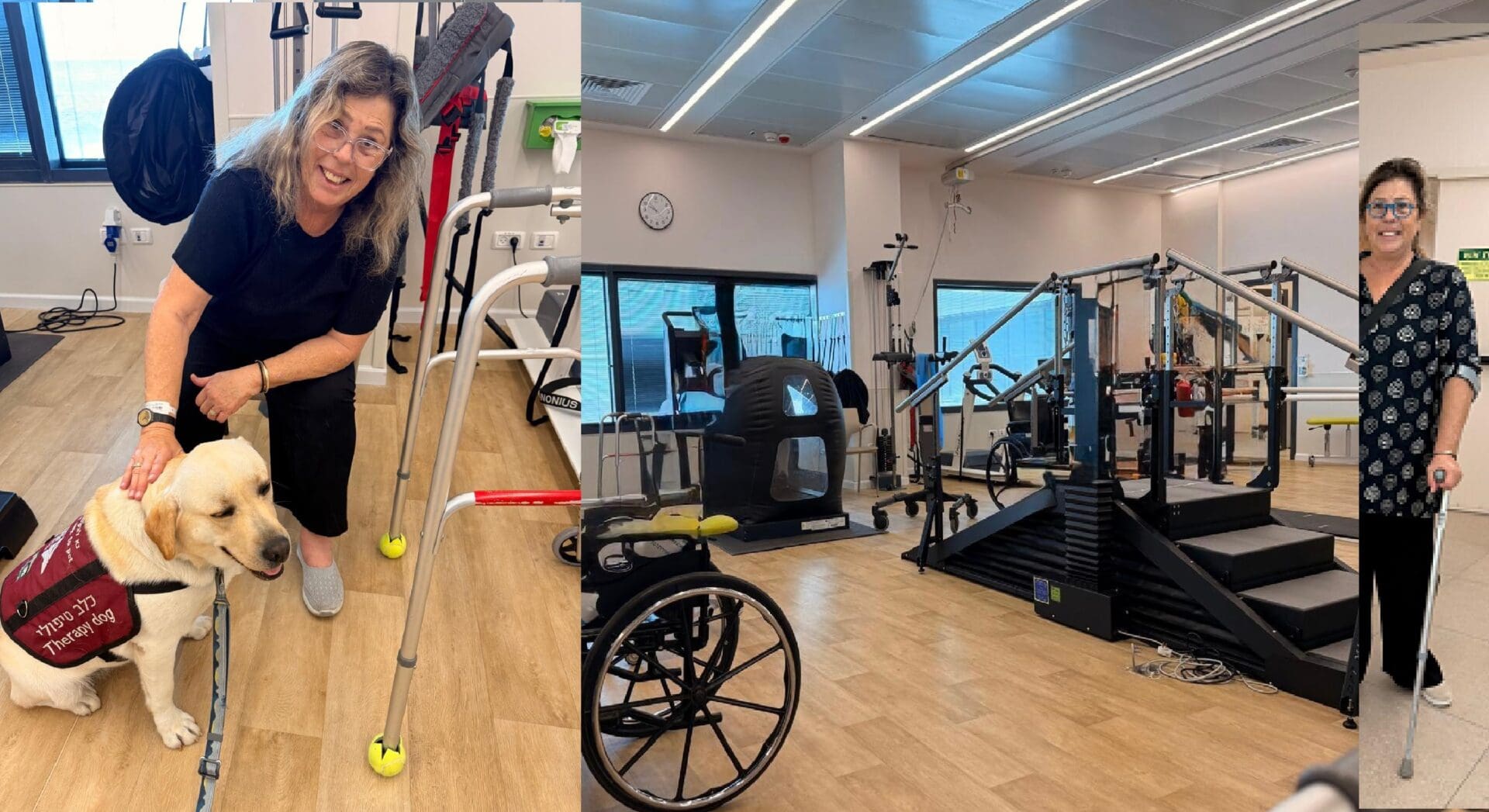
After ten days of hospitalization and five plasmapheresis treatments, I was transferred to the rehabilitation department at the North Medical Center. I arrived there in a wheelchair, still weak, still in pain, and still unsure of how well I would recover. But from the first few days, it was clear to me that rehabilitation is not just a physical process. It is a journey of rebuilding self-confidence and faith in the future.
The first stage was a 'forearm walker', one that helps you stand upright and lean on your forearms in addition to your legs and shuffle your first steps. Then the moment came. Two caregivers stood beside me, their hands holding the forearm walker, and their legs shaking with effort. One step. And another. Slow, hesitant, very far from the walking I knew. But these were the most beautiful steps I've ever taken in my life. The girls took pictures, the family was excited, and I cried. Because after long days in a wheelchair, my body gave me a sign that it was still fighting, that I could walk again, that I could recover.
Anyone who has not lost the ability to walk will have a hard time understanding how significant this moment is when the body signals that it is ready to try to walk. For me, it was the most moving proof that the road back is possible. The days were filled with physical therapy, occupational therapy, therapy dogs, and endless practice of movements that were previously completely natural. Bending over, standing up, maintaining balance, holding a small object between the fingers, taking one more step. Every step became an achievement. Every movement a victory. I don't give up on myself. I look for the right balance between effort and rest, and practice again and again.
After about a month, the regular walker arrived, then the crutches, and gradually the ability to go up and down stairs with them. My knees were still shaking, the pain still accompanied me, and the fear of falling did not disappear, but alongside all this, hope returned. The body began to remember what it once knew how to do, and I learned to trust it again. It was not always easy. There were days of frustration, pain, and fatigue, but I understood that the point was not to let it get me down and to keep practicing, to keep moving forward, even if progress is sometimes measured in millimeters.
Day followed day, week followed week, and after two months I returned home. I still use a walker and crutches. Still in pain. Still relearning what was once natural and simple. Gillian Barre Syndrome taught me that no step is taken for granted. There are mornings when I put both my feet on the floor and stop for a moment. Checking that they are carrying me. That the body and I are on the same side again. I once got up and walked without thinking about it. Today I know that it is a gift.
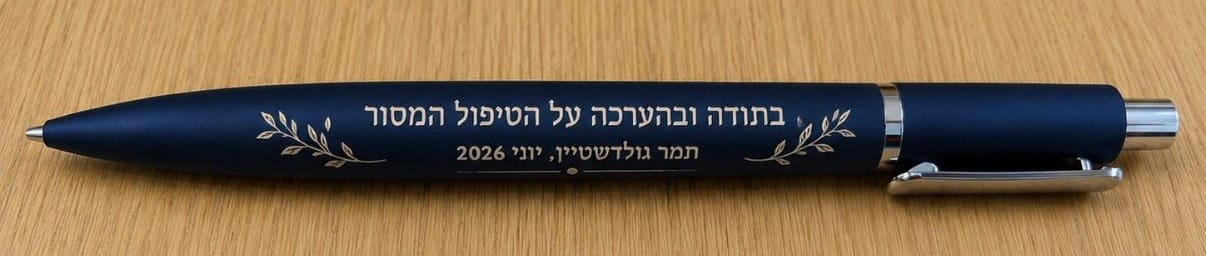
Thanks
Many raised an eyebrow when I chose to travel to receive treatment at the North Medical Center, the Forier Hospital. After two hospitals in Haifa failed to identify the syndrome I was suffering from and I was sent home without a diagnosis, I arrived at the North Medical Center, where I received the correct diagnosis, the necessary treatment, and most importantly, hope.
I would like to express my heartfelt gratitude toDr. Netta Golomb And to the respiratory intensive care team at the North Medical Center,Dr. Nizar Hourani And to the staff of the neurological department, who were by my side with dedication, professionalism, and humanity, day and night.
Special thanks toDr. Shadi Hussein, Director of the Youth Rehabilitation Department, and the responsible brother Ali Nojidat, at the Helmsley Rehabilitation Center of the North Medical Center. Thank you to all the doctors, nurses, physiotherapists, occupational therapists, social workers and psychologists, as well as the auxiliary forces, workers and national servicemen.
Throughout my hospitalization and rehabilitation, I received professional, dedicated, and sensitive care from you, provided with wisdom, patience, and extraordinary humanity. Every day you gave me not only medical care, but also strength, confidence, and faith on the long road back to life. For all of this, and for much more than words can express, I thank each and every one of you from the bottom of my heart. I will never forget what you did for me. ❤️
We caregivers forget to take care of ourselves, thinking that a caregiver doesn't need help, a mistake. When I discovered the cancer six months ago, I was in exactly this place, how could it be?! Wishing you good health, a journey of learning, insight, and the ability to ask for help ❤️❤️
Thank you and may you have good health too!
Tami - a very interesting, moving and hopeful article.
I don't understand that you didn't receive information, a correct diagnosis, and the start of the correct treatment that my two hospitals in Haifa have.
As a physiotherapist for over 60 years (and still working!!), you have treated several patients with Guillaume Barre.
I wish you constant improvement and a return to a full and good life.
Thank you!
Is this damage from the cocaine injections? And if so, how did you, as the caller, not recognize that this is a global scam?
Of course – health.
I don't think so. There is also some correlation to the shingles vaccine, but that's not it either. After all, the disease was discovered in 1916, and has been spreading around the world ever since.
Tami, great article.
I'm so happy you're back walking.
It is very difficult to be a caregiver, at any stage of life.
Thank you, dear Maya.
A moving article. How easily we take health for granted. And how fragile we truly are when we are out of balance for even a small moment.
Thanks!
Tammy is a champion warrior and because of the wind blowing at your back you will win a complete recovery. And good angels on the way to a full recovery. Much love. Gila and Emmanuel
Thanks!
Thanks!