


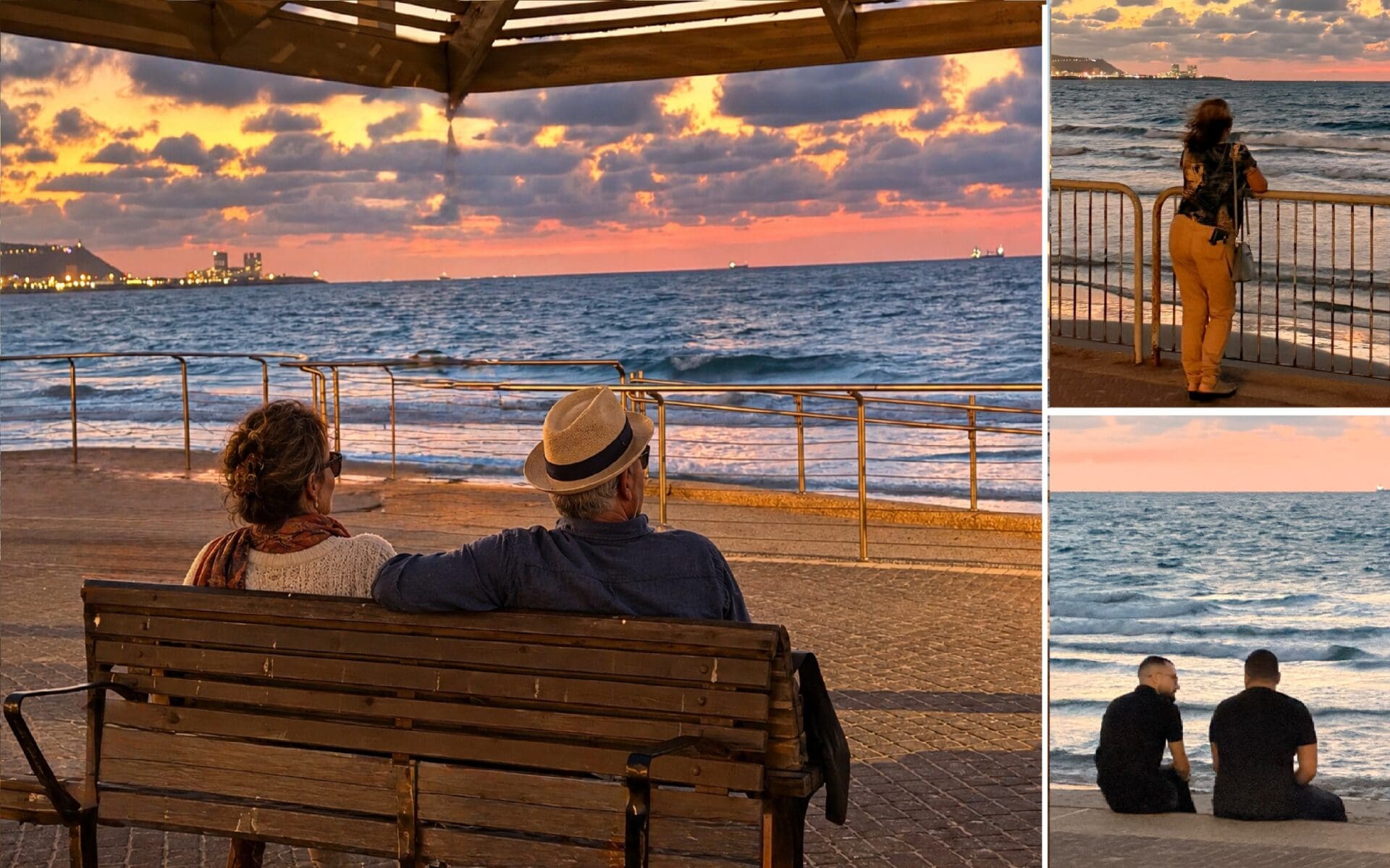
In the late afternoon, when the sun begins to set and the Haifa heat softens a bit, the beach fills with people who have come to watch the sea. Some walk along the promenade, others sit on a bench or on the sand. You can see couples chatting, an elderly man looking out to the horizon, a woman sitting alone holding a cup of coffee. There is no special event here, no performance, and no attraction that draws them to the place. They simply came to be by the sea.
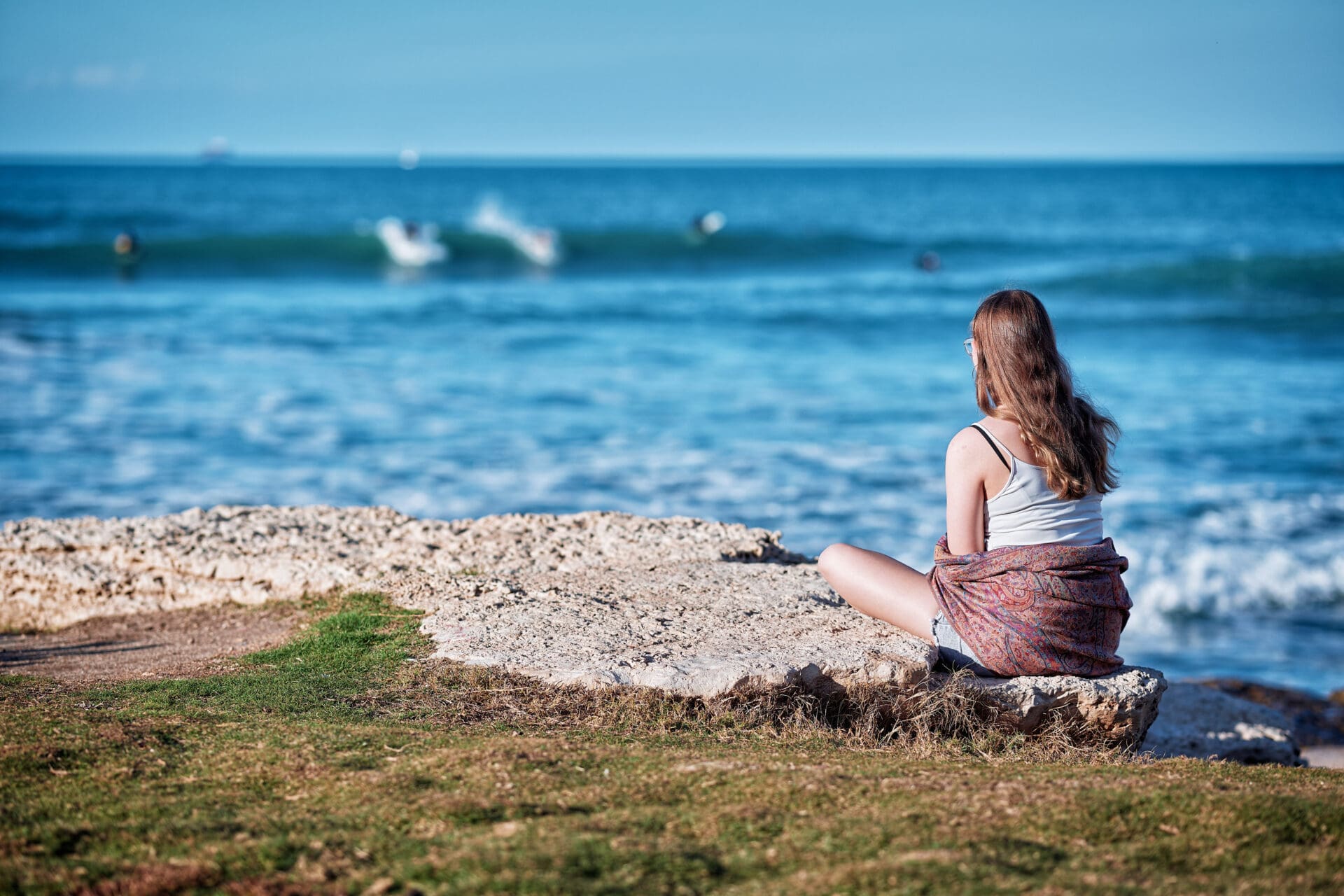
Beaches are sometimes a source of longing, as Nathan Yonatan wrote. A study by researchers from Cornell, published in 2024, examined the characteristics The visual and auditory of aquatic environments as a possible way to reduce anxiety. Participants were exposed to slow or fast-moving aquatic environments for 20 minutes, and anxiety was measured before and after exposure; in some participants, salivary cortisol was also measured. The researchers found a decrease in stress indices following exposure
One of the most familiar phenomena for those who live in a coastal city is walking on the beach. Perhaps precisely because it is so everyday, we hardly ask questions about it. Why do we come to experience the sea? After an exhausting day, an argument, a period of uncertainty, or just a bad mood, many people say to themselves: "I need the sea." Apparently there is something in this blue landscape, in the sound of the waves, that makes us feel, at least for a moment, that the world is a little less pressing on us.

Talk without pressure and breathe
"We come here because it's quiet, we can breathe, we can talk without pressure. We talk a little and we're silent a little. But our silences are pleasant because they allow us to sink into the changing shades of the sea for a moment, as if floating in our minds to all sorts of places," two friends I met on the steps leading to the beach told me.
In recent years, science has begun to take a serious interest in these questions. Researchers use the term “blue spaces” to describe natural water environments such as the sea, lakes, rivers and beaches, and examine their relationship with mental well-being, physical activity and quality of life. A systematic review published in 2017 that examined 35 studies found a positive relationship between exposure to blue spaces and mental health and well-being. However, the researchers cautioned that the studies varied greatly in their quality and the methods they used, so it is impossible to conclude from them that the sea itself is the direct cause of improved mental health.
A broader and more recent review, published in 2026 and including 139 studies, reached a similar conclusion: a connection was found between exposure to blue spaces and various aspects of mental health and well-being. It turns out that even without entering the water, and even without being on the beach, the mere sight of a seascape is linked to a feeling of relaxation.
Another study published in March 2026 at Chiba University in Japan examined 44 young, healthy people. Participants viewed a seascape from a high-rise window for 90 seconds, and another time through a covered window that served as a control. The researchers measured activity in the prefrontal cortex, heart rate variability, and psychological measures. While viewing the seascape, they found an increase in feelings of comfort and relaxation and an improvement in mood, along with a change in a measure of brain activity.
A blue and soothing thought
Arik Einstein wrote the song Time Out in 1984: To take a time out and not think, to sit in front of the sea and not worry, to give your head a rest from the explosions, to give your heart a rest from the pressures. Is just looking at the sea the calming factor? The answer to this question is complex because the sea does not come to us alone. When we go to the beach, we leave the house, move away from the computer, are exposed to natural light, sometimes walk, look into the distance and hear sounds that are not the phone's notifications. We are also in a place where we usually do not have an urgent to-do list. Therefore, it is difficult to separate the effect of the water from the effect of the whole package. Still, there seems to be something special about looking at the water.
American marine biologist Wallace J. Nichols popularized this idea with the term “Blue Mind,” which he introduced in his book. It describes a state of calm, openness, and a sense of well-being that many people experience when they are near water. It is important to note that this is a popular scientific concept and not a medical diagnosis, but it has contributed greatly to the research and public discourse surrounding the connection between water, nature, and mental health.
I have a theory that the wide image of the seascape, perhaps like the wide image of a desert landscape, or a patchwork of vegetation, releases the tension of the dense long images of buildings and roads and people. You could say that looking at the horizontal state of the sea, reduces the burden of the sharp verticals within us.
Perhaps the attraction to the sea can also be understood through the difference between the way we use urban space and the way we use the beach. In the city, almost everything is for something. We walk down the street to get to a certain place, enter a store to buy something, sit in a cafe to meet someone or work. Even our leisure is often planned in advance. The sea, on the other hand, allows for a different kind of presence. You can come to it without a defined purpose, sit and look, and then return home without being able to point out "what we did."
In an era where even rest has become a task, there is something almost revolutionary about sitting and looking at the sea. We are used to measuring the day by achievements: how much we managed, how many steps we took, how many messages we answered, how much work we finished. Even when we say we want to rest, we find ourselves in front of a series, a movie, a social network or a to-do list. Sitting in front of the sea is one of the few actions that can be done without producing a result. And that is where the impact begins.
respite. Like meditation
The couple sitting on the bench facing the sea smiled when I asked them what brings them to the beach. "It's romantic to sit on the bench in the evening and watch the sunset. We come almost every day," the woman told me. "I feel that with the setting sun, all the stress leaves my body. It's like meditation." And her partner added: "We hardly talk when we're here. We give ourselves some peace, each with our own memories and thoughts. Then at home we talk about it. What came to mind when we looked at the sea. Sometimes we remember things from our childhood, usually beautiful things because this silence and the pleasant evening breeze make for pleasant thoughts."
An international study published in 2021 in the journal Scientific Reports included more than 16 participants from 18 countries and examined the relationship between visits to nature and mental well-being. The researchers found a link between visits to nature, including coastal areas, and measures of well-being. One of the interesting conclusions that emerged from the study was that it is not enough to just live near nature. The frequency with which people actually visit it and use it is also related to well-being. This is a statistic that is especially interesting in a city like HaifaThere are people here who live minutes from the sea and can still go weeks without going there. Others, on the other hand, find themselves returning to it again and again, sometimes without being able to explain exactly why.
Sitting in front of the waves allows the eyes to relax, to stop looking for details for a moment and to calmly see the horizon. The cyclical movement of the waves and the color blue allow for peace. The ears surrender to the repetitive and rhythmic sound of the waves and the body enjoys the wind, the light and being outside. A review published in 2024 examined studies on the sounds of nature and their effect on stress. Among the sounds tested were water, ocean waves, streams and other natural sounds. The researchers found significant differences in physiological indicators such as heart rate, blood pressure and respiratory rate compared to a quiet environment.
In Poliker's work, Window to the Mediterranean, longing and hope for happiness that will come from the window facing the sea are revealed. Although the sea does not provide answers, it provides an opportunity to release stress and surrender to the flow of the waves. After a breakup, the sea has no advice to give. After a challenging day at work, the sea will not solve the problems. When there is concern about money, family, or health, the waves cannot change reality. And yet, we go there. Perhaps because sometimes we are not looking for a solution but a respite from the need to find a solution. The sea is the space where we are allowed to be for a few minutes without explaining ourselves and without making decisions.
Did the article interest you?