

Lately, it seems like Haifa has become a knitting powerhouse. If it used to be mostly grandmothers sitting in the corner of the living room with a basket of wool, today you can find dozens of women and even a few men gathering in public parks, community centers, and cultural centers to knit together. Some prefer one knitting needle, others swear by two, but everyone agrees on one thing: knitting has long been more than just a hobby. It is a social gathering, therapy, creativity, and sometimes a real anchor.
Maybe it's the war that pushed people to seek peace amidst the chaos. Maybe it's the longing for the days when grandma would pull out knitting needles and make a sweater out of nothing. Or maybe we've simply rediscovered that you can create a small world of colors with your hands, instead of scrolling through your phone for another hour. After all, you can make almost anything from simple yarn: clothes, blankets, toys, decorations, and even dresses for a spoiled little dog.
Beyond the creation, the studies tell a fascinating story. Knitting helps reduce stress, lowers blood pressure, improves concentration and cognitive function, relieves loneliness and gives a sense of meaning. The monotonous and repetitive action, along with creativity, helps slow memory decline, calm the nervous system and distract from pain and stress. Sometimes all it takes to feel a little better is one more row of crochet.
When you knit together, you create a bond of brotherhood.
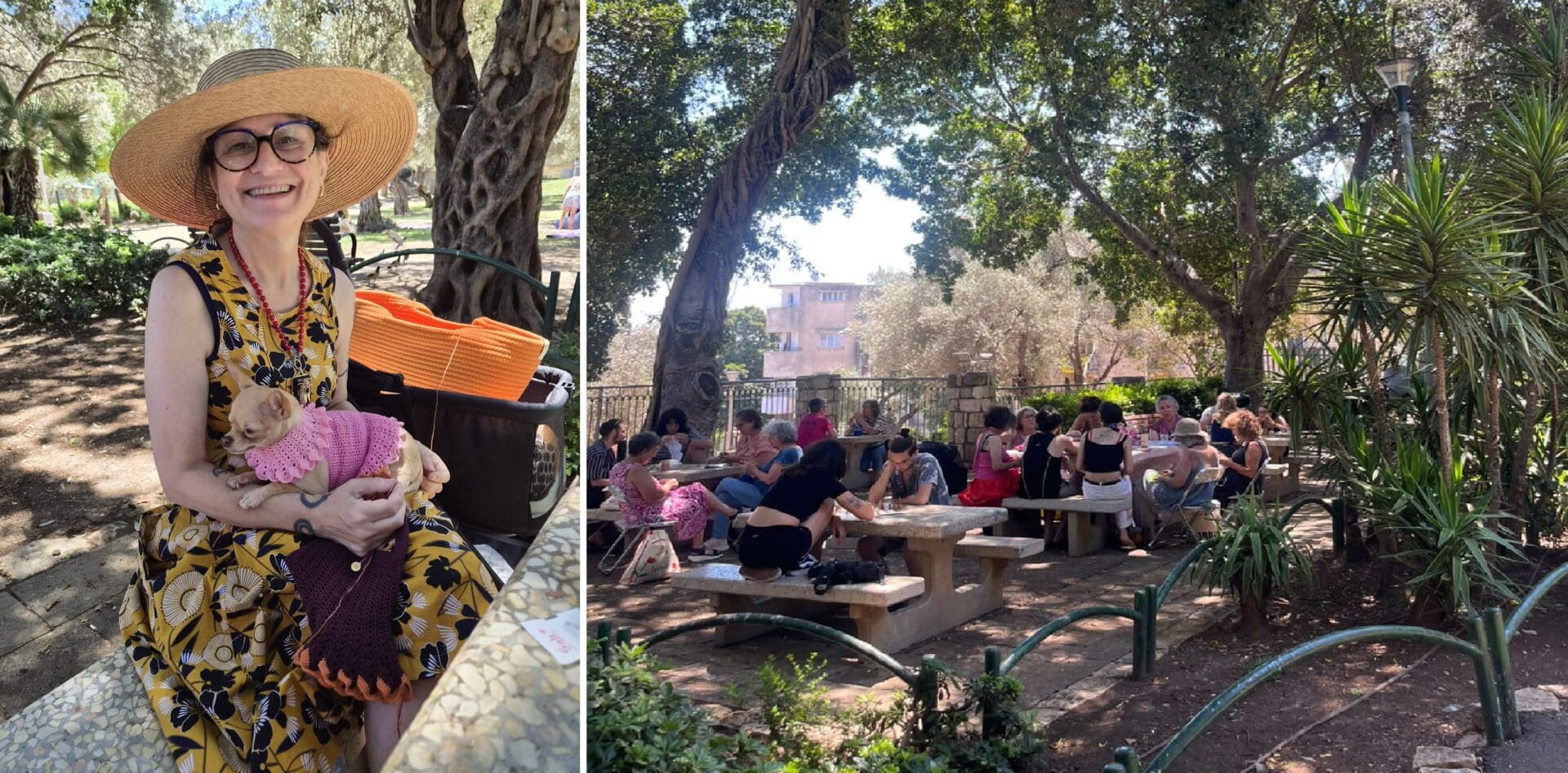
Karen Jeannie Alon, A 55-year-old Haifa resident who grew up in a house where people knitted. She is a creative artist, has a degree in art, and is convinced that most women who learn to knit received their first lesson from their grandmother. "My grandmother also taught my brother," she smiles, "but he doesn't knit." What is surprising is that it wasn't nostalgia that brought her back to knitting, but Lola, the little dog she adopted.
"During the war, I didn't knit at all. Then I adopted a husky dog. It was winter and I couldn't find clothes for her. I decided to knit one for her. I watched videos, learned, and since then I've knitted her ten dresses with ruffles and in all colors. She's my new baby." Lola, it turns out, is also the mascot of the knitting group that Karen founded at Gan Binyamin. About three months ago, she started looking for women who could sit with her and knit together. "I grew up in Canada, and there it's very common to meet up to knit. I looked for a group in Haifa and couldn't find one. There were only paid classes. So I posted a post in the Jerusalem Street and Surrounding Area group and suggested we meet on Saturday morning."
There was great interest, but only one woman came to the first meeting, named Jordan Lem."We sat for three hours, knitting and talking. In the end, we decided not to give up, and that the two of us would lift the group together." Today, just a few months later, about a hundred women come to the meetings. "They bring refreshments, some iced coffee, I bring a tablecloth for the table. Sometimes there are no chairs, so some are brought from home, some are borrowed from the nearby cafe. There is a knitting community." According to her, the magic continues even when the meeting is over. "The reactions are wonderful and moving. 'How fun it was,' 'How much I needed that.' The women leave feeling renewed. It clears away the stress and all the hustle and bustle of the week. It's social therapy."
"Even those who have just started knitting can come. There will always be someone to teach, explain and help. There is no age limit, no experience limit. There are women from all walks of life, people from the gay community, and also two or three men who come from time to time. Soon we will also add a monthly meeting on Wednesdays." Between rows, recommendations for wool stores, new patterns, solutions to mistakes, and even yarn left over from previous projects are also exchanged.
Knit healing for the heart and emotions
This good feeling is not just a matter of feeling. Many studies have found that knitting has proven neurological and psychological effects, and there is almost no difference in health benefits between knitting with one crochet hook and two. Regular engagement in handicrafts reduces the risk of mild cognitive impairment by 30% to 50%. Knitting simultaneously activates fine motor skills, short-term memory, attention and concentration. The rhythmic movement activates the nervous system responsible for relaxation, reduces stress hormone levels and slows down the heart rate. When you add a group meeting to this, you also get an effective remedy for loneliness. Completing a project, whether it is a scarf, a doll or a blanket, gives a sense of achievement and purpose, two factors known to strengthen mental resilience.
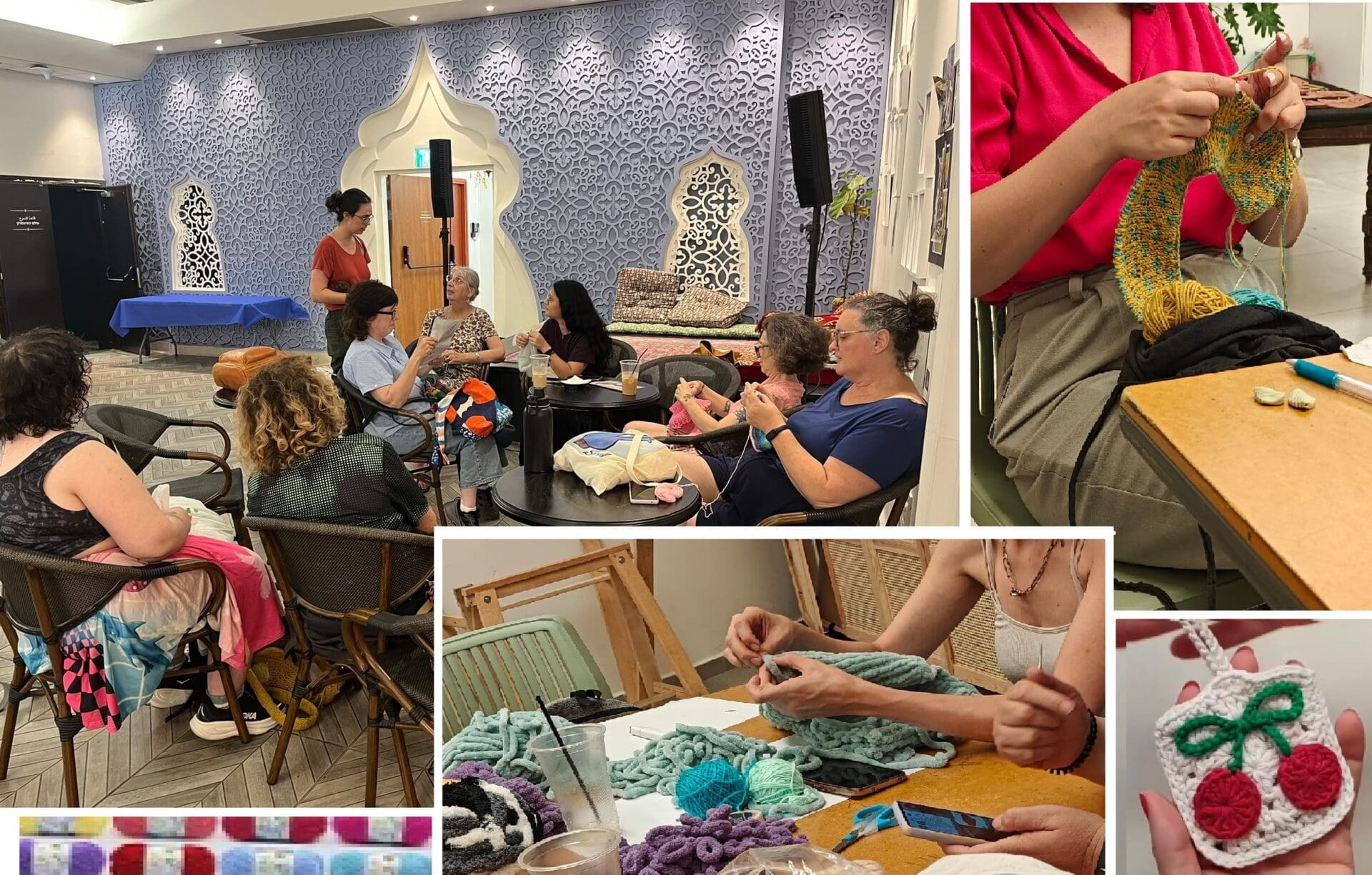
Angel Ibrahim, A Haifa resident, almost 25, has started a knitting group at Beit HaGefen on Tuesday afternoons. She is a multidisciplinary artist and a master's degree student in art, but she taught herself how to knit. "When I was a child, I insisted that I wanted to learn to knit. My parents bought me a kit, and I taught myself through videos, books and blogs." For her, knitting is much more than making a scarf. "Knitting is a language. You have to know how to read patterns, understand how to build what you want to create, anything, simple or complex, whether it's a shirt, a toy or a decorative tree."
She knits almost everywhere. "On the bus, at university lectures, at every opportunity. Hands are busy, head is relaxed." She also had a grandmother who knitted, but she passed away before she could teach her. "Maybe that's why it's important to me that anyone who has no one to ask will find answers with us." According to her, knitting requires much more skill than it seems. "There's a way to hold the yarn, the crochet hook, to understand the material. There's a whole world inside knitting."
The knitting group at Beit HaGefen has been operating for a little over a month, and has already become a community. "It could be a kind of escapism," she admits. "Between the alarms, I would knit to release my energy." But the conversations quickly drift to other topics. "We talk about fashion, sustainability, consumer culture, and the fact that when a person knits a garment for themselves, there is no other garment like it in the world." Every time a new participant joins, everyone joins in to help. "There is a lot of love here. Beit HaGefen is a multicultural space, and the group includes people from all walks of life. After all, there is no place in the world where knitting is not practiced. Every culture has its own style, but yarn connects everyone." In the group, you can find someone who knits dresses for a dog, another who specializes in colorful blankets for children, someone who knits dolls, another who creates woolen fruits, and when there is leftover yarn, they become donation projects for hospitals.
When research meets crochet
Researchers from Cardiff University, along with researcher and physiotherapist Betsy Corkhill, conducted an international survey of more than 3,500 knitters. The findings, published in the British Psychological Society, showed a direct link between the frequency of knitting and mood and cognitive function. 81% of participants reported feeling happier after knitting. The researchers found that the rhythmic movement creates a meditative effect, encourages the secretion of serotonin, a hormone that affects mood, and even helps the brain reduce feelings of pain and anxiety.
Dr. Pippa Burns from the University of Wollongong in Australia also reached similar conclusions in a study involving 8,436 women and men from 87 countries. 89.5% of participants reported that knitting calmed them down, 82% said they were happier as a result, and almost 75% reported that it gave them a sense of accomplishment and purpose. The researchers found a significant improvement in mood indicators before and after the activity.
Crocheted and embroidered in Nesher
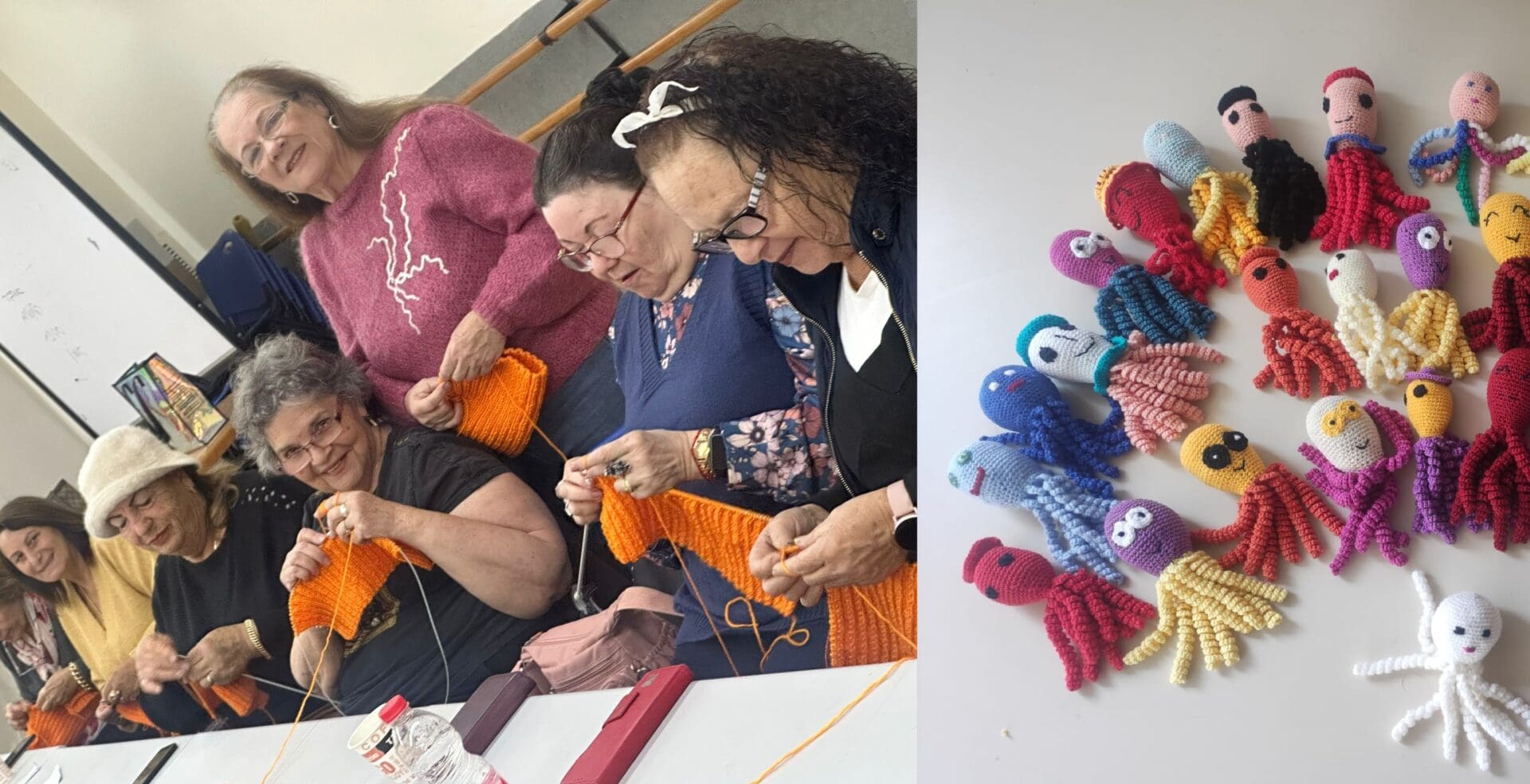
In Nesher, knitting has become something more than a hobby. A group of volunteer retirees meets at the Culture Hall as part of the "Come for Good, to Know and Cherish" initiative, with the support of the Ministry of Social Equality. Together, they knit gifts for residents and city employees. Hana Kashansky, one of the volunteers, proudly says: "We knitted hats for a challenge group, then hats for babies born during the war, octopus dolls for babies, baskets for walkers, and now we are making knitted bouquets for Nesher municipality employees."
She says the knitting materials come from donations and funding from the Ministry of Social Equality. "We recently did a project with high school girls who knitted woolen chicks for special education children. The children were so excited." Then she smiles and adds a phrase that is heard in almost every knitting class in the country: "They say that those who knit prolong their lives."
Maybe it's just a popular belief, or maybe not. But one thing is certain: amidst all the news, worries, and screens, there's something almost healing about the quiet sound of a crochet hook meeting yarn. It's no coincidence that more and more people are discovering that knitting is not just a craft. It's a way to connect people, generations, cultures, and sometimes even a person themselves. And if along the way you also get a dress for Lola, a doll for a baby shower, or a knitted bouquet of flowers, that's already a particularly colorful addition to a better life.
Did the article interest you?
There is a knitting group at the Nagler home, where women knit for cancer patients, the elderly, and especially soldiers.
Lovely article and puts you in a good mood.
There is a group in Wizo Kiryat Yam that meets once a week. They knit for sick soldiers, Rambam nursing homes, the absorption center, and according to the requests that are published.
You can open a WhatsApp group about wool stores with sales in the area. Meetings. Ideas, examples and more. You can call it Haifa Knitting Big.
Hello, how can I join the bar group in Haifa?
It's a shame there are no links to these groups🫠
Hey!
Attached is a link to our WhatsApp group for updates about the meetings, and some chatter 🙂
https://chat.whatsapp.com/EzUZGiXFG9D5IDatnWwOMs?s=cl&p=a&ilr=1
Finally, I can read a positive and interesting article! Thanks for the information too. I'm from Haifa and I didn't know.
Interested in joining knitting groups in Haifa? What are the phone numbers of the person in charge?
me too
🧶Haifa Knitting Groups | Knitting Groups | Knitting Groups 🧶
Knitters in Binyamin – Gan Binyamin Saturday from 10:00.
Knitting in Benjamin - Benjamin Garden, Saturdays from 10:00
Вязание в Бінямін* — парк Бінямін, суббота с 10:00
https://chat.whatsapp.com/L8uS1vPC85z6ojdBR9fTMq?s=cl&p=a&ilr=0&amv=3
Tip of the iceberg – Beit HaGefen, Tuesdays 18:00-20:30 PM
Taraf Khait - Beit Karma (Hachifin Street 2), Tuesdays 18:00-20:30
https://chat.whatsapp.com/EzUZGiXFG9D5IDatnWwOMs
Кце Хут — Бейт ха-Гефен, Tuesdays 18:00-20:30
Haifa Knitting Circle Thursday evenings / varying dates
Haifa Knitting Department - Thursday evening / variable times
Клуб вязания Haifa, четверги в вечерно / даты меняются
https://chat.whatsapp.com/IF8nEc41sBT6lUMwDG0DqG
At the age of 16, I knitted a single crochet coat, squares and squares in red and black. To this day, I wear it occasionally. My sister has been knitting hats and scarves for soldiers and babies in a hospital since the war.
Fortunately, knitting and crochet groups have often existed for years. These are not new phenomena.
I have been knitting for years and have been to many knitting meetings around the country and in our area. The meetings were held in parks, at workshops, and in private homes.