


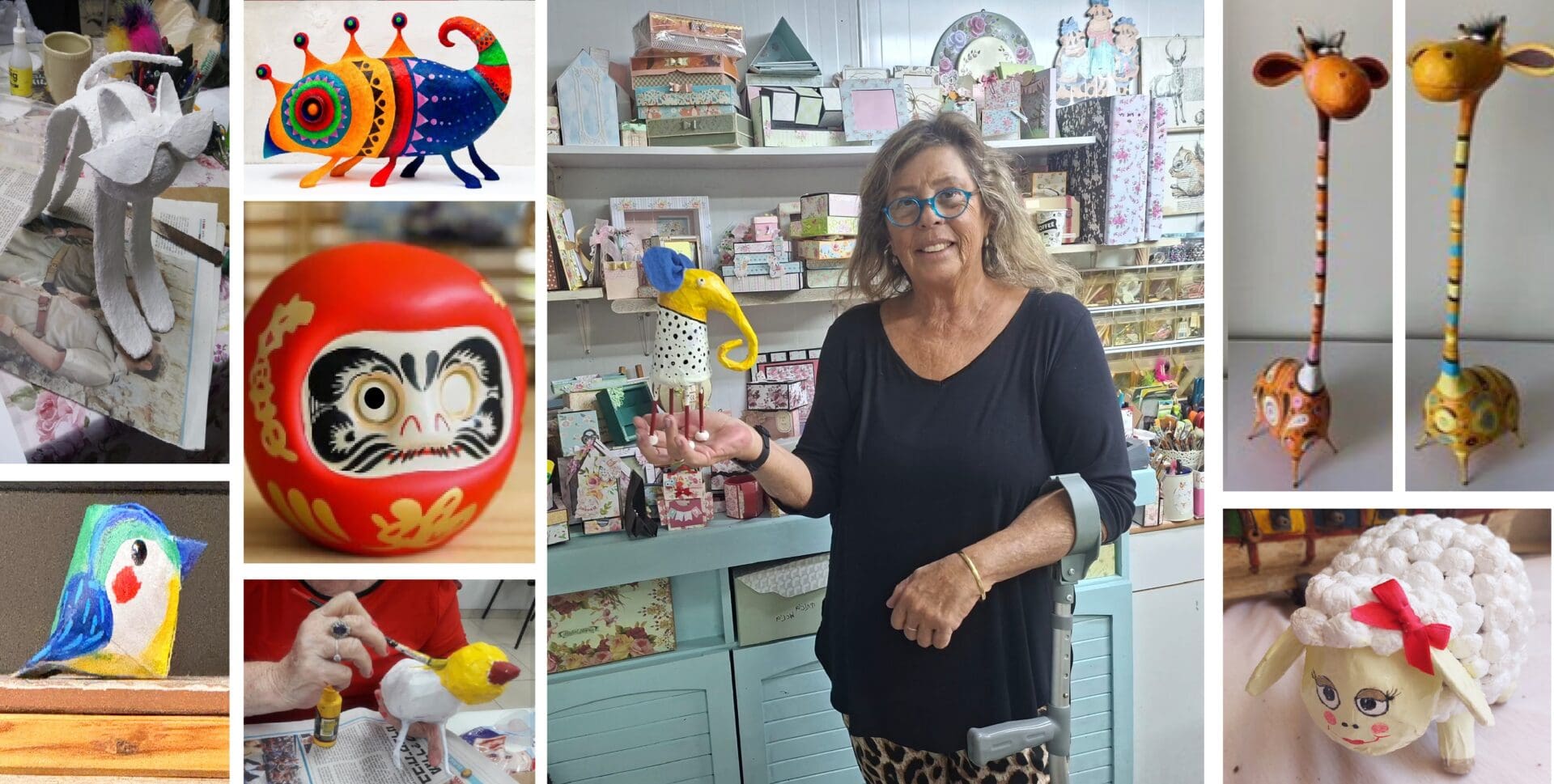
Paper mache is one of the oldest techniques in the art world. The idea is to transform simple raw materials into a work of aesthetic and practical value. But the value of working with paper mache goes beyond the world of applied art and design and also touches the world of emotion. There is something satisfying about taking a material that was meant to be thrown away, giving it a new shape, and turning it into something beautiful and useful.
For years I wanted to experiment in this field, but somehow it didn't help me until recently. Then, almost as if by invitation from the universe, two women standing next to me started talking about a paper mache class in my area, Kiryat Ata, with a wonderful teacher named Eilat HausnerI couldn't help but join the conversation and ask for details. You could say that an invisible hand directed me there, at exactly the right time. When I arrived at Eilat Hausner's studio, it was like entering another world, full of artwork of all kinds, a wonderful energy of peace and a space that encourages creativity.
I was looking for one like that. Everyone makes something there. Cardboard albums, gift boxes, and I revel in the combination of old newspaper scraps, used papers, and napkin scraps, mixed with wallpaper paste and transformed into something new under my hands. I create figurines and bowls for my own pleasure, enjoying the contact with the material and the possibility of shaping it almost without limits. I haven't gotten to furniture yet, but who knows? Maybe that will come too.
Helmets, dolls and boxes
In fact, it all began in ancient China during the Han Dynasty, around the 2nd century BC, just a short time after the invention of paper in that region. Chinese artists looked for creative ways to use leftover paper, mainly because it was a precious and rare material at the time. They discovered that if you crush the paper, mix it with natural adhesives, sometimes with wood fibers, and coat it with layers of lacquer, you get a strong, durable, and lightweight material. The earliest use of papier-mâché in China was to create protective armor and helmets for warriors. Coating with lacquer hardened the materials, leaving them lightweight but also strong, durable, and able to protect soldiers from arrows and sword blows. Today, there is a deep religious and cultural tradition in China, associated with making offerings to ancestors, from papier-mâché, figurines of houses, counterfeit money, cars, and figures that are burned during festivals and funeral ceremonies, in the belief that these objects will reincarnate and be of help in the afterlife. Pulp Paper is also used to create the heads of dragons and lions that dance at various festivals.
In Japan, papier-mâché has traditionally found expression in toys, masks, amulets, and lucky charms. One of the best-known examples is the daruma doll, a round doll that resembles our "Nachum Tekkoum." It represents perseverance, determination, and good luck, and is associated with the Japanese proverb: Fall seven times, get up eight. The doll is usually made of papier-mâché, has a round body, and a slightly heavier base, which allows it to swing and return to an upright position. The traditional daruma is usually painted red, and its face features a stylized beard, mustache, and eyebrows, along with decorations and words written in gold for longevity and luck. The more interesting detail is in the doll's eyes. When a person sets a goal for themselves or makes a wish, they draw a black pupil in the doll's left eye. Once the goal is achieved, they complete the pupil in the other eye. In this way, the doll becomes a tangible reminder of personal commitment: not only to dream, but also to act to fulfill the dream.
In the 8th century, following military conflicts between the Persians and the Chinese, Chinese papermakers were captured and taught their captors the secrets of the craft. Over time, a tradition developed of making jewelry boxes, trays, and decorative objects coated with shiny black lacquer with delicate gold decorations, products that were in great demand. Through the trade routes around the 10th to the 17th centuries, papier-mâché reached Morocco, and from there to Spain, Italy, and France, and became a hit. Paper pulps coated with a stiffening lacquer were used for furniture, frames, luxurious dolls, and architectural elements. In Europe, papier-mâché also became a useful material in the design of furniture, picture frames, and decorative elements. Thanks to its light weight, the possibility of shaping it into a variety of shapes, and the ability to coat and paint it, it provided artists and craftsmen with an interesting alternative to more expensive and heavier materials.
Recycle, create and relax
Beyond being an artistic technique, paper mache has practical and environmental advantages. You can start creating with it with a relatively small investment, without an expensive kiln like in ceramics or complex equipment. Old newspapers, cardboard, used papers, water and glue can become raw materials for a variety of creations. The environmental value is high. Instead of throwing away the paper, you can give it a new life. The process encourages creative thinking, reusing materials and understanding that you don't always have to buy something new to create something beautiful. Alongside all of this, there is also the pleasure of the craft itself. Working with paper mache requires direct contact with the material, tearing, crushing, kneading, gluing and shaping. The hands are busy, the attention is focused on the action, and gradually you can feel that thoughts about everyday matters are pushed aside a little in favor of creative peace.
For me, creating with my hands is a kind of active meditation that allows me to slow down, focus on the action, and experience pleasure. Studies in the field of art and mental health indicate that creative activities may contribute to reducing stress and improving a sense of well-being, although the effect varies from person to person. This is not a substitute for professional treatment for anxiety or depression, but an activity that may be integrated into life and add pleasure and meaning to it.
Working with papier-mâché has characteristics that are reminiscent of working with clay, a material that has been studied in the context of art therapy. In a review article published by Michal Sholt and Tami Gavron in 2006, they described how direct contact with clay, movement, and three-dimensional design may help express emotions and process internal experiences. Working with the material allows one to create a tangible form from an idea or feeling, and sometimes to express through it things that are difficult to express in words. A study conducted among adults hospitalized in a psychiatric ward examined the activity of creating with clay and found a decrease in immediate anxiety after the activity. These studies deal with clay and artistic work, not with papier-mâché, despite the similar feeling. The similarity between the activities is intriguing. In both, the hands knead, press, shape, and change the material, and the creator devotes himself to a process that requires attention and patience.
Paper pulp doesn't allow you to get everything right away. You have to shape, wait for it to dry, add layers, paint, and sometimes correct. Each step requires patience. You can't rush the material just because you're in a hurry. In this sense, the work reminds us of small but important lessons like giving things time, postponing gratification, agreeing to the process, and not expecting everything to be perfect on the first try.
From a small elephant to giant dolls
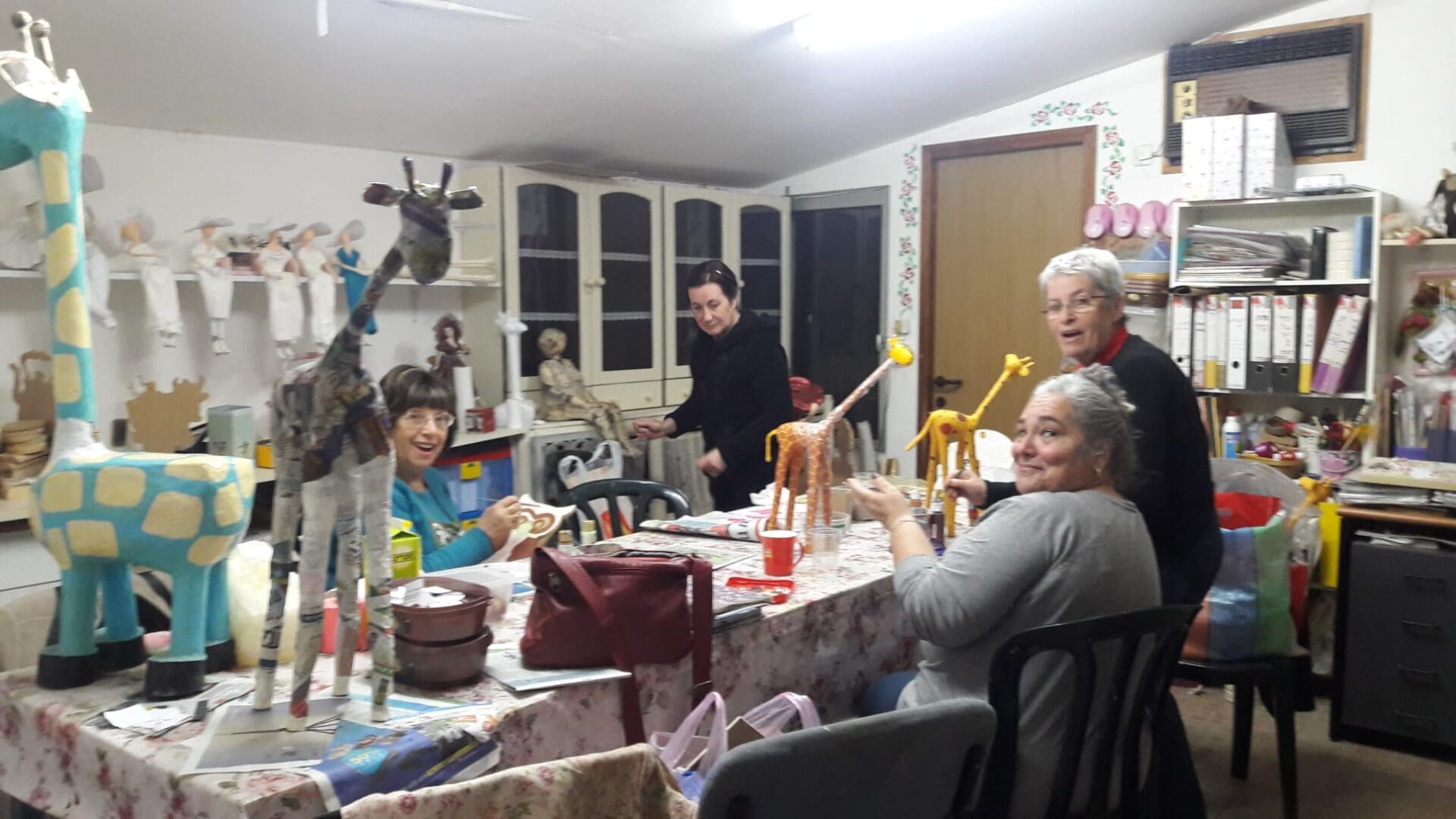
Paper mache is not limited to bowls and household figurines. It is also used to create large backdrops, stage props, theater masks, giant figures, and items for carnivals around the world, including the famous mask traditions of Venice. In Spain, in Valencia to be precise, every March the "La Palasa Festival" is held, in honor of the Christian saint Saint Joseph, who was the patron saint of carpenters. The festival features giant dolls made of paper mache, wood chips, and wax, and at the end of the festival, all of them are burned except for one who receives a pardon and stays until next year.
Eilat the instructor sent me to buy wallpaper glue, which is actually a powder that is mixed with water and a sticky liquid is created. The body of the products is made from torn newspapers and papers that are dipped in this glue liquid, and when the basic shape is ready, it needs to be allowed to dry. When the structure is dry, you can start painting and improving it until you get the desired result. On various websites like Pinterest, I found some figures to create with papier-mâché, and in the meantime I managed to make a small elephant, and the colorful chameleon is now on the shelf in Eilat the instructor's studio, to dry along with some bowls. I love the contact with the materials, the kneading and the possibility of taking a simple material and shaping it into a figure. I covered the bowls with colorful napkins dipped in wallpaper glue. After they dry, I will proceed to the appropriate finish and hope to be able to use them.
And so, between old newspapers, glue, colored napkins, and drying time, a seemingly worthless material gets a new chance. Maybe that's the secret to the magic of papier-mâché. You don't have to be a great artist, you don't need expensive equipment, and you don't have to know in advance what the result will look like. You just have to start, let your hands work, and agree to be surprised. When an artist looks at a material, he sometimes sees the entity that wants to be created from it. When I look at a pile of shredded paper or newspaper shreds, I try to think like the great artists, what's the next thing that would be happy to be born from these materials, and in most cases I open Pinterest and get ideas there.
So if you feel like creating, playing, and making something with your own hands, you should know that there are plenty of instructional videos online, classes, and Eilat Hausner's studio. And if the creation didn't turn out exactly the way you wanted, that's okay. Sometimes you can take it apart, crush it, add material, and start over. After all, in papier-mâché, as in life, not everything that seems like the end is really the end. Sometimes it's the beginning of a new creation.
A comprehensive and interesting article... I learned... and the truth is, I remembered that for years I had a corner in my heart that wanted to learn paper sculpture but never realized it.