


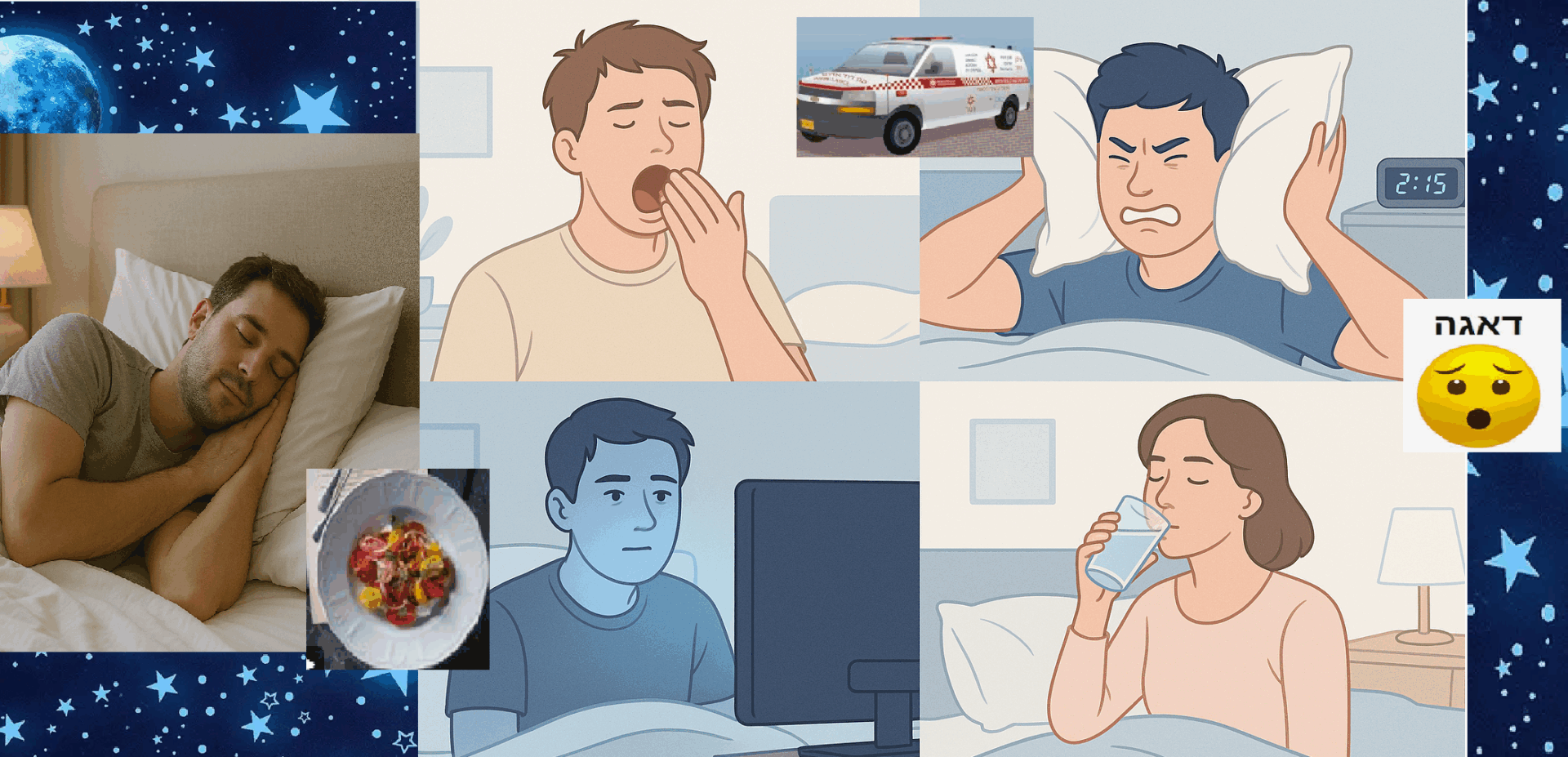
Most people who suffer from difficulty falling asleep, waking up frequently, and difficulty getting back to sleep do not report it until the condition worsens. Sleep disorders are not a weakness or a period that will pass. They are a real, familiar, documented phenomenon that can be improved. The path begins in the simplest place: listening, breathing, a daily routine, and a little patience with ourselves. People do not know how to stop the running of thoughts, the 'mind running', are unable to calm the tension, and tell themselves over and over again that they will not fall asleep tonight. Changing habits and improving routine can help.
Stress, noise and other disturbances
"I'm stressed. Everything stresses me out. I wake up every night at two, and sometimes I can't get back to sleep until four. In the morning I feel like a shadow," she says. Sarah, a mother of two who lives in an apartment in the city center. "It's the stress of life. In the country, at work, at home, everything is stressful. I feel like when I go to sleep all this stress sits on me and wakes me up. This is life. Not to say this is life? I started listening to meditations on YouTube, it helps a little, I know I need to look into how to reduce stress. Trust more, let go, not be constantly prepared for something that could happen. It's not easy," she says.
Miri who retired last year, and said that since she stopped working she hasn't been able to sleep. "Because of noise. Any noise makes it hard for me. I hear the neighbors, the cars on the road, I have less patience for it than I used to, and anything like that wakes me up. I know that when I don't sleep well, it affects my memory. What do I do about it? I tried earplugs, it's uncomfortable, it bothers me and falls off, so it's not suitable. I made windows with double glazing to stop the noise, but it doesn't prevent everything. Ambulances, motorcycles pass by, and there is noise that comes in despite the double dreams. It's not that I hear that well, but I hear the noises and it's really annoying. So I get up, start walking around the house, drink water and go back to bed. Sometimes I fall asleep, sometimes I'm in my thoughts until morning," she says.
These stories are not uncommon. They reflect a broad trend that is being recorded throughout the world and in Israel. A new study reported a significant increase in insomnia symptoms in the civilian population during times of crisis, including a 16-21 percent increase in symptoms of inability to fall asleep and extremely short sleep, lasting less than 6 hours. Why is this happening? The picture is multifaceted and has local and global causes, most of which are the result of a confluence of environmental, behavioral and emotional factors: stress and anxiety, dramatic social events, political events, crises and excitement, factors that cause nighttime arousal. Studies in times of crisis, including pandemics and emergency situations, have shown a significant worsening of sleep among more people than in calm periods.
Synchronize body and mind
Environmental and urban noise, exposure to nighttime noise, impairs sleep quality and creates frequent awakenings. Recent recommendations and reviews from international organizations indicate that neighborhood noise nuisances cause a significant burden of disease. Screen use and hours of artificial light suppress sleep, exposure to blue light in the evening can suppress the melatonin surge and disrupt the biological clock. The effect depends on the intensity, duration of exposure to blue light and the person's personal sensitivity. Medical conditions, certain medications, drugs and caffeine also affect falling asleep and the quality of sleep, so it is not recommended to drink beverages containing caffeine in the evening.
Changes in routine, such as shift work and working from home at irregular hours, eliminate boundaries between day and night, and inconsistent hours disrupt circadian synchronization. Circadian synchronization is coordination between the body's internal biological clock and the external day-night cycle. Our body has a kind of internal clock that controls sleep, alertness, hunger, body temperature, hormones, and more. When the internal clock matches the external reality, it is synchronized. When the light outside increases, the body secretes less melatonin and begins to wake up. When darkness falls, the body secretes more melatonin and begins to prepare for sleep. When there is good synchronization, the body knows when to be alert and when to sleep, and sleep comes easily and with good quality. What happens when there is no synchronization? Circadian synchronization can cause difficulty falling asleep, awakenings at night, daytime fatigue, poor mood, difficulty concentrating, and an increased desire for sweets or fatty foods. There are many reasons for this synchronization to be disrupted.
In addition to all of this, in an era of curiosity and fear of missing out on events and information, people are inattentive to their body's signals, rejecting the feeling of fatigue by eating or otherwise ignoring it, and silencing the mechanism that informs the body that it is time to sleep and replenish its energy reserves.
How do you restore circadian synchronization? Wake up with natural morning light and give your body up to 10 minutes of exposure to sunlight in the morning. At least expose yourself to screens at night to reduce blue light about an hour before bed. Try to set a regular time for going to bed and getting up even on weekends, keep eating at regular times and avoid heavy meals late at night. And just as important, complete darkness in the bedroom, because a little light can disrupt melatonin.
The currently recommended treatment for chronic insomnia is cognitive behavioral therapy, which focuses on the behaviors and thoughts that maintain the inability to fall asleep and provides tools for change. When a person tells themselves, "I won't be able to fall asleep," they are essentially convincing themselves not to sleep, thereby interfering with the natural processes from occurring.
Sleeping medications may help in the short term, but are not a long-term solution due to addiction, decreased sleep quality, or side effects, and are therefore only recommended in certain cases and under medical supervision.
Falling asleep in front of the TV
Danish, A 43-year-old man who works shifts says that when he comes back from a shift, it takes him a while to clear his thoughts and go to sleep. "It's like my body confuses day and night," he says. "I'm tired and not tired. If I worked in the morning, the evening goes by just fine, but when I work in the evening and come home in the morning, I feel like I have to stay awake a little longer, and then everything gets confused. So I turn on the TV, watch some program and fall asleep. It's become like conditioning; if I want to fall asleep, I turn on the TV. What's with all the studies about turning off screens to get a good night's sleep? I don't know. It works the other way around for me."
Most studies show that prolonged use of screens before bed can delay falling asleep by suppressing melatonin and affect sleep quality. However, the study's developers warn that the effect also depends on the intensity of the light and its content. If it is calm, it will have less of an effect than exciting or scary content. Therefore, the recommendation is to reduce it.
Natalie She would wake up at night, turn on the TV and watch series until the wee hours of the night. "Then I would stay thinking about the characters in the series, I would be tired all the time and couldn't fall asleep until I found a solution to it. In the evening I organize the house, watch some TV and go to sleep with a mask on my eyes. When I wake up at night I turn on a device that produces what is called white noise, I do some breathing exercises, and fall asleep again. It's not magic, it just helps me go back to sleep. I know that if I turn on the TV to the series channel, then I won't have a night. So I disciplined myself and I watch series in the afternoon instead of at night."
Some people recommend creating a bedtime ritual. Sasha, who underwent various treatments in the areas of body and mind until she found the formula that suits her to fall asleep, says: "I kind of tell my brain, that's it, now start getting ready for sleep. I take a long shower with hot water, read a book, then take some deep breaths and sleep. I have a feeling that the brain needs a "sign" that the night has begun," she says and adds: "It's something I used to do with the children when they were little and today I do it for myself."
Breathe, visualize and release stress
Professionals say you shouldn't lie in bed without sleep. If you haven't fallen asleep within about 20 minutes, leave the bedroom, do a relaxing activity, and return when you feel tired. Sleep disorders affect quality of life, concentration, and mood, but most cases can be improved. If you have trouble falling asleep, start with one change and gradually enter a new routine, in which you have a calm and quiet sleep.
Sleep disorder is a phenomenon that is felt in almost every home. Professionals will say that during this period it increases. There are more complaints about waking up, difficulty falling asleep and fatigue in the morning. There is emotional overload, there is news, there is work that never ends at home. They simply assume that it is part of life, but it is not. In addition, and as strange as it may sound, there is a fear of sleep. People lie in bed and a 'thought marathon' begins. What if I can't fall asleep? What if I wake up? What if I'm done with work tomorrow? The body is filled with stress. Sleep is a biological state, but insomnia, a chronic sleep disorder, is a condition that, among other things, depends on conditioning, on the beliefs that maintain the cycle of "I won't be able to fall asleep." People who change their habits change their lives.
Sometimes it seems like people don't know how to turn off their alertness. They're used to being on alert. Phone in hand, news on, head working. Then they get to bed and expect it to go away. It doesn't work like that. You have to train your body to reduce stress, to relax. Learn to breathe, imagine, let go. It's not magic, it's training.
The problem of noisy vehicles at night must stop.
We need to clean up weapons and motorcycles in the villages or it will explode in our faces one day like 7.10
Haifa has a serious problem with noise nuisances at night and a large percentage of Carmel residents are unable to sleep normally. At one pharmacy, a pharmacist told me that there has been a hundred percent increase in sleeping pills and it's not just the war and the alarms that have created problems with sleep patterns.
In Haifa, there are jackals in the middle of the night, from midnight until the early morning hours, howling loudly, sometimes in packs of 30-40 jackals, and this noise wakes up hundreds of people who wake up their neighbors when they can't sleep.
Not only the jackals, but also the noisy motorcycles and car races after midnight are deafening noise for those who live on Haifa's main thoroughfares, and the police are unable to overcome the phenomenon.
Another problem is that newspaper delivery people at 4-5 in the morning make noise in the stairwells. Maybe we should convince neighbors to cancel their subscriptions and switch to digital editions and complain about the noise.
The other problem is drones and aircraft at night since the war that patrol over the streets and create terrible noise.