


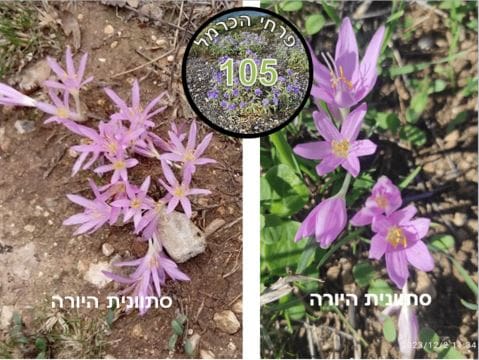
Carmel presents us with flowers in all seasons.
In this column, we will always feature one of the Carmel flowers, in parallel with its appearance in the field, and you will be invited to visit it in one of the places where it blooms this week.
Colchicum stevenii
A prominent perennial geophyte that heralds the arrival of autumn and the first rains in our region. It has an annual tuber, 4-7 cm high. The plant lacks an inflorescence stalk and its flowers are close to the ground. The plant is protected and picking is prohibited.
The tuber is shallow (4-7 cm deep) with a tuft of contracting roots about 2 cm in diameter. When flowering is over, the annual tuber empties and grows an above-ground shoot that develops a new tuber in the soil that grows above the old tuber. The contracting roots place the tuber at the appropriate depth in the soil. Each tuber produces a dense group of 1-9 flowers. Usually, 2-4 flowers bloom on each plant at the same time. The inflorescence lasts 5-16 days. The individual flower lasts 2-6 days.
Type name"Sithoon" is derived from the word "autumn", Determined for being one of the most obvious harbingers of autumn.
Species name: "The Shoot" describes the exact timing of its flowering - near the shoot falling.
Leaves: The leaves are arranged in a rosette at the base of the plant. They are ruler-like, veined along their length with parallel veins that resemble a gutter in cross-section. The leaves usually bloom a little after the flowers, but as a rule the bloom is accompanied by the leaves, unlike Jerusalem artichoke and cross-leaved artichoke, in which the flowers precede the leaves.
Flowering: The Jurassic summer flower blooms and blossoms in the fall, October–December. Two or three days after significant rainfall (over 5 mm). The flowering and budding probably occur due to a combination of a drop in temperature and the amount of rain. As winter approaches, a smaller amount of rain leads to budding and flowering.
flower: The flower is large, 4-10 cm, with a funnel-shaped perianth (without a calyx), consisting of 6 separate perianth leaves in the upper part (the perianth lobes) and fused in the lower part into a long, narrow tube (most of the tube lies below the ground where it protects an upper ovary with 3 long, thin, free leaf stalks that remain buried in the tube below the ground). The flower has 6 stamens arranged in two generations (3 shorter and 3 longer) with yellow anthers and thin white stamens located at the base of the perianth's mouth.
fruit capsule (A three-valved capsule), divided into three parts, ripens in spring, opens and releases a large number of brown seeds that scatter on the ground near the mother plant and are dispersed by ants that are attracted to a lump of fatty tissue on the back of the seed.
The flowers of the Jurassic summer flower are usually characterized by a very subtle or almost imperceptible scent to the human nose. The attraction of pollinators (small wild bees 4-9 mm, hoverflies, butterflies and honeybees) is based mainly on visuals (a carpet of lilac-pink flowers that appears on the bare ground after the first rain).
The nectar is secreted from stamens deep within the long and deep perianth tube, a fact that requires pollinators to reach the nectar while performing pollination (contact with the pollen-bearing stamens and the pistils).
The sedge grows in groups or singly in the fields and in the Mediterranean region. It is widespread throughout the Mediterranean region and the coffee belt.
Distribution in the country: Galilee, Coastal Plain, Valleys, Gilboa, Carmel, Samaria, Samaria Desert, Sharon, Shephelah.
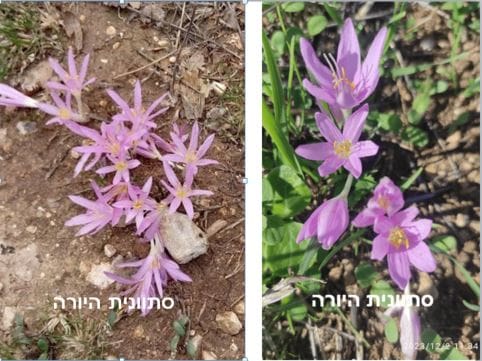
ID
| family: | Colchicaceae (Liliaceae) |
| root: | An annual tuber with a tuft of contracting roots. |
| height: | 8-4 cm. |
| Leaves: | The narrow stalked leaves, 3-1 mm wide, usually emerge during flowering. |
| stalk: | Stemless - the flowers and leaves emerge directly from the ground. |
| rash: | Blooms in autumn from October to January, the main flowering in November. |
| Flowers: | Pink, purple flowers, 11-2 cm in size. |
| The structure of the flower: | 6 petals arranged in 2 layers, inner and outer 3 in each layer. Usually grows in groups of 2-11 flowers. |
| The fruit: | The elongated capsule contains spherical brown or brown seeds. |
| smell: | Considered to be devoid of significant odor. |
| nectar: | Nectar is very little or absent. The plant is not considered an important honey plant. |
| uses: | Contains colchicine, a toxic substance used in medicine to treat arthritis. |
| Distribution in Israel: | In all parts of the Mediterranean region from the north to the northern Negev. |
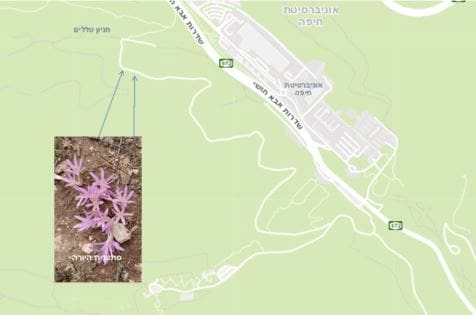
A place to meet the plant of the week
Carmel Park west of Abba Khushi Road.
- Drive from Haifa on Abba Khushi Road – Route 672 towards the university (southeast).
- Immediately after the pedestrian bridge to the university, turn right (west) towards the Tallim parking lot.
- Continue about 200 m to the parking area (located on the left of the road).
- After the parking lot, a paved road continues, go down it (on foot or by car) about 100 meters, to the place where the road turns south towards the wildlife area (from here there is no longer any vehicle access).
On the right (western) side of the paved footpath leading towards the wildlife area, before and after the Prof. Mike Yaffe Memorial Lookout, you will be able to see rich clusters of flowering juniper.
If you go to visit the flower with children, you can tell them the legend of the shooting star.
The Legend of the Jurassic Scythian
In a small, remote valley, where the hills are already yellow from the summer heat, a small tuber named Satvanit has been sleeping all summer deep in the ground, curled up in its thin cloak, waiting for one magical moment: Jurassic rain.
The autumnal one heard stories from the old tubers:
"When you hear the whistle of the Jurassic wind, the sky will be covered with heavy clouds
And the first drop of rain will touch your bud, then you will know that it is your time to bloom."
But this year the summer was prolonged… The sun was in no hurry to hide behind the clouds that were slow to cover the sky. The autumnal girl waited and waited. Sometimes she thought to herself:
“Maybe the shooter forgot to come? Maybe I won’t be able to bloom this year?”
One night, when the wind finally carried the scent of damp earth from afar, a light drizzle was suddenly heard and one small drop fell directly over the autumnal bulb, seeping through the brown earth and caressing its bulb:
“Peace be with you,” whispered the drop. “I am a nurse, sent by the shooter. Rise, it is your time to blossom.”
The little tuber woke up in a panic. The very next morning, a bright pink flower grew on the surface of the ground, delicate but brave, the first to bloom in the entire valley.
The animals stopped to look:
The turtle smiled and said, "Here's a sign that autumn has truly arrived!"
The birds burst into a new song.
And the wind caressed the pink petal of an autumn flower and said: "My beauty, how we have been waiting for you."
And so, thanks to one small drop that didn't give up, autumn became the first flower that announced to everyone that summer was over and autumn had come to replace it.
And since then, it has been said in the valley that if you look closely after the rains, you can see the little autumn flower smiling among the stones, proud to remind us all that it was she, the little flower, who was honored to be the one to herald the beginning of the autumn season.
🤩"Jurassic Autumn" – "Vorderada" illustrates "springiness" even in "autumn"!!!
Orange & yellow would be more connected to the memory of the "throwing away", which characterizes autumn😂
* How beautiful "nature" is 🙏