


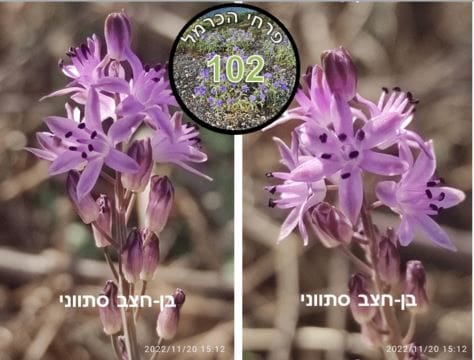
Carmel presents us with flowers in all seasons.
In this column, we will always feature one of the Carmel flowers, in parallel with its appearance in the field, and you will be invited to visit it in one of the places where it blooms this week.
Ben-Hatzeb Sethwani Scilla autumnalis
A geophyte (*) with a small bulb 15-25 mm in diameter located in the soil at a depth of 2-5 cm, from the asparagus family, and is one of the first flowers that herald the beginning of autumn in Israel. The Sitwani bee is the most common geophyte during the autumn period throughout the Mediterranean mountainous region.
Type name"Ben-Hatzeb": The prefix "ben" is used in Hebrew to denote a plant that resembles another plant. It was given to this plant because its appearance resembles thesquill, especially in its leaves and inflorescence structure, although it is smaller than it and belongs to a different genus.
Species name"Autumnal" comes from the scientific name of the genus – autumnalis, which means "Of Autumn", refers to its flowering season in autumn, immediately after the Jurassic rains.
This is an annual flower, 10-15 cm tall, with light purple blooms.
The plant has 2 flowering cycles in the same year: the first cycle in September and October before the rains come (then it blooms without leaves), and the second cycle in November after the first rains (after this flowering, 3-8 sessile leaves 5-7 cm long grow at the base of the stem).
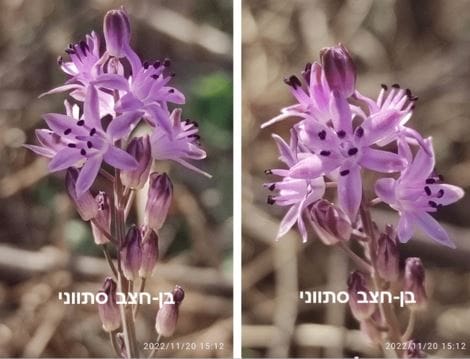
Each inflorescence has about 12 flowers. The diameter of each flower is 5-7 mm. Each flower has 6 tepals and 6 stamens whose pollen is dark purple. The flowers sit on pedicels that are twice the diameter of the flower.
The fruit is a dry, 3-lobed capsule that opens upon ripening and releases small, spherical black seeds. The seeds of the autumn primrose include a fleshy, nutritious appendage called an elaiosome or "fatty body." Ants are attracted to this body, drag the seeds into their nests, eat the elaiosome, and deposit the seed itself in a nutrient-rich substrate in the soil. The remaining seeds are dispersed by the wind or by falling near the mother plant.
The flowers of the autumn primrose are completely odorless.
At the base of the bracts are small nectar glands, which produce low to moderate levels of nectar. The nectar reward and pollen attract small bees, flies, and insects.
The Sitonian stonecrop is common in the Mediterranean region. Its habitat is cracks and pockets of soil on and near hard limestone rocks.
Distribution in Israel: Golan, Hermon, Galilee, valleys, Carmel, coastal plain, mountains and desert of Samaria and Judea.
(*) – the term Geophyte Geophyte describes a type of perennial plant that survives periods of harsh environmental conditions (usually drought or cold) by means of an underground storage organ. There are 4 types of geophytic storage: 1. tuber (as in potatoes), 2. bulb (as in green onions), 3. rhizome (as in ginger), 4. storage root (as in carrots).
ID
| family: | Asparagaceae (Liliaceae,Hyacinthaceae) |
| root: | A small onion, 15-25 mm, covered in dry husks. |
| height: | 20-15 cm. |
| Leaves: | 3-8 sessile leaves that appear only in the second wave of flowering in November. |
| stalk: | Before the shoot rains, the plant grows a leafless inflorescence stalk in the first flowering wave, bearing 10-20 small flowers with a diameter of 7-5 mm, which are pale purple in color. From the same bulb, after about two months, in the second flowering wave, another flowering stalk emerges, this time accompanied by 3-8 narrow, sessile leaves that are about 6 cm long and up to 0.5 cm wide. |
| rash: | The first wave of flowering occurs in September-October and the second in November. |
| Flowers: | At the top of the stem is an inflorescence of 10-20 small flowers, 5-7 mm in diameter, pale purple in color. |
| The structure of the flower: | The petal is a wide-open, carpel-shaped flower with 6 narrow, pale purple-purple bracts, 3-4 mm long. In the center of the petal, against the pale bract, stand out 6 bright purple stamens and a stamen with a single scar. |
| The fruit: | The dry, three-lobed capsule opens upon ripening and releases small, spherical, black seeds. The seeds are dispersed by the wind or by falling near the mother plant. |
| smell: | The flowers of the autumn primrose are completely odorless. |
| nectar: | At the base of the bracts are small nectar glands that produce low to moderate levels of nectar. |
A place to meet the plant this week
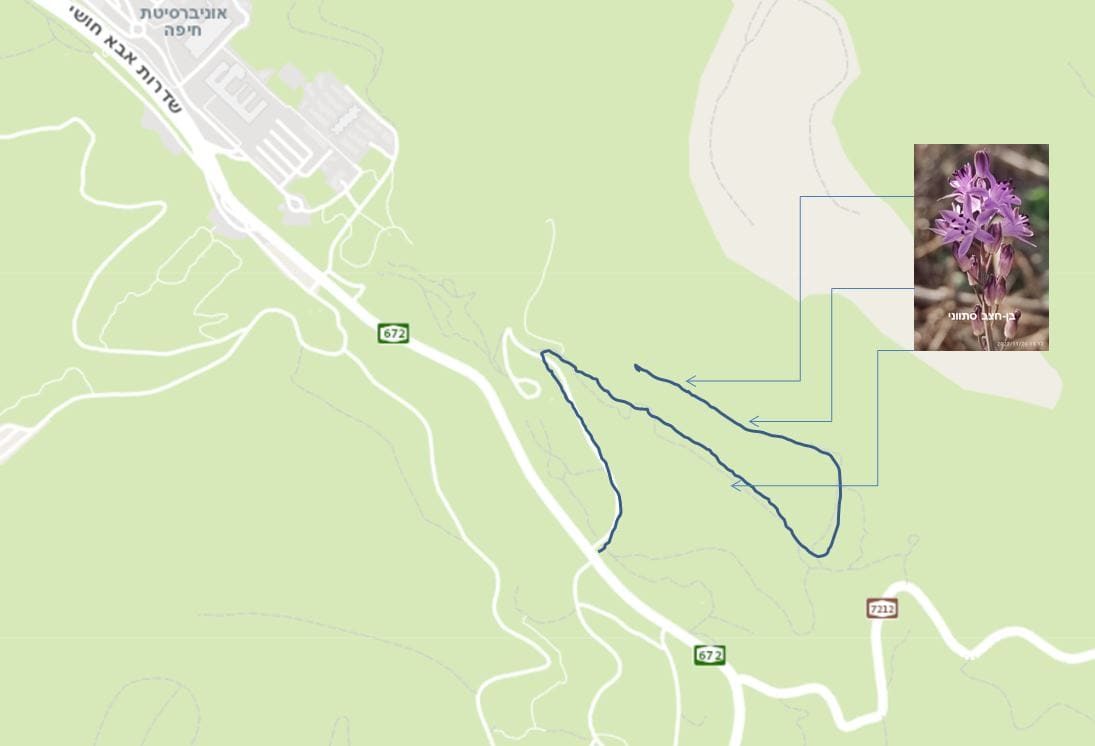
Southern entrance to the Forty Grove, turn left about 600 meters southwest on Highway 672, from the main entrance to Carmel Park.
- Drive from Haifa on Abba Khushi Road – Route 672 heading southeast.
- Exit left (towards northeast) onto Kurkar Road from Route 672, about 600 meters southwest of the main entrance to Carmel Park.
- Continue driving on the Kurkar Road for about 400 meters to a parking area on the right side of the road.
- Go east from the parking lot to a wide footpath (the path is closed to vehicles) leading to the Forty-Year Grove. On the right side of the path, about 25 meters before the entrance to the Forty-Year Grove, you will see a cluster of summer primrose flowers (marked by a circle of stones).
- Also on the left side of the path, next to the fence opposite the marked cluster, you can see another cluster of sedum.
- For those who are more adventurous, you can see many more items by Ben Hatzsev Sittwe along the perimeter trail that begins to the left of the well on the descent from the Forty Grove.
If you go to visit the flower with children, you can tell them the legend of Ben Hatzov Sithwani.
The legend of Ben Hashav Hasitavini
In ancient times, in a distant land where the mountains rise to the clouds and the valleys are filled with beds of blossoms, there was a special flower called "Ben Hatzeb Satwani."
The flower was special in its delicate and impressive appearance and its mysterious blooming times.
The villagers believed that the autumnal miner was endowed with special magical powers. They thought he could feel the heartbeat of the earth.
Indeed, every autumn the stonecutter would listen intently to the earth. He would bloom at the beginning of each autumn, then wait for the moment when the earth would wake up and begin to breathe. Then, after the first rainstorm, he would bloom again and celebrate the arrival of the rainy season.
The people knew that when the betel nut blossomed for the second time, the rains of blessing would come with it and bring with them a rich and bountiful harvest.
Thus, the ben-hatsav became a symbol of hope and a new era. Once a year, when the full moon rose over the mountains, the villagers would gather around the flower. They would sing and dance in its honor, hoping that its second bloom would bring them a blessed rainy season.
Over the years, the villagers learned to rely on the rain, and to work their land less hard. They knew that they could always count on the rain to make their crops flourish, and there was no need to work too hard. Because of the neglect, the harvest decreased a little, but it was still enough for them.
Then, during one of the disguises, a strange thing happened.
The rains had been delayed for a long time, and the villagers' crops had begun to wither. All eyes were on the autumn hyacinth. It had bloomed for the first time, and had been waiting patiently ever since, but it had not begun to bloom.
As time passed, the villagers began to worry. Some said the gods were angry with them, while others thought the earth had lost its power.
One night, the village elder came to the stonecutter. He knelt before the small, bald stem and asked: "Please, dear stonecutter, tell us why you are not blooming? What should we do to return the blessing?"
The stonemason, who had never spoken before, opened his mouth and began to speak in a soft, deep voice.
"Go to the humans," he said. "Tell them that the rain is not just drops of water. It is a part of you, of your spirit and of your heart. If you want to see me bloom again and the rains return, you must restore respect and love to the earth and the world around you. You must swear to protect it, take good care of it and love it as you love my son your home."
The village elder gathered all the residents in the village square and told them what he had heard from the stonecutter.
The villagers bowed their heads, ashamed that they had abandoned their land and neglected their connection to it. They vowed to restore its proper respect, and thus restore the blessing to their lives.
It wasn't long before the rains began to fall and wash the thirsty earth. The marigolds began to bloom, and their bloom was more magnificent than ever. Soon the crops began to bloom again, and the fields were filled with life.
Since then, every autumn, the villagers remember the oath they gave to the land and the quarry.