


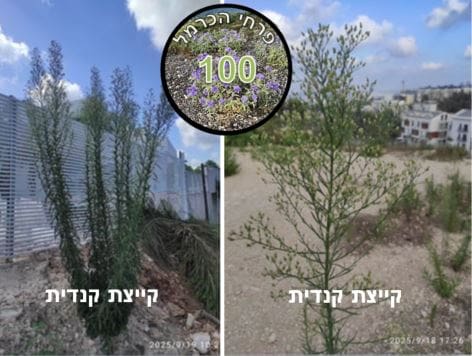
Carmel presents us with flowers in all seasons.
In this column, we will always feature one of the Carmel flowers, in parallel with its appearance in the field, and you will be invited to visit it in one of the places where it blooms this week.
קייצת קנדית Conyza canadensis
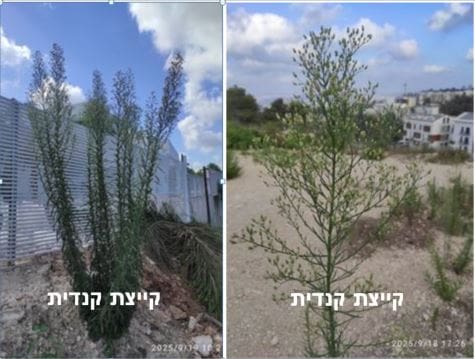
An erect annual herb, 150-200 cm tall. One of the most common roadside plants in Israel. It is an invasive plant, native to Israel, originating in North America. It arrived in Israel in the early 40s with the import of food dumplings for fish ponds in the Hula Valley. Canadian summersweet spread with incredible speed in wastelands and roadsides thanks to its summer activity and resistance to dry conditions. The plant provokes an allergic reaction in humans, caused by inhaling air containing pollen grains that penetrate the respiratory system.
The genus name "Kayts" is derived from the word "Summer "Most species of the genus Summer are notable for their flowering and peak activity during the hot, dry summer months, a period when most annual plants in Israel are already completely dry.
The species name is "Canadian", the Hebrew name is derived from the Latin transliteration of the species name.
The leaves are simple, lanceolate, sessile, ending in a pointed tip. Arranged alternately around the stem. Their length is uneven, from 3-12 cm. The leaf margin is slightly serrated. At the end of each tooth is a short bristle. Along the margin is a row of short hairs. On the upper side, the leaf is green, while the lower side is gray and covered with short, thin, dense velvety hairs that face in one direction.
The stem is green, herbaceous, with many, dense leaves along its length. Side branches branch out along the main stem. The tips of the branches, especially at the top of the stem, end in a prominent inflorescence. The stems are grooved along their length, thickening the stem and giving it strength. Despite its height, it remains stable and moves easily in the wind without breaking. The stem is hairy, covered with fine, silvery hairs along its entire length. The direction of the hairs is upward.
Canadian summer blooms from June to November, mainly from July to September.
Small inflorescences, 2-3 mm in diameter, have 2 types of flowers: The flowers of the perimeter – Lingual, female, very narrow, almost invisible, yellowish-white in color. Flowers of the Center – Tubular, yellow, bisexual, including stamens and anthers.
The fruit is a flattened seed equipped with a tassel. The seed and tassel are 0.5 mm long, consisting of one generation of fine, thin bristles. Seed dispersal occurs a few days after flowering. When the stem moves, the seeds detach from the scalp and are dispersed by the wind.
When the leaves or stems of the Canadian summersweet are crushed, a strong and pungent odor is emitted. The characteristic odor is due to a high concentration of essential oils in the plant's glands. These oils serve as the plant's natural defense mechanism against pests and grazing.
The calyxes of the Canadian summer flower are very small. The tubular flowers in the center of the calyx produce a small but available amount of nectar. The nectar is easily accessible to insects with short proboscis, especially hoverflies, small wasps, tiny bees, and beetles.
Although the flowers secrete nectar and attract occasional pollinators, the Canadian summersweet relies primarily on highly efficient self-pollination. This trait, along with the production of thousands of wind-dispersed seeds, is a key driver of its success as an invasive and highly accessible species.
Canadian summer squash grows in most areas from Mount Hermon in the north to the Arava and the Dead Sea. The plant grows in irrigated areas on heavy soils and also in areas of the Arava on light soil. Common on roadsides, in wastelands, and in gardens.
Distribution in Israel: Golan, Hermon, Galilee, valleys, Gilboa, Carmel, mountains and desert of Samaria and Judea, Dead Sea Valley, Ein Gedi, coastal plain, northern Negev, Negev and mountains of Eilat, Arava, Jordan Valley.
ID
| family: | Compositae (Asteraceae) – composite |
| root: | Skewered root. |
| height: | 200-150 cm. |
| Leaves: | The stem leaves are narrowly lanceolate to oblong, glabrous or covered with cilia at their margins. |
| stalk: | Tall, sparsely covered with long eyelashes. |
| rash: | In the summer until the beginning of winter, from June to November, mainly in the months of July-September. |
| flower: | Inflorescences are small, 2-3 mm in diameter, and have 2 types of flowers: the peripheral flowers are linguineous, female, very narrow - almost invisible, their color is yellowish-white. The central flowers are tubular, yellow, bisexual. They include stamens and anthers. |
| The structure of the flower: | The flowers are pollinated mainly by the wind, sometimes also by insects. |
| fruit: | The fruit is a small, elongated, slightly flattened, yellowish-brown achene, less than 2 mm long, with a tassel at the top that allows it to be dispersed by the wind. |
| smell: | The flowers have no noticeable scent. |
| nectar: | The tubular flowers in the center of the head produce a small but available amount of nectar. |
A place to meet the flower of the week
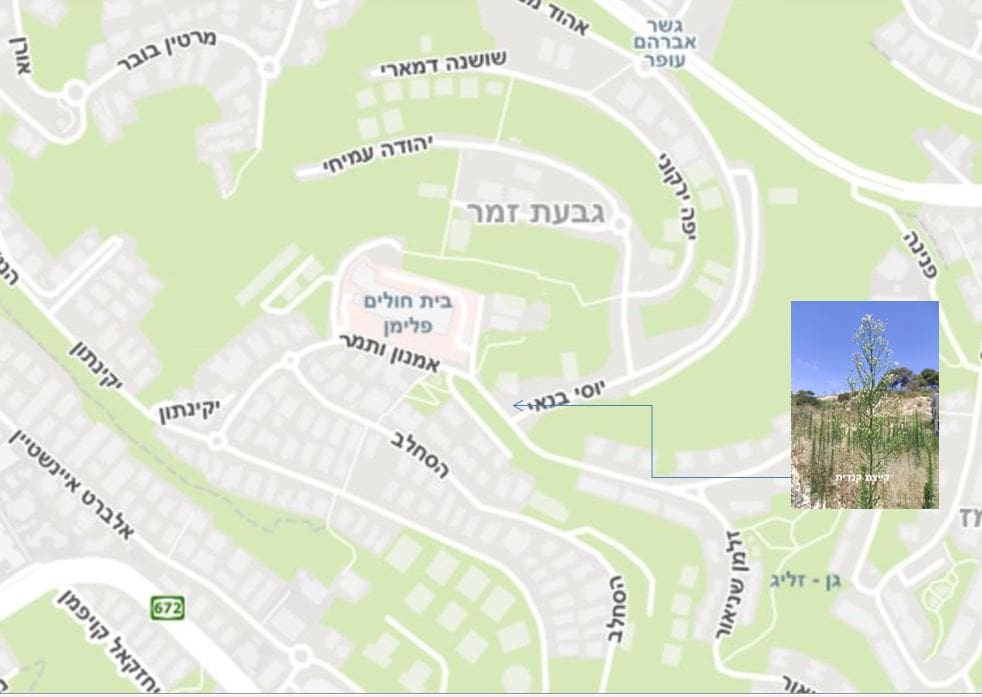
- Ramat Almogi / Givat Zemer - For those coming from Givat Zemer: In an empty lot next to house No. 7 on Yossi Banai St. before the intersection of Yossi Banai and Zalman Shneur streets.
If you go to visit the flower with children, you can tell them the legend of a Canadian summer flower.
The Legend of a Canadian Summer
At the edge of a wide field, near the path leading to the stream, grew a small, determined plant, called קייצת קנדית.
It is a stranger in the land – its small seeds came from far away, across the sea, hidden inside bags of fish food brought to the country by ship.
When the first sprout burst from the ground, the summer resident looked around and saw the local plants, the wild fescues and the brambles preparing for autumn. They wondered among themselves: "Who is this new one? She is not from our neighborhood..."
But the summer flower was not frightened. She knew a secret: Although its flowers are small and simple, they are very numerous, and it blooms for months, until every small insect finds food in it.
And most importantly, the seeds of the summer squash are light and have tassels, and at the first wind they fly far away, looking for a new place to take root.
The flowers chuckled: "Come on, why are you scattering yourself everywhere? It's not certain that they'll accept you..."
The summer woman smiled and replied: "I believe that every empty space needs something green to bloom. Even if I am a stranger, I can bring joy to my eyes and shade to the little ants."
And so it happened, the little summer sorrel became a familiar plant in all the fields. Although it is a guest from a foreign land, its ability to adapt taught all plants an important lesson: Even a stranger can become an acceptable and useful neighbor, if only given the opportunity.
And since then, every summer, when the wind blows and scatters the seeds of the tassel leaves, the children say:
"Here again, the Canadian summer sends little kisses so that we don't forget that everyone has a place in the world."
Thank you very much, Danny, for the interesting information you provide us. I really love botany, especially when it combines with love for the land. Shabbat Shalom and all the best, Sela.