


Carmel presents us with flowers in all seasons.
In this column, we will always feature one of the Carmel flowers, in parallel with its appearance in the field, and you will be invited to visit it in one of the places where it blooms this week.
Scabies Tweeter – Atractylis comosa
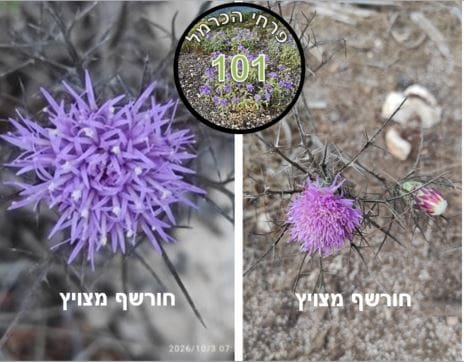
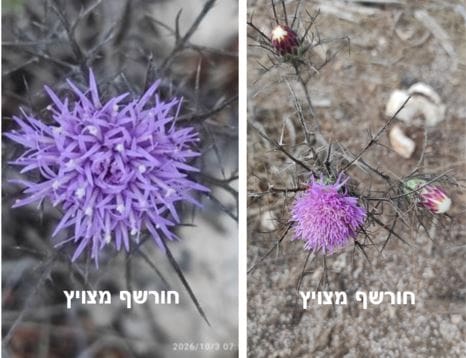
A thorny perennial herb, 30-45 cm tall, blooms in late summer and autumn when all its limbs are dry. The flowers are clustered in a crown-like or basket-like panicle, bright lilac-purple in color. Crested horcheph is a plant endemic (*) to Lebanon and Israel.
Type name "Horshef", the Hebrew name for the month, was changed based on its phonetic and morphological similarity to the Arabic word ( Khushuf ארשופון), which means artichoke or thorn, due to the thorny appearance of the scalp.
Species name "Tweeted", derived from the scientific name of the species comosa = Tufted. This name describes the appearance of the spiky, feathery bracts surrounding the head of the inflorescence, or the grayish-white feathery seed tuft of the plant.
At the beginning of winter, a rosette of hairy, spiky leaves blooms. Towards the end of spring, an inflorescence stalk and a scalp bud emerge at its top. Towards the summer, the leaves and stalk dry out, and only in the fall does the bud at the top of the stalk open into a beautiful inflorescence. The inflorescence is crowned with branched spines in the outer sheath, the inner sheath leaves are ragged and not spiky. The diameter of the open scalp (including the spines that surround it) is 3.5-5 cm, the color of the scalp flowers is bright lilac.
Crested horcheph blooms in late summer and early fall, August-October. During flowering, most of the leaves wither, thus reducing water loss during the dry season.
The inflorescence is a capitula consisting of a large number of small, bisexual, tubular flowers of a bright lilac color. The flowers on the periphery of the capitula are larger and more elongated than the flowers in the center. They are characterized by an especially long tubular corolla, the base of which is a tube made of fused and deeply split corolla lobes, which causes their ends to spread out to the sides and look like a linguineous corolla. The capitula of the flowers is wrapped in an inner sheath of split bracts, which are rounded at the top and spineless. Beneath them is an outer sheath of clipped, feathery bracts that end in sharp, branched spines, adding a kind of protective and graceful cover to the entire capitula.
The fruit of the horsef is a small, dry seed that does not open even when ripe. The seed is elongated with a brown or gray shell and a grayish-white feathery tuft at its top that helps it spread by the wind and sometimes by sticking to animal fur.
The flowers have no pronounced odor to humans.
The flowers secrete nectar, which is concentrated at the base of the petal tube. Because the structure of the tubes is not too deep, the nectar is accessible to a wide range of insects, mainly bees, butterflies, and various beetles. The plant relies primarily on the abundance of nectar and the prominent color of the pink-purple scalp to attract pollinators, rather than on a non-existent aroma.
The plant is common and grows scattered in meadows, groves, and open areas in limestone mountains.
Distribution in Israel: Golan, Galilee, Mediterranean coast, Gilboa, Carmel, Samaria Mountains, Judean Mountains, Shephelah.
ID
| family: | Compositae(Asteraceae) |
| root: | Thickened in the soil with a shoot developing from a regeneration bud at ground level. |
| height: | 45-30 cm. |
| Leaves: | In winter, a rosette of hairy, spiky leaves grows that dry out in preparation for summer. |
| stalk: | Towards the end of spring, a flower stalk emerges from the rosette of leaves, topped with a bud. Towards the summer, the stalk dries out. |
| rash: | In the summer, mainly from August to October. |
| flower: | The scalp is a bright lilac-purple color, 3-4 cm in diameter. The inflorescence is crowned at its base with branched spines, while the inner bracts are ragged and not spiny, except for the upper bracts adjacent to the inflorescence, which are spiny. |
| The structure of the flower: | The flowers on the periphery of the head are lingual and female, while the flowers in the center are tubular and bisexual. |
| fruit: | Dry seeds bear shiny, white tassels. |
| smell: | The leaves and flowers lack a noticeable fragrance. |
| nectar: | The tubular flowers produce a moderate amount of nectar, attracting mainly bees. |
| uses: | There is no information about uses for the plant. |
A place to meet the flower of the week
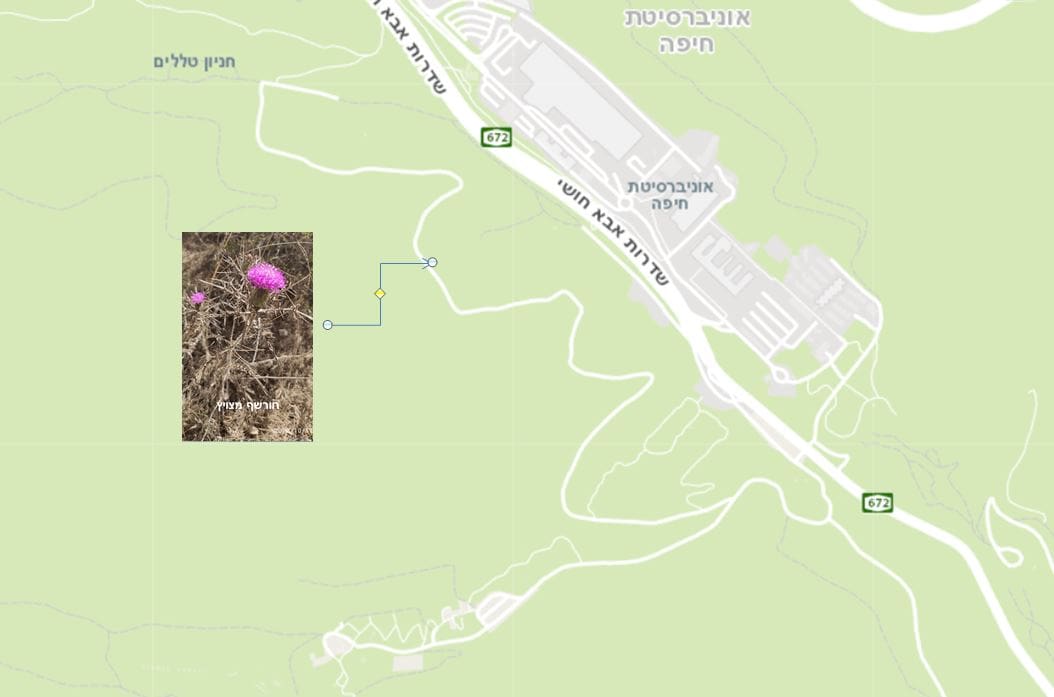
- Drive from Haifa on Abba Khushi Road – Route 672 heading southeast.
- Immediately after the pedestrian bridge to the university, turn right (south) to Tallim parking lot
- Continue about 200 m to the parking lot (located on the left of the road)
- After the parking lot, a paved road begins, go down it (on foot or by car) for about 70 m, until the place where the road turns south (from here there is no more entrance by car).
- Continuing along the footpath, clusters of tufted crocuses bloom on the eastern side of the trail (see location on the attached map).
If you go to visit the flower with children, you can tell them the legend of the crested hawkmoth.
The Legend of the Crested Horshef
In a warm, wide valley, where the sand is golden and the sun hardly sets, many plants lived. Most of them withered at the beginning of summer. When the rain stopped and the heat turned the soil hard. Only one plant remained upright and flourished in the desolate surroundings, The tufted shrike.
The horsef was no ordinary plant. Even its leaves, which were covered with thin, shiny thorns, had withered, and only its flowering stem remained blooming and upright. Every day it looked around and saw its fellow flowers withering, the poppies disappearing, the daisies wilting, and only it still stood in the scorching heat and bloomed in all its glory.
"Why do you bloom in the height of summer?" the wind asked him. "Isn't that the hardest time for everyone?"
The thornbush smiled and replied: "I believe that everyone should find the right time to bloom. Summer is mine."
And it opened its bright flowers, as if calling the sun to come and play with them.
The sun heard his words, was moved, and said: "You are a brave plant, crested primrose! For your courage, I will give your flowers a special shine, that they may shine from afar even when everything around is dry."
From that day on, every hot summer, when everything seems still and desolate, the flowers of the tufted horsef, purple-pink and bright, emerge, reminding everyone that even in difficult times, there are those who choose to bloom.
And if you stop in the middle of a hot day and see a spiky purple-pink flower standing proud in the sun, you'll know it's him: "The tufted crocus," whispering to you: "Even when it's hard - we must continue to smile and flourish!"