


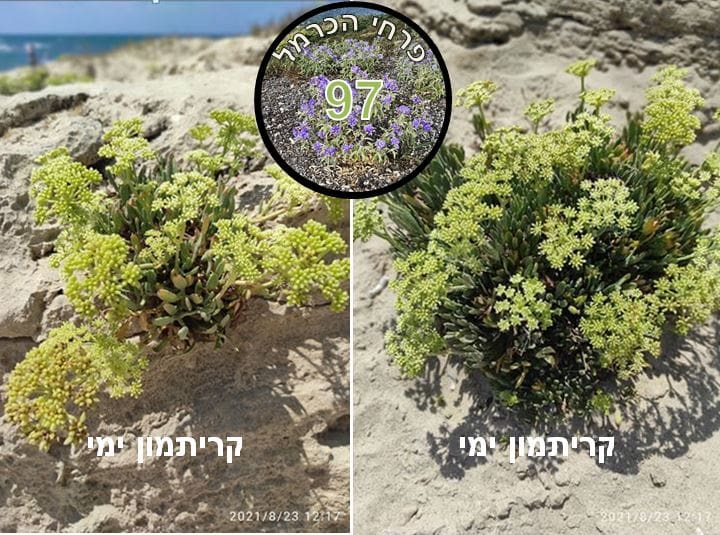
Carmel presents us with flowers in all seasons.
In this column, we will always feature one of the Carmel flowers, in parallel with its appearance in the field, and you will be invited to visit it in one of the places where it blooms this week.
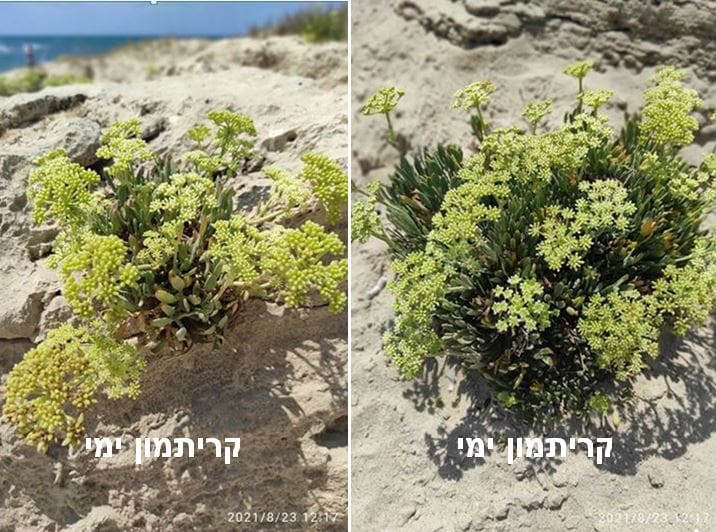
Krithamon Yami – Crithmum maritime
A perennial herb with a stout base, 30-50 cm tall. It has a thick, strong rhizome that penetrates deep into the rocks, allowing for good grip on coastal and saltwater substrates, as well as vegetative reproduction through the sprouting of new shoots.
Sea hyacinth grows exclusively along the coast, in the sands and kurkar hills from Rosh HaNikra in the north to the Gaza Strip in the south. Its habitat is called the "spray belt." This area, very close to the coast, is characterized by strong winds and, as a result, a lot of salt water spray. Very few plants, including sea hyacinth and the beach lily, are able to survive in such conditions.
Genus name "Crithomon" Scientific name Crithmum Derived from the ancient Greek word Krithe, meaning barley. The name was given to the plant because its small, elongated seeds resemble barley grains in shape and appearance. In Hebrew, the scientific Greek name is transformed into a weight with a distinct Hebrew suffix ("-ven"), and thus Kritmon was born.
The species name "marine" indicates the plant's typical habitat - cliffs, rocks, and sea spray along beaches.
The leaves are fleshy, pinnately dissected, finger-like, and bluish-green in color. They sit on the branches and are arranged in pairs or triplets of lobes or leaflets that are 2-3 cm long and about 1 cm wide. They are coated with a waxy layer that allows them to cope with dry and salty conditions.
The stem is fleshy, branched, upright-inclined, and light green in color.
Watercress blooms from May to November, mainly from August to October.
The flowers are bisexual, small, 2-4 mm, yellow-greenish, arranged in umbel inflorescences consisting of small umbels emerging from a common joint. The flowering is profuse, the entire plant is densely covered with flowers that hide the leaves and stems. The small flowers secrete accessible and visible nectar on the surface of the disc in the center of the flower. The flower attracts mainly flies, wasps, beetles and bees, which are attracted to the sugar level in the nectar and the resinous aroma of the bloom.
The plant is rich in powerful essential oils, which also give it its characteristic spicy-sour flavor.
The plant has a strong, spicy, herbaceous scent, reminiscent of a combination of parsley, dill, celery, and citrus, with a slight salty-sea scent. The essential oils and strong scent are primarily intended to repel pests and herbivores.
The fruit is an egg-shaped dicot, about 5-6 mm long, green when ripe, turning yellowish-brown when dry, and has 5 ribs. It is covered with a layer of cork that allows the seeds to be dispersed by wind on land and on sea waves.
The flowers of the sea hyacinth are tiny, greenish-yellow, and arranged in axils. The nectar is secreted from a cryptic disc located at the base of the sepals, at the top of the ovary. The nectar is secreted directly onto an open, exposed surface. This structure does not require a long stem, so the nectar is accessible to a very wide range of occasional pollinators. The combination of late summer and fall flowering with accessible nectar secretion makes the sea hyacinth a major refreshment station for insects in the coastal environment.
Prevalence and distribution: The plant grows on kurkar rocks on the beach in the Hassa area along most of the Mediterranean coast from the Galilee in the north to the Gaza Strip in the south.
ID
| family: | Umbelliferae Apiaceae (Umbelliferae) |
| root: | Thick, strong rhizome, deep between rocks, allows for good grip on coastal substrates and brackish water. |
| height: | 50-30 cm. |
| Leaves: | The leaves are fleshy, pinnately dissected, finger-like, and have a bluish-green hue, with a waxy coating that protects them from the salt that is carried to them in fragments by the wind coming from the sea. |
| stalk: | The flowering stem emerges in August, solid, green, and completely leafless. |
| rash: | In the summer, from May to November, mainly from August to October. |
| flower: | The flowers are bisexual, small 4-2 mm, yellow-greenish. |
| The structure of the flower: | The flowers are arranged in umbel inflorescences consisting of small umbels emerging from a common joint. The flowering is profuse, the entire plant is densely covered with flowers that hide the leaves and stems. |
| fruit: | The fruit is an egg-shaped dicot about 6 mm long, greenish with variegated crimson, and has 5 ribs. It is covered with a layer of cork that allows the seeds to be spread by wind on land and on sea waves. |
| smell: | The plant has a strong, fresh-pungent scent reminiscent of a combination of parsley, celery, and black pepper. |
| nectar: | There is a small amount of nectar, attracting mainly small insects. |
| uses: | Edible plant: The berries are used as a spice, in marinades, pickled, or fresh in salads. |
A place to meet the flower of the week
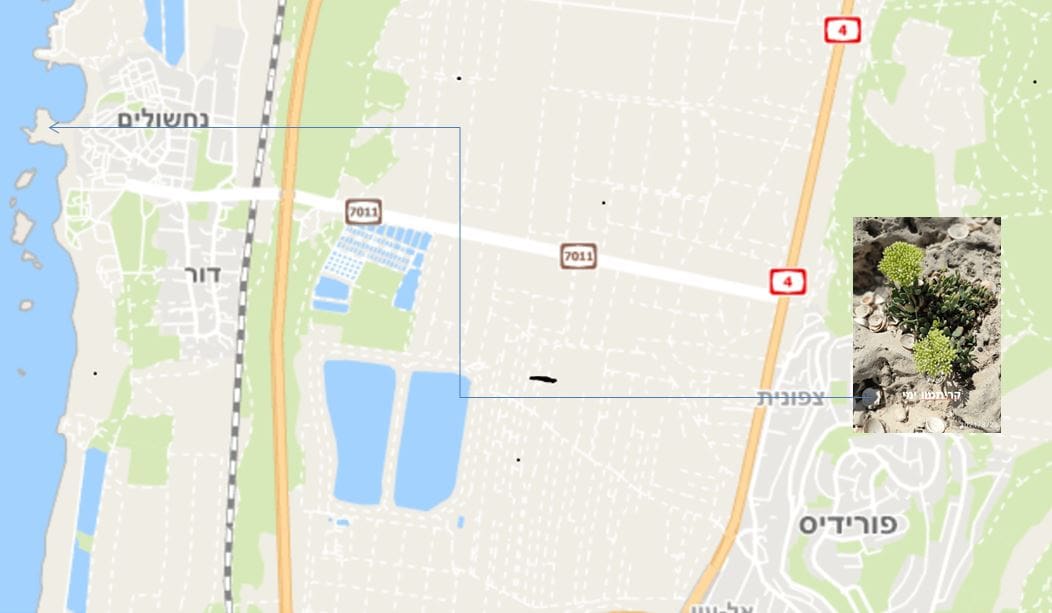
Dor Beach – known by its Arabic name Tantura.
- Drive from Haifa on Highway 4 south (after the Ein Ayala junction) to the entrance junction for Nahsholim/Dor - Highway 7011.
- At the intersection, turn right toward Nahsholim/Dor, Route 7011, continue driving on Route 7011 to the parking area of the Dor-Tantura beach.
- Park the car in the David Beach – Tantura parking lot.
- From the parking area, continue on foot to the entrance gate to the beach. Enter the beach (free entry) and continue on foot inside the beach west about 50 meters to the water's edge.
- On the waterfront, continue about 100 meters north, then go up west to the sand hill that juts out like a peninsula into the sea. On the sand hill, you will see a scattering of clusters of sea urchins. In each cluster, you will see a concentration of sea urchins with yellow-green blooms arranged in umbrella inflorescences consisting of small umbrellas.
If you go to visit the flower with children, you can tell them the legend of the sea urchin.
The legend of Krithamon Yami
On the seashore, where the waves play ancient songs and the sand is colored gold, a special plant grows called My daily cry, Unlike other plants, it was not afraid of the salt, the wind, or the splashes of water, on the contrary! It loved them very much.
Every morning, the chervil would open its green, nutritious leaves and smile at the sun. "Hello, dear sun," it would say, "Give me strength to guard the seashore."
The fish in the sea knew it well. When they would jump out of the waves, they would see its thick leaves sparkling like jade. The sailors who passed by in their boats would say:
"This is a brave plant. It keeps the shore from being completely washed away by the water and carried out to sea, and offers shade and help to the insects that come to it."
Once upon a time, a small, thin flower, swept from the fields, came to the shore,
"I can't grow here," cried the flower. "The salt is burning my roots, the wind is too strong, and I won't survive here."
The Critmon smiled at him affectionately:
"Do not be afraid. I was born here, among the waves of the sea. I will teach you a secret: He who listens to the waves, he who bends with the wind, can remain strong even in the most difficult place."
The little flower listened to Kritimon and realized that not everyone can survive on the beach. He asked the waves to take him back to the fields, where a gentler soil suitable for his development awaits him.
Before they parted, the Critmon said to him:
"Always remember – everyone has their own special place where they flourish. Mine is by the sea and yours is in the fields."
Since then, the children who come to play on the beach look at the fleshy leaves of the sea cretimon, and tell each other:
"He guards the seashore, and teaches us that everyone must find the place most suitable for their destiny and development in the world."
.
Did the article interest you?