


Carmel presents us with flowers in all seasons.
In this column, we will always feature one of the Carmel flowers, in parallel with its appearance in the field, and you will be invited to visit it in one of the places where it blooms this week.
Common sandpiper Drimia maritima
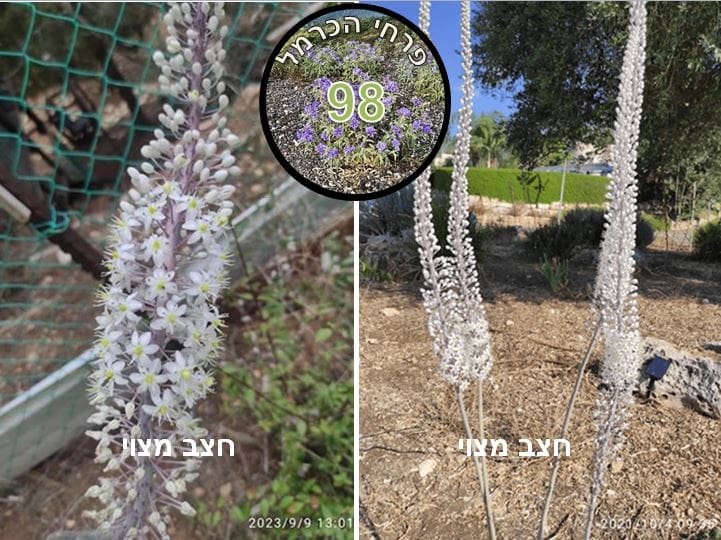
A geophyte (*) with an exceptionally large and poisonous bulb (the bulb of the sedge is the largest of the bulbs of wild plants in the country). The sedge is a protected plant. It is characterized by an upright flowering stem that rises to a height of one meter or more, its flowering is early and is actually the harbinger of autumn.
The genus name "Hatzeb" probably comes from the ancient Hebrew word squill, is related to the onion's ability to carve into rocks and grow in them.
The species name "matzoi" is a common botanical name for species with a wide distribution.
The rosette of sedge leaves emerges in November after the rains. The leaves are large and wide, 25*8 cm, and are very poisonous. At the same time, the vegetative propagation (**) of the plant's bulb begins.
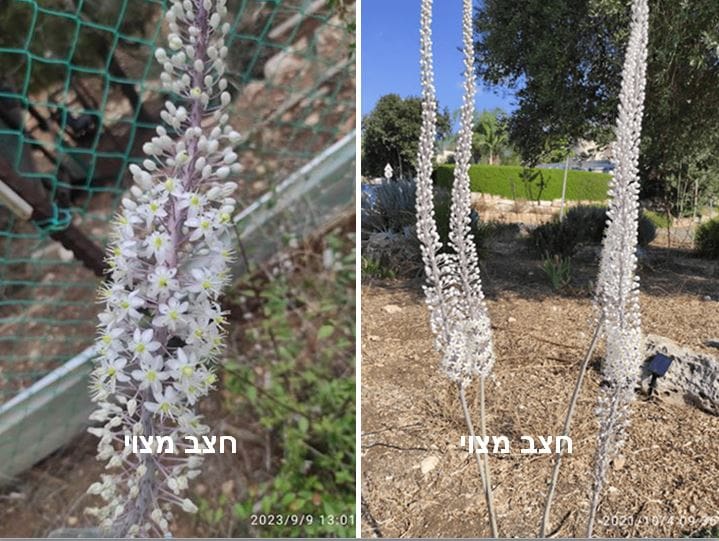
During the month of August, a leafless inflorescence stalk emerges from the onion, 80-180 cm high, single and unbranched, along its upper part are dozens of flowers arranged on short spikes in elongated panicles. The flowering begins from the bottom, and each day another group of about 30 flowers opens above the previous ones, and the flowers that opened the previous day wither.
Common marigold blooms in late summer and early autumn, from August to November.
The single flower is small, about 10 mm in diameter, and has 6 wide-open bracts that are grayish-white on the inside, while on the outside a green longitudinal stripe runs down their center. The flower secretes abundant nectar from 3 crypts located on the ovary wall, and is visited by a wide variety of insects.
The fruit is a 3-lobed capsule containing lightweight, winged black seeds. The capsule opens only when dry, while in the hirtabu it closes and does not release the seeds. Any movement of the wind or impact of an animal shakes the inflorescence column bearing the ripe fruit and disperses the seeds a distance.
The nectar is secreted from crypts located at the base of the ovary and stored at the bottom of the perianth. Since the flowers are open and showy, the nectar is accessible to a wide range of insects. The nectar attracts mainly bees, wasps, flies and butterflies. For honeybees in late summer and early autumn, the honeysuckle is an essential and critical source of nectar and pollen due to the lack of other flowers at this time of year.
The flowers of the marigold have a sweet, unique, and delicate scent that is strongly felt around the flowering stalk. The scent directs pollinators to the flowering stalk from a distance, combined with the visual prominence of the tall, white flowering stalk against the dry, late-summer landscape.
The stonecrop is very common throughout the Mediterranean region, in the mountains and in the lowlands. Its distribution in Israel: Golan, Hermon, Galilee, the Mediterranean coast, the Upper Jordan Valley, valleys, Gilboa, Carmel, the Samaritan Mountains, the Samaritan Desert, the Judean Mountains, the Judean Desert and the Dead Sea Valley, Ein Gedi, Sharon, the Lowlands, the Northern Negev, the Negev and the Eilat Mountains, the Arava, the Jordan Valley.
(*) The term geophyte describes a type of perennial plant that survives periods of harsh environmental conditions (usually drought or cold) by means of an underground storage organ.
There are 4 types of geophytic storage organs: 1. tuber (like cyclamen), 2. bulb (like narcissus), 3. rhizome (like daisies), 4. storage root (like carrots).
(**) The term vegetative reproduction (asexual reproduction) describes a type of reproduction in which organisms reproduce without the involvement of gametes or fertilization. In this process, offspring are formed from a single parent organism, without the need for two parents.
| family: | Asparagaceae (Liliaceae, Hyacinthaceae) |
| root: | A giant onion. |
| height: | Can reach a height of 1.5 meters. |
| Leaves: | In November, after the rains and the withering of the inflorescences, a rosette of large, broad leaves (25*8 cm) emerges, which are very poisonous, and which carry out an assimilation that fills the bulb in preparation for the new season. The leaves wither in April. |
| stalk: | In August, a single, unbranched flowering stem emerges. |
| rash: | In late summer and autumn, mainly in the months of August-November. |
| flower: | The flowering stem contains dozens of flowers (50 to 250) arranged along its upper part on short spikes in elongated panicles. Flowering begins from the bottom, and each day another group of about 30 flowers opens above the previous ones, and the flowers that bloomed the previous day wither. |
| The structure of the flower: | The solitary flower is bisexual, small, about 10 mm in diameter, with 6 petals that are grayish-white. Inside them are 6 stamens, and inside is a triangular ovary. |
| fruit: | The collection has 3 subjects. |
| smell: | The flowers of the marigold have a sweet, unique, and delicate scent that is clearly noticeable around the flowering stem. |
| nectar: | Nectar is secreted from crypts located at the base of the ovary and is stored at the bottom of the perianth. |
| uses: | The toxic substances in the plant are used to make medicine and rat poison. |
A place to meet the flower of the week
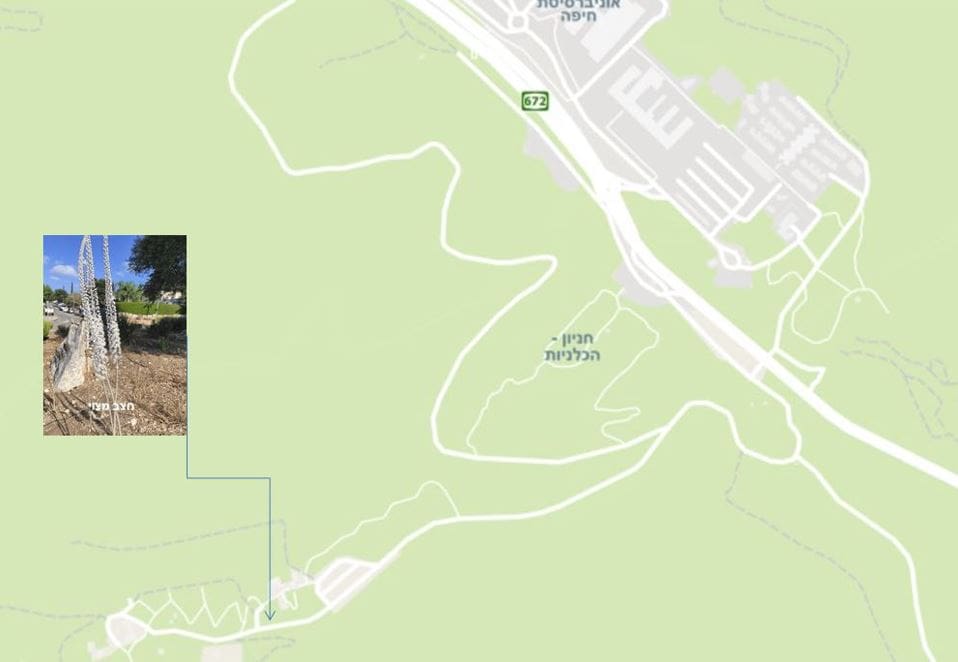
- Drive from Haifa on Abba Khushi Road – Route 672 heading southeast.
- Turn right (slightly after the second entrance to Haifa University) at the main entrance to Carmel Park. From the entrance, continue left on the road towards the wildlife sanctuary.
- On the way you will see a fork in the road to the left towards Little Switzerland (do not go there), further on the road to Haibar. At the entrance to Haibar you will be able to see several flowering specimens of common sedge.
If you go to visit the flower with children, you can tell them the legend of the common hyacinth.
The legend of the common scythe
In a small valley near a green grove, the plants lived in harmony. Each knew when to bloom:
Almonds in spring
Cyclamen in winter
And the anemones are red, in late spring.
But there was one plant, a bit strange, called common marigold. It didn't bloom like the rest in spring or early summer. On the contrary, precisely when the summer heat was at its peak, and the ground was dry and thirsty, the marigold would suddenly raise a tall, white column, full of tiny flowers.
The other plants laughed:
"What are you doing, stonecutter? Everyone is resting now. Who will even see you?"
But the stonecutter smiled shyly and said:
"I bloom to announce, summer is over, autumn is coming. I herald the change of seasons."
And then, one day, the children from the village arrived at the field. They saw the white stone pillars standing in rows in the yellow field, and they exclaimed with excitement:
"Autumn is coming! The hyacinths are already blooming!"
From that day on, all the plants understood that the hyacinth was an important messenger. It didn't just bloom at a strange time, but it Harbinger of autumn, the one that informs everyone that the season is changing: summer is over, autumn is upon us.
And so, from then until today, every year when summer says goodbye and autumn approaches, the grove raises its white flowering columns and reminds everyone
"Pay attention, summer is over, autumn is coming, you just have to listen and internalize."