


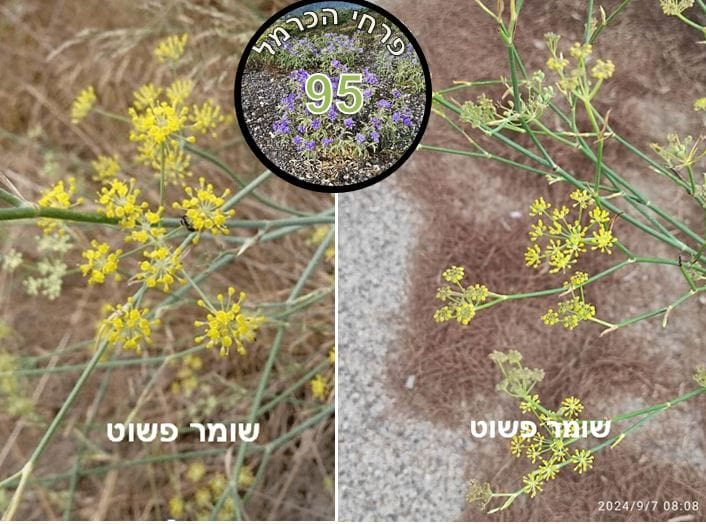
Carmel presents us with flowers in all seasons.
In this column, we will always feature one of the Carmel flowers, in parallel with its appearance in the field, and you will be invited to visit it in one of the places where it blooms this week.
Common Fennel • Foeniculum vulgare
A perennial herb, 150-250 cm tall. It sheds its leaves in the summer, but continues to reproduce without the leaves using its stems.
"Type name"Guard"Preserved in Hebrew tradition for generations, associated with a spice plant that smells of anise, has thin leaves and a characteristic aroma.
"Species name"simple"The meaning of the word vulgare In Latin it is "common," "ordinary," or "popular." In Hebrew botanical terminology, it is customary to translate this adjective as "simple" to indicate the most common and familiar species within the genus.
In winter, fennel grows a rosette of leaves that are cut 2-4 times into delicate, dark green hairy lobes. The leaves have a delicate anise flavor, known by their popular name: "Shamir."
The stems are rhytidaceous (*), long and flexible, branching at an acute angle.
Fennel blooms in summer and fall, from June to October, mainly in August to September.
The flowers are small, bisexual, numerous, with 5 petals, arranged in small umbels. The inflorescences are made up of umbels that are separated from each other and are borne on long, glabrous stalks of equal length.
All parts of the plant, especially the crushed fruits, have a strong, sweet, and characteristic odor reminiscent of aniseThe dominant scent is due to a high concentration of essential oils, mainly אנתול (Anethole) andPanchon(Fenchone). The plant is a magnet for honeybees, wasps, flies and beetles. The honey produced is rich in fennel and has a unique aromatic taste and aroma.
The small, yellow flowers are clustered in axils and secrete a considerable amount of accessible nectar rich in sugars, which is not hidden deep within the flower. The nectar is a major food source for many insects during the dry season when it blooms.
The fruit is a two-seeded, elongated-cylindrical capsule 5-10 mm long, which splits at the ripening stage into 2 units, each containing one seed. Its surface is grooved lengthwise with fine grooves. Its color changes from olive-green when young to yellowish-brown when dry. The fruit has an aromatic odor and a sweet-spicy taste reminiscent of anise.
Fennel, which grows in the garden, is the most prominent plant along roadsides and in Mediterranean summer pastures.
Its distribution in Israel: Golan, Galilee, valleys, Gilboa, Carmel, mountains and desert of Samaria and Judea, Dead Sea Valley, coastal plain, northern Negev, Negev, Jordan Valley.
(*) The term Spartoid describes a plant whose stems are similar to those of the Spartium plant: (green, thin, flexible, and leafless) that carry out the process of assimilation (photosynthesis).
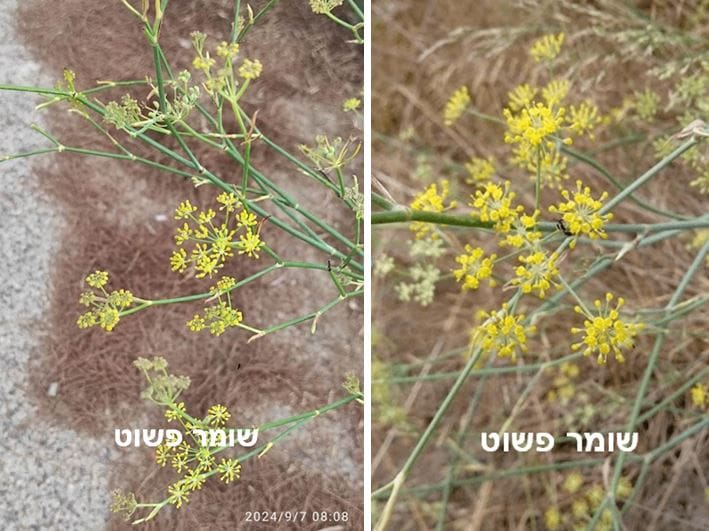
ID
| family: | Umbelliferae - Apiaceae (Umbelliferae |
| root: | thickened. |
| height: | 200-150 cm. |
| Leaves: | Feathery, cut into thin, dark green lobes. In winter, the leaves wilt and turn gray. |
| stalk: | In late spring, the inflorescence stems emerge. Along the stem, it is herbaceous, long, green, and flexible, branching at an acute angle. |
| rash: | In summer and autumn from June to October. |
| flower: | Bisexual flowers, small and numerous, arranged in umbels. |
| The structure of the flower: | An awning consists of separate awnings carried on long poles of equal length. |
| fruit: | An elongated-cylindrical dicot, 10-5 mm long, about 3 mm wide. |
| smell: | The stems and fruit exude an anise scent. |
| nectar: | Contains nectar from my garden. |
| uses: | Used to season cooked food, pickle vegetables, and in alcoholic beverages. Its roots are used in folk medicine to treat rhinitis, digestive disorders, and eye infections. |
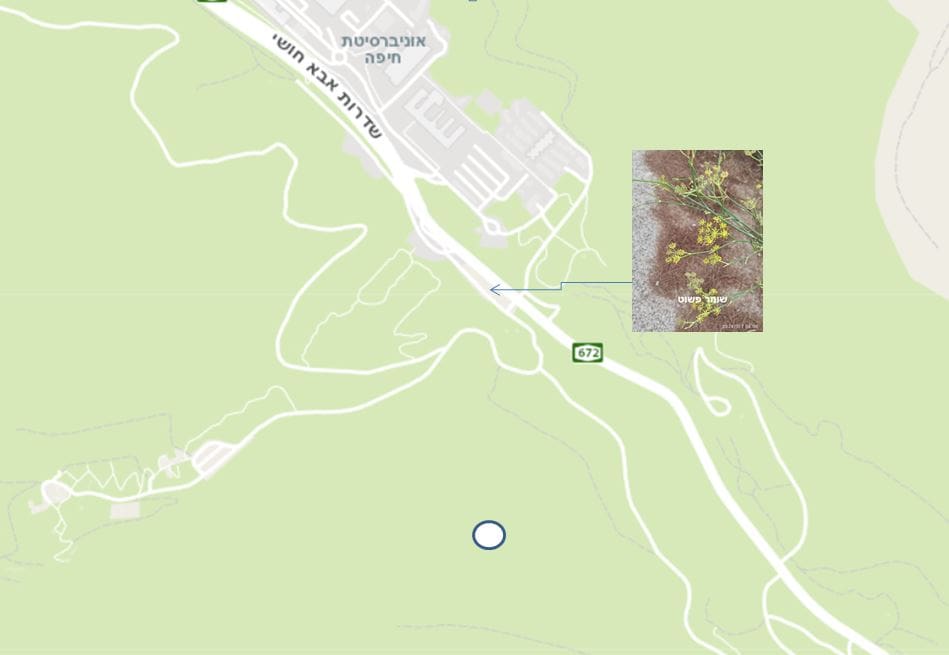
A place to meet the flower of the week
- Drive from Haifa on Abba Khushi Road – Route 672 heading southeast.
- Turn right (slightly after the second entrance to Haifa University) at the main entrance to Carmel Park, park your car in the parking lot.
- In the narrow, bare strip of land between the main road - 672 and the parking lot, you can see a large number of tall, yellow-flowering specimens of common fennel.
If you go to visit the flower in the company of children, you can tell them the fairy tale about a simple keeper.
The Legend of a Simple Guard
On a green hill, at the edge of the field, grew a simple sedge. It was tall and thin, with feathery leaves and a special, sweet-anise-like scent that filled the air around it.
But despite its intoxicating scent and beauty, the simple guard felt… too simple.
"What's wrong with me?" he thought to himself. "I'm not a colorful flower like the hibiscus, not majestic like the lily, and not even strong and stubborn like Sabres. I'm just... a simple guard."
One day, a small bee passed by him looking for food. It landed on the small yellow fennel flowers, licked some of the nectar, and thanked him happily:
"Dear Guardian, thanks to you I have the strength to continue flying!"
The guard smiled, but still thought in his heart: "Okay, I'm useful to the bees, but what else is there?"
A short time later, a woman from the village passed by, picked some fragrant leaves and kept them in a basket.
"This fenugreek will cure my little son's stomach," she said. "It's a wonder plant."
The guard straightened up in surprise. He didn't know how much it had healing properties for humans.
More days passed, and the wind scattered the fennel seeds in all directions. The small seeds were carried far and wide, and new fennel plants grew from them, spreading a pleasant scent, feeding insects and bringing health to people.
Then the simple guard realized that there was no need to be flashy or too special, because in his simplicity lay a great gift.
And since then, every summer, when its little flowers opened like yellow stars, he would whisper to himself proudly
"I may be a simple plant... but I have a lot of importance and giving to the environment."
Congratulations to my friend Danny Katz. Congratulations to Deborah and the woman from the village for supporting the guard who lost his self-confidence. There is no one like the guard flower and there will never be one like it.