


Carmel presents us with flowers in all seasons.
In this column, we will always feature one of the Carmel flowers, in parallel with its appearance in the field, and you will be invited to visit it in one of the places where it blooms this week.
Curly hair Erigeron crispus
An annual, grayish, erect herb, 20-100 cm tall. Its inflorescence is spherical in each panicle of hundreds of flowers. Curled summersweet is an alien plant in Israel, appearing here only at the end of the 19th century. It originates from America and managed to spread rapidly thanks to efficient seed dispersal. Today, it is widespread in all parts of the country.
"Type name"Summer" – The name is derived from the word summerMost members of this genus, and the curly summer squash in particular, are characterized by reaching the peak of their growth, flowering, and germination during the summer months.
"Species name"Curled" – describes a curly appearance of On the flower envelope Or from the shape of the leaves, which are characterized by wavy, curled, and slightly curved outward margins.
The plant develops a rosette of narrow leaves at its base, the leaf is covered with dense hairs. The middle stem leaves have narrow legs. The leaf edge is curled - hence the name of the species.
Curly summer blooms throughout the summer and early fall, mainly from June to November.
The plant is characterized by small, spherical, multi-flowered panicles borne on the stem segments. The panicle diameter is 8 mm. The involucre is ragged. At the top of the panicle is a white ring of hundreds of tiny female flowers and in its center are 10-15 yellow, bisexual, tubular flowers bearing stamens. The rest of the flowers are linguineous, female, light and white. They are difficult to distinguish, they look like a strip or hair, arranged in many layers.
The fruit is a small, elongated, single-seeded berry. At its upper end is a tuft of hairs designed to help the seeds be carried by the wind over long distances. The plant produces thousands of seeds.
Curled summerwort thrives in places where there is water even in the dry season, such as roadsides, lawns, cracks in sidewalks, and irrigated areas. Curled summerwort is considered a real nuisance to agriculture. The widespread distribution of its seeds, their easy germination, and rapid establishment, along with its high resistance to pesticides, make it a very harmful plant.
Distribution in the country: Golan, Hermon, Galilee, Valleys, Gilboa, Carmel, Mountains and Desert of Samaria and Judea, Dead Sea Valley, Ein Gedi, Coastal Plain, Northern Negev, Negev, Jordan Valley.
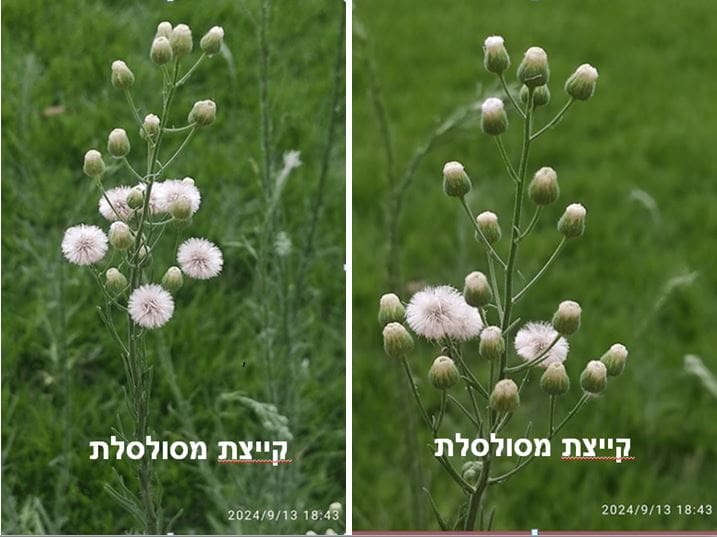
ID
| family: | Compositae(Asteraceae) |
| root: | Skewers. |
| height: | 20–100 cm. |
| Leaves: | In late winter, a rosette of narrow leaves emerges. The leaf is covered with dense hairs. The leaf edge is curled, hence the species name. |
| stalk: | The stem is erect, the stem leaves are narrowly lanceolate. |
| rash: | Blooms almost all year round, mainly between June and November. |
| flower: | The panicles are small, spherical, borne on the stem segments. The panicle diameter is about 8 mm. The bracts are cracked. Each panicle has about 100 flowers. |
| The structure of the flower: | In the center of the head are 10 yellow tubular flowers, bisexual, but functioning as male. Around the circumference are many light, straw or smoky-colored, female linguine flowers. They are difficult to distinguish, they look like a strip or hair, arranged in many generations. |
| fruit: | Hairy, elongated spermatozoa that aid in wind dispersal. |
| smell: | Considered to be significantly odorless. |
| nectar: | The flowers are rich in nectar and attract mainly bees and butterflies. |
| uses: | In South America it is used as a spice. It removes intestinal worms. |
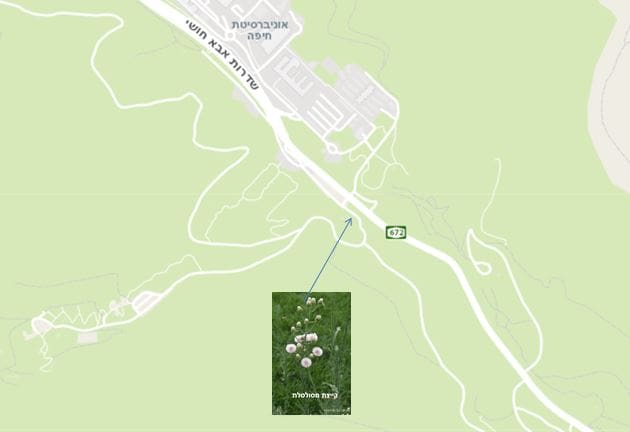
A place to meet the flower of the week
- Drive from Haifa on Abba Khushi Road – Route 672 heading southeast.
- Turn right (slightly after the second entrance to Haifa University) at the main entrance to Carmel Park, continue driving your vehicle on the road leading towards the wildlife park and Little Switzerland.
- On the right side of the road before turning towards Little Switzerland, you will see a row of curly summer flowers in various stages of bloom.
If you go to visit the flower with children, you can tell them the fairy tale about the curly summer flower.
The Legend of the Curled Summer
Once, in the middle of a hot, dry summer, when all the flowers had already withered and dried up, there was one small field left at the edge of a quiet field, empty of blossoms. Even the bees didn't come anymore, because there was no nectar left to sip and no flowers to visit.
But then, just when everyone thought summer had defeated nature, a miraculous thing happened. Out of the cracked earth grew a small, strange flower. Its stem was thin and blue-green, and on it were small, curled leaves like colorful ribbons. At the top of the stem, a scalp opened, in the center of which were a few yellow tubular flowers, and around it were bright linguineous flowers.
This plant was the curly summer squash.
The flower stretched towards the sun and said in a soft voice:
"I may be the last of the flowers, but even summer deserves beauty."
The other plants were amazed:
"Why are you blooming now, when everything is dry and thirsty?"
"I have a secret. I save my strength for the end, when everyone is tired, and then I bring hope."
The bees returned, hovering around the flower. Butterflies danced around it, and the birds chirped happily. Even the warm wind blew softly, as if whispering thanks to the brave plant that had not given up.
From then until today, if you walk in the fields in the summer and see an upright flower, with curled leaves, with white seed balls, you will know that it is the curled summer flower, which comes to remind you that even at the end of the hottest and driest summer, a small and surprising beauty can bloom, just like hope in the heart.
Thank you very much for the knowledge you impart to us, especially about the flowers of the Land of Israel. I really love botany and for me it is my studies.
Excellent section, it's just worth adding the Latin name of the plant.