


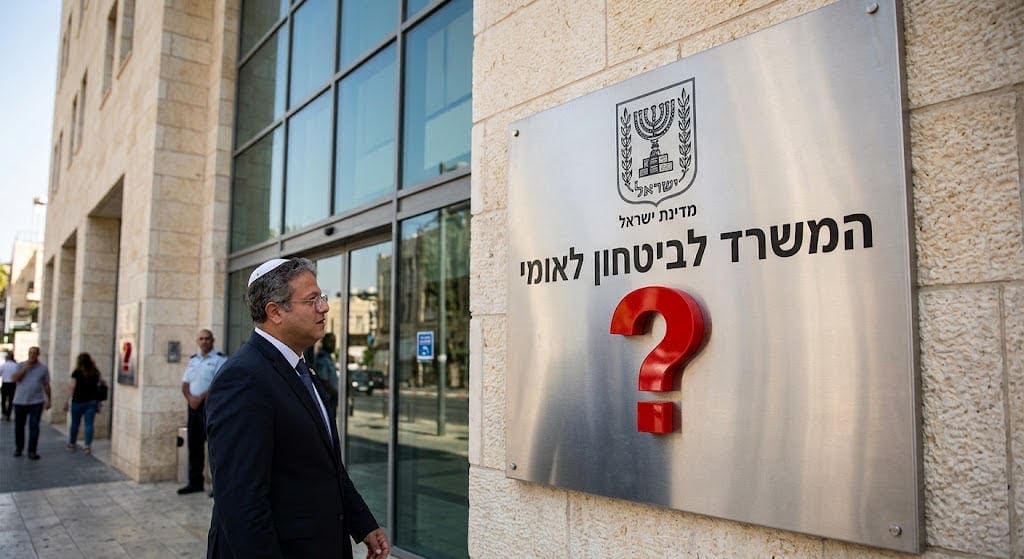
Changing the name of the Ministry of Internal Security to the Ministry of National Security raises a question that goes far beyond a symbolic choice of words: What does national security include, and how is responsibility for it divided among the various bodies? Policing, enforcement, and public order are undoubtedly important components, but a comprehensive security concept must deal with strategic threats, home front preparedness, and civilian resilience.
What does national security include??
National security is the ability of a state to defend its existence, sovereignty, and vital interests against existential and strategic threats. It is a broad concept that includes the defense system, intelligence services, foreign policy, economic resilience, infrastructure, and social resilience.
From this perspective, examining national security requires consideration of deterrence, threat assessment, and long-term planning, alongside emergency preparedness. It also requires close coordination between the systems that work to protect the state and the public.
Name of the firm and areas of responsibility – the on-site test and all examples
You put a minister in charge. Ministry of National Security Accompanied by a name that seemingly expresses a broad concept. The central question is how this name reflects the actual powers.
The police, prison service, and fire brigade play key roles in law enforcement, maintaining public order, personal security, and dealing with emergencies. However, when responding to national extreme scenarios is required, such as multi-sector street riots (similar to the "Guardian of the Walls" events), complex dealing with serious crime in the Arab sector, which serves as a destabilized rear area, operating the rescue and firefighting system under heavy missile barrages in dense urban areas, managing civilian emergency households and securing vital supply routes, or dealing with combined attacks on energy and communications infrastructure; and in addition, low- or high-intensity war scenarios that include: managing a large-scale population evacuation system under fire from conflict centers on the northern or southern borders; Containing and operating armed terrorist squads that have penetrated deep into the country (domestic warfare) until the arrival of IDF forces; and securing security detention and internment camps that house detainees and terrorist operatives during a multi-scene war, the essential gap between ongoing police management and overall strategic-systemic management is evident.
Changing the name of a ministry alone does not change the operational nature of the bodies subordinate to it, and does not in itself solve the need for deep coordination with the IDF and the General Security Service.
From daily policing to strategic planning
Dealing with a specific criminal incident or disorderly conduct is completely different from strategic planning for national security. Both are of paramount importance: personal security and public order contribute directly to national resilience, but dealing with regional threats and extreme events requires intelligence, protection, and cross-organizational coordination.
The question is whether the current division of responsibility allows for a rapid and coordinated response to complex scenarios that simultaneously affect an entire population and the civilian home front. In this context, a sharp local question also arises: Do the security needs and preparedness of a city of strategic, industrial, and port importance like Haifa receive full weight within the framework of the national security concept? This is not a statement that the existing response is inadequate, but rather a question that requires a professional examination of the level of preparedness and the division between the bodies.
A proposal to reexamine the concept of security
The proposal in this article is not just a critique, but a call to reexamine the division between everyday civilian enforcement and strategic state responsibility. It is important to define unequivocally who is responsible for each scenario, and how the various systems coordinate with each other in real time. A clear and up-to-date concept document will serve as an essential basis for public and professional discussion of the necessary changes.
The model proposed in the podcast – "A New National Security Model for the State of Israel" ◄ To listen, click here
The model proposed in the podcast seeks to restore the concept of "national security" to its full breadth, reexamine the division between civilian enforcement and state strategic responsibility, and ask whether an update of the existing structure and concept is required.
The goal is not to point an accusing finger at a specific individual, but to raise a broader question for public debate: Is the State of Israel, including major cities such as Haifa, currently prepared to define and protect national security in accordance with the threats of the 21st century?
And what is your opinion on the matter? Should a Ministry of National Security with broad powers be established immediately, or should a conceptual document for national security be established, similar to that adopted in various countries around the world?