


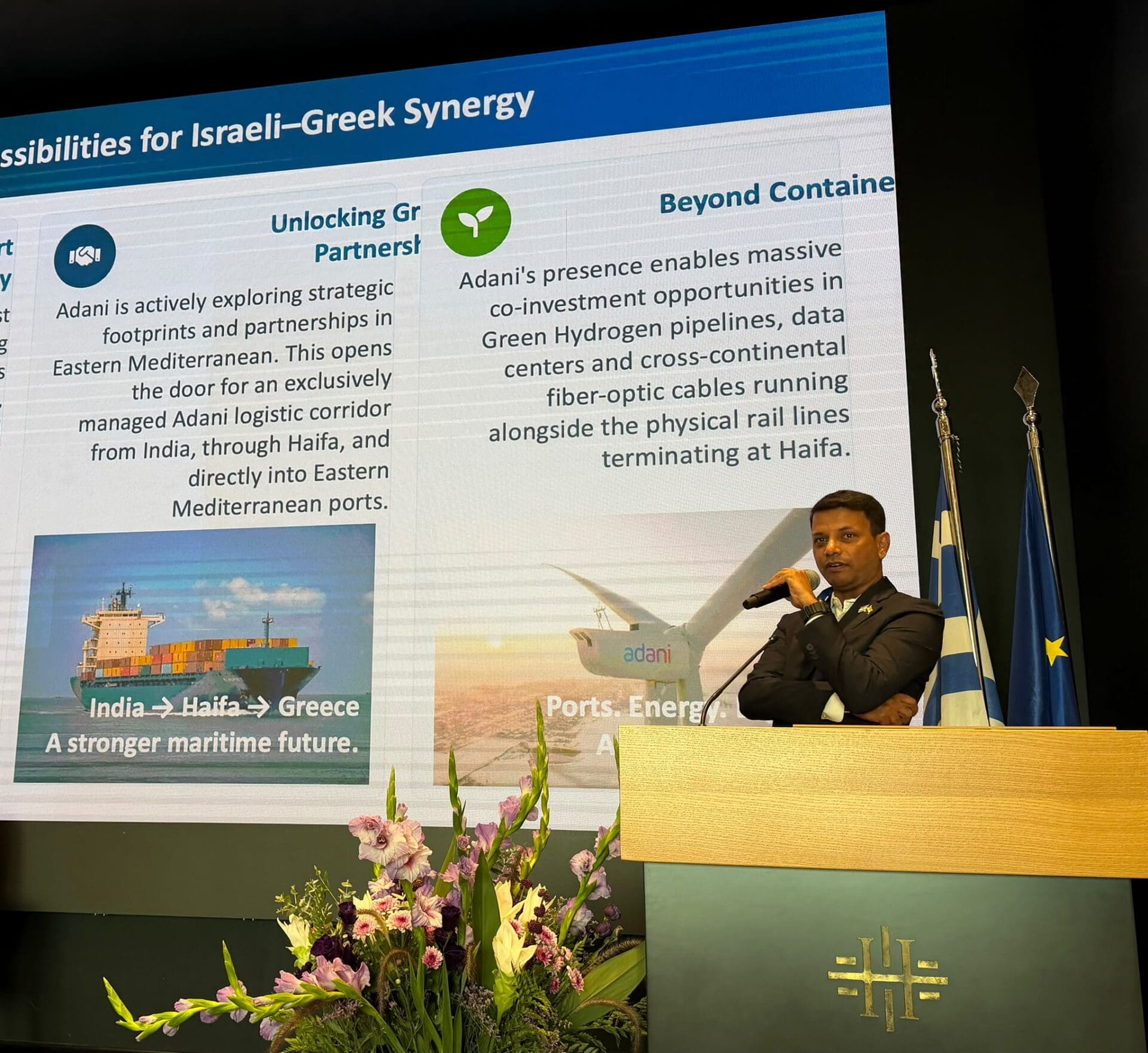
At the Mare Med conference held in Tel Aviv, he presented Captain Sumit Chauhan, President of the Port of Haifa, the economic and logistical potential of IMEC — The India-Middle East-Europe corridor and the possible role of the Port of Haifa as a central axis in the movement of goods between India, Europe and North America.
Shortening transportation times and reducing costs
According to Chauhan's estimates, the IMEC corridor could shorten transportation times by about 40% and reduce logistics costs by up to 30% compared to the trade route through the Suez Canal. This is subject to infrastructure development and regulation of activity along the corridor.
Cargo movement potential
Chauhan presented scenarios according to which the corridor has an initial potential to move about 1.5 million TEUs per year, with the possibility of expanding to about 3 million TEUs per year through increased capacity and coordination between the railway and port systems. A TEU is a unit of measurement equivalent to a 20-foot container.
Logistical connection between India and Israel
According to Chauhan, Adani Group's port network in India and the investment in Haifa Port create the basis for a coordinated logistics connection between the two ends of the corridor. This connection could support digital cargo tracking, coordination of clearance times and improved transport chain processes.
Regional collaborations
Another pillar of the vision he presented is the development of partnerships with ports in the Eastern Mediterranean. Maritime feeder services between Haifa and ports in the region, alongside land connections, could expand access to markets in the Balkans and Central Europe.
Haifa as a transit point to the USA
Chauhan also presented the possibility of using the port of Haifa as a transit point for cargo destined for the East Coast of the United States, via direct transatlantic lines or via connecting ports.
Strengthening regional cooperation
Alongside cargo movement, Chauhan addressed opportunities for investments in green hydrogen infrastructure, data centers, and intercontinental communication cables.
The Port of Haifa sees the promotion of the corridor as an opportunity to strengthen regional cooperation, expand trade, and create long-term economic value for Israel and its partners.
Mare Med Conference
The Mare Med conference was designed to strengthen and promote the economic, strategic, security and technological partnership between Israel, Greece and Cyprus, including the promotion of the IMEC initiative and cooperation in the fields of energy, innovation and agriculture. Senior delegations and business leaders from the three countries participated. The conference was held in cooperation with the Foreign Ministries of Israel, Cyprus and Greece.
Did the article interest you?
A fundamental problem with the corridor concept: IMEC is supposed to provide an alternative to vulnerable trade routes, but it itself passes through an area exposed to an Iranian threat.
Although it is possible to unload cargo at Emirati ports outside the Strait of Hormuz, this does not eliminate the threat to the ports, railways, and operational infrastructure.
This leads to an engineering conclusion: IMEC's feasibility assessment cannot be limited to transport time and cost per ton or container. It must also include availability during a conflict, recovery capability, alternative routes, and concentration of critical points of failure.
The strategic question is whether IMEC is designed to operate only under conditions of regional stability, or also under conditions of conflict with Iran. This difference may determine its true value as an alternative to the Suez Canal.
Too late!!! As a result of there being almost no passage on the Sheikh Hussein Bridge.. we missed the chance to lead and are being bypassed through Syria, Turkey and Egypt
The port of Eilat is privatized and owned by Jordache. The ports of Haifa have become private and owned by the Chinese, Indians, and Shlomi Fogel, and thus the State of Israel has given up the land bridge, bypassing the Suez Canal, in favor of wealthy individuals.