


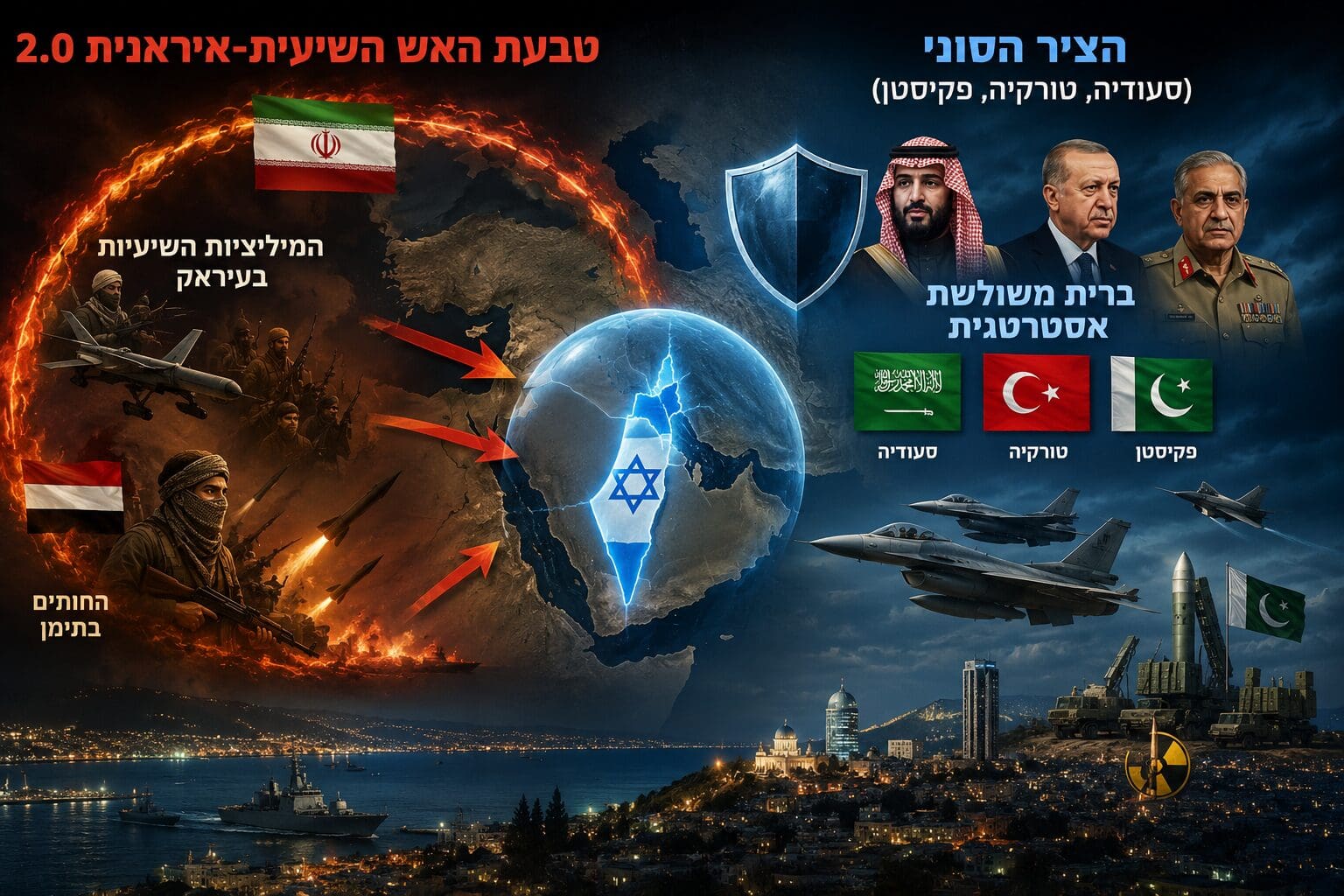
The Iranian move to tighten the "ring of fire" around Israel has entered a new phase. Tehran is redeploying its subcontractors, the Shiite militias in Iraq and the Houthis in Yemen, as a central implementing arm for a controlled regional escalation. The goal is not just a direct military challenge to Israel, but to exert simultaneous pressure designed to complicate the Middle East arena and directly affect the Trump administration's room for maneuver.
By increasing the specification and armament of these militias (the Iranian-Shiite "miracle beds"), Iran is creating a multi-pronged threat that is cheap for it and has a high erosion horizon.
On the other hand, the expansion of the threat is accelerating the organization of the counter-organization on the other side of the barricade: the formation of a strategic Sunni axis based on the triple alliance between Saudi Arabia, Turkey, and Pakistan. This connection is not accidental; it weaves together the economic power and religious status of Saudi Arabia, the military and industrial capabilities of Turkey, and the strategic and nuclear backstop of Pakistan. For the Sunni camp, the triple alliance constitutes a necessary counterweight to curb Iranian-Shiite expansion and protect critical regional assets.
In practice, the Iranian game focuses on using proxy forces to dictate facts on the ground and test Washington's deterrence policy.
For the residents of Haifa and the Gulf, this regional struggle, alongside the militias' lack of ability to conduct ground maneuvers remotely, shows that the real threat remains confined to the communications and distant fire arena, while the Sunni axis and air superiority curb the possibility of a broader escalation.