


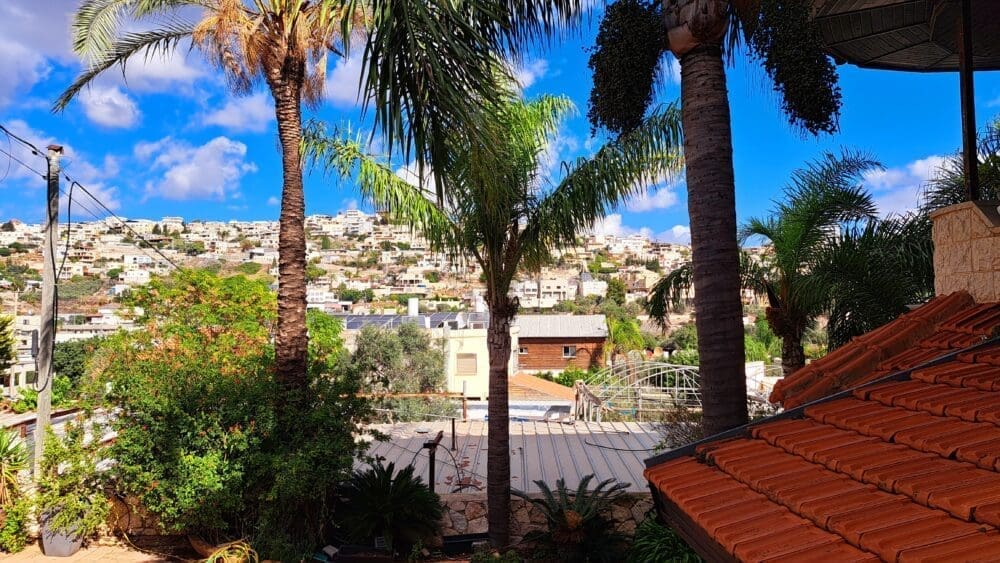
The decision to promote the establishment of a new Druze settlement in the Yavor Junction area has been presented, with some justification, as historic news. After years of housing shortages, a shortage of land available for construction, and the increasing difficulty for young couples to find a residential solution, any move that expands housing options in Druze society deserves serious consideration. But precisely because the shortage is real, a more fundamental question needs to be asked: Is it right to establish a new settlement from scratch, when the state has not yet completed the planning, regulation, and development of the existing Druze settlements?
The housing shortage in Druze society does not begin and end with the number of housing units. The root of the problem is deeper. For decades, the settlements developed at a faster pace than the pace of planning. The population grew, families expanded, a new generation sought to build their own homes, but the national and local planning systems did not always advance at the same pace. The result is evident today on the ground. Areas awaiting detailed planning, houses remaining outside approved planning frameworks, families who own private land but are unable to realize the possibility of legal construction on it, difficulties in regulated connection to infrastructure, and alongside all of this, administrative fines, enforcement orders and sometimes demolition orders.
Here lies one of the most difficult paradoxes of the planning reality in Druze communities, Planning can take years, but life cannot wait years. Young people get married. Families grow. The need for a home does not stop until the planning institutions finish their work. A family can own land for generations, but owning the land does not guarantee that it will be possible to obtain a building permit for it. The land exists, the family exists, and the need for housing exists, but the planning track is sometimes not yet ready.
When planning does not catch up with life, an impossible reality is created. Some citizens wait for years, others build within a planning reality that did not provide them with a timely response, and later they may encounter the state precisely through enforcement mechanisms. Added to this is the problem of infrastructure. A home is not just four walls. A residential neighborhood needs a road, sidewalks, electricity, water, sewage and drainage, parking, public transportation, educational institutions, public buildings and open spaces. When planning comes after construction, the infrastructure also chases after reality instead of getting ahead of it.
Therefore, the discussion about the housing shortage in Druze society cannot be reduced to the question of how many housing units we will add. The more important question is What kind of living environment and quality of life do we want to create for the next generation? This is exactly the point at which priorities need to be examined. To establish a new settlement, the state will be required to do almost everything from scratch. Plan neighborhoods, pave roads, establish water, sewage and drainage systems, deploy electricity and communications infrastructure, build schools and kindergartens, allocate areas for public buildings and commerce, and connect the settlement to transportation systems. The state knows how to do this when it decides that it is a national goal.
Here the question arises: If this planning, budgetary, and executive capacity can be mobilized to establish a new settlement, why not direct it with similar force to the existing Druze settlements? The alternative is not to leave the situation as it is, on the contrary, it is more ambitious. To expand the existing settlements and establish within them and adjacent to them new, modern, and pre-planned neighborhoods that will provide a solution for the next generation for decades to come.
In Carmel, the Galilee, and the Golan Heights, it is possible to invest in and build new neighborhoods as part of existing communities, not neighborhoods that grow house by house and only then seek solutions for roads, drainage, parking, and public institutions, but living spaces that are planned in advance as a whole, with diverse housing, roads and sidewalks, green spaces, schools and kindergartens, commerce, public transportation, and full infrastructure. Instead of a young family being forced to leave the community where they grew up to find a housing solution in a new Druze community, it is possible to create a new residential horizon for them within the community space where they already live. This is not an opposition to renewal, it is renewal from within what exists.
This approach has another significant advantage: it can address the future and the gaps of the past at the same time. Along with establishing new neighborhoods, detailed planning can be completed in existing areas, building regulations can be promoted, roads and infrastructure can be upgraded, local planning can be accelerated and tightly controlled, and public space can be developed. In this way, public investment does not just produce more housing units, it improves the quality of life of an entire community.
In addition, it also strengthens existing authorities and communities. In Druze communities, there are already schools, education and welfare systems, municipal services, businesses, public institutions, culture and community life that have been built over generations. A new neighborhood does not have to establish this entire system from scratch. It can connect to it, expand it and strengthen it. Therefore, the choice is not between only two options, leaving the predicament as it is or establishing a new community. There is another way, To renew, expand and complete the existing Druze settlements.
There is no need to oppose a new Druze settlement in principle, there may be a place for it too. But the new settlement must not become a substitute for dealing with the reality within the existing settlements. Druze society doesn't just need another dot on the map. It needs the dots already on it to finally have a horizon.
If the state is able to mobilize land, budgets, planning institutions and infrastructure to establish a new settlement from scratch, it is able to mobilize the same determination to make existing settlements modern, planned and ready for the next generation. To plan instead of chasing reality, to regulate instead of perpetuating the problem, to accelerate, develop and control instead of leaving behind. Before establishing a new Druze settlement, it is time to complete the existing Druze settlements and build the future within them.
Dr. Zidan, with all due respect to the Druze community and I have a lot of respect for it, the Druze have become accustomed to living in luxurious houses, large houses with wide yards and splendor. The community numbers perhaps 150,00 people, the living space per person is 7 to 10 times larger than among the Jews. There is no need for any additional settlement, build a little higher and be content with what you have now, which is already a lot compared to the Jews.