


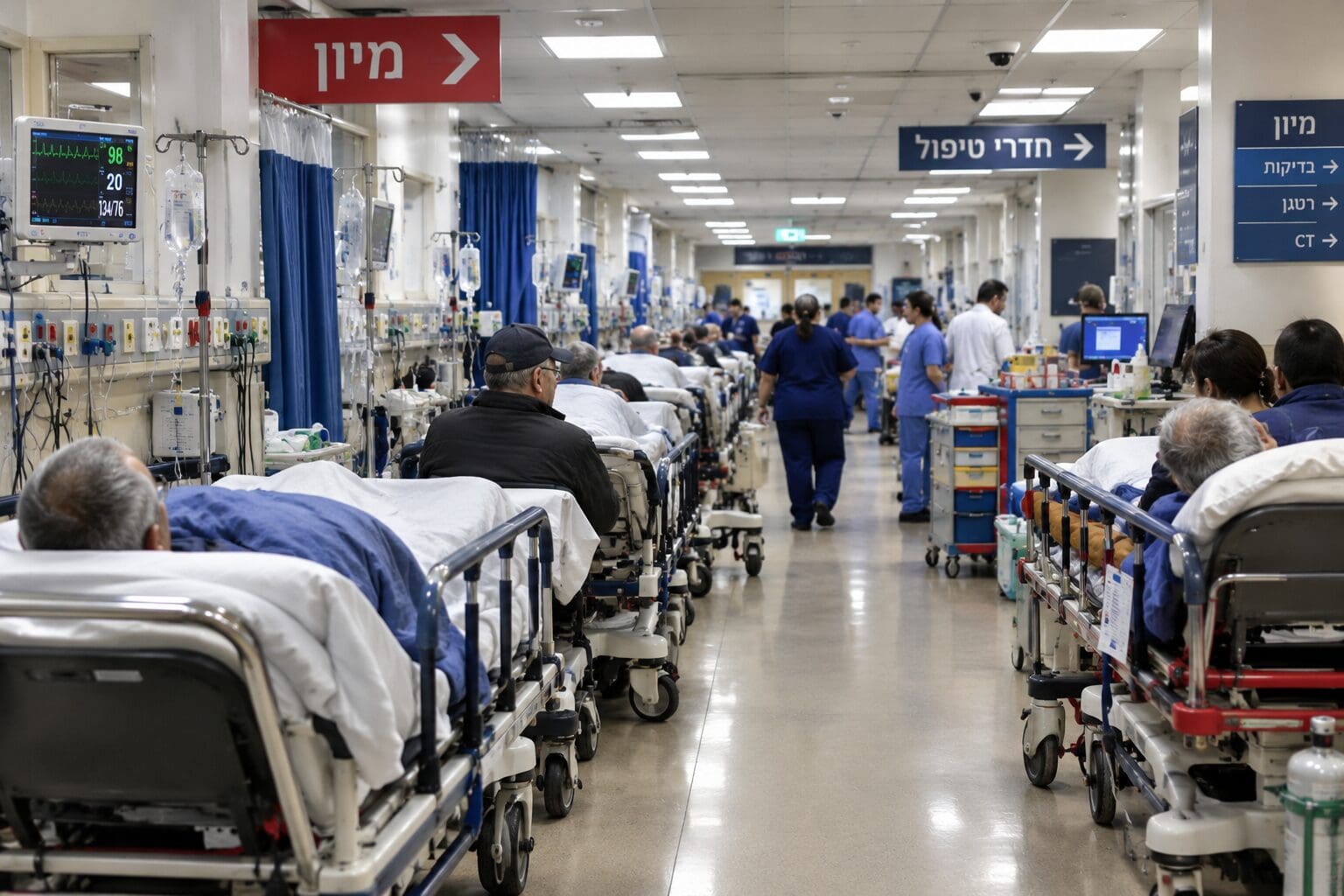
What happens when hundreds of people need urgent medical care at the same time? Epidemiological studies from recent years raise a disturbing question: Does overcrowding in emergency rooms impair treatment outcomes and pose a risk of mortality?
A comprehensive systematic review including dozens of studies, alongside a large multicenter study, published in the journal Annals of Emergency Medicine and analyzed nearly a million hospitalization visits, indicate a disturbing connection: During periods of extreme congestion, there is an increase of about 5% in the risk of mortality during hospitalization, along with significant delays in treatment, longer lengths of stay, and a disruption in the provision of critical medical care such as antibiotics and stroke treatment. Additional studies conducted in Europe and Sweden have reinforced the findings, reporting an increase of up to about 8% in the risk of mortality within 30 days. This does not mean that congestion in the emergency room "kills," but rather that it harms critical processes and delays life-saving medical care.
So what's happening in Haifa?
The city has three major public hospitals: Rambam, Carmel, and Bnei Zion, which constitute a critical medical network for residents of Haifa, the suburbs, and the north. Rambam functions as a supra-regional center, serving millions of citizens and security forces personnel, while Carmel and Bnei Zion provide a broad daily response to thousands of patients in the emergency room and wards.
But a hospital is not measured only by buildings and equipment. When a patient arrives at the emergency room with chest pain, bleeding, or a serious injury, the entire system is required to act in seconds. Therefore, in my personal opinion, the question that should occupy the heads of the health system and the city is not only whether we have enough hospitals, but how much real manpower and resources we provide to the medical teams, precisely when the health system reaches the limit of its capacity. A truly strong medical system is tested on the exceptional day when the emergency room fills up and every minute counts.
For all of us, the hospital is a place we only go to when we really need to, and that's exactly why we want to know that someone will be there for us.
And what do you think? Have you also felt the overload during your visits to hospital beds in Haifa?
A quarter of a million residents in Shfaram and the Kiryats without a hospital
A quarter of a million!!!!!!!!!!
The state has 200 billion shekels for a fancy metro for the residents of the Dan Bloc. The residents of the suburbs don't have half a billion shekels to build a medical center.
That is, for the Dan bloc – 200
For the Kiryats – none 0.5
Do you understand our situation?!
Abandoning a quarter of a billion residents, in close proximity to refineries and Rafael, without a hospital. Rambam is 20 minutes away. This is how it has been for decades, 10 health ministers came and promised that a hospital would be built.. 40 years in the desert of government promises. Chulirot.
Plus some 27-year-old tax-exempt referees who just finished some degree in economics and feel superior to us, the treasury boys, want to move a hospital from Haifa when all the hospitals are already at a hidden occupancy of 90-100 percent in normal times and 120 percent in the winter. Give Haifa a raise instead of an extra. The blanket is short, so fight over it.
Swelling.
Long waits in the emergency room lead to outbursts of anger and violence. People who come to the emergency room are stressed and on edge.
We must not strain their nerves further.
Below are the true figures regarding waiting times in emergency rooms:
• Rambam (Rambam Medical Center): Offers online monitoring of emergency room congestion and waiting times on the official website and app (updated every half hour with a traffic light index: green up to 4 hours, yellow up to 8 hours, red over 8 hours). On a national average, emergency room times in Haifa range from about 2.5 to 3.5 hours.
• Bnei Zion and Carmel: Average waiting times in emergency rooms in Bnei Zion and Carmel are generally 3.5 to 3.9 hours on average, depending on the load in the departments and the time of day.