


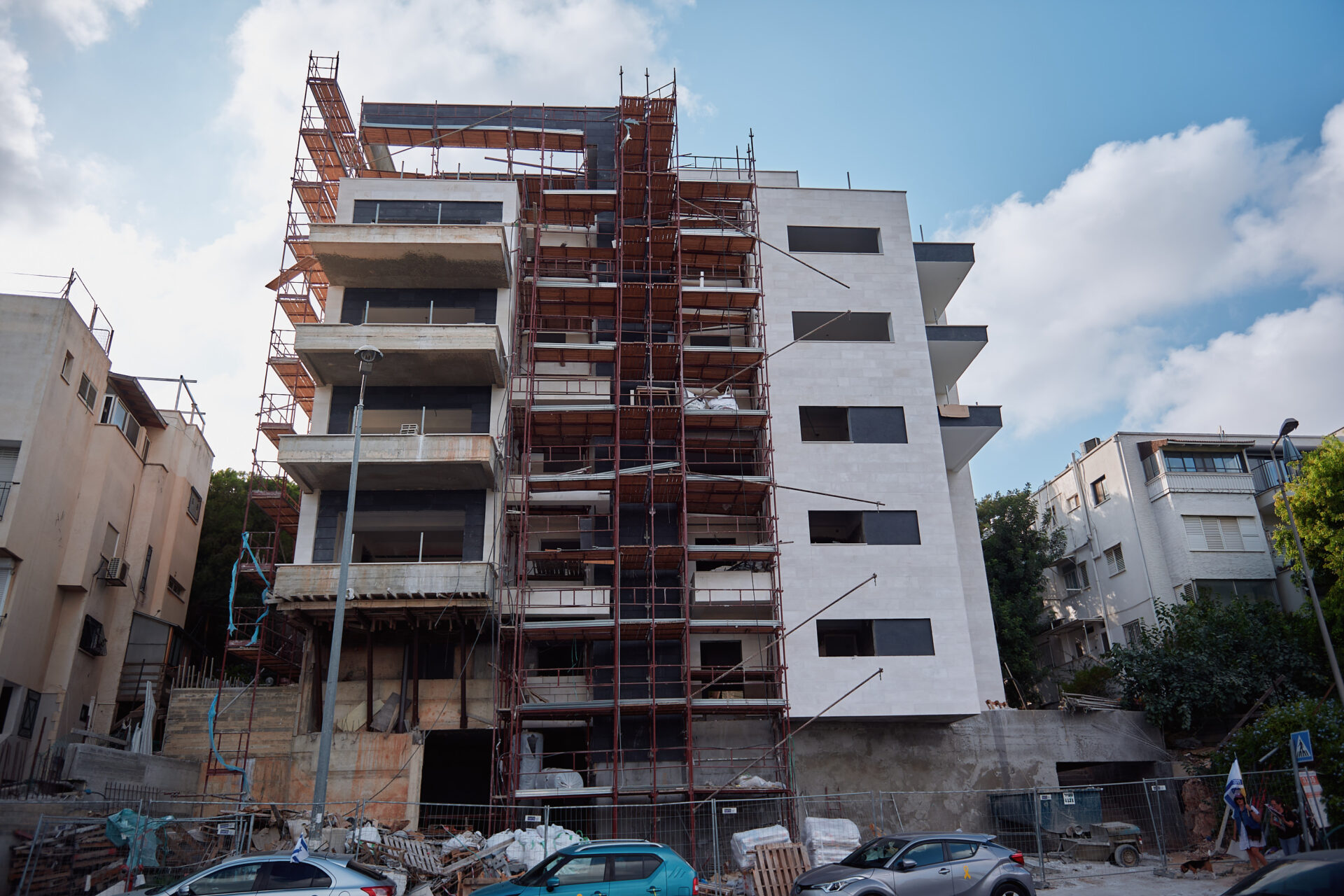
(haipo) – A new ruling by the Tel Aviv District Court corrects a fundamental distortion in the evacuation-construction industry: Uniform addition of 12 square meters for all apartment owners –no longer…
Judge Gilad Hess It ruled that this model is inequitable, discriminates against owners of large apartments, and may be considered a justified reason for opposing the project. The decision is creating an earthquake in the industry, raising concerns about a wave of objections, the opening of agreements, and lawsuits from tenants all over the country.
The full verdict is presented at the end of the article, for your reference.

Background: The ruling that emerged from Ramat Gan
The incident that led to the precedent-setting ruling occurred in an evacuation-construction project at 75-79 Haroeh Street in Ramat Gan. In this project, which was signed in 2014, it was agreed that all 37 apartment owners would receive a uniform addition of 12 square meters, along with a balcony, parking, and storage room.
However, two apartment owners, one with a 61-square-meter apartment and the other with a 104-square-meter apartment, refused to sign the agreement, claiming that the consideration was unequal. The developer, Keren Or, held the rights to 35 apartments and filed a lawsuit against them, claiming "unreasonable refusal."
Judge Gilad Hess turned the tables: He determined that the uniform model is the most unreasonable., because it disadvantages owners of large apartments and gives a relative advantage to owners of small apartments. This is where the ruling that is now shaking up the entire industry was born.
The Revolution: Formal Equality ≠ Real Equality
The ruling establishes a fundamental principle: Equality in exchange cannot be artificial. When owners of large apartments receive the same supplement as owners of small apartments, they are in fact giving up a proportional part of their rights, sometimes without realizing it.
Meaning: Model "Everyone gets the same thing."Does not meet the test of legal equality."
Widespread implications: Hundreds of projects could reopen
The ruling is not limited to the project in Ramat Gan. It concerns hundreds of projects across the country, in which agreements were signed based on a uniform supplement.
Possible meanings:
- A new wave of opposition From tenants who will feel deprived.
- Requirements for opening existing agreements – Especially in projects that have not yet reached the building permit stage.
- Significant delays In the schedules of advanced projects.
- Increase in the number of claims From tenants who claim inequality or deprivation.
- Damage to entrepreneurial certainty, on which the entire industry rests.
Developers warn that changing the accepted model could make it difficult to make projects economically viable, but on the other hand, the law states that tenants' rights are not a "flexible variable" for the benefit of developer convenience.
Tenants no longer stand: new bargaining power
The ruling gives apartment owners significant legal tools:
- Requirement for an independent appraiser review Before signing.
- Claims of deprivation, even when the payoff seems uniform.
- Appealing to uniform models which do not reflect relative rights.
- Stronger protection against "reluctant tenant" claims.
In other words: tenants become key players, not passive signatories.
Criticism of the state: Regulation that allowed "shelf transactions"
The ruling also reveals a regulatory failure. For years, The State and the Urban Renewal Authority Encourage uniform models to accelerate projects, but in doing so Weakened the power of apartment owners.
Instead of requiring full transparency, clear balance sheets, and fair distribution mechanisms, a culture of "sign and don't ask questions" has been created.
The verdict indicates: This period is ending.
what will happen now
Following the precedent-setting (and justified) ruling, the industry has entered a period of uncertainty. Developers will be required to adjust models, tenants will demand in-depth inspections, and lawyers will be required to draft more complex compensation mechanisms.
The forecast:
- New agreements will be more detailed and equitable.
- Negotiations between tenants and developers will be prolonged.
- The state will be required to intervene. and create new standards for the distribution of rights.

Chairman of Yaffe Nof, attorney and real estate appraiser Assaf Gastfreund:
This ruling touches on one of the most sensitive fundamental points in the world of urban renewal, the question of equality among apartment owners. For years, the entire industry has relied on the uniform conversion model, mainly out of a desire to create certainty, simplicity, and the ability to promote complex projects with dozens and sometimes hundreds of rights holders. The court is now effectively saying that an identical addition for everyone is not always necessarily an equitable result.
From an appraisal and economic perspective, there is logic in the claim that a permanent addition of space creates relative gaps between small and large apartments. On the other hand, it must be understood that urban renewal in Israel relies to a large extent on the ability to create a uniform and clear mechanism. As we move to an individual model of examining the changes for each tenant, we may find ourselves in endless appraisal and legal disputes that will make it very difficult to advance projects.
In my opinion, the ruling does not necessarily immediately change the rules of the game, but it certainly opens the door to new discussions about how the changes will be distributed and will strengthen apartment owners who will seek to challenge mechanisms that were until now almost taken for granted. Ultimately, new certainty will need to be created, whether through a ruling by the Supreme Court or through clearer policy determination by the state.
Earthquake – but also correction of ongoing deformation
Judge Gilad Hess's ruling is not just a legal decision; it is an indictment against an entire culture in the urban renewal industry. It requires the market to move from a simple marketing model to a real, transparent, and fair distribution mechanism.
Will it delay projects? Probably yes. Will it lead to a more equitable distribution of rights? Almost certainly.
Opponents of the construction eviction on Stephen Wise Street in Haifa will not allow the eviction to be prevented against their will.
What happens if 3-room apartments are 75 square meters in area and 4-room apartments are 100 square meters in area, but the value gap is 95 percent?
The ruling went a long way, but it had to address the Supreme Court's mindset as expressed both in the ruling of the Centers Court - which determined that the rights would be distributed according to value and not according to area (a case that discussed a different issue but can certainly be used in this case since the original building was demolished) and in the words of the Honorable Justice Y. Kasher in the matter of Yocheved Peretz v. Shlomo Shohat, in which he gave a positive response to the economic value test.
The proportional share in the registered common property is not the whole story, and even correcting the proportional share according to the actual apartment areas cannot provide a full answer to all the appraisal issues that need to be examined by a skilled professional on behalf of the tenants.
In a construction clearance, an addition of 12 square meters is essentially a uniform addition because it is an area attributed to the municipal building. In fact, it is not possible to give less than this due to a proportional share because a municipal building is a municipal building according to civil defense regulations. In practice, today the consideration for all property owners must increase in accordance with the area of the municipal building that has increased.
The relative share of the common property that is supposed to reflect the proportionality in the floor area is not the whole picture for several reasons: 1. Different measurement methods over the years of registered apartment space that do not at all represent the actual apartment space. 2. What is relevant is the relative value of each unit in the total value of the apartments. A method that expresses many different parameters and should be subject to the determination of an appraiser. In this matter, the weight should be shifted to economic equality, as the Supreme Court referred to in the ruling mentioned in the judgment. Only with such a method is proper weight given to each parameter that affects the incoming situation and the outgoing situation. 3. As stated, this is an addition to the MMD.
Regarding a 12 square meter balcony by virtue of regulations, attaching parking, it is clear that every apartment is entitled to benefit from these contributions. Therefore, an addition of 12 square meters (in current area) to the existing flat area + 12 square meters of balcony + parking, should be a *minimum* addition in any project.
Tama 38 in a demolition and construction format allowed rights up to 25 square meters of floor space (including basement) + 12 balconies + parking, and storage if possible on the first floor or in the basement.
Pinuy Binui reduced the payments to tenants due to pressure from committees to 12 square meters, which is actually just the dimensions + 12 square meters + parking and maybe a storage room. The developers celebrated and suddenly the celebration was over. The ruling does justice to the case before it, but it did not take into account several things: Today, the square meter must be greater than 12 square meters. The relative share of the common property is not the be-all and end-all. There is a ruling by the Supreme Court regarding economic equality in such cases (mentioned in the Hess ruling), and its proper application is only through a balance sheet prepared by an appraiser who weighs all the parameters that determine the value of an apartment (except for renovations that are not relevant to demolition, just like in the Beit Merkazim ruling). The remaining additions should be uniform in any case. In other words, the area of the municipal building cannot be affected because of relativity, and neither can the sun terrace and parking areas be affected (Gilad Hess did not touch on these components in his ruling either). Conclusion: Anyone who wants to save a project delay for years, expensive judicial time, and expensive legal proceedings would do well to hire an appraiser to represent the rights holders in Day One!!!
😍"Well done" to the judge: "Gilad Hess" for a fair & logical "ruling" in the Israeli "trial" in the "State of Israel"...!!!@🙏🙏
So far, "pressing pressure" has been applied to "apartment owners" in the project - "Evacuation-Construction", in the sense of: "Sign without knowledge" = not asking questions! Not finding out about the nature of the "developer"! Flowing like a "herd" to dreams in the assembly of the "representatives", whose, as it sounds & seems - were promised a benefit in advance... for the assistance in "blind signing"...!!!@😭😭
Shocking ruling! Increasing rights are compensation for mandatory legislative updates on the MAMD issue, it shouldn't be a financial question of profitability in an industry buried in mountains of easy profits for pig entrepreneurs
In light of this ruling, it becomes clear that all the assessments of those called "evacuation and construction appraisers" were wrong. The courts that accepted such assessments were wrong. Who will reimburse all the tenants who were run over by such erroneous assessments for their expenses and compensate them for the mental anguish they have been caused?