


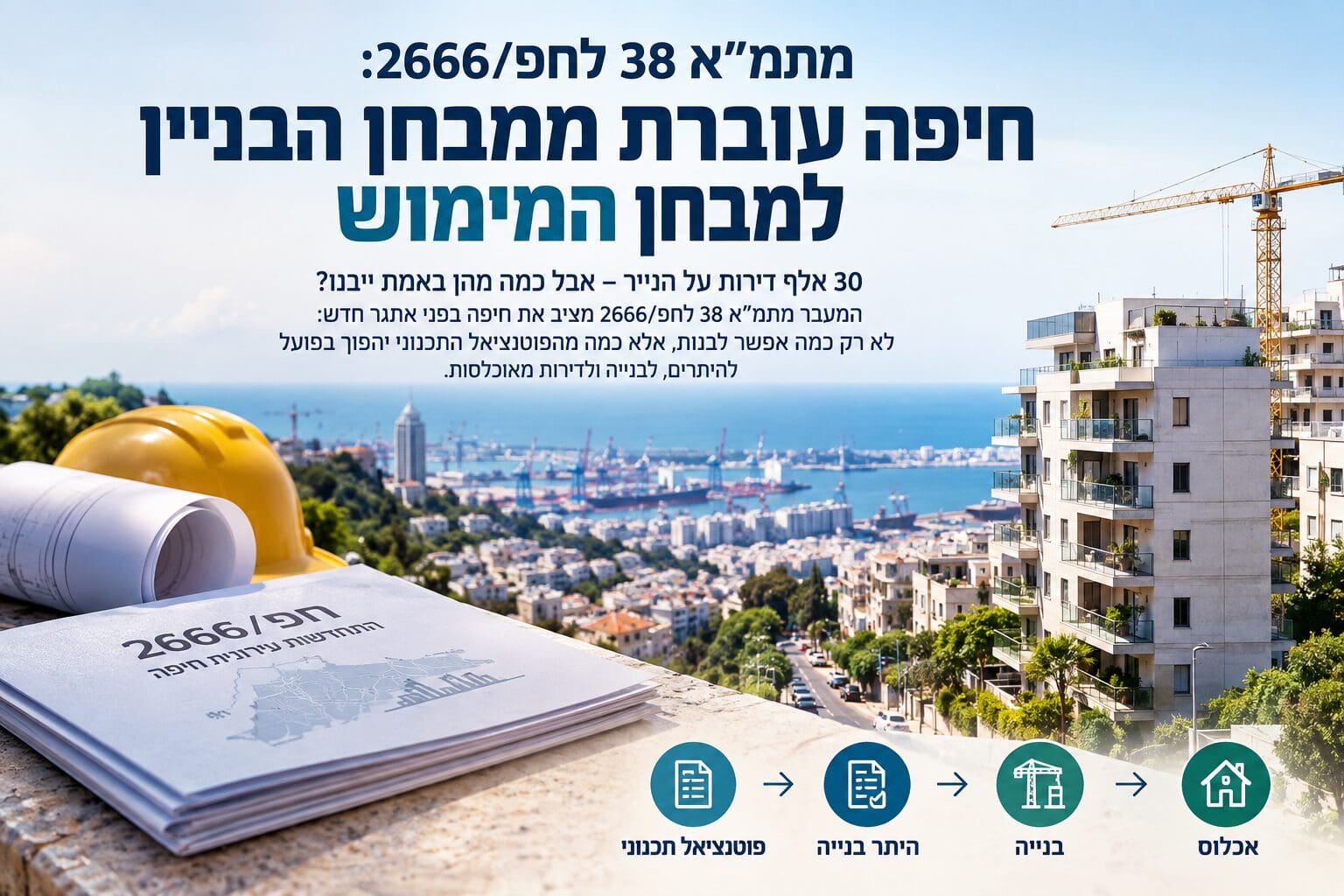
This is perhaps the most important question currently facing urban renewal in Haifa.
The previous articles dealt with the question of what 2666 is and what it might enable. This time the focus is on the next stage: the transition from TAMA 38 to the new framework, and especially the gap between Planning potential and actual construction.
Not all neighborhoods will receive the same construction boom.
Hf/2666 promotes renewal and additional rights in the old structures, but in areas that are already planned for intensive renewal through evacuation and construction, including: Neve David, Kiryat Sprinzak, Ramat Shaul, parts of Neve Sha'anan, areas in Kiryat Haim, Kiryat Eliezer, Kiryat Eliyahu and the southern area of Bat Galim, most of the densification will be done within the framework of separate plans. On the other hand, in areas where there is no large-scale evacuation and construction plan, Hf/2666 may be the main driver for the renewal of buildings and the addition of apartments and condominiums. The intention is simple:
- In neighborhoods where a large evacuation and construction plan already exists – The renewal will be done mainly through the same plan. That is, entire complexes are being rebuilt, and not just a single building according to חפר/2666.
- In neighborhoods that do not have a large-scale evacuation and construction plan – 2666/2666 can be the central tool. It allows for the promotion of Strengthening or demolishing and rebuilding individual buildings, and at the same time add apartments and residential buildings.
in simple words: ХФ/2666 is particularly relevant to places where there is currently no major evacuation-construction that provides a solution for renewal..
38/2666
TAMA 38 – There was a national master plan that was originally intended to strengthen old buildings against earthquakes. It granted, depending on the route and conditions, rights and incentives that allowed buildings to be strengthened or demolished and new ones built in their place.
Hef/2666 – is a local plan for Haifa, intended to create a framework for building renewal after the completion of TAMA 38. It seeks to take into account not only the building, but also its surroundings: the street, the neighborhood, the topography, the infrastructure and the public space.
in simple words: TAMA 38 focused primarily on the building; Hf/2666 also seeks to look at the city around it.
According to the Haifa Municipality, the plan is expected to allow permits to be issued for approximately 30 protected apartments throughout the city. But here it is important to pause: 30 A thousand apartments are planning potential, not 30 apartments that will be built.
The path from paper to reality
There is a long way between building rights and an inhabited apartment: planning, agreements between the apartment owners, an economic feasibility study, licensing, permits, financing, construction, and finally occupancy.
Therefore, including a building in the plan does not guarantee that the project will actually get underway. Implementation depends, among other things, on the characteristics of the plot, building rights, construction costs, and economic viability.
Here too, it is important to distinguish between three stages: Planning potential, building permit and actual implementation.
Haifa is in a period of transition.
On May 18, 2026, TAMA 38 expired in Haifa. On July 4, 2026, the Haifa District Planning and Building Committee decided to deposit Hf/2666. The deposit is a significant step, but is not yet the final statutory approval.
At the same time, renewal is already taking place. In 2025, permits were issued in Haifa for 2,775 housing units, compared to 2,115 in 2024. About 1,025 of them were within the framework of urban renewal projects.
The numbers should not be compared directly: 2,775 These are units that received a permit in a particular year, while 30 are future planning potential.
The real test begins now.
Renewal will not necessarily progress at the same pace in every neighborhood. Apartment prices, construction costs, building rights, lot characteristics, and location will all affect viability.
At the same time, Haifa will be required to deal with the impact of the renewal on transportation, parking, public institutions, open spaces, and infrastructure.
Therefore, the test of Chf/2666 will not only be How much can you build?, But How much will actually be built?.
How many projects will receive permits? How many will begin construction? And how many apartments will be occupied?
This is the important transition that Chf/2666 brings with it: From the 38th Master Plan, which focused mainly on the building's potential, to the test of realization for the entire city.
It is not stated that the treatment of the plan began 3 years ago and to this day it has not even been deposited...
Indeed, the municipality's efficiency has increased.
The district committee gave the Haifa Municipality only one more week to submit the plan.
A self-respecting media outlet avoids the term "regeneration" and "calls the child by his name":
Evacuation-construction-torture.
The evacuees-builders recognize the disaster that is befalling them only when it is too late to retreat.