


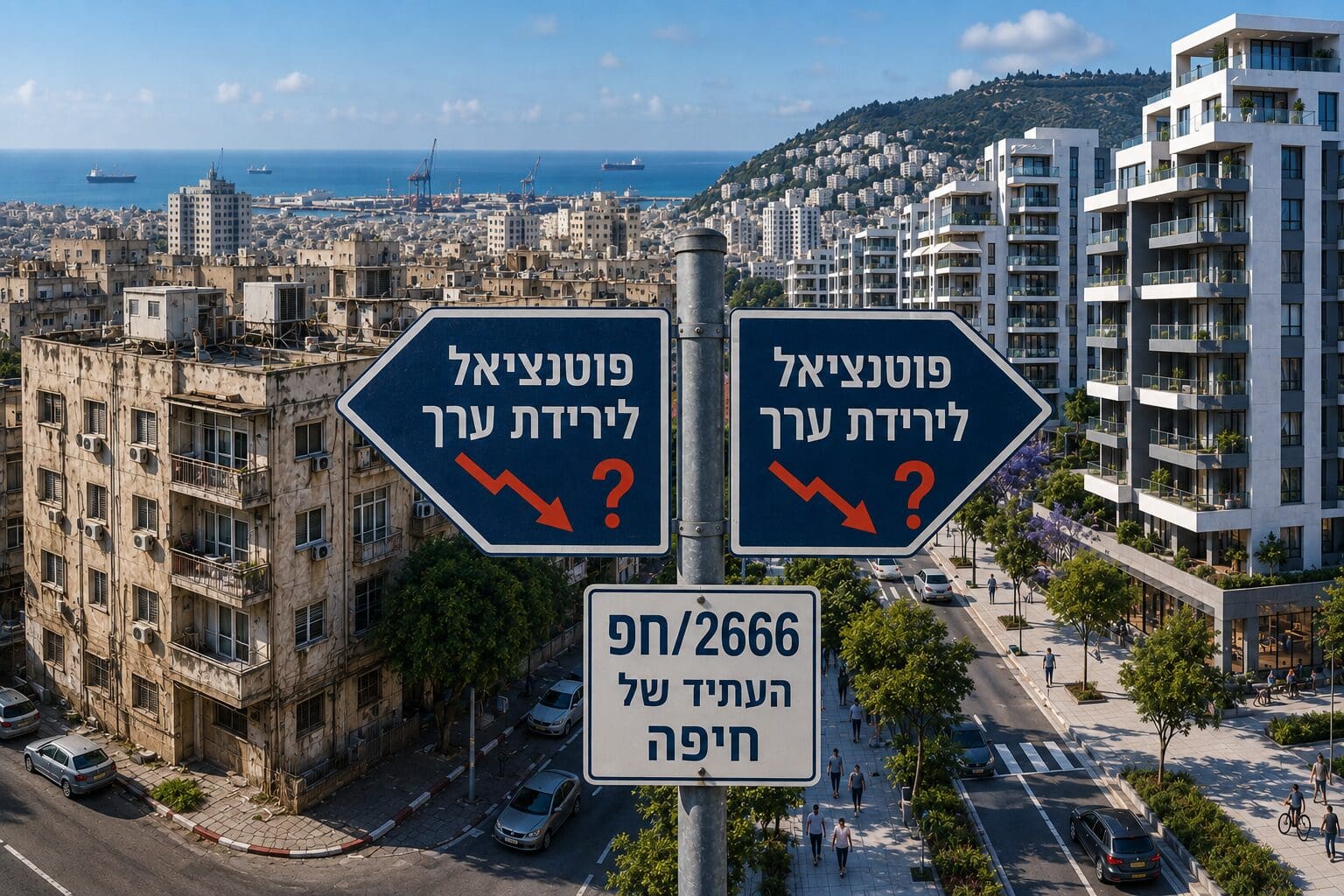
Haifa is at a turning point in the field of urban renewal. ХФП/2666, approved for deposit in 2026, is intended to replace TAMA 38 and create a framework for the renewal of old buildings. According to publications, the plan may allow for approximately 30 new and protected apartments, while adapting the construction to the infrastructure, topography, conservation values, and the different character of Haifa's neighborhoods.
Why could the impact be greater than that of TAMA 38?
TAMA 38 focused largely on the renewal of Single building. הפ/2666 offers a broader framework, which divides Haifa into planning areas and establishes different rules according to the characteristics of the area.
The possible positive process is:
Old buildings
↓
Demolition and reconstruction/reinforcement
↓
Buildings + elevators + balconies + new buildings
↓
Renewal of many buildings in the neighborhood
↓
Improving public space and infrastructure
↓
A more attractive neighborhood
↓
Increase in demand
↓
Possible increase in apartment prices
For example only: If an apartment is currently worth 2 million shekels, and successful regeneration increases the attractiveness of the neighborhood by 10%, the price of the apartment could theoretically reach2.2 million shekelsIf the impact is 15%, this is about2.3 million shekelsThese are illustrative examples only and not a forecast for Haifa prices.
But there is also an opposite scenario.
Large addition of apartments
↓
More residents
↓
More cars
↓
Traffic congestion + lack of parking
↓
Overburdening schools, kindergartens and infrastructure
↓
Density + noise + shading + damage to the landscape
↓
ירידה באיכות החיים
↓
Decrease in the attractiveness of the neighborhood
↓
Possible pressure on apartment prices
For example, if an apartment is worth 2 million shekels and the congestion in the neighborhood affects its attractiveness by 5%, the price could theoretically drop to1.9 million shekels; down 10% – to1.8 million shekels.
The concern is not merely theoretical in terms of planning: Even within the framework of TAMA 38, the municipality has already examined the impact of additional housing units on transportation and infrastructure, and distinguished between areas with transportation advantages and narrow streets and areas where there is infrastructure limitation.
And what will happen to the old apartments?
Another interesting scenario is possible:
Neighborhood renewal
↓
New apartments with a central heating system, elevator and balcony
↓
Increase in the quality of the new product
↓
A larger gap compared to older apartments
↓
Older apartments may lose relative value
In other words, Hf/2666 can increase the value of apartments in buildings that are being renovated, but not necessarily increase to the same extent the value of apartments in buildings that will not be renovated.
On the other hand, if the municipality manages to adapt the Transportation, parking, public institutions, infrastructure and public space Depending on the pace of construction, the result could be the opposite: a new, more protected and attractive neighborhood, which will increase demand for apartments.
Therefore, the main question is not only How many apartments will you add?, but:
Will the pace of neighborhood and infrastructure improvement be fast enough to cope with the rate of apartment additions?
If so, renewal can be an engine for an increase in value.
If not, there is a risk that in some neighborhoods the increased density, cars, and congestion will harm the quality of life and the value of the apartments.
Definitely a decrease in value.
This makes sense because Haifa does not follow a quality model.
She is deliberately lowering herself, and anyone who didn't understand this should open their eyes now.
😍"Life experience" increases "life wisdom" and teaches: Real estate always goes up, unless there is a major/severe national and/or global "economic crisis"... as occurred in "history" following "world wars", "collapse of stock values", etc.
* Also the "stabilization" of real estate prices, after the "bubble": some will see this as a loss, for most people = excellent, because everyone who "sells" a property also "buys" another property at the same time (usually) 😭
Let's examine how Tama/38 affected the quality of public space, in a neighborhood where many buildings were built according to Tama/38, taking Carmelia as a model.
We see that in recent years, the municipality has widened the roads, widened the sidewalks, which have now become more comfortable for pedestrians. Parking on the sidewalks has been completely banned. Parking lots have been added. Public parks have been added, kindergartens and a school have been added, and even the metro line has entered the neighborhood.
All this good was done by the Haifa Municipality, with the copy money it collected from the new construction. Blessed is the believer.
As it seems, the power of developers and contractors in Haifa is outweighing that of the municipality and building approval committees, which are supposed to make the city no less comfortable to live in than it was in the past.
Some neighborhoods will go down and some will go up regardless of this analysis.
Such a simplistic analysis... unbelievable.