

Anyone passing through the complex between Derech Hayam (118-120), HaTamar Street, and Agmon Street in Western Carmel might see the four residential buildings in the area as another typical cluster of housing developments from the 60s, awaiting "urban renewal," without realizing that there is an extraordinary story hidden behind them.
The Brazilian commune
The story of the complex, known as the “Brazilian Commune,” begins in the late 50s, among the Jewish communities in the cities of São Paulo, Rio de Janeiro, and Recife in Brazil. At that time, a group of Jewish families, members of Mapam, who shared a Zionist-socialist worldview, organized themselves with the goal of immigrating to Israel together and establishing a communal living environment.
The group, which numbered 17 families and was called "Mapam's First Aliyah Company from Brazil," was formed with the help of the movement's emissaries from Israel. One of them, Aharon Haranesh, a member of Hashomer Hatzair, proposed establishing a kind of urban kibbutz - a framework that would allow its members to integrate into the life of the city and their professions, while maintaining community life and mutual assistance.
Preparations for the aliyah lasted about four years and included Hebrew studies, visits to Israel, and consideration of employment and housing options. Haifa Mayor Abba Hushi, who was enthusiastic about the initiative, helped allocate land in the Western Carmel for the construction of a residential complex that included four buildings, which were built by the "Workers' Housing" company. The commune members purchased the apartments while still in Brazil.
The group arrived at Haifa Port on May 28, 1964. Although the commune families lived in separate apartments, they maintained a shared social and cultural life. Its members managed their affairs through meetings and committees, celebrated holidays together, and held community events. Alongside this, a mutual aid system operated, which included a joint fund to assist families who had difficulty finding work and organized purchasing of basic necessities.
Benny Bloch, who came to the complex when he was four years old, particularly remembers watching the World Cup games together. Friends would bring a TV out into the common area, gather to watch the games and drink cachaça, the traditional Brazilian drink, to celebrate victories or console themselves after losses.
The intensive communal lifestyle continued until the late 70s. As the children grew up and left their parents' homes, joint activities gradually diminished, but the bonds of friendship between the families and members of the second generation were maintained over the years.
About the buildings
The residential complex was built in the early 60s on a triangular plot of land, bounded by Derech Hayam, Agmon and Tamar streets. The four residential buildings are located on Derech Hayam 118 and 120 and on Agmon Street 1 and 3.
Architecturally, the buildings belong to the type of housing that was common in Israel in the 50s and 60s, and were characterized by a simple, economical and functional design. The buildings are three stories high above a columned floor. Their facades are characterized by emphasizing the horizontal and vertical lines of the building's skeleton, columns and floor ends, with exposed concrete, while the rest of the facade surfaces are covered with rough plaster.
However, the uniqueness of the complex does not lie precisely in the design of the buildings themselves, but in the way they are positioned and in the interrelationships between them and the common area.
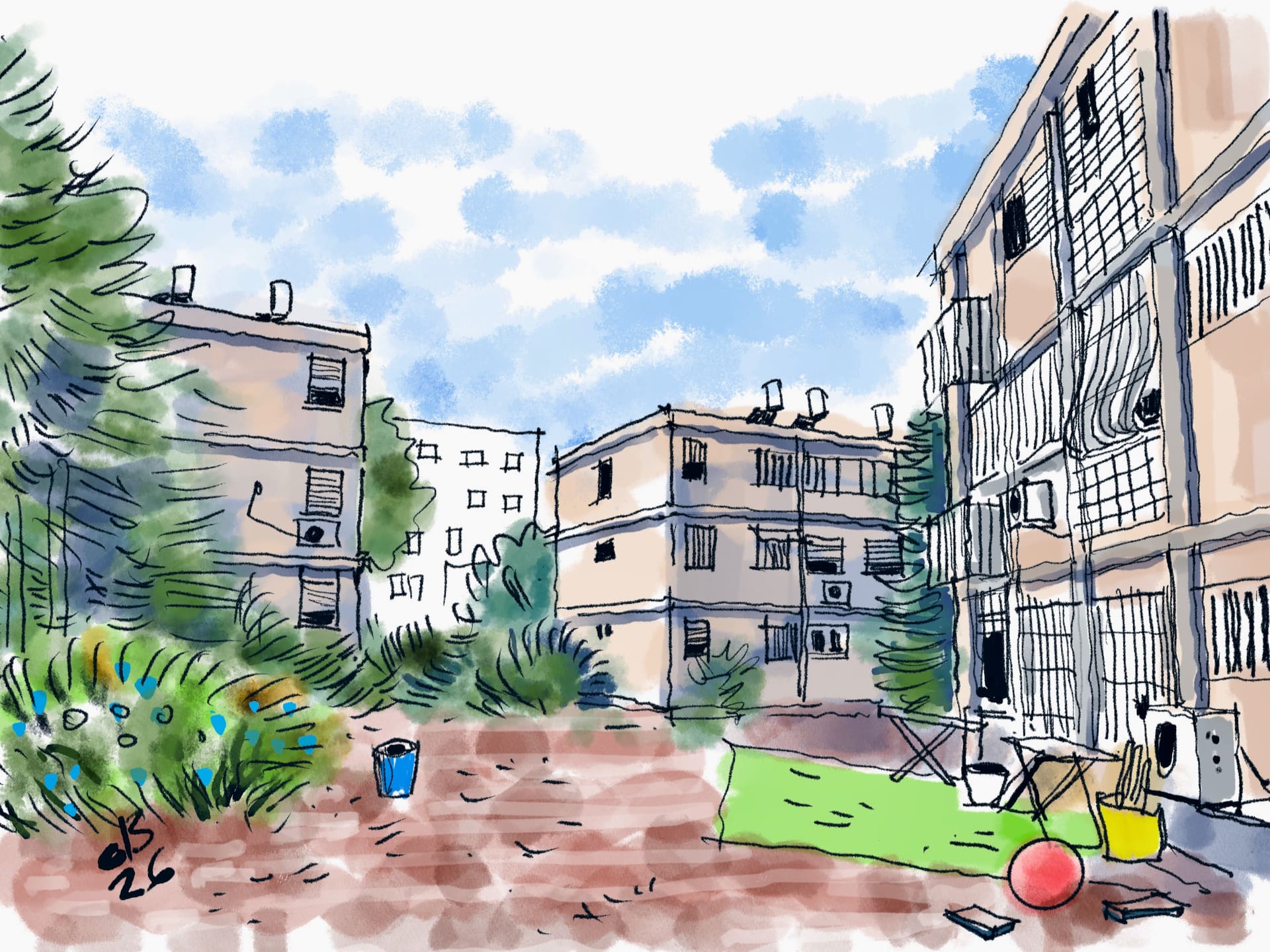
The buildings are arranged in a sort of R-shape, along the Sea Road and Agmon Street, and enclose a common open space with a large lawn in the center. The lawn served as a meeting place for children and adults, as well as an arena for celebrations and community events. Alongside it were play areas for children, protected from vehicle traffic, and a grill area for preparing Brazilian-style meat (Churrasco). There was also a club on site that was used for meetings, assemblies, and cultural activities.
This created a combination between private residences and community space: while each family led their lives in their own apartment, the common areas made it possible to maintain a lifestyle with collective characteristics in the heart of the city.
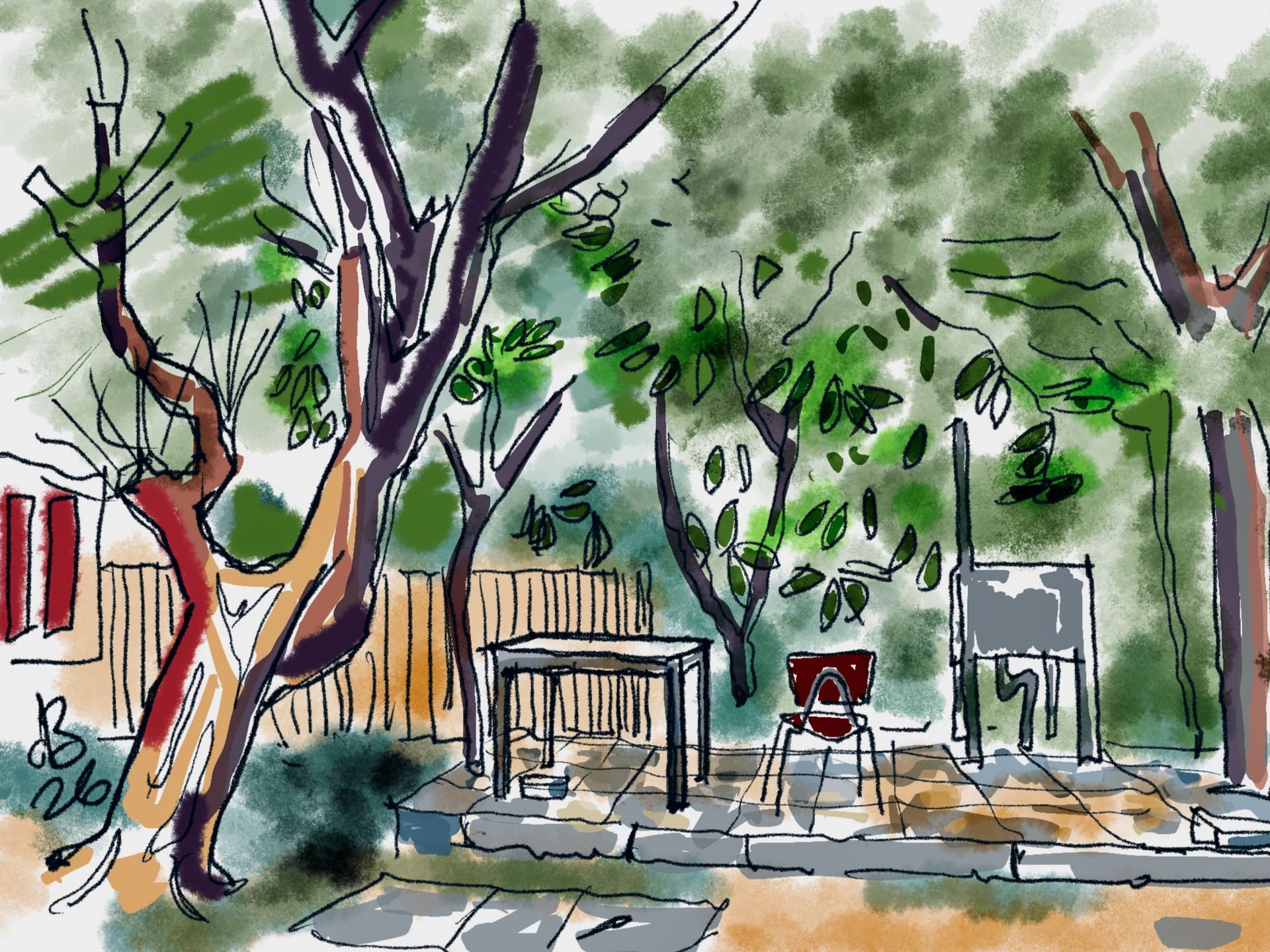
Over the years, the character of the common space has changed. The large lawn has disappeared, and the open space is now used mainly as a garden and a courtyard shared by the buildings, but the original spatial layout of the complex can still be seen. A visit to the site also found the remains of the Brazilian grill corner, which used to serve as a focal point for social gatherings of the commune members.
The identity of the architect who designed the complex has not yet been revealed. We would be happy to receive information, plans, or historical documents from our readers that may assist in identifying him and completing the architectural story of the complex.
And what about conservation?
The complex is not included in the municipal preservation list. Although the four buildings are not particularly architecturally outstanding, should the value of a building for preservation be determined solely by its architectural qualities, or should its historical and social value also be considered?
The story of the Brazilian commune illustrates the importance of this question. The uniqueness of the complex lies not in the architecture of the individual buildings, but in the complex they create and the communal lifestyle that existed there. Isn't this also valuable and worthy of preservation?
Thanks
My thanks to Benny Bloch, a member of a founding family, who suggested that I write about the Brazilian neighborhood and shared with me his personal memories of life in the commune.
My thanks also go to Zeev Kulikovsky, also a member of the founding family, for the detailed historical information in his article "The Brazilian Commune in Carmel," which was published in the journal of the Haifa History Association, issue 19, December 2021, and served as a central source for the preparation of this article.
I knew Prof. Chaim Lichtig well, who later became the director of the Hepatology Institute at Rambam and Julio Hospital, where he treated the bodies.
Are they still alive?
Since I immigrated from Merca in 1975, I would like to know which people/families immigrated from Merca to these buildings.
Long live Dar Brown. Very important to the history of Haifa in particular and Israel in general.
Thank you very much for your words of appreciation.
I was with him in the class of Sergeant Major Rami Bloch.
1968-1974
Son of Brazilian immigrants.
This is my uncle. What did you want to know?
very interesting.
Why don't they initiate an event of houses from the inside in Haifa? There is one every year in Jerusalem and Tel Aviv.
I'm sure there are beautiful and interesting public buildings in Haifa as well as unique private apartments.
Tamar Sandler
In 65 or 66, when I was in high school in the SMT, we had a math teacher who had immigrated from Brazil. His last name was Bloch. He was a nice and sympathetic person. He told us a little about Brazil. Unfortunately, the stories were forgotten.
We already understood then that he lived in Carmel and we heard that he came from that neighborhood. Unfortunately I don't remember his first name.
Thank you for your response. I have forwarded your response to Benny Bloch, the son of your teacher.
Avraham Bloch, immigrated to Israel with his two brothers, David and Julio Bloch, and his father, Yehuda Bloch.
His first name is Abraham. Father of my son mentioned in the article
Dear Sarah. Indeed, my father, Avraham Bloch, the late, was a math teacher at Basmat in the years after immigrating to Israel. He was a very respected and beloved teacher and indeed he used to tell stories about Brazil, about the commune and play music from there. I was touched that you remembered him!
The late Avraham Bloch. A special and wise writer.
Professor Bloch. He was a special person and an excellent teacher. I remember him giving us an exercise to solve at home and intervening, Brazilian style, intervening with shoes, so that we wouldn't solve it.
Professor Bloch is a legendary teacher. A warm, smart man and a great teacher. He would bet "shoes" with us, as Brazilians usually bet, that we wouldn't solve a homework exercise he gave. It challenged me and I solved it. But I didn't get shoes.😅
As a third generation member of the company, I remember well my childhood in the grass between the buildings, climbing the tree with my cousins, walking around between the legs of the adults, with bossa nova in the background and a night of Hebrew and Portuguese. Great memories, thank you very much for the unique article and recognition of this group. Natalie, my son's daughter.
Thank you very much for your moving response to the beginning of the article thanks to the appeal of your brother (?), my son.
I enjoyed and was moved by what was written. The architectural perspective is interesting and innovative. The illustrations are also really beautiful and definitely in the spirit of this beautiful place, where I grew up.
Thank you very much for your moving response.
Dr. Bar On, what a moving article! As someone who grew up in the Brazilian commune complex, your beautiful paintings brought me back to the beautiful days on the lawn. Thank you for the lovely combination that brings our childhood back to life.
Thank you very much for your moving response.
There is no need to forcefully preserve projects that cover a large area and have more than a few unique architectural features. Look at the nearby sanatorium project.
You can make do with an appropriate sign and/or street or square name up to the project.
Thank you for your response. I did not suggest preserving the complex, even a sign is a form of preserving memory.
As usual, interesting and fascinating! Thanks to David Bar-On
Thank you for your complimentary response.
Warm thanks to Dr. Bar-On for the fascinating articles. Interesting history, not only preserves memory, but makes one look up and appreciate the city's builders and founders.
Thank you very much for your kind words.