


In the Ramat Begin neighborhood, at 3 Rabbi David Assaf Street, stands an unusual public building – "Yad Rabbi David Assaf, Institute for the Study of Maimonides' Writings"Its name indicates its original purpose, but the story of the place shows that over the years its character has changed considerably.
Brief history of the institute
The beginning of the institute in the factory of Rabbi David Assaf, who devoted years to researching the language of Maimonides and initiated the “Treasure of Maimonides’ Language” – a concordance, that is, a comprehensive alphabetical index to the words and place references in the “Mishnah Torah.” The first volumes were published in Haifa in 1960.
After his death, his son continued, Rabbi Yehuda Assaf, the factory, and in the early 70s, the "Yad Rabbi David Assaf - Institute for the Study of Maimonides' Writings" was established in his memory. The institute's activities included the publication of books and studies dealing with Maimonides' writings, including his medical writings.
In the 80s, a permanent headquarters was built for the institute in Ramat Begin, designed by architects Yeshayahu Ilan and Gideon Aderet.
The controversy surrounding the use of the structure
Years after its construction, the use of the structure became the focus of public and legal controversy.
In late 2017, residents of Ramat Begin protested the fact that an ultra-Orthodox yeshiva had begun operating there. They claimed that a building intended to serve as an institute for the study of Maimonides' writings had actually begun to be used for another purpose, one that exceeded its designated purpose.
Following complaints from residents, the Haifa Municipality took action on the site, including removing equipment and dismantling partitions installed in the building. The association that operates the institute claimed for its part that the municipality's actions were unlawful and caused damage to the building, and the dispute moved to the legal arena.
In 2018, the association and Yehuda Assaf filed a lawsuit for damages against the Haifa Municipality and its senior officials. The meeting was subsequently evacuated from the site, and in 2020 the legal proceedings ended with a settlement agreement reached through mediation. The Haifa Magistrate's Court granted the agreement the force of a judgment, and the lawsuit was subsequently dismissed.
The managing association
The association "Yad Rabbi David Assaf - Institute for the Study of the Writings of Maimonides" is still registered as an active association and its address is at the same location. However, the latest financial data indicate very limited activity: the reported turnover for 2024 was a few thousand shekels, with no employees and no reported volunteers.
This data, combined with the lack of recent publications on research activity, conferences, or significant publishing, raises the possibility that the Institute's activity as a research institution has been greatly reduced. It appears that today the building is mainly used for prayer and study purposes.
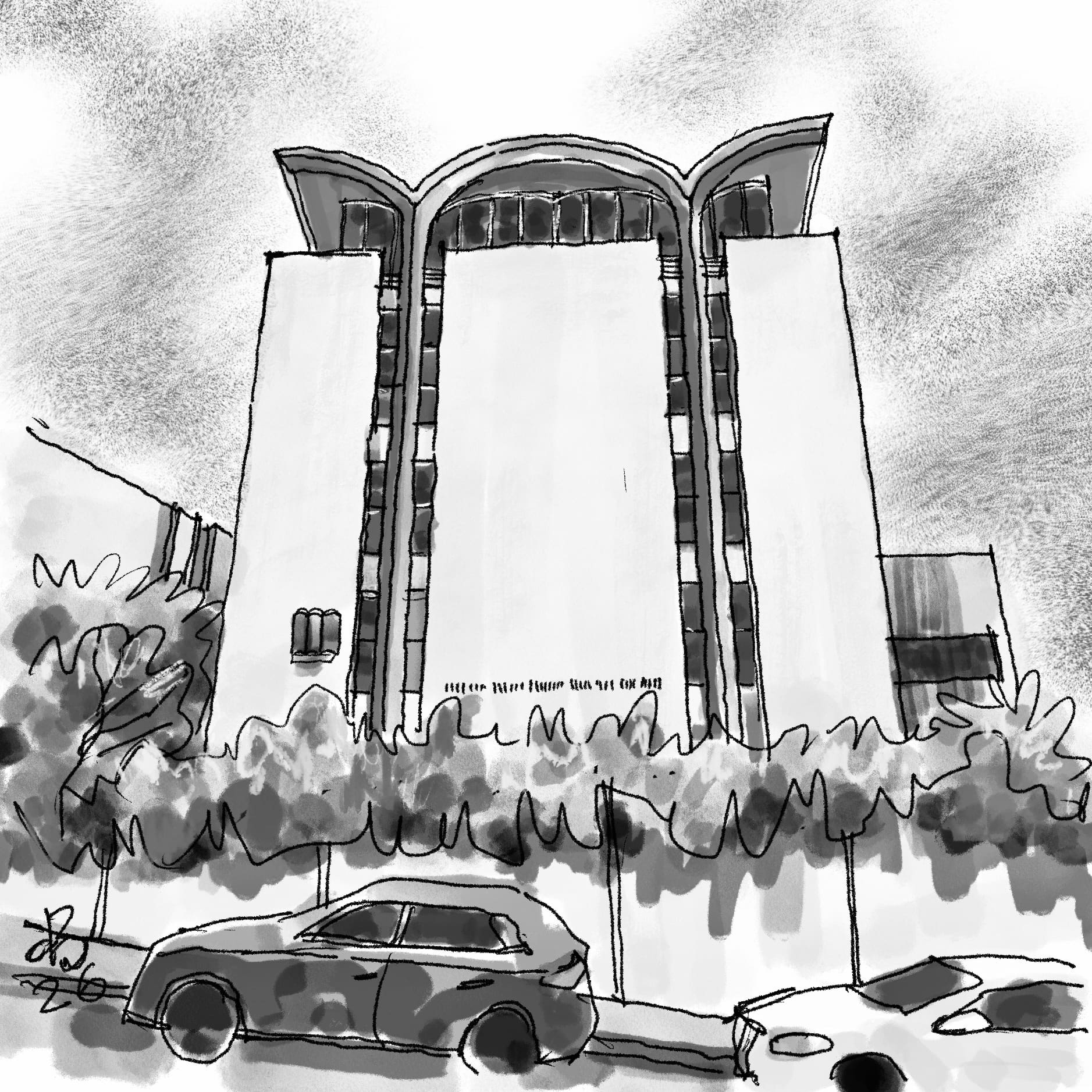
on the building
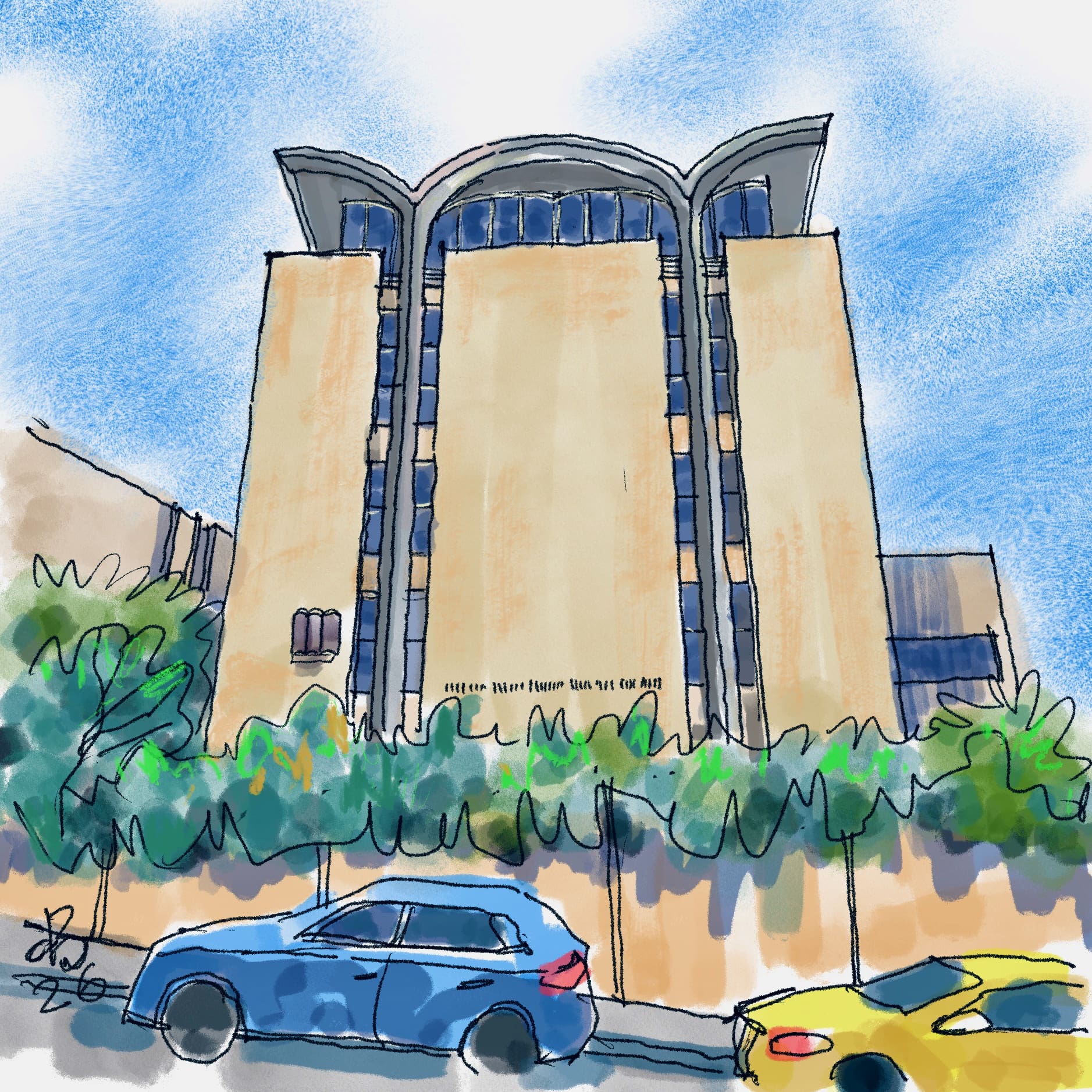
The building was constructed in 1982 and designed by Architects Yeshayahu Ilan and Gideon AderetThe original plans preserved in the Yeshayahu Ilan Archive at the National Library indicate that one of the central components of the project is a Beit Midrash and a synagogue, with a prayer hall, a platform, a sacred ark, and galleries.
The building itself is designed as a cube and above it Floating roof which is detached from the walls of the cube. The cube space, at a height of about 15 m, contains the prayer hall that serves as a synagogue and a Beit Midrash. A peripheral gallery overlooking the prayer space serves as a study and book storage area.
The building's unique feature is the "floating roof," which is detached from the building envelope and consists of a system of crossed vaults supported by a series of tall concrete columns.
About the architects
the architect Isaiah Ilan (1931–1999) was one of the senior planners in Israel who dealt with the architecture of synagogues, yeshivots and religious institutions. He studied architecture at the Technion and later became a member of the faculty's academic staff. Alongside his professional work, he also dealt with the theoretical aspects of the connection between architecture and Jewish thought, and, among other things, researched the concept of architectural space in the Mishnah and Talmud.
Since the 60s, Ilan has worked in partnership with the architect Gideon Aderet, and within the framework of their office, many public buildings, educational institutions and religious buildings were designed. The Institute for the Study of Maimonides' Writings was also designed by the office of Yeshayahu Ilan-Gideon Aderet, architects and urban planners.
One of the most prominent features of Ilan's work in the field of synagogues was his concern with the roof as an architectural and symbolic element in itself. At the Institute for the Study of Maimonides' Writings, the "floating roof" is particularly prominent, which is visually detached from the walls of the central space. This motif appears in two other buildings designed by Y. Ilan in Haifa: the synagogue in Ein Hayam and the "Elijah the Prophet" synagogue in the Ahuza neighborhood.
the situation today
A visit to the site reveals a significant gap between the name and purpose of the institution, the "Institute for the Study of Maimonides' Writings," and the current reality. There was no evidence of an active research institution. The impression obtained from the visit is that the main use of the building today is for prayer and study purposes on a limited scale.
The current state of the building is apparently not disconnected from the state of the association that manages it, as is evident from the latest financial reports. This situation may explain, at least in part, the gap between the institution's purpose and its current physical and maintenance condition.
The story of the "Institute for the Study of Maimonides' Writings" is also the story of the gap between an ambitious vision and a reality that has narrowed over the years.
Thanks
My thanks toNoga Carmi, Director of the "Hai Fe" news corporation, for suggesting the topic for the article and for her support over the years in the "Building Story" project that is published on this site.
Dear readers,
The articles in this section are based on open information published in sources such as Wikipedia and other websites and may include various historical inaccuracies arising from the aforementioned sources.
We invite our readers to suggest buildings as subjects for articles and if interesting stories are found behind them we will be happy to review them in this section.
Bear, once they come out against it, just to discredit it. The structure is beautiful. It can be used. It's a shame to destroy such a structure, David. Thanks!
A false association like thousands of other associations
It's time to put an end to this and an inactive association - the Registrar of Associations will close it down.
This is public land, the building should return to the municipality. Kindergartens or community centers.
So now the history… from a (former) owner of an apartment that borders… Soroka 33… On a clear day, dozens of Haredim flocked to the place for a strange ceremony. When we tried to find out in the Tza in question that the area was clearly “shtsap” and that is why we bought there, it turned out… in the heart of an exemplary secular neighborhood, Gural let it go if he didn’t support it… to our questions… he replied that “Tmura” would build two tennis courts on the spot… you are invited to tour there and see them… oh… no??? A light palette… but why and why would they build such an element there… is beyond my understanding.