


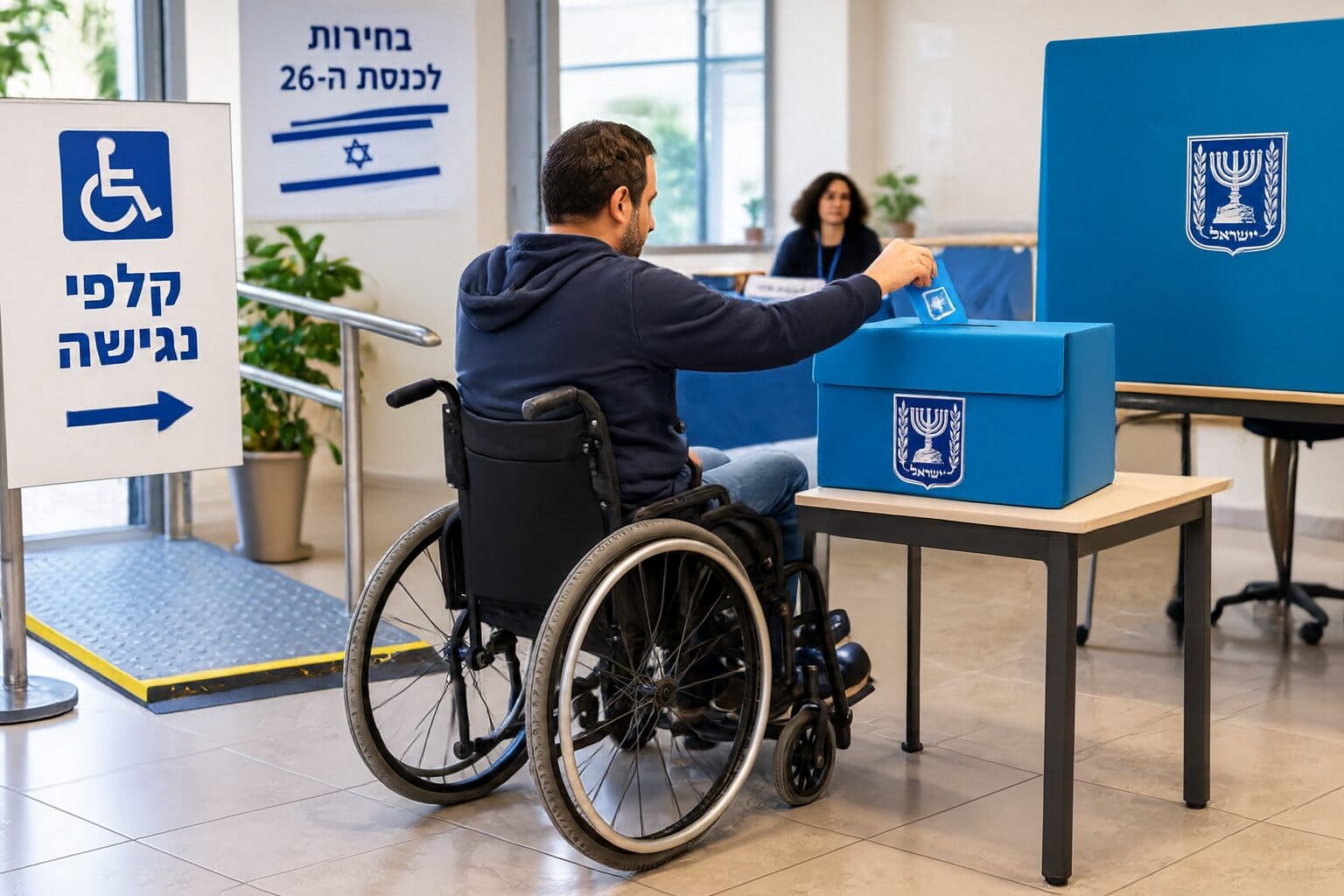
(haipo) The right to vote and influence the Knesset elections belongs to every citizen who meets the eligibility requirements, including people with mobility, vision, hearing or functional disabilities. However, in order to exercise this right, it is important to familiarize yourself in advance with the accessibility arrangements at polling stations, the possibility of using an attendant, and the differences between the types of polling stations. In preparation for the elections for the 26th Knesset, the Israel Accessibility Association is publishing a guide explaining how to prepare for accessible voting and what to do in the event of difficulty.
Before leaving home: Check eligibility and polling location
According to the guide, eligibility to vote is conditional on Israeli citizenship on the day the voter register is drawn, registration in the population registry as a resident, and reaching the age of 18 no later than election day.
The next step is to find out the location of the polling station and whether it is accessible.
It is important to check the voter's notice: if it states that the voter is assigned to a regular accessible polling place or a special accessible polling place, the address and polling place number listed on it should be reached. If there is no assignment to an accessible polling place, it is recommended to find out in advance where the nearest special accessible polling place is located.
Three types of ballot boxes – and what is the difference between them?
The guide distinguishes between three types of ballot boxes:
- Regular ballot: The polling place to which the voter is associated according to the voter register. If it is not marked as accessible, it does not necessarily have the required accessibility arrangements.
- Accessible regular ballot: A polling station to which the voter is associated, with access and voting arrangements adapted for people with mobility disabilities. It is intended for registered voters only.
- Special accessible ballot boxes: A polling station designed to allow voting even for eligible persons with mobility disabilities who are not associated with it, including those whose disability prevents them from voting at the polling station to which they have been assigned. In this case, voting is done in a double envelope.
According to the guide, the disability can be permanent or temporary, and it is not necessary to have a disability certificate to vote at a specially accessible polling place. As needed, a declaration of mobility impairment can be signed by the polling clerk.
What should be on an accessible ballot?
An accessible polling station should include a continuum of accessibility from the outside space to the voting area. Among other things, the guide details disabled parking, an accessible route, directional signage and polling station numbers, an opening wide enough for a wheelchair, and a table that allows a person in a wheelchair to approach it and put their knees under it.
In addition, ballot boxes should be arranged so that the ballots are as close to the edge of the table as possible. Polling station staff are trained to provide service and communicate with voters with disabilities, and the polling station can be entered with guide dogs and appropriate service dogs.
The guide also states that polling station clerks should honor queue exemption certificates, and where possible, waiting chairs suitable for adults should be placed. Each polling station should also have an information sheet about the voting process for people with hearing impairments.
Is it allowed to come with a companion?
Yes, in appropriate cases. A person whose illness or disability prevents him from performing the practical steps in the voting booth himself may be assisted by a companion. The companion can be a family member, friend, personal caregiver, or volunteer, and does not have to be a relative.
The role of the attendant is to assist in identifying the ballot and performing the required actions according to the voter's choice. He is not permitted to choose in his place, force a choice on him, or vote on his behalf when he is not present.
The escort's details are recorded in the protocol, and he must present an ID card. According to the guide, a person may accompany a maximum of two voters on Election Day, even if they vote at different polling stations. A director or employee of a nursing home or institution where the voter resides is not permitted to serve as his escort inside the voting booth.
It is important to emphasize that simply being a volunteer does not automatically grant them permission to enter the polling booth. If there is any doubt about eligibility for assistance, the decision is up to the secretary of the polling station committee.
Accommodations for the blind, the hearing impaired, and people with post-traumatic stress disorder
The guide also lists accommodations and recommendations for people with various types of disabilities.
People who are blind or visually impaired: Those who cannot vote alone may be assisted by a companion in accordance with the conditions set forth in the law. It is recommended to familiarize yourself in advance with the letters of the list you wish to vote for and to seek the assistance of a person you trust. You can also use mobile phone technologies to identify ballots, and it is permitted to enter with a guide dog.
Deaf and hard of hearing people: You can request a written explanation and face-to-face communication. It is recommended to inquire in advance what communication accommodations are available at the polling place. Hearing impairment in itself does not automatically confer the right to vote at a specially accessible polling place or to have the assistance of an attendant inside the polling booth.
People with post-traumatic stress disorder: According to the guide, a quiet atmosphere is generally maintained at polling stations, staff are instructed to respect queue exemption certificates, and it is possible to arrive with a companion and service animals.
People with intellectual or cognitive disabilities: It is recommended to prepare in advance and use a simple language guide. The guide emphasizes that cognitive difficulties or difficulty reading and writing, in themselves, do not automatically grant eligibility for an escort inside the voting booth.
What should I bring to the polls?
Before Election Day, it is recommended to prepare the following in advance:
- Valid ID document: ID card, Israeli passport or driver's license.
- Message to the voter: Not mandatory, but can help locate the polling place.
- Mobile Phone: For the use of assistive devices or accessible technologies.
- Personal assistance equipment: As needed, including a guide dog or service dog.
Those eligible for exemption from the queue can present the appropriate ID to the polling clerk. Priority is given according to the order of arrival and procedures at the location, and the guide asks the public to be patient and sensitive towards voters who need accommodations.
Encountering an accessibility problem? Here's how to act
If access to the polling station is blocked or the required assistance is not provided, it is recommended to contact the polling station secretary immediately and request a solution. If the problem persists, you can contact the Regional Elections Committee or the Central Elections Committee hotline.
Early preparation can help reduce difficulties on election day: finding the appropriate polling place, preparing the necessary documents and equipment, and becoming familiar with assistance options allow you to arrive at the polls better prepared and exercise your right to vote.