


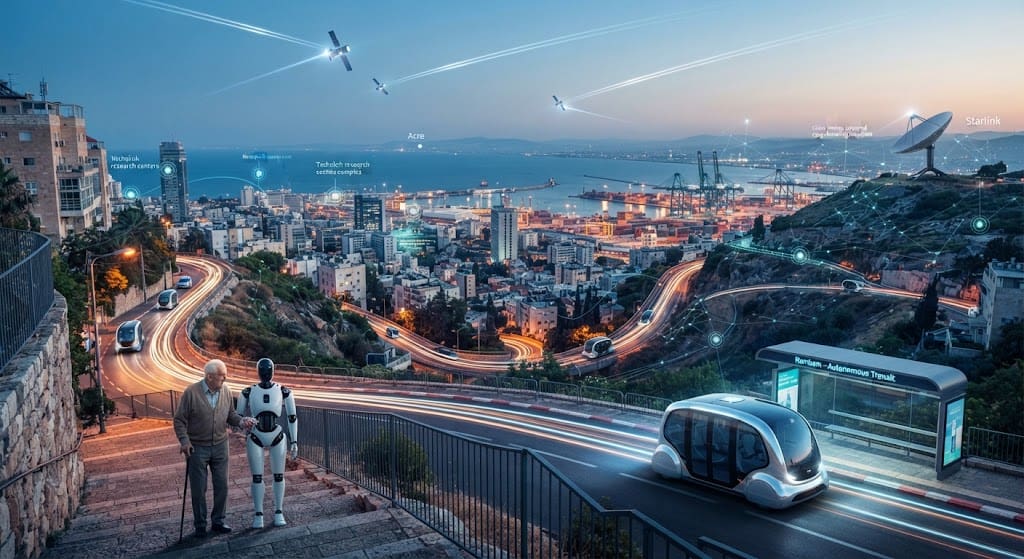
Imagine Haifa in a few years: an elderly resident arrives for a check-up at Rambam in an autonomous vehicle, a robot assists him on the Carmel Steps, and an AI system processes his medical findings. The revolution promoted by companies like Tesla, Neuralink, and Starlink offers an impressive vision, but its impact on the Haifa area will be complex and two-way.
On the one hand, technologies offer precise solutions to the city's challenges. A fleet of autonomous vehicles (Cybercab) could bridge the topographical complexity and connect the winding mountain neighborhoods to the transportation arteries and metro in the city center. The city's leading educational and medical institutions, the Technion and Rambam, could serve as a central research and clinical center for the development of brain-computer interfaces (Neuralink). At the same time, assistive robots (Optimus) could ease the burden on the elderly population and reduce risks in industrial work in the bay and port, while satellite internet (Starlink) would ensure functional continuity for the city's air force in emergencies and fires.
On the other hand, alongside the public promises stand serious social and economic challenges. Extensive automation could lead to structural unemployment and harm the livelihoods of drivers, maintenance workers, logistics workers, and paramedics. The costs of accessing these technologies could deepen the social gaps between affluent neighborhoods and disadvantaged areas, while the municipality would be required to make huge investments in communications infrastructure, sensors, and digital mapping.
In conclusion, the integration of Musk's developments in Haifa is not just a technological matter, but a policy test: the ability to leverage progress for the benefit of residents, while preparing to reduce gaps and protect the local labor market.