


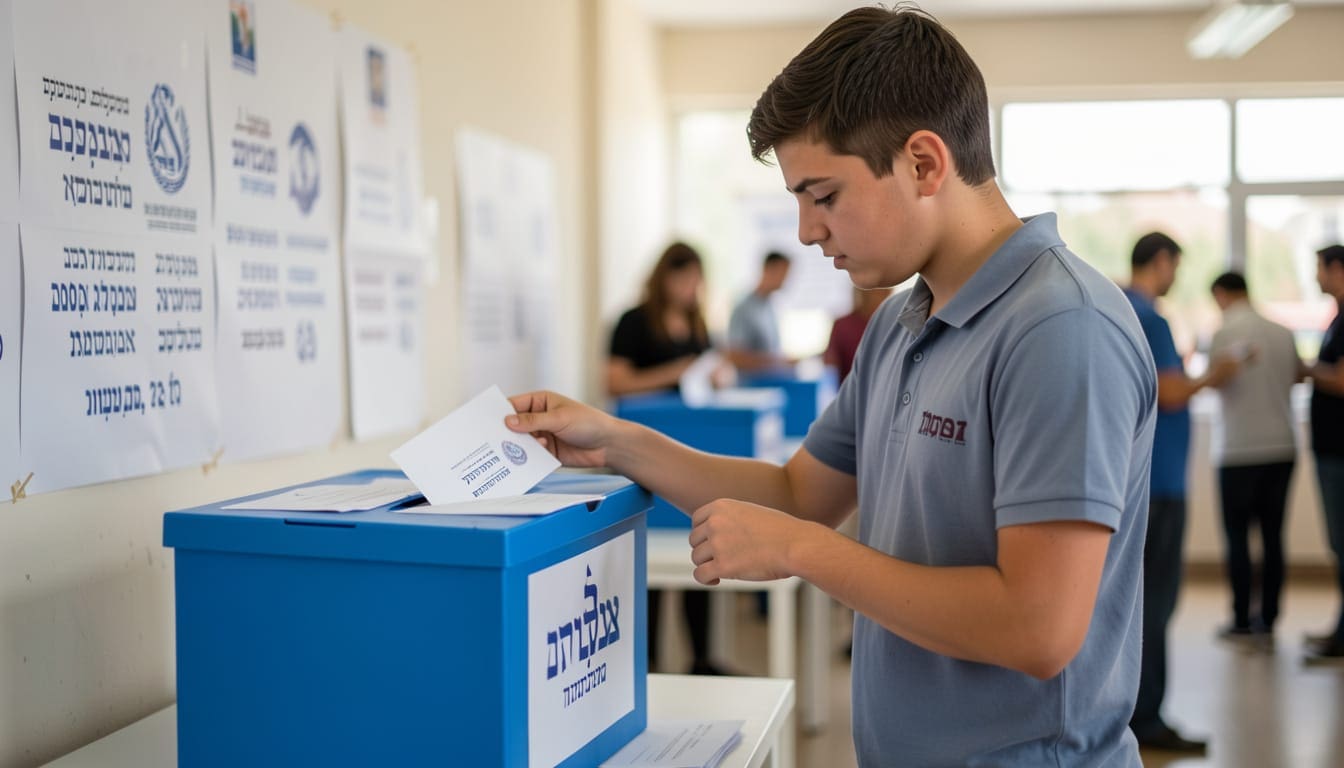
On October 27, 2026, the Knesset election campaign reaches its decisive moment. All Israeli citizens will go to the polls to determine the character of the national leadership and the direction of the country in the coming years. At first glance, the elections look like a routine political process, parties, campaigns, platforms and coalitions. But when you delve deeper into things, you discover that the very participation in the democratic process and the responsibility to the entire public are rooted in very deep roots in the origins of Israel.
What is proper leadership?
In the Book of Numbers (Chapter 27), when Moses asks God to appoint a new leader for the people, because the time has come for a change of leadership, he uses a special expression: "Who went before them and who will come before them". Chazal explain that a true leader is not one who sits in an ivory tower, but one who walks at the head, attentive to the needs of the people, bears the burden and cares for all parts of society.
Therefore, when we elect representatives to the Knesset and to lead the country, we must remember the Hebrew sources that require us to seek not only promises and speeches, but also virtues, integrity, decency, and responsibility to the public. In other words, qualities that have been a cornerstone of Israel's leaders throughout the generations.
On the duty to influence
In Pirkei Avot (Chapter 2, Mishnah 4), a short and unambiguous command appears: "Don't withdraw from the public.". Maimonides interprets that one who withdraws from the ways of the public and does not participate in its decisions, even if he does not commit a crime, cuts himself off from the community and the people.
Going to the polls is not, therefore, just a civil right, but also a profound expression of mutual guarantee, since "all of Israel guarantees each other." A decision not to vote, to use the Sabbath day to shop in malls, take a walk by the sea, and sit in cafes, is a relinquishment of the ability to influence the image of Israeli society, its security, its economy, and the future of all of us.
On partnership in repairing the world
The prophet Jeremiah (chapter 29) calls out to the people: "And seek the peace of the city…for in its peace you will have peace."When we look at Israeli society, at the diverse human mosaic of communities, ethnicities, and styles, which is also well reflected in Haifa, the demand to ensure the peace of all takes on practical significance. Voting is nothing more than the way for each and every one of us to be active partners in shaping society and "repairing the world."
On the freedom of speech
In recent years, and especially as we approach the elections, we have witnessed a sharp escalation in the culture of speech in the public sphere in Israel. Slander, vulgar slander, and derogatory epithets are no longer the fringes of low politics, but have become a central tool in political discourse.
Even more terrible is the fact that this harsh language is no longer limited to politicians: it has spilled over into television and radio studios. Media professionals and broadcasters, who are supposed to represent a matter-of-fact, critical, and respectful discourse, are dragged along and even lead, at times, the use of derogatory nicknames and personal humiliation of political opponents.
When television cameras and studios become an insulting arena, the main victim is Israeli society as a whole.
Death and life in the hands of the tongue
In the book of Proverbs (chapter 18) the immortal rule is stated: "Death and life in the hands of the tongue". Chazal likened the insulting word to a bullet shot from a bow. Once it is shot, it cannot be returned.
When a TV host or politician uses a derogatory epithet, they are not just expressing an opinion. They are causing irreparable damage to our social fabric.
According to Halacha"Facial whitening"(Shaming a person in public) is one of the most severe prohibitions. In Tractate Bava Metzia, it is stated that "Anyone who publicly whitewashes the face of his friend is like shedding blood."The use of predatory words in prime-time television tramples on human dignity and blurs the line between legitimate criticism and harm and humiliation."
"Wise men, be careful of your words"
In Pirkei Avot (Chapter 1, Mishnah 11) an explicit warning appears: "Wise men, be careful with your words."This warning is more valid today than ever for both media professionals and television broadcasters, as well as for politicians, on whose shoulders rests an extremely heavy public and moral responsibility.
When they use foul language and slander, they not only lower the level of public debate, but also legitimize millions of viewers to behave in the same way, on social media, which is becoming toxic. Political discourse is thus transformed from an arena of substantive controversy into an arena of verbal bloodshed.
The House of Shammai and the House of Hillel disagreed deeply, on almost every issue, but the Sages say that they treated each other with respect and decency. The disagreement was substantive ("for the sake of heaven") and not personal or spiteful.
On the eve of the elections, it seems that the majority of the Israeli public is thirsty for a different culture of speech. One that knows how to express a firm and sharp position, but preserves human dignity and does not degenerate into contempt and derogatory nicknames.
The public as a barricade
On October 27.10, our role, as citizens and observers, is not only to vote at the ballot box, but also to determine what norms of speech we are willing to accept. When we reject cheap discourse and slander, we are, in effect, demanding more worthy leadership and communication.
Another serious concern hovers over Election Day: the fear of compromising the purity of the elections and falsifying voters' votes. In modern reality, rumors and fears of envelope tampering, ballot protocol tampering, or illegal interference with the results undermine one of the most important foundations of a reformed society: Public trust in the system.
When the public loses confidence that its voice will be properly counted, the damage is not only technical, but it undermines the legitimacy of the government and the entire state.
The commandment of decency
In Deuteronomy (Chapter 25), the Torah commands absolute honesty in commerce and the management of public systems: "A stone of Solomon and justice will be yours, where will Solomon and justice be yours?".
From this, the Sages learned the strictest adherence to weights and measures: just as it is forbidden to cheat in commerce with a "biased weight" or "double measure," so this takes on even greater force in shaping the future of the nation.
The ballot is society's "scale of justice." Any attempt to sway a vote, conceal an envelope, or cheat in the counting is tantamount to serious fraud that robs the public of its will and violates the foundations of morality.
"Lies speak far away"
One of the strictest commands in the Torah appears in the Book of Exodus (Chapter 23): "מדבר שקר תרחק"The Torah is not content with prohibiting lying, but demands that one stay away from everything that has even the shadow of deceit, forgery, or pretense.
The polling station secretaries, the observers from the various factions, and all those involved in the task of counting the votes, carry on their shoulders a moral mission of the highest order. Chazal in Tractate Baba Batra state that "The punishment for false weights and measures is more severe than the punishment for adultery.", because the loser of public fraud does not know how to behave. Election fraud is nothing more than the robbery of millions of citizens.
Truth from the land will grow
When we go to the polls to vote, it is worth remembering that the strength of Israeli society depends not only on who is elected, but also on how the elections were conducted. Fairness and transparency are not political code words, but are the lifeblood of Hebrew culture and a reformed society.
The winds are rough, but Choosing truth, mutual respect, and inner peace is the most important note we can all put in an envelope.
😍 You wrote beautifully! You "quoted" beautifully! You phrased beautifully! You clarified beautifully! You demonstrated beautifully!
Now, let's hope that 😇"our choice will be beautiful"!!!