


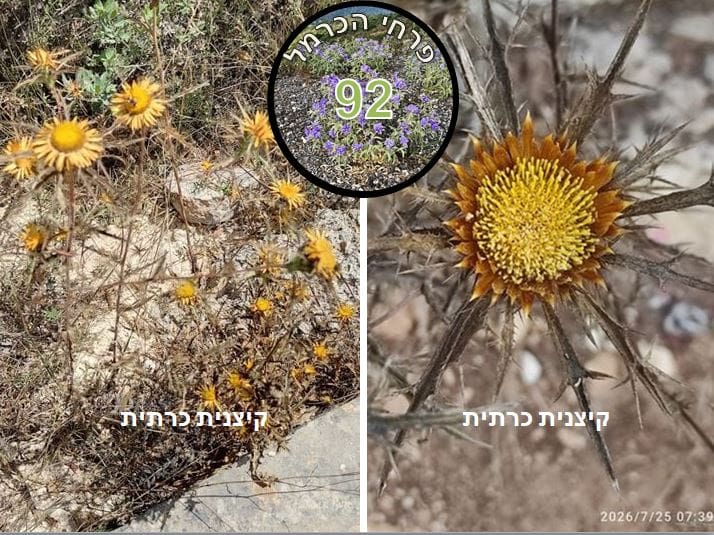
The flowers on the Carmel: The Carmel presents us with flowers in all seasons of the year. In this column, we will always present one of the Carmel flowers, in parallel with its appearance in the field, and you will be invited to visit it in one of the places where it blooms this week.
Cretan thorn Carlina curetum
A perennial thorny herb that blooms in summer, 25-50 cm tall. (Formerly called wrapped heather). The growth regime of heather is special and depends on the seasons: vigorous vegetative growth in winter, slowing down of activity in spring, drying of vegetative parts and flowering in summer. In autumn, all above-ground parts of the plant die and a root remains in the ground, whose buds awaken.
The genus name "Kitsnit" is derived from the word "thorn" due to the plant's characteristic spiny leaves and bracts.
The species name "Kritit" refers to the island of Crete, where the plant was first identified.
At the beginning of winter Developing from buds located at the root collar in the ground, the first leaves are sessile, simple, 4-7 cm long with a lobed, spiny edge. Each lobe ends in a prickly spine, as does the tip of the leaf, which is pointed and spiny.
In the spring Growing from the center of the rosette are several erect flowering stems bearing small, very spiny, sessile leaves, their bases clasping the stem.
With the arrival of summer The leaves and stems dry out and the plant appears dead. It is precisely then that inflorescences emerge at the top of the plant. The diameter of the flower head is 6-8 cm. All the flowers of the head are tubular, bisexual, and yellow. The plant's thorniness is mainly due to the outer edges of the flower heads.
Cretan summer primrose blooms in the summer months of June - September.
The flowers are tubular without a calyx, the corolla consists of 5 leaves fused into a tube that widens at the top into 5 open teeth. 5 stamens whose anthers are fused together and protrude upward from the tube. The ovary is a lower 2-leafed ovary with a single ovule inside. The pistil has 2 scars. The flowers ripen and bloom in circles from the periphery of the calyx to the center.
The calyx, which is full of tubular flowers, is wrapped in a double sheath of bracts: the inner sheath bracts are striking in their beauty, they are membranous, shiny, golden in color, and resemble petals or ligulate flowers. Their length is twice the length of the tubular calyx flowers. The outer sheath bracts are what give the plant its thorny appearance and immunity to grazing; they are few, narrow, and spiky. Their length is 4-5 cm, twice the diameter of the calyx. They do not hide the inner sheath, which is golden in color and striking in its beauty.
The flower is pollinated by insects.
The fruit is a hairy seed, bearing a tassel made of juicy grains at its head that allows the fruit to be dispersed by the wind.
Cretan summersweet thrives especially in fields that suffer from overgrazing, as well as on abandoned mountain terraces, growing scattered in open woodland and in its native habitat in the Mediterranean region.
Distribution in Israel:
Golan, Hermon, Galilee, valleys, Carmel, the mountains and desert of Samaria, the Judean Mountains, the coastal plain, the northern Negev, the Jordan Valley.
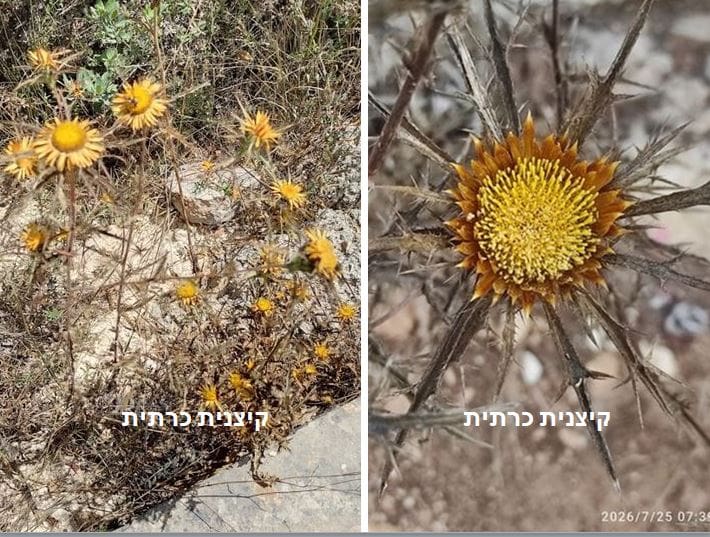
Cretan summer squash – ID
| family: | Compositae (Asteraceae) |
| root: | profound. |
| height: | 50-25 cm. |
| Leaves: | At the beginning of winter, the first sessile, simple leaves develop, 4-7 cm long, with a lobed, spiny edge. Each lobe ends in a prickly spine, as does the tip of the leaf, which is pointed and spiny. |
| stalk: | The stem is green, sometimes reddish-brown, and bears small, very spiny, sessile leaves. Their bases clasp the stem. |
| rash: | In the summer, mainly in the months of June - September. |
| flower: | The diameter of the calyx is 6-8 cm. All the calyx flowers are tubular, bisexual, yellow. The circumference of the inflorescence is a ring of membranous, shiny, yellow, petal-like bracts, twice the length of the tubular flowers. The inflorescence bears spiny bracts that arch backward beneath it. |
| The structure of the flower: | The calyx of bisexual tubular flowers is surrounded by a double envelope of membranous bracts. The outer one is ligulate and the outer one is spiny. |
| fruit: | A hairy seed that develops from the tubular flowers bears a tassel made of juicy grains at its head that allows the fruit to be dispersed by the wind. |
| smell: | The plant has no special smell. |
| nectar: | The plant produces nectar that attracts insects. |
| uses: | It is mainly used for decoration thanks to its shiny yellow inner shell. |
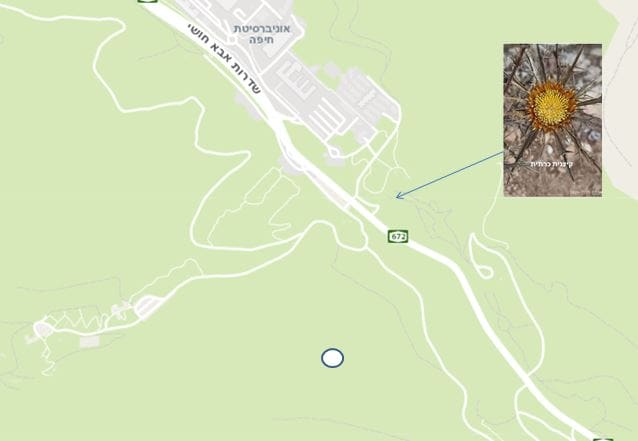
A place to meet the flower of the week – Cretan summer flower
- Drive from Haifa on Abba Khushi Road – Route 672 heading southeast.
- Turn left (about 100 meters after the second entrance to Haifa University) opposite the main entrance to Carmel Park, park the car in a small area further down the driveway.
- Continue on foot on the road that continues towards Horesht -40. After about 50 meters, turn right off the road onto a hiking trail. Continue on the hiking trail for about 45 double steps, and even if you continue on the trail, on the left side of the trail you will be able to see a cluster of Cretan summer flowers, prominent with their golden-yellow blooms and the thorns surrounding them.
The legend of the Cretan summer flower
If you go to visit the flower with children, you can tell them the legend of the Cretan summer flower.
At the edge of a sunny hill, where the summer was so hot that the ground cracked with thirst, grew a small Cretan heather. It was covered with sharp thorns, so all the animals stayed away from it.
"Who would want to come near me?" sighed the eccentric. "Everyone thinks I'm just a prick."
The anemone, which had already finished blooming in the spring, whispered to her:
"Don't be sad. Every plant has its time."
The poppies were gone, the daisies had dried up, and even the grasses had turned golden and bent in the warm wind. The whole hill looked tired and quiet.
Then came the time of the summer heather. In the middle of the dry summer, when it seemed that there was no life in the field anymore, its beautiful flowers opened. They lit up the hill and invited bees and butterflies that had difficulty finding flowers this season.
The old bee said:
"How good that you waited for us! Just now, when there are almost no flowers, we found nectar with you."
The little finch also landed on the thorns without being hurt. She discovered that the thorns were not meant to hurt her friends, but to protect the plant from those who might eat it.
The scoundrel smiled for the first time.
"Now I understand," she said. "My thorns are not a sign that I am not nice. They are simply protecting me, so that I can flourish while others are resting."
Since then, every summer, when the sun is hot and the fields are dry, the summer heather blooms, reminding everyone who passes by that everyone has their own special time to bloom, and even those who seem tough on the outside can give tenderness, life, beauty, and help to others.
And the morality of intellect:
Don't judge by outward appearance. Even those surrounded by "thorns" may have a good heart, and everyone has their own time to shine and benefit others.
.