


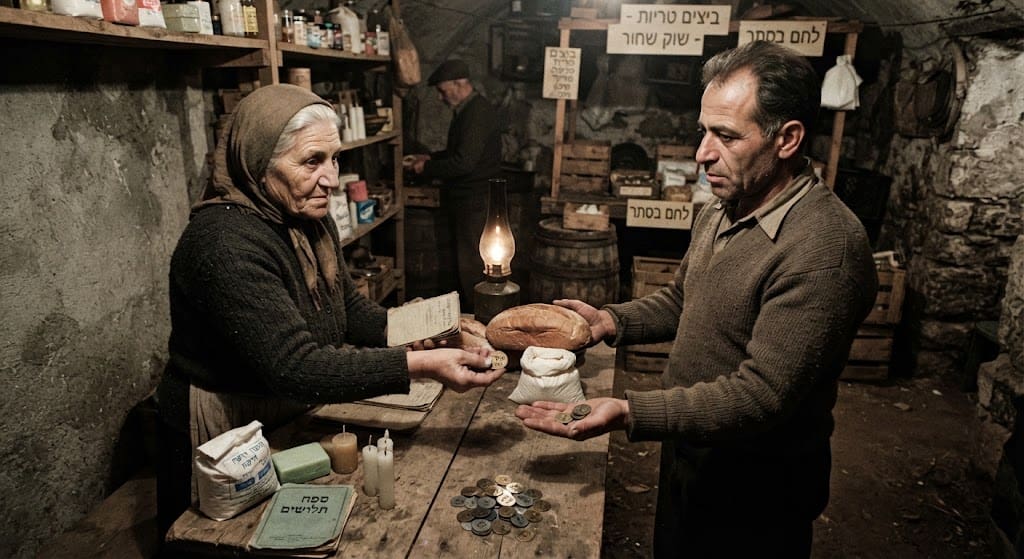
The early 1950s in Haifa and Israel are remembered in the collective memory as the period of austerity – an era of rationing, scorecards, chronic shortages and draconian government supervision of every crumb of bread and drop of oil. The Israeli government, attempting to manage an economy of acute shortages and provide an equitable basic food basket for the many immigrants and veterans, operated a rigid system of supervision. But, as is the custom of rigid bureaucracies that attempted to strangle the laws of supply and demand, reality on the ground struck back with full force.
The official currency, the Israeli pound, lost its true value because there was nothing to buy with it. And so, out of existential distress and a natural survival instinct, a parallel and fascinating economic system developed in Haifa, especially in the alleys of the lower city and in neighborhoods like Hadar Carmel: an underground shadow economy that issued internal fiat currencies and alternative means of payment under the noses of finance officials.
The Mechanism: Black Market Private Banking
When the state collected every gram of produce and monitored every kilo of flour, an economic vacuum was created that required a creative solution. Merchants, agricultural cooperatives, artisans, and clandestine bakeries in Haifa began operating a closed-loop economy based on tin and plastic tokens, rubber-stamped paper cards, and internal "coffee" ledgers.
This is exactly how it worked on the ground:
Advanced Barter: A worker who repaired pipes for a private contractor or helped on a farm near Haifa did not receive payment in worn-out pounds controlled by the state, but instead received "credit points" or signed vouchers.
The inner circle of benefits: With the same vouchers and tokens, the same worker could pull flour from a hidden basement of a neighborhood grocery store, receive eggs from a farm that did not report its yield, or obtain shoes from a local tailor.
It was a completely alternative financial system – a kind of "local private banking" that operated on the basis of mutual trust, and managed to feed entire families while the official system collapsed under the burden of bureaucracy.
Between Criminals and Human Entrepreneurship
From the authorities' perspective, the establishment of local currencies and the circumvention of food controls were a serious sabotage of the national economy and a real criminal crime. The Israel Police and austerity inspectors deployed undercover agents, raided suspicious warehouses, and searched for the register books and tokens hidden in Haifa basements.
But in retrospect, economic history teaches us something much deeper about human nature and market forces: When a government tries to impose total centralized planning that ignores the basic needs of its citizens, civil society will always find a way to circumvent it. The people in Haifa did so not out of rebellious or ideological intent, but out of a simple existential need to make sure their children had something to eat.
A look into the past: what can we learn from it today?
The story of the coins of privilege and the shadow economy in 1950s Haifa is a fascinating reminder of the power of human initiative and business creativity in times of crisis. It reveals a forgotten facet of the city's daily history, not just stories of battles and leaders, but the story of The ordinary people who reinvented the economy when all other gates were closed to them.
Did the article interest you?
Everything that fuels crime and protectionism in the sector today, and criminal organizations launder tens of millions through the restaurants on the Moshava axis.