


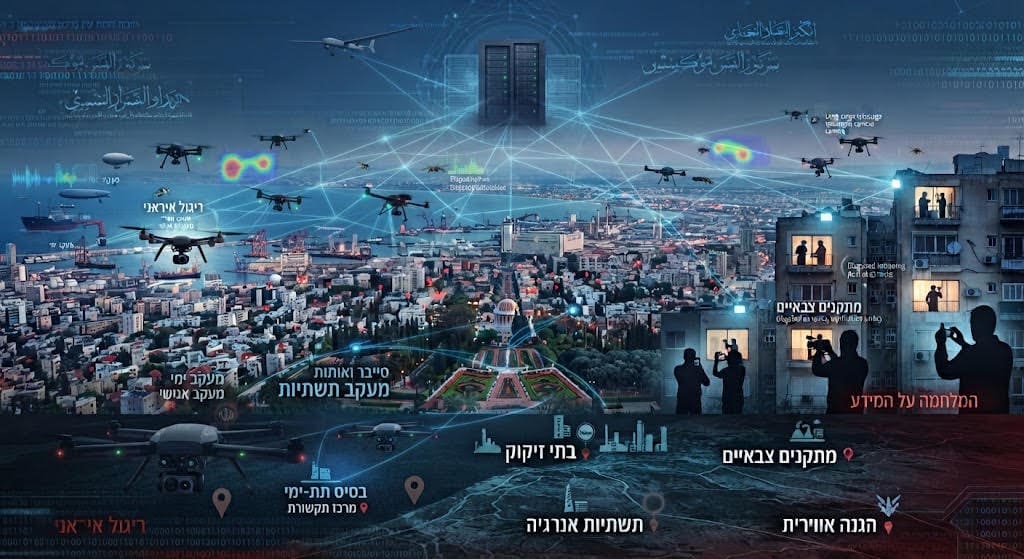
Haifa is much more than a port city, an industrial center, and a northern metropolis. It is one of Israel's most important concentrations of strategic infrastructure: a seaport, refineries, energy facilities, transportation systems, military installations, and communications centers. This fact makes it a target of intelligence importance for Israel's enemies.
In recent years, the method of intelligence gathering has changed significantly. In the past, intelligence services were required to deploy agents, take photographs remotely, or rely on satellite imagery. Today, a small drone equipped with a high-quality camera is capable of collecting visual information about sensitive installations, vessel traffic, industrial activity, and infrastructure.
In June 2024, Hezbollah released a video that it claimed was filmed by a drone over the Haifa area. The video showed, among other things, the port, industrial facilities, and other sites. Its very publication demonstrated the terrorist organization's ability to gather information on strategic targets.
However, espionage in Haifa is not only conducted using drones. In 2024, a case was uncovered in which, according to the indictment, seven residents of Haifa and the north carried out about 600 missions for Iranian operators over a period of about two years. Among the missions were photographing the port of Haifa, the Ramat David base, and air defense systems.
In another case published in 2025, a man was suspected of renting an apartment in Haifa overlooking the port, with the aim of using it as an observation point and gathering information. That same year, an indictment was filed against a Russian citizen who allegedly photographed military vessels, the Haifa port and the refineries from an observation point in Nesher.
Civilian sites have also allegedly become targets for collection. In another case, it was alleged that a Haifa resident photographed Haifa Bay and the Baha'i Gardens for an Iranian operator, and was later asked to follow a person and document a residence in Tirat Carmel.
Another case involved a person with professional knowledge in the field of international shipping, who was asked, according to the indictment, to provide information on shipping processes, cargo inspection and port security. In another case, published in 2026, it was alleged that a foreign citizen photographed the port of Haifa and an Elbit facility in the Achihud area and passed the information on to Iranian operators in exchange for digital currencies.
The examples illustrate the change in espionage methods: a professional agent is not always required. Sometimes a citizen willing to carry out photography tasks for money, in an apartment overlooking a strategic facility or on a mobile phone connected to a social network, is enough.
For Haifa, this means that protecting the city cannot be limited to air defense systems. A combination of intelligence, aerial monitoring, information security, protection of critical infrastructure, and cooperation between security agencies, local authorities, and strategic enterprises is required.
The campaign for Haifa is not being waged solely with missiles and rockets. It is also being waged with tiny cameras, digital information, and spy networks. In the new security reality, gathering information about the city may be the first step in preparing the ground for a campaign against it.