


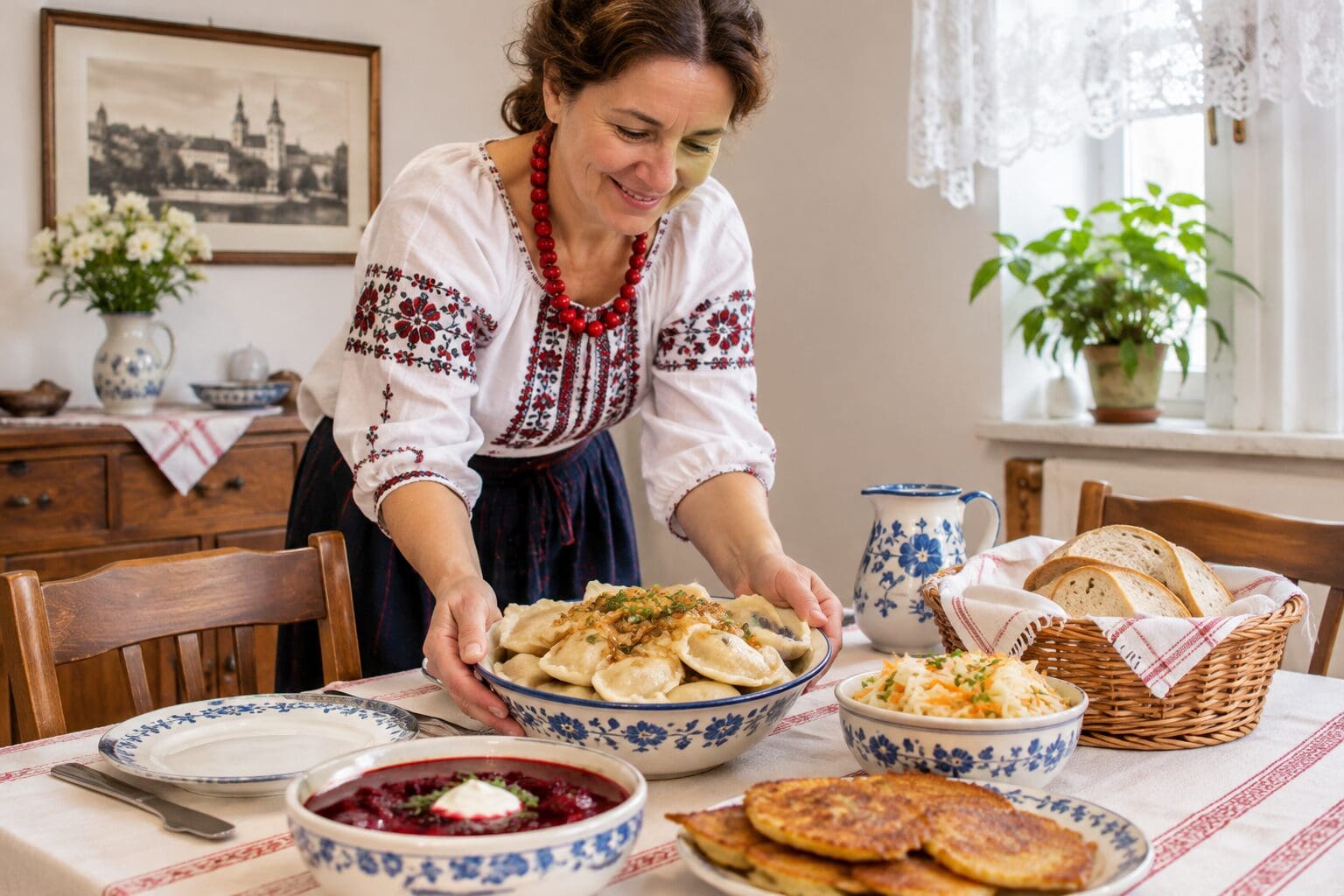
In the Hadar Carmel neighborhood of old Haifa, the aromas of cooking mingled with age-old maternal complexes. My mother, for example, developed a groundbreaking educational method. Years before anyone had heard of "critical pedagogy" or "educational narratives," she already had a living laboratory for applied sociology, which was our kitchen in the apartment on Masada Street.
Certified Polish education was not based on shouting or dry rules. True Polish education was built on the senses and, first and foremost, on a heartbreaking narrative, which combined a sophisticated sense of guilt with complex historical geography. For example: the story of the bad girl who didn't eat the carrot. In my mother's eyes, every spoonful that didn't find its way to the toddler was, in fact, a strategic attack on the Zionist enterprise. "Don't you want to eat carrots? Imagine what happened in Poland in Krakow? In 1930, when there were no carrots at all. And even if there were, they were frozen and bitter"! And at that moment, every average girl not only learned about vitamin A, but also underwent a crash course in the history of the survival of Eastern European Jews, including tears in my mother's eyes and a sense of guilt that could have financed a bachelor's degree in psychology.
Or take the sweater issue. In the Haifa spring, when the humidity outside broke records and the sleet came directly from the valleys, my mother would stand by the window of the house on Masada Street and announce: "Aliza, take your sweater, it's cold outside." It should be clarified that for my mother, the concept of "cold" was not a meteorological matter, but a mental state of accumulation. The temperature outside could be 30 degrees in the shade, but in the depths of the Polish consciousness, the cool wind always blows from the Siberian steppe. What does a nine-year-old Haifa girl do, torn between the scorching sun of Hadar Carmel and the terror of metaphorical pneumonia? She immediately develops phenomenal defense mechanisms. She puts on the sweater, sweats like the engine of an old truck, and on the way from home to her friends develops the diagnostic senses that will one day make her a researcher at the university. She buries the sweater in a niche in the yard.
The years passed, Masada and Hadar Streets of old took on new urban twists, the Remez School (Masada) where we grew up remained in memory, and I found myself standing in front of a hall packed with students who had come to study literature, and there were many of them at the time. Introductory classes, exercises, seminars. Folktales of the various ethnic groups living in Israel, fairy tales, theories of the construction of reality, the power of the story and the way in which family myths shape the consciousness of the individual.
My mother had a rich repertoire of stories. She concocted for me a whole world of exemplary educational stories about the duty to honor elderly parents, about a mother's supreme devotion to the limit of her ability, and about the danger of the duplicity of sons and daughters who forget where they came from and where they are leading their mother. For years and years, I heard these stories with interest and even awe, and I was convinced that they were exclusive family dramas tailored especially for me. Like the story of the wooden plate. Only years later, when I began my studies at the Hebrew University of Jerusalem and delved deeper into the field of folklore, did all the chips suddenly fall. I realized to my amazement that all those dramatic stories were not born in a kitchen on Masada Street, but were ancient folk tales, treasures of folklore passed down from generation to generation and pulled out at precisely the right time from an ancient arsenal of ammunition, to illustrate to the disobedient child the proper and desirable behavior.
The truth is that the stories never went anywhere. They simply changed clothes and moved from the apartments with key deposits in Hadar Carmel to the Instagram feed, and from there they continue to manage us with a high hand. Today, the work of education and design has passed from the hands of Polish mothers to an entire army of new educators, hidden from sight and completely visible. If it once took a dramatic effort, including a sorry look, a dramatic changing tone, and the necessary facial expressions to convince a child that she must behave well or something terrible and terrible will happen, today this work is completely automated. TikTok and Instagram are the new Polish mothers, only without the smell of chicken soup. They tell us every second a sophisticated educational story about what our lives are supposed to look like: whoever does not wear the right sweater or, more precisely, the right brand, whoever does not eat the perfect green salad, and whoever does not have enough before breakfast, is immediately doomed to discover that they are missing out on the next important thing. Instead of folk tales of our ancestors, the algorithm at any given moment pulls out personal "miracle stories" of others to instill in us the exact same sacred guilt.
Today's parents may have left behind the threats about carrots in Poland and the story about the son who disrespects his father and makes him eat on a wooden plate and at a separate table in his old age, but the world of narratives has undergone a psychological upgrade. Instead of "Eat because there are hungry children in India," we now hear: "You are damaging your brain neurons if you look at the screen for another five minutes." Instead of folk tales about ungrateful sons, children tell their parents' generation reasoned stories about coaching, emotional boundaries, and safe spaces. Family drama has not disappeared, it has just received a university degree.
In our childhood, the Remez School on Masada Street set the tone, followed by experienced teachers. Today, our children and teenagers get their value system from twenty-something YouTubers, who sit in an editing room and tell modern morality tales about success, failure, friendship, and betrayal. They are the actual educators. They are the ones who determine what values are considered “proper,” what proper behavior is, and what a person who manages to understand the world looks like.
So who today educates children through folktales? Everyone. We live within one continuous story, in which everyone tries to sell us their moral. It used to be about carrots and honoring father and mother, and today it's about likes, self-realization, and the doubters. But between myself, when I look back on all the years of teaching and research, I know my little truth: no digital algorithm, series on Netflix, or scholarly lecture at the University of Haifa will be able to produce the same magical effect that one little story, told quietly in a Haifa kitchen under the smell of fresh soup, had, when the only goal in the world was to make me a better person.
But between myself, I always knew the truth: every article I published, every research project I led, every book and every seminar, were nothing more than a long, learned footnote to that masterful lecture delivered every evening around the dinner table, with a spoonful of steaming chicken soup in one hand and a loving, reproachful look in the other that said: "I'm only doing this for you."
Then Thank you, mom.Thanks to you, I learned that there is no such thing as just history, but only history in which everyone is guilty of something, preferably without a sweater, and no degree in the world will be able to explain the magic in which a piece of salmon floating in a bowl of soup manages to sort out the head better than any clinical psychologist.
Dear Aliza, I read with eagerness. You described everything beautifully and so movingly, reading and smiling. Thank you!
Dear Aliza,
What a pleasure to read you! You managed to take the world of legends and folk tales, and show that the most powerful, moving, and mind-altering narrative did not come from a band of researchers at the University of Haifa, but from a deep pot of chicken soup in a Haifa kitchen.
There is no doubt that you are the only professor who has succeeded in proving that fresh soup is not only a cure for colds, but the most solid foundation for both the humanities and social sciences.
Take a big breath, Prof. Shenhar!
I agree with every word, in every group there was a similar melody with a clear message.
Well done, dear Aliza, for documenting with good humor and deep insights for all generations.
Aliza, thank you again for bringing up the figures of my parents, the great educators and shapers of my personality in a gentle way, developing feelings of guilt, and everything was wrapped in infinite love, which in fact did not depend on anything. You are here for all of us, who remember our childhood in our parents' house, who are with us to this day. I think - or rather I hope, that even in our days, in the technological age that invades our lives and the pseudo-social networks, there is still a crucial and fundamental importance to parent-child relationships. Thank you
Dear Aliza, your writing is fascinating as always and reminds us of oblivion that we too have experienced. The Polish mother syndrome characterized many homes. Thank you for bringing back memories from the depths. Mali