


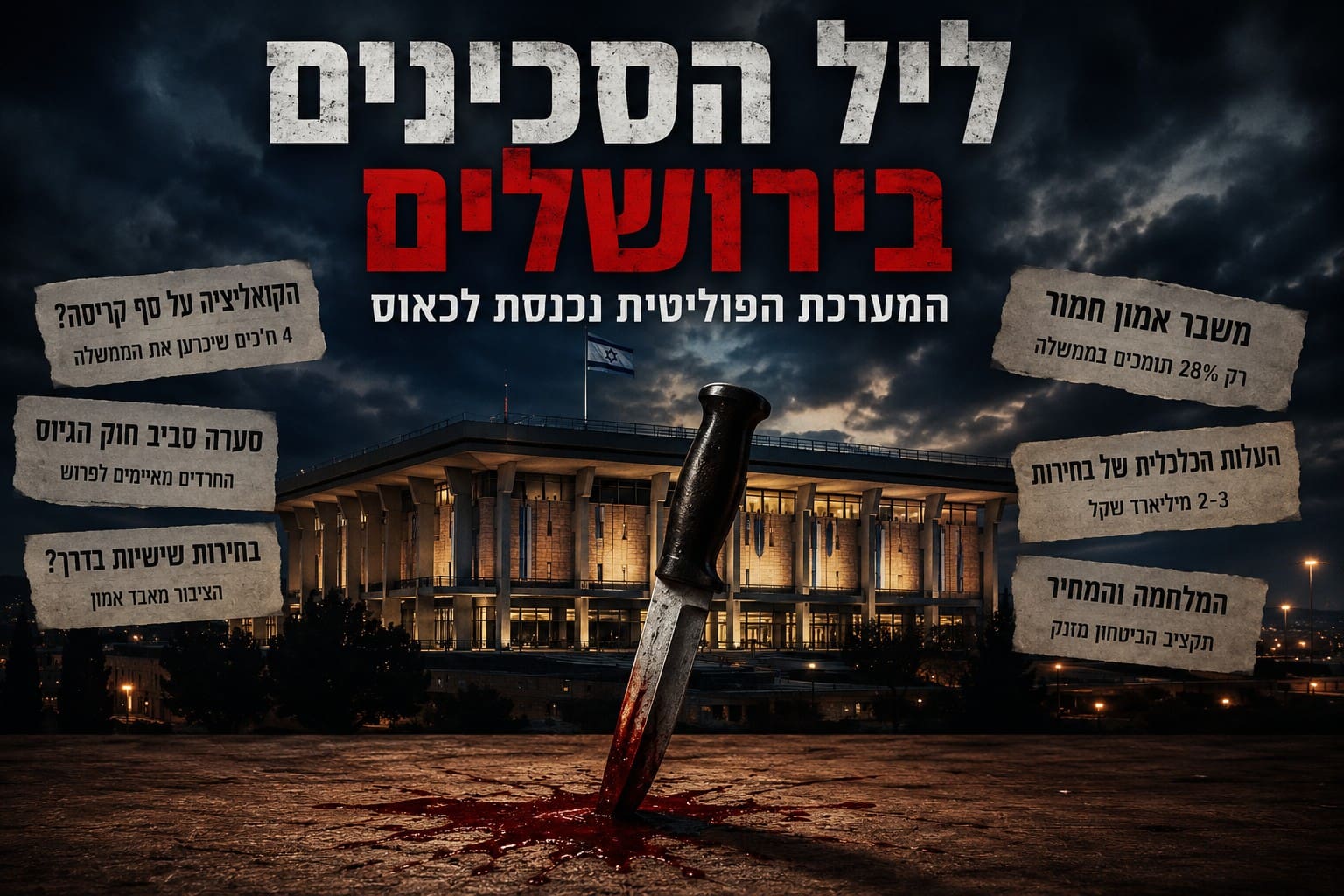
It is three in the morning. The long corridors of the Knesset building in Jerusalem, bustling with businessmen and journalists during the day, are now immersed in a tense gloom. But behind the closed doors of the offices of the prime minister and party leaders, the lights do not go out. The armored phones are constantly rattling, draft agreements are shredded and rewritten, and the air is thick with suspicion. The term “Night of Knives” is no longer a political cliché of historians; on this night, in the Jerusalem of 2026, it becomes a survival work program, in which loyalties of years are slaughtered on the altar of immediate interest.
The Israeli government system is walking a tightrope, almost impossible. The coalition relies on a fragile and nerve-wracking majority of Only 64 Knesset membersIn a period of ongoing regional war, a deep public crisis, and an unprecedented erosion of public trust – currently at a historic low of Less than 25% support for the political system – This number is almost a death sentence for stability… A slight shock, a capricious or political resignation of Only 4-5 Knesset members, or even by a coordinated abstention of one sub-faction in a crucial vote, to bring down the entire tower, dissolve the Knesset, and drag the country into a complete systemic spiral.
At the heart of the current drama stands the national minefield:
The Conscription Law. This is the most acute rift that threatens to break up the alliance between the Likud and the ultra-Orthodox parties. On one side of the fence, the Israeli public, bearing the burden of the bloody and worn-out reserves following the war – with some members of the reserve force already having crossed the threshold The 200th day of active service in the past year – Demands distributive justice and equality of burden. On the other hand, the Haredi leadership is standing on its hind legs, issuing strict ultimatums and threatening to dismantle the family package, since it involves more than66,000 yeshiva students and avrechim of military age who are not drafted, who are currently at the center of the explosion. And if that weren't enough, within the Likud itself, the internal rumbling begins; voices of rebellion, Knesset members who understand that their public demands change, and refuse to commit political suicide for the continuation of the partnership.
Secret conversations in the dead of night
This brutal dynamic translates behind the scenes into an all-out war. Secret late-night conversations with opposition members, unprecedented offers of political bribes, desperate attempts to hunt down “defectors,” and venomous mutual briefings leaked to the media to burn the adversary.
The distrust between the partners reached a boiling point: Every vote in the plenary, even the most technical, becomes a life-or-death test in which the fate of the country is decided on the tip of a vote. In a psychic struggle over the voice of the 61st finger.
Money burned on ballots
The pressure is intensifying further given the economic cost of the horror. While defense spending has soared In tens of billions Since the outbreak of the war, the government deficit threatens to swallow the economy – climbing to an alarming rate of Over 8% GDP deficit – A new election system will impose a catastrophic price on the country of more 2–3 billion shekels – Money burned on ballots instead of on reconstruction and security.
In this bloody reality, the "Night of Knives" is Jerusalem's modern gladiatorial arena. It is a Sisyphean struggle for survival, where every decision, every leak, and every compromise in the dead of night will not only determine whether the government sees the light of day - but will reshape its borders and the future of the entire State of Israel for years to come.