


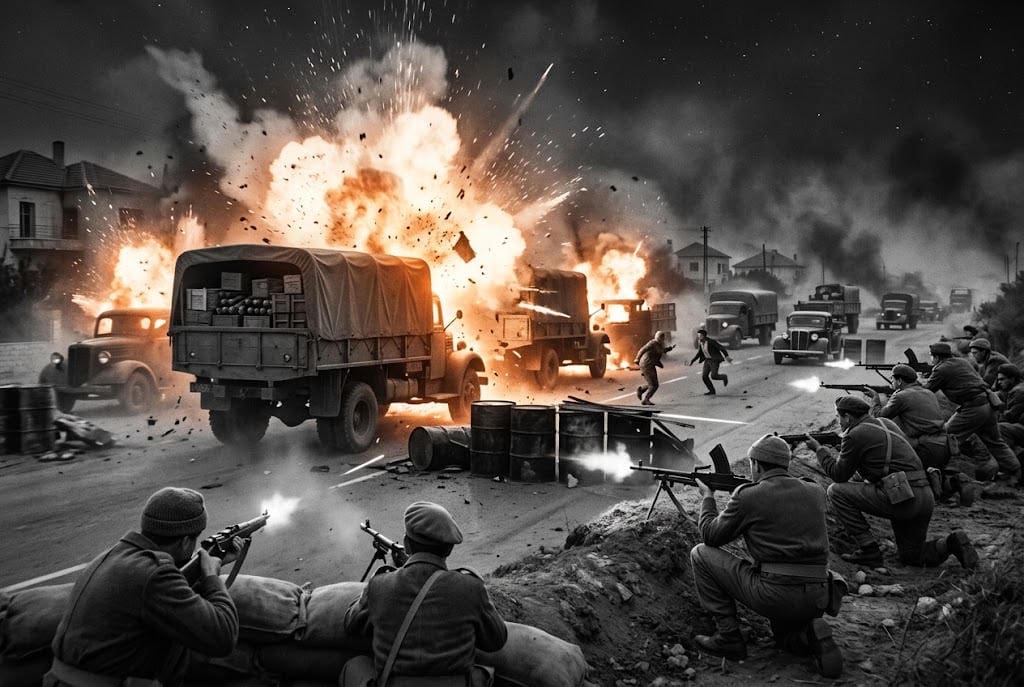
In March 1948, just weeks before the declaration of the state and the fall of Arab Haifa to the Haganah, one of the most dramatic and decisive battles of the campaign for the north took place in Kiryat Motzkin. This battle was not just a local conflict, but a strategic turning point that decided the fate of the entire campaign for Haifa.
The night that changed the balance of power
In mid-March 1948, the Haganah Information Service (SHS) received a golden intelligence tip: a huge Arab arms convoy, which had left Beirut under the command of Izz ad-Din al-Qassem (the grandson of the famous sheikh), was making its way along the Lebanese coast towards Haifa. The convoy included trucks loaded to the brim with explosives, rifles, ammunition and fighters, and its goal was to decide the battle for the city of Haifa in favor of the Arab forces.
The commander of the Carmeli Brigade, Moshe Carmel, understood that if these weapons reached their destination in Haifa, the Jewish forces in the city, who were few and surrounded, would face the danger of extinction. The order was unequivocal: stop the convoy at all costs.
The ambush at Motzkin Junction
On the night of March 17, 1948, soldiers from the 21st Battalion of the Carmeli Brigade, under the command of Ben Ami Pechter, set out and set up a well-planned ambush at the Kiryat Motzkin junction (in the area where the Acre-Haifa highway now passes).
When the Arab convoy reached the ambush point, the defense forces opened concentrated fire. The night battle was difficult, fierce, and stormy. During the intense exchange of fire, one of the explosives carried in the Arab trucks was damaged, and a huge explosion shook the entire area. The explosion caused a secondary chain of explosions that destroyed a significant part of the convoy, killed its commanders (including the convoy commander), and caused the remaining Arab fighters to flee.
The strategic significance of the fall of Haifa
The victory at the Battle of Kiryat Motzkin radically changed the map of forces in the region:
- Dispossession of headquarters and equipment: The Arabs in Haifa lost the main weapons shipment intended for them and the senior commanders who were supposed to lead the fighting in the city.
- A severe morale blow: The explosion and defeat in Motzkin had a profound effect on the morale of the Arab community in Haifa and created a sense of impending collapse.
- Paving the way for Operation "Bleaching the Leaven": About a month later, on April 21–22, 1948, the Carmeli Brigade embarked on the decisive operation in Haifa. Without the ammunition and commanders that had been destroyed in Kiryat Motzkin, the Arab forces in the city were unable to withstand the Haganah attack, and the city of Haifa was liberated in less than 24 hours.
The Battle of Kiryat Motzkin was inscribed in the history of the War of Independence as a model example of intelligence and operational initiative, and the central Blue Line in the chain of events that led to the fall of Haifa at the hands of the Haganah forces.
Did the article interest you?