


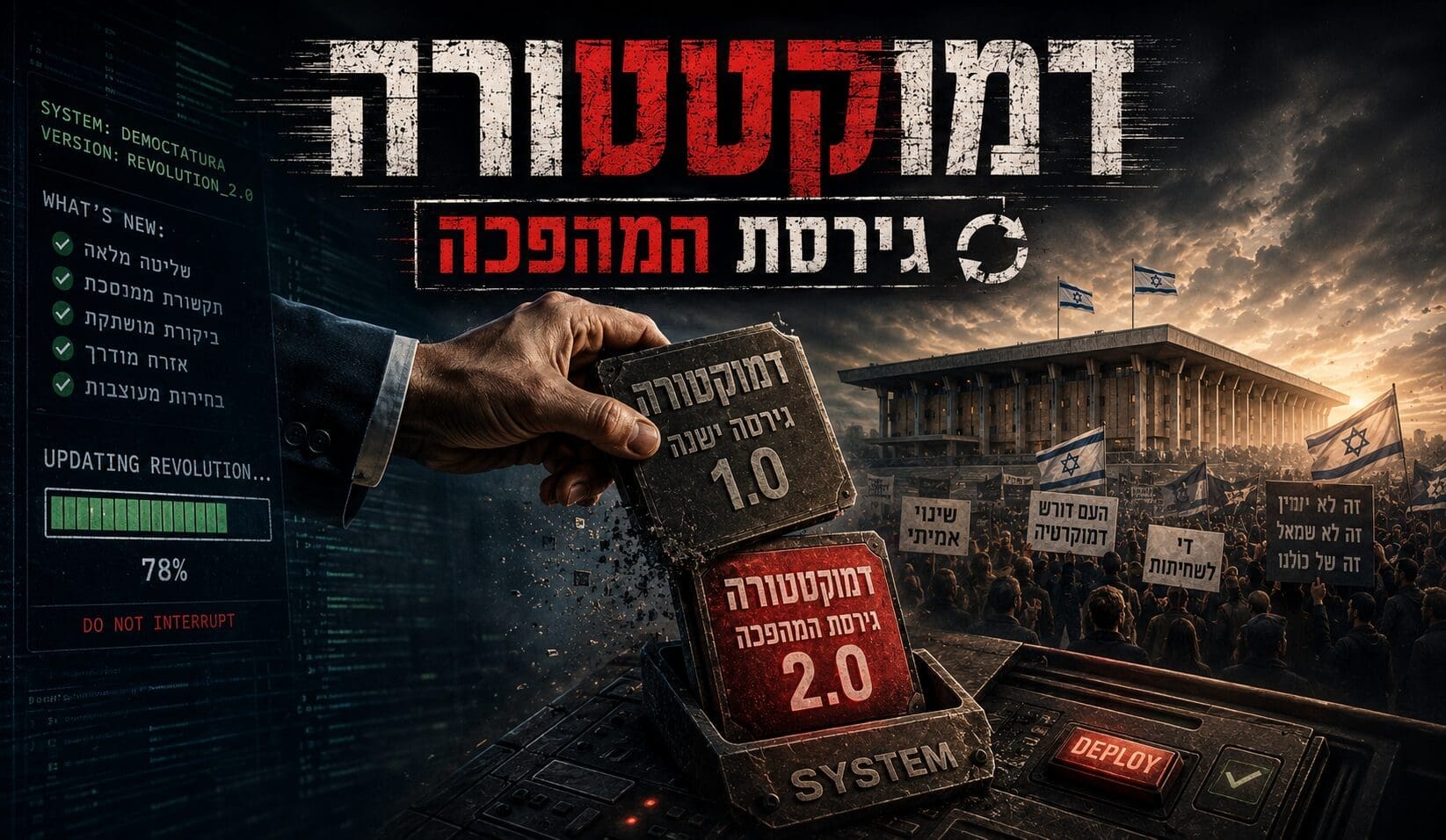
Part One: The Marathon to the Polls
The summer session of the Knesset opened this week – just before the election campaign. The current debate no longer revolves around this or that specific law, but around the race itself: a race in which the Knesset does not stop, the public does not understand enough, and Israeli society discovers that it is running faster than it can agree on where it is going.
A technical term in the past, such as “legislative marathon,” has become a phenomenon that shapes the current reality. It is a rapid succession of decisions made at a high pace, each of which not only changes policy but also draws another line in the social divide. Instead of a democracy that produces slow consensus, we get a system that produces quick decisions – but also more extreme reactions.
Part Two: The Quiet Revolution – A “Version Update” Instead of a Frontal Upheaval
In recent years, and especially in the run-up to elections, Israel has witnessed an accelerated process of legislation, appointments, and institutional changes aimed at reshaping the country’s power structure. In the eyes of government supporters, this is a “systemic overhaul” and a return of power to elected officials; in the eyes of opponents, it is a process of “democratization”—a combination of formal democracy and the increasing concentration of power in the hands of the coalition.
The central characteristic of the current period is not expressed in one dramatic law, but in a sequence of “version updates” in various fields.
What all these moves have in common is the rhythm: Accelerated legislation and specific but cumulative changes, which create an attempt to complete as many moves as possible before the elections. Instead of one big, noisy revolution, a mosaic of small changes is being built here that together create a deep and fundamental change in the entire system.
Part Three: Three Faces of the Legislative Mosaic
Three key examples illustrate the depth of the strategic move and its long-term impact on the centers of power:
- The legal system and relations between authorities: Promoting changes regarding the status of legal advisors, the powers of the High Court, and the manner of oversight of government decisions. These moves are interpreted by one side as a necessary administrative amendment, and by the other side as a complete change in the democratic rules of the game.
- Civil rights, freedom of expression and protest: Laws surrounding the right to protest and enforcement powers that intensify the tension between freedom and control, and between the citizen and the state. This is joined by initiatives in the field of communications to change the structure of regulation and supervision of broadcasting organizations, alongside attempts to expand the influence of the political echelon on public communication mechanisms.
- The budgetary arena and political appointments: Rapid economic legislation of budgets and reforms that bridge gaps between perceptions of efficiency and concerns about the concentration of power. State budgets and designated financial transfers have become a key tool in strengthening the coalition's support base (including through expanding budgets for Haredi institutions, settlement infrastructure, and sectoral mechanisms), alongside new appointments in public bodies and regulatory authorities.
Part Four: Steering or Weakening the Brakes?
The controversy surrounding these moves reflects two completely opposing visions of the design of the state:
Supporters of the move strongly claim that it is about strengthening governance, returning sovereignty to the people, and adapting the bureaucratic system to the will of the voter as expressed at the ballot box.
On the other hand, opponents warn against weakening the necessary balance and oversight mechanisms, and turning Israeli democracy into a system in which a temporary and contingent political majority holds too much power, without checks and balances.
Summary: Is there a common path left??
Either way, it seems that the “revolution” is not stopping — it is simply undergoing an accelerated version update in preparation for the decision at the ballot box.
The current legislative marathon is becoming more than a routine political process; it is becoming a race with no finish line. The reason for this is not that laws never end, but that society itself no longer agrees on where that finish line should be. Each new law does not close a debate, but opens the next debate. And in such a polar race, the most pressing question is not who is currently leading the mandate graph — but whether there is even a common track to run on the day after.
The problem of legal advice
The role of the Legal Counsel to the Government is to provide legal advice to the political echelon, to represent the state in legal proceedings, and to ensure that the actions of the government and ministers are carried out in accordance with the law and court rulings. In practice, the opinion of the Legal Counsel is often perceived as binding, and therefore it significantly influences decision-making in the government.
According to many critics, a situation has arisen in which legal advice is not just an advisory body, but a factor that sets real limits to government policy and sometimes even delays or prevents decisions by the elected echelon.
The first example is in the area of appointments: In various cases, legal advice prevented or delayed senior appointments in the public service or the security establishment, due to issues of conflict of interest or legal implausibility, even when the political echelon sought to promote them quickly.
A second example concerns security issues: There are situations in which legal advice places restrictions on operational procedures or on the manner of operation in conflict areas, citing the need to comply with the rules of international law and protect human rights, even when the security echelon believes that this narrows the operational scope.
A third example is the delay or change of government decisions. In urgent budgetary or administrative matters, when additional legal process or amendments are required before the decision can be implemented, even in situations where the government wishes to act quickly.
This is also my opinion: The duties of the Attorney General must be changed. And to set clearer limits on the degree of intervention by the legal advice to the government, so that a situation does not arise in which legal considerations unduly limit the government's ability to act, especially in the areas of security, the military, and the fight against external and internal threats. A proper balance between law and governance is essential, but it should not come at the expense of the decision-making ability of the elected echelon.
Did the article interest you?
The public understands everything very well, there are two options: a Jewish state on the one hand, and a state for all its citizens on the other. Everything else is trifles.
Only the Light Party