



(haipo) On Wednesday evening (02/25/2026), a decision was made in Jerusalem that could change the future of one of Haifa's most important historical properties: the Mount Carmel Hotel. The National Planning and Building Council's Appeals Subcommittee convened for a crucial discussion of the plan submitted by developer Yuval Alon, a plan that has sparked widespread public controversy in recent years. While the developer sought to build a large assisted living complex on the site, the municipality and public activists insisted on preserving the historic hotel and the surrounding grove and returning it to public use. The discussion, which was held in a matter-of-fact and focused atmosphere, ended with the formation of a creative solution that includes exchanging areas, unifying and redistributing, and restoring the hotel at an estimated cost of approximately 30 million shekels.
A long-running public struggle over the future of a historic site
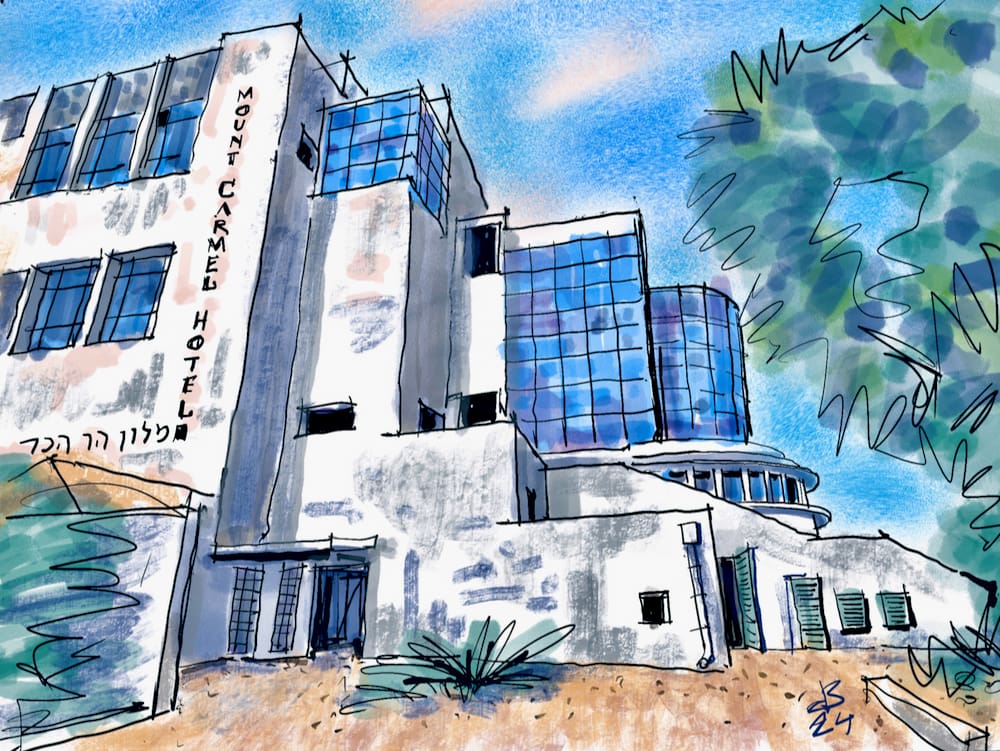
The Mount Carmel Hotel, also known as the Teltach Hotel, has been at the center of an ongoing public struggle. The municipality, together with the Carmel Public Forum and environmental activists, claimed that turning the complex into a private assisted living complex would harm the public interest and prevent residents from enjoying a unique green and architectural space. Deputy Mayor and Chairwoman of the Planning and Building Subcommittee, Attorney Sarit Golan-Steinberg, led the struggle alongside Mayor Yona Yahav, emphasizing that this is a public asset of historical, architectural and community value.
The historical background of the Mount Carmel Hotel
The Mount Carmel Hotel was built in the 30s and was one of the most prestigious tourist destinations in the Land of Israel during the Mandate. The building was designed in a meticulous international style, with clean lines and balconies overlooking the Carmel landscape. It hosted public figures, diplomats, artists and intellectuals and was part of Haifa's development as a resort and cultural city. Over the years, its status declined, the hotel closed and stood abandoned, but its historical and architectural value remained significant. For this reason, the building was designated a building for strict preservation, and many residents saw it as a symbol of a glorious past and unrealized tourism potential.
The emerging solution: construction elsewhere, preservation in the hotel
The solution presented in the discussion includes a complex process of land swapping, consolidation, and redistribution. The municipality will allow the developer to build residential units in another public area on the slopes of the Carmel, above the Ramot Hanasi neighborhood. The proceeds from the project will be used to finance the restoration of the historic hotel, which will resume operation as a public hotel. The grove surrounding the building will be fully preserved, and the entire site will remain open to the public.
The estimated cost of renovating the hotel is approximately 30 million shekels, a significant sum, but one that the municipality believes can be financed through the new arrangement. This is a creative solution that allows the entrepreneur to advance an economic project on the one hand and preserve an important public asset on the other.
A substantive and complex discussion: all parties around the table
The discussion in the national committee was convened at the initiative of the committee itself, out of a desire to bridge the gaps between the developer and the municipality and reach a broad consensus. Representatives of the Carmel Public Forum, Galia Becker and Yael Amitai, participated in the discussion and presented the position of the residents who oppose the original plan. Alongside them were representatives of the Haifa District Committee, representatives from the municipality and the economic society, Attorney Golan-Steinberg, former city engineer, Ariel Wortman, who has known the project since its inception, Keren Goldschmidt, the municipality's attorney, as well as representatives of the residents. On behalf of the developer, a large team was present at the discussion this evening, including: lawyers, planners, and consultants.
The discussion was conducted in a professional atmosphere, with the committee chair, Attorney Shuli Avni-Shoham, and her members asking focused questions and trying to understand the full implications of each alternative.
Leading the struggle: Hanna Yaffe, Noa Belter and environmental activists
One of the central figures in the struggle to preserve the hotel was landscape architect Hana Yaffe, one of Haifa's most prominent activists on environmental and conservation issues. Yaffe was the one who wrote the opposition to the plan and later, together with Noa Belter, she wrote the appeal filed against Yuval Alon's plan. The two led the struggle alongside architect Liora Dreyfus, and were later joined by environmental activists Benny Eitan and Lior Apt. Throughout the entire process, the activists worked in close cooperation with the municipality, understanding that the struggle was not only environmental but also urban and community. Their joint work created a broad front that significantly influenced the process and the decision made.
The municipality's position: "Waiting for the official document"

At the end of the discussion, Golan-Steinberg said that now we have to wait for the official document of the committee, which will determine the final decision. According to her, this is a decision of enormous importance for the future of the site and the residents of Haifa. She emphasized that the municipality worked over time to reach an arrangement that will allow for the full preservation of the hotel and the return of the complex to public use.
The Struggles of Preservation vs. Development in Haifa: The Delicate Balance
The struggle over the Mount Carmel Hotel joins a long line of struggles in which Haifa residents seek to influence the city’s image and preserve its unique identity. Haifa is a city where almost every significant construction plan provokes public debate, due to its combination of historic neighborhoods, buildings for preservation, natural forests, and rare mountain and sea views. In recent years, struggles have been waged over buildings such as the Foundation House, the Rothschild House, and buildings in Hadar, as well as over preserving forests and open spaces in Carmel. Environmental activists emphasize that the city cannot afford to lose additional historic and green assets, and that the municipality must find creative solutions that will allow development without harming public space. The debate over the future of the Mount Carmel Hotel illustrates the central challenge of urban planning in Israel: balancing development and preservation. The proposal to build elsewhere and preserve the hotel presents a possible model for such a balance.
The importance of the decision: a planning and values precedent
Environmental activists emphasized that the decision constitutes an important precedent. They claim that it proves that even in cases where there is an approved construction plan or a strong private initiative, alternative solutions can be found that do not harm green areas or historic buildings. "Instead of damaging the grove and turning it into concrete, alternatives can be found such as transferring rights or financial compensation," they said. They noted that even when it comes to neighborhoods that have already been approved for construction, there is room to reexamine the impact on the environment and the quality of life of the residents.
Looking to the future: What will happen now?
After the official decision of the National Committee is published, the municipality is expected to begin detailed planning procedures for the hotel's rehabilitation. At the same time, the developer will be able to advance the residential project in the alternative area. If everything goes as planned, within a few years the Mount Carmel Hotel could be back in operation, this time as a rehabilitated hotel, open to the public and integrated into a natural green space.
Did the article interest you?
Honestly. A beautiful building. And besides respect for the past, not every ancient building needs to be renovated..
Well, "drum roll" - Miriam…!!!@@@
Past memories = wonderful…
* It is even more important to preserve "historical buildings" from different periods in the history of "beautiful Haifa", which display a unique "architecture": "arches" in windows, on balconies, use of basalt "stone" from the "Arab"-Turkish period, and construction in "Jerusalem stone", "Roman columns", narrow or winding "wooden" or metal "stairs", special gardens overlooking a "wild-natural area", etc.
✨️"Beautiful Haifa – between the "Carmel" and the sea" – is there another city like it in the world…?????
Maybe… "Marseille"??? – as a "twin" city not identical = from 2 different "eggs"…
*In "Israel" – Haifa of immense and rare beauty🙏🙏🙏🙏🙏🙏
But the natural green space is the hotel garden, meaning the developer will receive it when the hotel is renovated. It is not a public space.
And when will the Haifa Municipality decide to open the community cinema in Neve Sha'anan that it owns? For the benefit of the residents?
It is also a historical property.
Congratulations to the environmental activists in Haifa👏👏👏🏆🏆A great success.
Is there a plan for Shavit Cinema?
To the cinema in Neve Sha'anan?
Does the Mainz house have a beautiful view?
And more and more
And who will save the casino and the mythical swimming pool in Bat Galim??? And what about the Tamar Cinema and the Hapoel pool???
What is there to save there?
To demolish and build in Hapoel Gigurim and Bat Galim, to return the area to the public and/or to deepen the beach and build a beautiful marina that this beautiful city of Haifa lacks.