


(haipo) – Yesterday, Saturday night, November 29, 2025, an extension of the detention in the case of Dr. Yavor was held at the Haifa Magistrate's Court. Dozens of protesters gathered outside the courthouse, seeking to express support for her and follow the legal proceedings closely. Many of them hoped to be allowed to enter the detention room and see her during the hearing, but remained outside the courthouse walls. The event aroused widespread public interest, not only because of the detention itself, but mainly because of the questions it raises regarding freedom of expression in the State of Israel.
Idan Bechor on the extension of Dr. Yolanda Yavor's detention ► Watch
Police claims and the initial investigation
During the hearing, the police presented their position. The police representative noted that during her interrogation, Yavor said that she was not violent and did not incite. However, he said, "the post she published indicates otherwise. It is not possible to know exactly how many people were exposed to this post." The police claimed that the mere publication of the post could constitute encouragement of an act of terrorism, even if the words were not directly said.
The police's main argument is that on social media it is difficult to assess the extent of the impact of posts, and that even statements that seem innocent or general may be interpreted as a call to dangerous action.
Defense arguments and comparison to other posts
On the other hand, Yavor's defense attorney, Attorney Oshrat Badash Kirma, presented the judge with examples of posts published by people from the other side of the political map. According to her, these posts included clear calls for violence, but did not lead to the arrest of the writers. Attorney Kirma asked the police representative why Yavor was considered to have encouraged an act of terrorism, while others were not required to account for their words.
The police representative replied: “There is the post, and the court will decide whether there is encouragement of an act of terrorism here.” Ultimately, the court extended her detention for another day, leaving her supporters feeling disappointed and frustrated.
Public support and demonstrations outside the courthouse
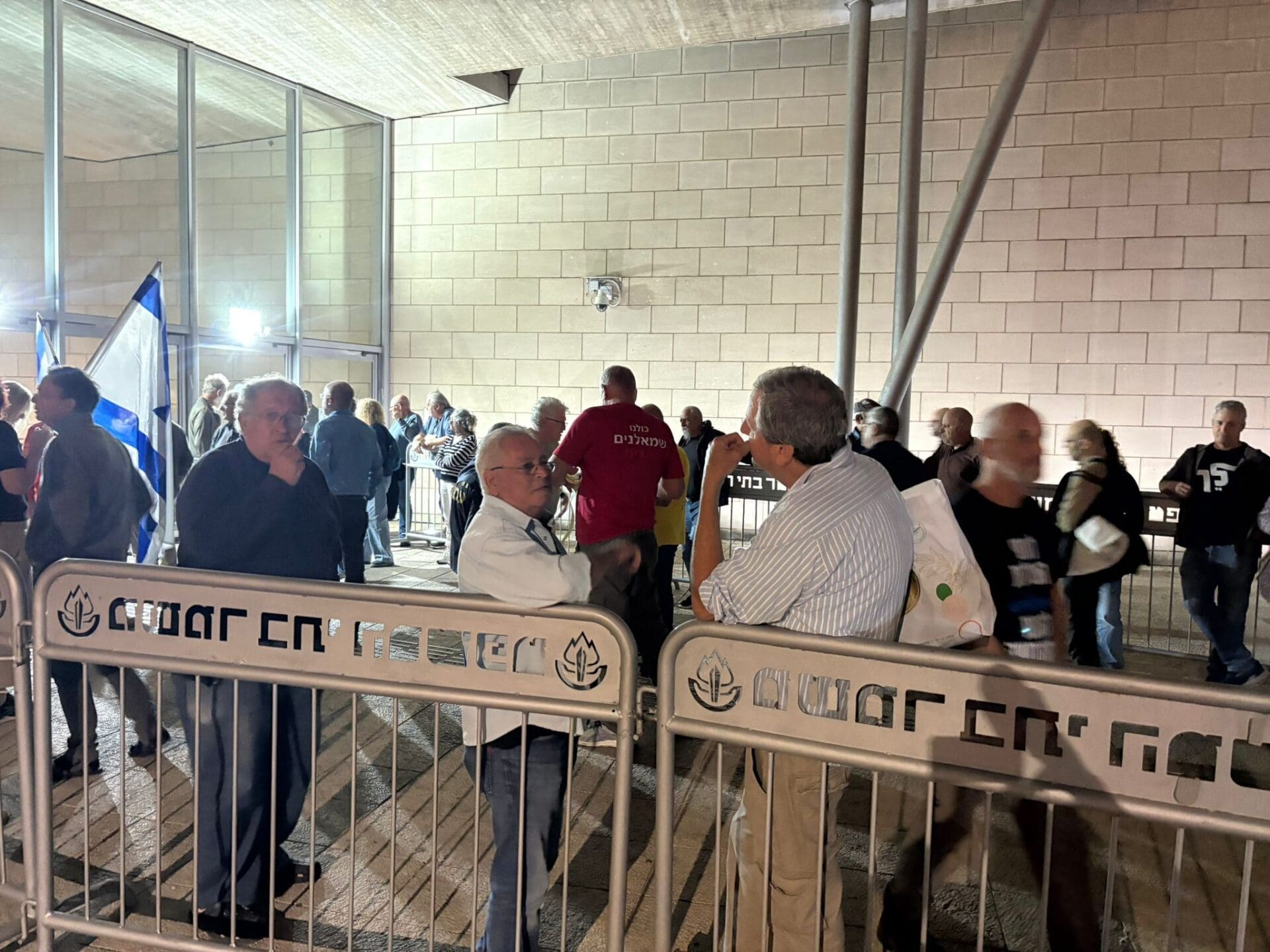
As stated, dozens of protesters gathered outside the courthouse. One of them, Idan Bechor, a resident of the city, said: "I came here to support Dr. Yavor. Dr. Yavor said that we need to fight for democracy and I believe in that. We came here to support her and we hope that she will be released home this evening."
The mass presence of protesters indicates that Yavor's arrest is seen by many not only as a personal legal proceeding, but as a symbol of a broader struggle for freedom of expression and democracy in Israel.
Questions about the limits of freedom of expression
Dr. Yavor's arrest raises fundamental questions about the limits of freedom of expression in the country. Yavor published a post in which she called for a change of government and the struggle for democracy, but did not explicitly call for violent action. If you go through many posts on social media today, you can find curses, threats, and sometimes clear calls for violence. The question is what is allowed and what is not allowed to be written, and is it possible for one person to be arrested for a political post, while others continue to publish harsh statements, without legal consequences.
This dilemma concerns every citizen in the country, regardless of their political stance. Is it permissible in a democracy to say that one must "fight for democracy"? Can such a statement be considered incitement? And is any of us at risk of finding ourselves interrogated or arrested for a post written out of political belief?
The broader context of freedom of expression in Israel
The struggle for freedom of expression in the State of Israel is not new, but it is gaining renewed force in the age of social media. In countries with dark regimes, people are very careful with their words, for fear of the regime and the police. Israel, on the other hand, was established as a pluralistic state, where every group has the right to express its opinion.
However, reality shows that the boundaries are not always clear. On the one hand, it is necessary to protect the public from calls for violence or incitement. On the other hand, it is necessary to ensure that freedom of expression, which is one of the fundamental principles of democracy, is not violated.
The role of social networks in exacerbating the situation
Social media has become the central arena for public discourse. Posts, tweets, and comments can reach thousands or even millions of people in minutes. This gives enormous power to each user, but also increases the level of responsibility.
In Yavor's case, the police argued that it was impossible to know how many people were exposed to her post, and therefore it should be considered dangerous. On the other hand, the defense argued that much more serious posts were not treated similarly. The question is whether there is selective enforcement, and whether political elements are involved in forwarding certain posts to the police.
Police presence and fear of escalation
Alongside the protesters, police officers were also stationed at the entrance to the courthouse, whose job was to prevent escalation. The mere presence of the police indicates the fear that the legal hearing would turn into a physical confrontation or a violent demonstration. So far, the demonstrations have been relatively quiet, but the very need for such a deployment indicates the great sensitivity of the issue.
The public and political implications
Dr. Yavor's arrest is not limited to a personal legal proceeding. It has become a public and political issue, raising questions about freedom of expression, the role of the police, and the limits of democracy. Many see it as a test of the state's ability to maintain a balance between maintaining public safety and protecting civil rights.
The public debate surrounding the case is expected to continue for a long time, and it may affect the way freedom of expression is perceived in Israel and the public's trust in the judicial system and the police.
Let us guess – the same group of instigators from Amulat Asha-e-Samah also came to support this instigator.
From their perspective, everything is permissible, including inciting the murder of politicians because it is "on the right side of the map."
Suddenly this is freedom of expression? What expression – incitement to murder a prime minister? It seems to me that after Rabin's assassination you demanded that the inflammatory discourse stop and the flames be put down, so what happened? Are you allowed to?
If it's from the right, it's incitement and the media is silent.
If it's from the left, it's freedom of expression and the media is mobilized.
You hypocrites, you're fed up.
Walking in a convoy with a coffin with Rabin's name on it or a picture of him with a hanging rope at his side is different from the chants against Netanyahu.